Comprehensive Lesson Exemplar on Louis Pasteur's Contributions in General Science for Senior High School
Explore Louis Pasteur's impact on chemistry and biology, including his discoveries in disease prevention, vaccination, and food safety, designed for senior high school science educators.
Lesson Exemplar forGeneral Science
Quarter 2, Unit 1
This material is intended exclusively for the use of senior high school teachers participating in the implementation of the
Strengthened Senior High School Curriculum. It aims to assist in delivering the curriculum content, standards, and lesson
competencies. Any unauthorized reproduction, distribution, modification, or utilization of this material beyond the designated scope is
strictly prohibited and may result in appropriate legal actions and disciplinary measures.
Borrowed content included in this material are owned by their respective copyright holders. Every effort has been made to
locate and obtain permission to use these materials from their respective copyright owners. The publisher and development team do
not represent nor claim ownership over them.
Every care has been taken to ensure the accuracy of the information provided in this material. For inquiries or feedback, please write
or call the Office of the Director of the Bureau of Learning Resources via telephone numbers (02) 8634-1072 and 8631-6922 or by
email at blr.od@deped.gov.ph.
Development Team
Writer: Jennifer Lou B. Abuzo
Region II
Division of Cagayan
Validator: Catherine O. Sison
Language Editor:
Consultant: Alfons Jayson O. Pelgone, PhD
Philippine Normal University
Learning Area Specialist: John Cyrus L. Doblada
Bureau of Learning Delivery
Bureau of Curriculum Development
Bureau of Learning Resources
Learning Area Specialist
Wilson R. Santiago
BLD Learning Area Specialist
3.
Republic of thePhilippines
Department of Education
BUREAU OF LEARNING DELIVERY
LESSON EXEMPLAR
Learning Area General Science Grade Level 11
Semester 1st Quarter 2
I. OBJECTIVES (Identifying the Goals)
Content
Standard
Learners learn that:
Past research in the field of chemistry provides the foundations for the development of helpful products and processes;
Performan
ce
Standard
By the end of the quarter, learners apply research skills to find out how scientists have made an impact on our lives. They
recognize the significant role of different agencies in the Philippines, such as DOST and DTI, in scientific innovation and
development. They show critical thinking in explaining the different substances present in household and personal care products
including their benefits and potential risk of using and disposing of them. They demonstrate appropriate and safe handling and
use of chemicals. They explain that chemical reactions take place in human activities and in the environment, and that there
are several chemical solutions that pose a threat to the community.
Learning
Competen
cies
The learners...
use information from secondary resources to report how Louis Pasteur combined research from the fields of chemistry and
biology that has helped scientists to better understand the causes of some diseases and prevent infection;
II.
REFEREN
CES and
MATERIA
LS
(Selecting
Resources
References:
Debré, P. (1998). Louis Pasteur. Johns Hopkins University Press.
Geison, G. L. (1995). The private science of Louis Pasteur. Princeton University Press.
Duclaux, É. (1920). Pasteur: The history of a mind. W.B. Saunders Company.
Bulloch, W. (1938). The history of bacteriology. Oxford University Press.
Brock, T. D. (1999). Robert Koch: A life in medicine and bacteriology. ASM Press.
4.
Republic of thePhilippines
Department of Education
BUREAU OF LEARNING DELIVERY
and
Material)
https://www.pasteur.fr/en/file/44615/download
Materials: Journals, Books, illustrations, printed materials, laptops
(These shall be accomplished per topic)
III.
CONTENT
(Sequencin
g Content)
Chemists and how they have made an impact on our lives
IV.
OBJECTIV
ES
(Setting
Clear
Objectives
and
Analyzing
the Tasks)
At the end of the lesson, the learners will be able to:
a. Create a timeline that highlights the major contributions of Louis Pasteur in the fields of chemistry and biology.
b. Enumerate the contributions of each experiment and explain how they enhanced scientists’ understanding of the causes
of disease and the prevention of infection.
c. Identify modern products that were developed based on Pasteur’s scientific experiments.
d. Explain how these products are applied in society today.
e. Discuss the impact of Pasteur’s discoveries on daily life, particularly in the areas of medicine, food preservation, and
commonly used materials.
f. Recognize the role of chemists in improving the quality of human life.
IV. PROCEDURES
(Selecting Strategies, Making Meaningful Content, Delivering Lesson and
Assessing Learning)
(Each part shall have 2-3 varied activities)
ANNOTATION
*Instruction to teacher on how to facilitate the activities.
*In the Annotation, explicitly explain how the IDF is applied
in each part of the lesson
A.
Activating
Prior
Knowledg
e
VIRTUAL TOUR TO PASTEUR’S MUSEUM
Students will be instructed to visit Pasteur’s Virtual Museum at
https://artsandculture.google.com/story/XAXBwj6OxM9xKA
For the virtual museum tour activity, the teacher may
request access to the computer laboratory, allowing
students to explore Pasteur’s Museum more effectively.
5.
Republic of thePhilippines
Department of Education
BUREAU OF LEARNING DELIVERY
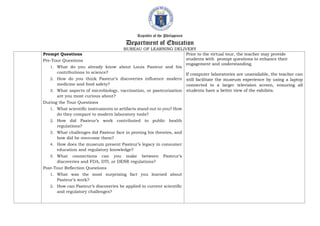
Prompt Questions
Pre-Tour Questions
1. What do you already know about Louis Pasteur and his
contributions to science?
2. How do you think Pasteur’s discoveries influence modern
medicine and food safety?
3. What aspects of microbiology, vaccination, or pasteurization
are you most curious about?
During the Tour Questions
1. What scientific instruments or artifacts stand out to you? How
do they compare to modern laboratory tools?
2. How did Pasteur’s work contributed to public health
regulations?
3. What challenges did Pasteur face in proving his theories, and
how did he overcome them?
4. How does the museum present Pasteur’s legacy in consumer
education and regulatory knowledge?
5. What connections can you make between Pasteur’s
discoveries and FDA, DTI, or DENR regulations?
Post-Tour Reflection Questions
1. What was the most surprising fact you learned about
Pasteur’s work?
2. How can Pasteur’s discoveries be applied to current scientific
and regulatory challenges?
Prior to the virtual tour, the teacher may provide
students with prompt questions to enhance their
engagement and understanding.
If computer laboratories are unavailable, the teacher can
still facilitate the museum experience by using a laptop
connected to a larger television screen, ensuring all
students have a better view of the exhibits.
6.
Republic of thePhilippines
Department of Education
BUREAU OF LEARNING DELIVERY
3. If you could ask Pasteur one question, what would it be and
why?
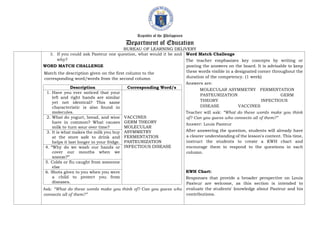
WORD MATCH CHALLENGE
Match the description given on the first column to the
corresponding word/words from the second column
Description Corresponding Word/s
1. Have you ever noticed that your
left and right hands are similar
yet not identical? This same
characteristic is also found in
molecules.
VACCINES
GERM THEORY
MOLECULAR
ASYMMETRY
FERMENTATION
PASTEURIZATION
INFECTIOUS DISEASE
2. What do yogurt, bread, and wine
have in common? What causes
milk to turn sour over time?
3. It is what makes the milk you buy
at the store safe to drink and
helps it last longer in your fridge.
4. “Why do we wash our hands or
cover our mouths when we
sneeze?”
5. Colds or flu caught from someone
else
6. Shots given to you when you were
a child to protect you from
diseases.
Ask: “What do these words make you think of? Can you guess who
connects all of them?”
Word Match Challenge
The teacher emphasizes key concepts by writing or
posting the answers on the board. It is advisable to keep
these words visible in a designated corner throughout the
duration of the competency. (1 week)
Answers are:
MOLECULAR ASYMMETRY FERMENTATION
PASTEURIZATION GERM
THEORY INFECTIOUS
DISEASE VACCINES
Teacher will ask: “What do these words make you think
of? Can you guess who connects all of them?”
Answer: Louis Pasteur
After answering the question, students will already have
a clearer understanding of the lesson's content. This time,
instruct the students to create a KWH chart and
encourage them to respond to the questions in each
column.
KWH Chart:
Responses that provide a broader perspective on Louis
Pasteur are welcome, as this section is intended to
evaluate the students' knowledge about Pasteur and his
contributions.
7.
Republic of thePhilippines
Department of Education
BUREAU OF LEARNING DELIVERY
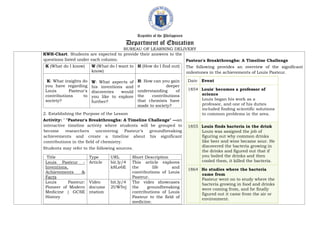
KWH-Chart. Students are expected to provide their answers to the
questions listed under each column.
K (What do I know) W (What do I want to
know)
H (How do I find out)
K: What insights do
you have regarding
Louis Pasteur's
contributions to
society?
W: What aspects of
his inventions and
discoveries would
you like to explore
further?
H: How can you gain
a deeper
understanding of
the contributions
that chemists have
made to society?
2. Establishing the Purpose of the Lesson
Activity: " "Pasteur's Breakthroughs: A Timeline Challenge" —an
interactive timeline activity where students will be grouped to
become researchers uncovering Pasteur’s groundbreaking
achievements and create a timeline about his significant
contributions in the field of chemistry.
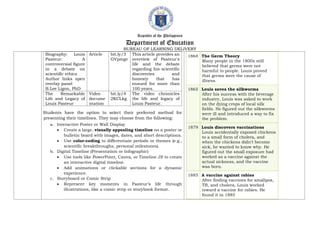
Students may refer to the following sources.
Title Type URL Short Description
Louis Pasteur -
Inventions,
Achievements &
Facts
Article bit.ly/4
k8Le6E
This article explores
the life and
contributions of Louis
Pasteur.
Louis Pasteur:
Pioneer of Modern
Medicine | GCSE
History
Video
docume
ntation
bit.ly/4
2UW5vj
The video showcases
the groundbreaking
contributions of Louis
Pasteur to the field of
medicine.
Pasteur's Breakthroughs: A Timeline Challenge
The following provides an overview of the significant
milestones in the achievements of Louis Pasteur.
Date Event
1854 Louis' becomes a professor of
science
Louis began his work as a
professor, and one of his duties
included finding scientific solutions
to common problems in the area.
1855 Louis finds bacteria in the drink
Louis was assigned the job of
figuring out why common drinks
like beer and wine became sour. He
discovered the bacteria growing in
the drinks and figured out that if
you boiled the drinks and then
cooled them, it killed the bacteria.
1864 He studies where the bacteria
came from
Pasteur went on to study where the
bacteria growing in food and drinks
were coming from, and he finally
figured out it came from the air or
environment.
8.
Republic of thePhilippines
Department of Education
BUREAU OF LEARNING DELIVERY
Biography: Louis
Pasteur: A
controversial figure
in a debate on
scientific ethics
Author links open
overlay panel
B.Lee Ligon, PhD
Article bit.ly/3
GVpmgv
This article provides an
overview of Pasteur's
life and the debate
regarding his scientific
discoveries and
honesty that has
ensued for more than
100 years.
The Remarkable
Life and Legacy of
Louis Pasteur
Video
docume
ntation
bit.ly/4
2KCLkg
The video chronicles
the life and legacy of
Louis Pasteur.
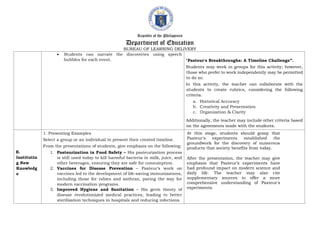
Students have the option to select their preferred method for
presenting their timelines. They may choose from the following:
a. Interactive Poster or Wall Display
• Create a large, visually appealing timeline on a poster or
bulletin board with images, dates, and short descriptions.
• Use color-coding to differentiate periods or themes (e.g.,
scientific breakthroughs, personal milestones).
b. Digital Timeline (Presentation or Infographic)
• Use tools like PowerPoint, Canva, or Timeline JS to create
an interactive digital timeline.
• Add animations or clickable sections for a dynamic
experience.
c. Storyboard or Comic Strip
• Represent key moments in Pasteur’s life through
illustrations, like a comic strip or storybook format.
1864 The Germ Theory
Many people in the 1800s still
believed that germs were not
harmful to people. Louis proved
that germs were the cause of
illness.
1865 Louis saves the silkworms
After his success with the beverage
industry, Louis was asked to work
on the dying crops of local silk
fields. He figured out the silkworms
were ill and introduced a way to fix
the problem.
1879 Louis discovers vaccinations
Louis accidentally exposed chickens
to a small form of cholera, and
when the chickens didn't become
sick, he wanted to know why. He
figured out the small exposure had
worked as a vaccine against the
actual sickness, and the vaccine
was born.
1885 A vaccine against rabies
After finding vaccines for smallpox,
TB, and cholera, Louis worked
toward a vaccine for rabies. He
found it in 1885
9.
Republic of thePhilippines
Department of Education
BUREAU OF LEARNING DELIVERY
• Students can narrate the discoveries using speech
bubbles for each event. "Pasteur's Breakthroughs: A Timeline Challenge”.
Students may work in groups for this activity; however,
those who prefer to work independently may be permitted
to do so.
In this activity, the teacher can collaborate with the
students to create rubrics, considering the following
criteria.
a. Historical Accuracy
b. Creativity and Presentation
c. Organization & Clarity
Additionally, the teacher may include other criteria based
on the agreements made with the students.
B.
Institutin
g New
Knowledg
e
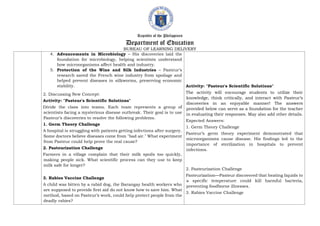
1. Presenting Examples
Select a group or an individual to present their created timeline.
From the presentations of students, give emphasis on the following:
1. Pasteurization in Food Safety – His pasteurization process
is still used today to kill harmful bacteria in milk, juice, and
other beverages, ensuring they are safe for consumption.
2. Vaccines for Disease Prevention – Pasteur’s work on
vaccines led to the development of life-saving immunizations,
including those for rabies and anthrax, paving the way for
modern vaccination programs.
3. Improved Hygiene and Sanitation – His germ theory of
disease revolutionized medical practices, leading to better
sterilization techniques in hospitals and reducing infections.
At this stage, students should grasp that
Pasteur's experiments established the
groundwork for the discovery of numerous
products that society benefits from today.
After the presentation, the teacher may give
emphasis that Pasteur’s experiments have
had profound impact on modern science and
daily life. The teacher may also cite
supplementary sources to offer a more
comprehensive understanding of Pasteur's
experiments.
10.
Republic of thePhilippines
Department of Education
BUREAU OF LEARNING DELIVERY
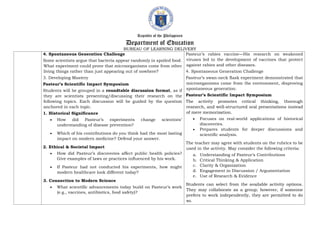
4. Advancements in Microbiology – His discoveries laid the
foundation for microbiology, helping scientists understand
how microorganisms affect health and industry.
5. Protection of the Wine and Silk Industries – Pasteur’s
research saved the French wine industry from spoilage and
helped prevent diseases in silkworms, preserving economic
stability.
2. Discussing New Concept:
Activity: "Pasteur's Scientific Solutions"
Divide the class into teams. Each team represents a group of
scientists facing a mysterious disease outbreak. Their goal is to use
Pasteur’s discoveries to resolve the following problems.
1. Germ Theory Challenge
A hospital is struggling with patients getting infections after surgery.
Some doctors believe diseases come from "bad air." What experiment
from Pasteur could help prove the real cause?
2. Pasteurization Challenge
Farmers in a village complain that their milk spoils too quickly,
making people sick. What scientific process can they use to keep
milk safe for longer?
3. Rabies Vaccine Challenge
A child was bitten by a rabid dog, the Barangay health workers who
are supposed to provide first aid do not know how to save him. What
method, based on Pasteur’s work, could help protect people from the
deadly rabies?
Activity: "Pasteur's Scientific Solutions"
The activity will encourage students to utilize their
knowledge, think critically, and interact with Pasteur’s
discoveries in an enjoyable manner! The answers
provided below can serve as a foundation for the teacher
in evaluating their responses. May also add other details.
Expected Answers:
1. Germ Theory Challenge
Pasteur’s germ theory experiment demonstrated that
microorganisms cause disease. His findings led to the
importance of sterilization in hospitals to prevent
infections.
2. Pasteurization Challenge
Pasteurization—Pasteur discovered that heating liquids to
a specific temperature could kill harmful bacteria,
preventing foodborne illnesses.
3. Rabies Vaccine Challenge
11.
Republic of thePhilippines
Department of Education
BUREAU OF LEARNING DELIVERY
4. Spontaneous Generation Challenge
Some scientists argue that bacteria appear randomly in spoiled food.
What experiment could prove that microorganisms come from other
living things rather than just appearing out of nowhere?
3. Developing Mastery
Pasteur’s Scientific Impact Symposium
Students will be grouped in a roundtable discussion format, as if
they are scientists presenting/discussing their research on the
following topics. Each discussion will be guided by the question
anchored in each topic.
1. Historical Significance
• How did Pasteur’s experiments change scientists’
understanding of disease prevention?
• Which of his contributions do you think had the most lasting
impact on modern medicine? Defend your answer.
2. Ethical & Societal Impact
• How did Pasteur’s discoveries affect public health policies?
Give examples of laws or practices influenced by his work.
• If Pasteur had not conducted his experiments, how might
modern healthcare look different today?
3. Connection to Modern Science
• What scientific advancements today build on Pasteur’s work
(e.g., vaccines, antibiotics, food safety)?
Pasteur’s rabies vaccine—His research on weakened
viruses led to the development of vaccines that protect
against rabies and other diseases.
4. Spontaneous Generation Challenge
Pasteur’s swan-neck flask experiment demonstrated that
microorganisms come from the environment, disproving
spontaneous generation.
Pasteur’s Scientific Impact Symposium
The activity promotes critical thinking, thorough
research, and well-structured oral presentations instead
of mere memorization.
• Focuses on real-world applications of historical
discoveries.
• Prepares students for deeper discussions and
scientific analysis.
The teacher may agree with students on the rubrics to be
used in the activity. May consider the following criteria:
a. Understanding of Pasteur’s Contributions
b. Critical Thinking & Application
c. Clarity & Organization
d. Engagement in Discussion / Argumentation
e. Use of Research & Evidence
Students can select from the available activity options.
They may collaborate as a group; however, if someone
prefers to work independently, they are permitted to do
so.
12.
Republic of thePhilippines
Department of Education
BUREAU OF LEARNING DELIVERY
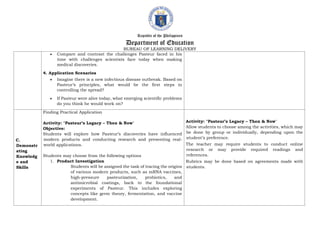
• Compare and contrast the challenges Pasteur faced in his
time with challenges scientists face today when making
medical discoveries.
4. Application Scenarios
• Imagine there is a new infectious disease outbreak. Based on
Pasteur’s principles, what would be the first steps in
controlling the spread?
• If Pasteur were alive today, what emerging scientific problems
do you think he would work on?
C.
Demonstr
ating
Knowledg
e and
Skills
Finding Practical Application
Activity: "Pasteur’s Legacy – Then & Now"
Objective:
Students will explore how Pasteur’s discoveries have influenced
modern products and conducting research and presenting real-
world applications.
Students may choose from the following options
1. Product Investigation
Students will be assigned the task of tracing the origins
of various modern products, such as mRNA vaccines,
high-pressure pasteurization, probiotics, and
antimicrobial coatings, back to the foundational
experiments of Pasteur. This includes exploring
concepts like germ theory, fermentation, and vaccine
development.
Activity: "Pasteur’s Legacy – Then & Now"
Allow students to choose among the activities, which may
be done by group or individually, depending upon the
student’s preference.
The teacher may require students to conduct online
research or may provide required readings and
references.
Rubrics may be done based on agreements made with
students.
13.
Republic of thePhilippines
Department of Education
BUREAU OF LEARNING DELIVERY
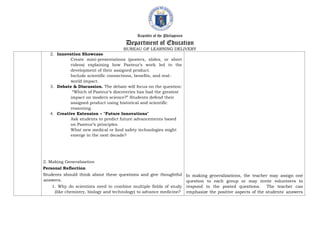
2. Innovation Showcase
Create mini-presentations (posters, slides, or short
videos) explaining how Pasteur’s work led to the
development of their assigned product.
Include scientific connections, benefits, and real-
world impact.
3. Debate & Discussion. The debate will focus on the question:
“Which of Pasteur’s discoveries has had the greatest
impact on modern science?” Students defend their
assigned product using historical and scientific
reasoning.
4. Creative Extension – "Future Innovations"
Ask students to predict future advancements based
on Pasteur’s principles.
What new medical or food safety technologies might
emerge in the next decade?
2. Making Generalization
Personal Reflection
Students should think about these questions and give thoughtful
answers.
1. Why do scientists need to combine multiple fields of study
(like chemistry, biology and technology) to advance medicine?
In making generalizations, the teacher may assign one
question to each group or may invite volunteers to
respond to the posted questions. The teacher can
emphasize the positive aspects of the students' answers
14.
Republic of thePhilippines
Department of Education
BUREAU OF LEARNING DELIVERY
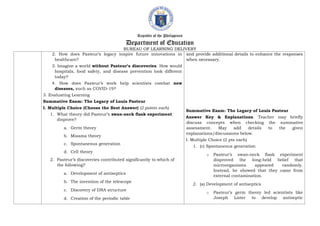
2. How does Pasteur’s legacy inspire future innovations in
healthcare?
3. Imagine a world without Pasteur’s discoveries. How would
hospitals, food safety, and disease prevention look different
today?
4. How does Pasteur’s work help scientists combat new
diseases, such as COVID-19?
3. Evaluating Learning
Summative Exam: The Legacy of Louis Pasteur
I. Multiple Choice (Choose the Best Answer) (2 points each)
1. What theory did Pasteur’s swan-neck flask experiment
disprove?
a. Germ theory
b. Miasma theory
c. Spontaneous generation
d. Cell theory
2. Pasteur’s discoveries contributed significantly to which of
the following?
a. Development of antiseptics
b. The invention of the telescope
c. Discovery of DNA structure
d. Creation of the periodic table
and provide additional details to enhance the responses
when necessary.
Summative Exam: The Legacy of Louis Pasteur
Answer Key & Explanations. Teacher may briefly
discuss concepts when checking the summative
assessment. May add details to the given
explanations/discussions below.
I. Multiple Choice (2 pts each)
1. (c) Spontaneous generation
o Pasteur’s swan-neck flask experiment
disproved the long-held belief that
microorganisms appeared randomly.
Instead, he showed that they came from
external contamination.
2. (a) Development of antiseptics
o Pasteur’s germ theory led scientists like
Joseph Lister to develop antiseptic
15.
Republic of thePhilippines
Department of Education
BUREAU OF LEARNING DELIVERY
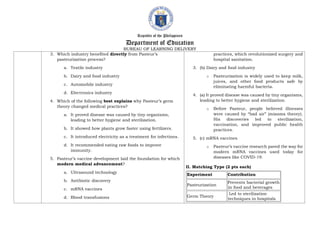
3. Which industry benefited directly from Pasteur’s
pasteurization process?
a. Textile industry
b. Dairy and food industry
c. Automobile industry
d. Electronics industry
4. Which of the following best explains why Pasteur’s germ
theory changed medical practices?
a. It proved disease was caused by tiny organisms,
leading to better hygiene and sterilization.
b. It showed how plants grow faster using fertilizers.
c. It introduced electricity as a treatment for infections.
d. It recommended eating raw foods to improve
immunity.
5. Pasteur’s vaccine development laid the foundation for which
modern medical advancement?
a. Ultrasound technology
b. Antibiotic discovery
c. mRNA vaccines
d. Blood transfusions
practices, which revolutionized surgery and
hospital sanitation.
3. (b) Dairy and food industry
o Pasteurization is widely used to keep milk,
juices, and other food products safe by
eliminating harmful bacteria.
4. (a) It proved disease was caused by tiny organisms,
leading to better hygiene and sterilization.
o Before Pasteur, people believed illnesses
were caused by “bad air” (miasma theory).
His discoveries led to sterilization,
vaccination, and improved public health
practices.
5. (c) mRNA vaccines
o Pasteur’s vaccine research paved the way for
modern mRNA vaccines used today for
diseases like COVID-19.
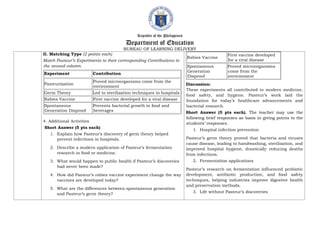
II. Matching Type (2 pts each)
Experiment Contribution
Pasteurization
Prevents bacterial growth
in food and beverages
Germ Theory
Led to sterilization
techniques in hospitals
16.
Republic of thePhilippines
Department of Education
BUREAU OF LEARNING DELIVERY
II. Matching Type (2 points each)
Match Pasteur’s Experiments to their corresponding Contributions in
the second column.
Experiment Contribution
Pasteurization
Proved microorganisms come from the
environment
Germ Theory Led to sterilization techniques in hospitals
Rabies Vaccine First vaccine developed for a viral disease
Spontaneous
Generation Disproof
Prevents bacterial growth in food and
beverages
4. Additional Activities
Short Answer (5 pts each)
1. Explain how Pasteur’s discovery of germ theory helped
prevent infections in hospitals.
2. Describe a modern application of Pasteur’s fermentation
research in food or medicine.
3. What would happen to public health if Pasteur’s discoveries
had never been made?
4. How did Pasteur’s rabies vaccine experiment change the way
vaccines are developed today?
5. What are the differences between spontaneous generation
and Pasteur’s germ theory?
Rabies Vaccine
First vaccine developed
for a viral disease
Spontaneous
Generation
Disproof
Proved microorganisms
come from the
environment
Discussion:
These experiments all contributed to modern medicine,
food safety, and hygiene. Pasteur’s work laid the
foundation for today’s healthcare advancements and
bacterial research.
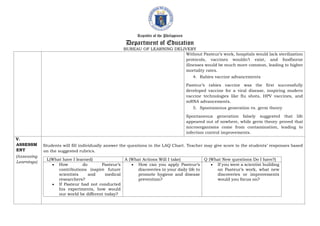
Short Answer (5 pts each). The teacher may use the
following brief responses as basis in giving points to the
students’ responses.
1. Hospital infection prevention
Pasteur’s germ theory proved that bacteria and viruses
cause disease, leading to handwashing, sterilization, and
improved hospital hygiene, drastically reducing deaths
from infections.
2. Fermentation applications
Pasteur’s research on fermentation influenced probiotic
development, antibiotic production, and food safety
techniques, helping industries improve digestive health
and preservation methods.
3. Life without Pasteur’s discoveries
17.
Republic of thePhilippines
Department of Education
BUREAU OF LEARNING DELIVERY
Without Pasteur’s work, hospitals would lack sterilization
protocols, vaccines wouldn’t exist, and foodborne
illnesses would be much more common, leading to higher
mortality rates.
4. Rabies vaccine advancements
Pasteur’s rabies vaccine was the first successfully
developed vaccine for a viral disease, inspiring modern
vaccine technologies like flu shots, HPV vaccines, and
mRNA advancements.
5. Spontaneous generation vs. germ theory
Spontaneous generation falsely suggested that life
appeared out of nowhere, while germ theory proved that
microorganisms come from contamination, leading to
infection control improvements.
V.
ASSESSM
ENT
(Assessing
Learnings)
Students will fill individually answer the questions in the LAQ Chart. Teacher may give score to the students’ responses based
on the suggested rubrics.
L(What have I learned) A (What Actions Will I take) Q (What New questions Do I have?)
• How do Pasteur’s
contributions inspire future
scientists and medical
researchers?
• If Pasteur had not conducted
his experiments, how would
our world be different today?
• How can you apply Pasteur’s
discoveries in your daily life to
promote hygiene and disease
prevention?
• If you were a scientist building
on Pasteur’s work, what new
discoveries or improvements
would you focus on?
18.
Republic of thePhilippines
Department of Education
BUREAU OF LEARNING DELIVERY
• How does learning about
Pasteur’s work help you
appreciate the role of science
in improving lives?
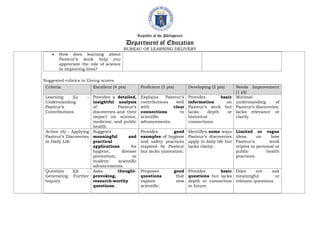
Suggested rubrics in Giving scores
Criteria Excellent (4 pts) Proficient (3 pts) Developing (2 pts) Needs Improvement
(1 pt)
Learning (L) -
Understanding
Pasteur’s
Contributions
Provides a detailed,
insightful analysis
of Pasteur’s
discoveries and their
impact on science,
medicine, and public
health.
Explains Pasteur’s
contributions well
with clear
connections to
scientific
advancements.
Provides basic
information on
Pasteur’s work but
lacks depth or
historical
connections.
Minimal
understanding of
Pasteur’s discoveries;
lacks relevance or
clarity.
Action (A) - Applying
Pasteur’s Discoveries
in Daily Life
Suggests
meaningful and
practical
applications for
hygiene, disease
prevention, or
modern scientific
advancements.
Provides good
examples of hygiene
and safety practices
inspired by Pasteur
but lacks innovation.
Identifies some ways
Pasteur’s discoveries
apply to daily life but
lacks clarity.
Limited or vague
ideas on how
Pasteur’s work
relates to personal or
public health
practices.
Question (Q) -
Generating Further
Inquiry
Asks thought-
provoking,
research-worthy
questions.
Proposes good
questions that
explore new
scientific.
Provides basic
questions but lacks
depth or connection
to future.
Does not ask
meaningful or
relevant questions.
19.
Republic of thePhilippines
Department of Education
BUREAU OF LEARNING DELIVERY
VI.
REFLECTI
ON
(Feedback
and
Continuou
s
Improveme
nt)
Prepared by: Validated by:
JENNIFER LOU B. ABUZO CATHERINE O. SISON
Master Teacher II Master Teacher II
Approved by:
JOHN CYRUS L. DOBLADA ALFONS JAYSON O. PELGONE, PhD
LA Specialist Consultant
Philippine Normal University
 Most read