Comprehensive Introduction to Social Science Disciplines and Research Methods
Explore social science fundamentals, including its disciplines like anthropology, economics, and geography, and understand the scientific method in social research to address societal issues and human behavior.
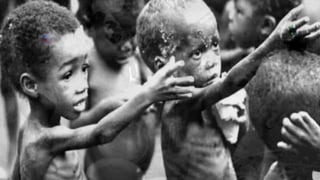
What areyour thoughts on the
picture?
What feelings does it give you?
Do you sad right after seeing the
picture?
5.
1.What do youthink is the “Complete Me
Puzzle Activity” all about?
2.What makes the activity challenging? Is it
difficult to do the activity as a group?
3.What social issue/problem could you see
from the pictures? Elaborate.
LEARNING OBJECTIVES
1. Definesocial science as the study of society
2. Discuss the different disciplines of social sciences
3. Accept responsibility in doing the assigned activities; and
4. Compare and contrast various social sciences based on
their definition, concepts, and objects of study.
Social Science,in its broadest sense, is the study of society and the
manner in which people behave and influence the world around us.
The uttermost goal of social science is to answer different questions
and problems about the society and human condition on how to
improve it. (Hunt, 2002) It is very important for us humans to
understand social science to explain specific behavioral pattern and
human phenomena.
It tells us about the world beyond our immediate experience, and can
help explain how our own society works – from the causes of
unemployment or what helps economic growth, why people vote,
why do we follow rules, why is social inclusion important, why is there
inequality, why is there cultural diversity, or what makes people
happy. It provides vital information for governments and
policymakers, local authorities, nongovernmental organizations, and
others.
12.
Social Science isbeing related to the fields of
natural science and humanities because of
some concepts. The social sciences main
concern is to deal with aspects of human
condition. Natural sciences main concern is to
explain natural and environmental
phenomena. Humanities main concern is
more on the philosophical side which aims to
answer and interpret big questions like “what
is the meaning of life?” (Hunt, 2002)
13.
The Social Sciencesare sometimes interchanged in these fields of
study because there are some content that fits the characteristics of
the natural sciences and humanities. For the natural science and social
science, both of them can be classified as a science. Both natural
science and social science uses a systematic way in explaining a
certain theory. This systematic way is called scientific method. Social
scientists use this method in understanding certain social behaviour.
For humanities and social science, both of them are closely related to
each other because this two fields both deal with “humans and its
culture.” (Hunt, 2002).
14.
WHAT IS SOCIALRESEARCH? HOW TO USE THE SCIENTIFIC METHOD IN
SOCIAL RESEARCH?
A research refers to systematic process of collecting and logically
analysing information (data) for some purpose (Ms Millan, J, & Schumacher, S.,
2001). Doing a research helps society to answer many questions that one would
like to know or find answers to many questions or find solutions to many
problems in society.
In a social research, a social scientist or a group of social scientists
following a systematic plan, explore, describe, examine, explain, and predict
human behaviour or a social issue or social problem. Through a research, a
social scientist or groups of social scientists. Try to find answers to questions
like: what is poverty? Who are the poor? Where are the poor? Why does poverty
exist in society? How to address poverty in society?
15.
To pursue qualitysocial research, the use of scientific method is
a prerequisite. Scientific method refers to systematic, organized
series of steps that ensures maximum objectivity and
consistency in an investigating phenomenon, acquiring new
knowledge, or correcting and integrating previous knowledge.
For a social research to be termed scientific, a method of
inquiry must be based on gathering observable, empirical and
measurable evidence subject to specific principles reasoning.
16.
HOW SOCIAL SCIENCESHAPES LIVES
Social scientists influence our lives usually without us being aware they are
doing so. For example, a study of behaviour of interest groups, like a farmer
group or a public transport group, has shown that if police avoid heavy-handed
tactics this can help maintain crowd control in potentially hostile situations. The
study’s findings on how to create a less confrontational atmosphere are being
included in police training in such situation. Other research findings have
informed policies aimed at reducing poverty to help poorer families, like the
Pantawid Pamilyang Pilipino Program.
SOCIAL SCIENCE DISCIPLINES
Social Science is a very complex study. It is divided into
different areas according to focus or subject. These include:
ANTHROPOLOGY, ECONOMICS, GEOGRAPHY, HISTORY,
LINGUISTIC, POLITICAL SCIENCE, PSYCHOLOGY, SOCIOLOGY,
AND DEMOGRAPHICS. All of which are interrelated with each other
where some aspects can be explained in different perspectives.
17.
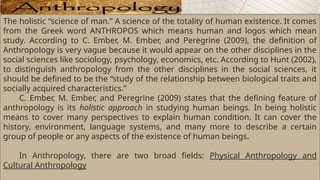
The holistic “scienceof man.” A science of the totality of human existence. It comes
from the Greek word ANTHROPOS which means human and logos which mean
study. According to C. Ember, M. Ember, and Peregrine (2009), the definition of
Anthropology is very vague because it would appear on the other disciplines in the
social sciences like sociology, psychology, economics, etc. According to Hunt (2002),
to distinguish anthropology from the other disciplines in the social sciences, it
should be defined to be the “study of the relationship between biological traits and
socially acquired characteristics.”
C. Ember, M. Ember, and Peregrine (2009) states that the defining feature of
anthropology is its holistic approach in studying human beings. In being holistic
means to cover many perspectives to explain human condition. It can cover the
history, environment, language systems, and many more to describe a certain
group of people or any aspects of the existence of human beings.
In Anthropology, there are two broad fields: Physical Anthropology and
Cultural Anthropology
18.
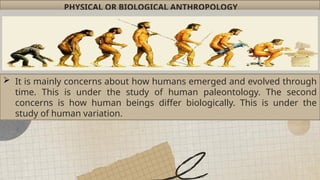
PHYSICAL OR BIOLOGICALANTHROPOLOGY
It is mainly concerns about how humans emerged and evolved through
time. This is under the study of human paleontology. The second
concerns is how human beings differ biologically. This is under the
study of human variation.
19.
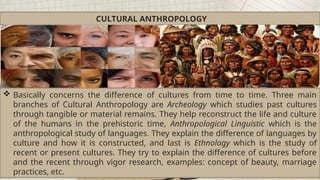
CULTURAL ANTHROPOLOGY
Basicallyconcerns the difference of cultures from time to time. Three main
branches of Cultural Anthropology are Archeology which studies past cultures
through tangible or material remains. They help reconstruct the life and culture
of the humans in the prehistoric time, Anthropological Linguistic which is the
anthropological study of languages. They explain the difference of languages by
culture and how it is constructed, and last is Ethnology which is the study of
recent or present cultures. They try to explain the difference of cultures before
and the recent through vigor research, examples: concept of beauty, marriage
practices, etc.
20.
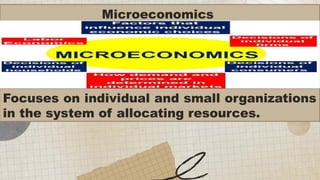
ECONOMICS
The studythat aims to explain social interactions which satisfy
economic wants. It is derived from the Greek word oikos which means
house and nomos which means laws hence the definition: “rules of the
house.” According to Robbins (1932), it is “a science which studies
human behaviour as a relationship between ends and scarce means
which have alternative uses.”
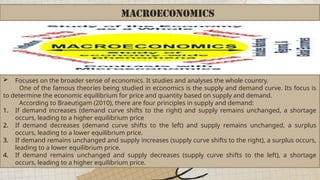
MACROECONOMICS
Focuses onthe broader sense of economics. It studies and analyses the whole country.
One of the famous theories being studied in economics is the supply and demand curve. Its focus is
to determine the economic equilibrium for price and quantity based on supply and demand.
According to Braeutigam (2010), there are four principles in supply and demand:
1. If demand increases (demand curve shifts to the right) and supply remains unchanged, a shortage
occurs, leading to a higher equilibrium price
2. If demand decreases (demand curve shifts to the left) and supply remains unchanged, a surplus
occurs, leading to a lower equilibrium price.
3. If demand remains unchanged and supply increases (supply curve shifts to the right), a surplus occurs,
leading to a lower equilibrium price.
4. If demand remains unchanged and supply decreases (supply curve shifts to the left), a shortage
occurs, leading to a higher equilibrium price.
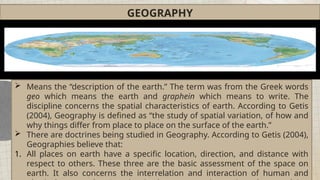
GEOGRAPHY
Means the“description of the earth.” The term was from the Greek words
geo which means the earth and graphein which means to write. The
discipline concerns the spatial characteristics of earth. According to Getis
(2004), Geography is defined as “the study of spatial variation, of how and
why things differ from place to place on the surface of the earth.”
There are doctrines being studied in Geography. According to Getis (2004),
Geographies believe that:
1. All places on earth have a specific location, direction, and distance with
respect to others. These three are the basic assessment of the space on
earth. It also concerns the interrelation and interaction of human and
25.
• It canbe the identification of a specific place (absolute location) or
a place in relation to other places (relative location. Second is
Direction. It can be I and identified by cardinal points like north,
south, east, and west (absolute direction) or it can be altered like
for example “far eastern”, “back east,” and “down south.” (Relative
direction). And third is Distance.
• It can be identified by how much miles or kilometers separates two
points (absolute distance) or by using other measurements like
time (relative distance).
26.
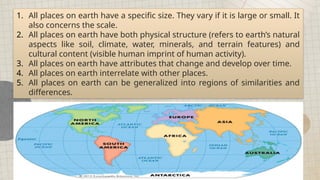
All places onearth can be generalized into regions of similarities and differences.
1. All places on earth have a specific size. They vary if it is large or small. It
also concerns the scale.
2. All places on earth have both physical structure (refers to earth’s natural
aspects like soil, climate, water, minerals, and terrain features) and
cultural content (visible human imprint of human activity).
3. All places on earth have attributes that change and develop over time.
4. All places on earth interrelate with other places.
5. All places on earth can be generalized into regions of similarities and
differences.
27.
All places onearth can be generalized into regions of similarities and differences.
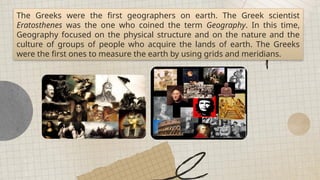
The Greeks were the first geographers on earth. The Greek scientist
Eratosthenes was the one who coined the term Geography. In this time,
Geography focused on the physical structure and on the nature and the
culture of groups of people who acquire the lands of earth. The Greeks
were the first ones to measure the earth by using grids and meridians.
28.
All places onearth can be generalized into regions of similarities and differences.
The study of the past and its records about events. It is derived from the
Greek word historia which means to inquire knowledge through
investigation. According to hunt (2002), History refers to:
“The study of past events. It is social science in the sense that it is a
systematic attempt to learn about and verify past events and to relate
them to one another and to the present. Every event has a historical
context within which we commonly say the event must be studied. The
subject matter of history is everything that has already happened.”
Areas of study in history are periods, geographical locations, military
history, history of religion, social history, cultural history, diplomatic
history, economic history, world history, and many more
29.
All places onearth can be generalized into regions of similarities and differences.
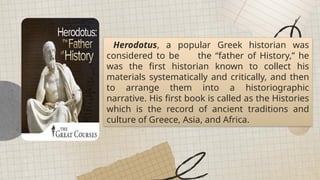
Herodotus, a popular Greek historian was
considered to be the “father of History,” he
was the first historian known to collect his
materials systematically and critically, and then
to arrange them into a historiographic
narrative. His first book is called as the Histories
which is the record of ancient traditions and
culture of Greece, Asia, and Africa.
30.
All places onearth can be generalized into regions of similarities and differences.
Basically the study of language. Language is the “principals means used by
human beings to communicate with one another, is defined as “a system of
voluntarily produced symbols by which members of a community interact
and communicate in terms of their common experiences and expectations,”
(Dizon, 2003), it concerns the association of symbols or signs to the human
condition.
In language, it is composed by Phonetics which concerns the sound being
used in language; Phonology which concerns with the way sounds are used in
individual languages; Morphology which concerns with the structure of
words; Syntax which concerns the structures of phrases and sentences; and
Semantics which concerns in giving and studying the meaning.
31.
All places onearth can be generalized into regions of similarities and differences.
According to Dizon (2003), there are five specific functions of language:
1. It makes possible our great flexibility in the use of words for both communication and
information processing in general;
2. It enables us to acquire information by providing labels for the objects and events in
our environment;
3. It helps us to encode information into memory by providing many of the linkages in
the associative network of memory;
4. It helps us to find meanings, relationships, and similarities and thus, build concepts on
top of concepts;
5. It helps us to think and solve problems.
According to the history of Linguistics, it is the old Babylon who was the one who first
created linguistic texts or what they called Sumerian. Time pass, the Hindus also
started to create text or vedas. These were religious texts for the culture of these
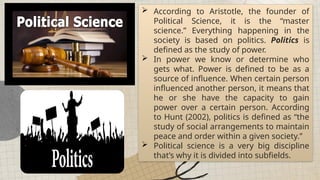
According toAristotle, the founder of
Political Science, it is the “master
science.” Everything happening in the
society is based on politics. Politics is
defined as the study of power.
In power we know or determine who
gets what. Power is defined to be as a
source of influence. When certain person
influenced another person, it means that
he or she have the capacity to gain
power over a certain person. According
to Hunt (2002), politics is defined as “the
study of social arrangements to maintain
peace and order within a given society.”
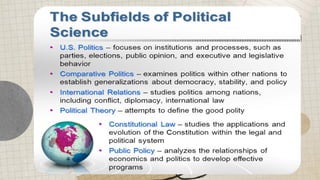
Political science is a very big discipline
that’s why it is divided into subfields.
36.
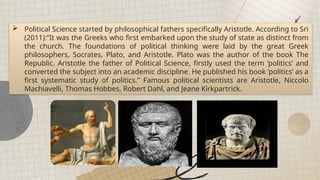
Political Sciencestarted by philosophical fathers specifically Aristotle. According to Sri
(2011):”It was the Greeks who first embarked upon the study of state as distinct from
the church. The foundations of political thinking were laid by the great Greek
philosophers, Socrates, Plato, and Aristotle. Plato was the author of the book The
Republic. Aristotle the father of Political Science, firstly used the term ‘politics’ and
converted the subject into an academic discipline. He published his book ‘politics’ as a
first systematic study of politics.” Famous political scientists are Aristotle, Niccolo
Machiavelli, Thomas Hobbes, Robert Dahl, and Jeane Kirkpartrick.
37.
The studyof behaviour and mental
processes. The term comes from the
Greek words psyche which means soul
and logos which means study hence the
definition “study of the soul.” According
to William James, a renowned
psychologist defined the disciplines as
“the science of mental life, the science
of feelings, desires, cognition,
reasoning, decisions, and the like.”
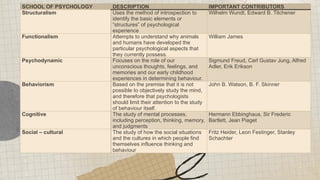
In Psychology, specific schools of
thoughts were created. These grand
theories were formulated due to the
large concept or view of psychology.
SCHOOL OF PSYCHOLOGYDESCRIPTION IMPORTANT CONTRIBUTORS
Structuralism Uses the method of introspection to
identify the basic elements or
“structures” of psychological
experience
Wilhelm Wundt, Edward B. Titchener
Functionalism Attempts to understand why animals
and humans have developed the
particular psychological aspects that
they currently possess.
William James
Psychodynamic Focuses on the role of our
unconscious thoughts, feelings, and
memories and our early childhood
experiences in determining behaviour.
Sigmund Freud, Carl Gustav Jung, Alfred
Adler, Erik Erikson
Behaviorism Based on the premise that it is not
possible to objectively study the mind,
and therefore that psychologists
should limit their attention to the study
of behaviour itself.
John B. Watson, B. F. Skinner
Cognitive The study of mental processes,
including perception, thinking, memory,
and judgments
Hermann Ebbinghaus, Sir Frederic
Bartlett, Jean Piaget
Social – cultural The study of how the social situations
and the cultures in which people find
themselves influence thinking and
behaviour
Fritz Heider, Leon Festinger, Stanley
Schachter
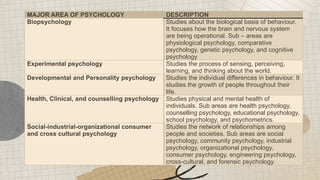
40.
MAJOR AREA OFPSYCHOLOGY DESCRIPTION
Biopsychology Studies about the biological basis of behaviour.
It focuses how the brain and nervous system
are being operational. Sub – areas are
physiological psychology, comparative
psychology, genetic psychology, and cognitive
psychology
Experimental psychology Studies the process of sensing, perceiving,
learning, and thinking about the world.
Developmental and Personality psychology Studies the individual differences in behaviour. It
studies the growth of people throughout their
life.
Health, Clinical, and counselling psychology Studies physical and mental health of
individuals. Sub areas are health psychology,
counselling psychology, educational psychology,
school psychology, and psychometrics.
Social-industrial-organizational consumer
and cross cultural psychology
Studies the network of relationships among
people and societies. Sub areas are social
psychology, community psychology, industrial
psychology, organizational psychology,
consumer psychology, engineering psychology,
cross-cultural, and forensic psychology.
41.
Most ofPsychology started by the questions of Philosophy like the
origin of knowledge. Two perspective were formulated rationalism,
and empiricism. Rationalism states that knowledge comes only
through reasoning while Empiricism states that man can be
“fooled” by their senses. In the medieval ages, memory, emotion,
and motivation were discussed by the book Confessions by Saint
Augustine. (Dizon, 2003) It is Wilhelm Wundt who made the first
movement to make Psychology as a science. He is the father of
Psychology. In his time, the first laboratory experiment in
psychology started.
42.
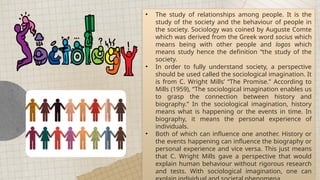
• The studyof relationships among people. It is the
study of the society and the behaviour of people in
the society. Sociology was coined by Auguste Comte
which was derived from the Greek word socius which
means being with other people and logos which
means study hence the definition “the study of the
society.
• In order to fully understand society, a perspective
should be used called the sociological imagination. It
is from C. Wright Mills’ “The Promise.” According to
Mills (1959), “The sociological imagination enables us
to grasp the connection between history and
biography.” In the sociological imagination, history
means what is happening or the events in time. In
biography, it means the personal experience of
individuals.
• Both of which can influence one another. History or
the events happening can influence the biography or
personal experience and vice versa. This just means
that C. Wright Mills gave a perspective that would
explain human behaviour without rigorous research
and tests. With sociological imagination, one can
43.
There are threeapproaches in sociology:
1. Structural functionalism, according to Mooney, Knox, and Schacht
(2012) “Society is a system of interconnected parts that work
together in harmony to maintain a state of balance and social
equilibrium for the whole.” (d.q) This perspective stresses that
parts of the society or the system is very important because if not it
would be dysfunctional. For this perspective, it is related to the
human system. All systems of the body should be working
harmoniously in order to be functional body. The structure or the
whole is very important to be functional. In this perspective,
connection is very important. Notable structural functionalists are
Emile Durkheim, Robert Merton, Talcott Parsons, and Herbert
Spencer.
44.
2. Conflict theory,it is the opposite of structural functionalist perspective
because in this perspective, society is composed by groups competing with
each other. There are different factors why groups of people compete and
what are they competing for. There are different perspective in the conflict
theory. The famous conflict theorist Karl Marx stated that there is conflict
within the proletariats (working class) and bourgeoisie (upper class). He
stated that the upper class gets all the credit and resources while the working
class gets a little percentage of the resources but they are the ones creating
and working hard for the products hence the term alienation. It is where the
creator of the products doesn’t get any credit that it is theirs. In the conflict
theory, there are conflicts in the division of the society for example the
working class and the upper class or the people in the authority and the
regular citizen. Famous conflict theorists are Karl Marx, Andre Gunder Frank,
and Ralf Dahrendorf.
45.
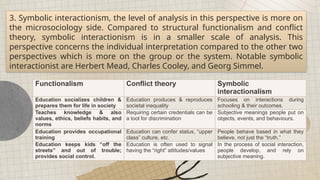
3. Symbolic interactionism,the level of analysis in this perspective is more on
the microsociology side. Compared to structural functionalism and conflict
theory, symbolic interactionism is in a smaller scale of analysis. This
perspective concerns the individual interpretation compared to the other two
perspectives which is more on the group or the system. Notable symbolic
interactionist are Herbert Mead, Charles Cooley, and Georg Simmel.
Functionalism Conflict theory Symbolic
interactionalism
Education socializes children &
prepares them for life in society
Education produces & reproduces
societal inequality
Focuses on interactions during
schooling & their outcomes.
Teaches knowledge & also
values, ethics, beliefs habits, and
norms
Requiring certain credentials can be
a tool for discrimination
Subjective meanings people put on
objects, events, and behaviours.
Education provides occupational
training
Education can confer status, “upper
class” culture, etc.
People behave based in what they
believe, not just the “truth.”
Education keeps kids “off the
streets” and out of trouble;
provides social control.
Education is often used to signal
having the “right” attitudes/values
In the process of social interaction,
people develop, and rely on
subjective meaning.
46.
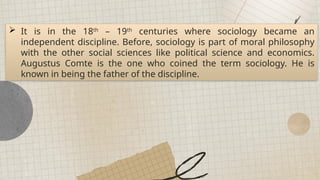
It isin the 18th
– 19th
centuries where sociology became an
independent discipline. Before, sociology is part of moral philosophy
with the other social sciences like political science and economics.
Augustus Comte is the one who coined the term sociology. He is
known in being the father of the discipline.
47.
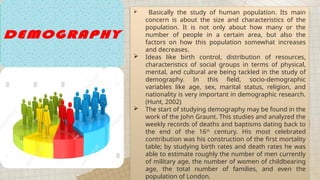
Basically thestudy of human population. Its main
concern is about the size and characteristics of the
population. It is not only about how many or the
number of people in a certain area, but also the
factors on how this population somewhat increases
and decreases.
Ideas like birth control, distribution of resources,
characteristics of social groups in terms of physical,
mental, and cultural are being tackled in the study of
demography. In this field, socio-demographic
variables like age, sex, marital status, religion, and
nationality is very important in demographic research.
(Hunt, 2002)
The start of studying demography may be found in the
work of the John Graunt. This studies and analyzed the
weekly records of deaths and baptisms dating back to
the end of the 16th
century. His most celebrated
contribution was his construction of the first mortality
table; by studying birth rates and death rates he was
able to estimate roughly the number of men currently
of military age, the number of women of childbearing
age, the total number of families, and even the
population of London.
48.
INDIVIDUAL ACTIVITY: 1/2
1.WHY IS THE STUDY OF SOCIETY IMPORTANT?
2. WHAT ARE THE ADVANTAGE AND DISADVANTAGES OF
HAVING SOCIAL AWARENESS?
3. LIST DOWN SOCIAL ISSUES IN THE PHILIPPINES. (3
ISSUES)
49.
CONTENTS OF THISTEMPLATE
FONTS
To view this template correctly in PowerPoint, download and install the
fonts we used
USED AND
ALTERNATIVE RESOURCES
An assortment of graphic resources that are suitable for use in this
presentation
THANKS SLIDE You must keep it so that proper credits for our design are given
COLORS All the colors used in this presentation
INFOGRAPHIC RESOURCES These can be used in the template, and their size and color can be edited
CUSTOMIZABLE ICONS
They are sorted by theme so you can use them in all kinds of
presentations
For more info:
SLIDESGO | SLIDESGO SCHOOL | FAQS
You can visit our sister projects:
FREEPIK | FLATICON | STORYSET | WEPIK |
VIDFY
This is a slide structure based on a marketing campaign presentation
You can delete this slide when you’re done editing the presentation
50.
01
You can describe
thetopic of the
section here
02
You can describe
the topic of the
section here
03
You can describe
the topic of the
section here
04
You can describe
the topic of the
section here
05
You can describe
the topic of the
section here
06
You can describe
the topic of the
section here
TABLE OF CONTENTS
ABOUT
US
MARKET
ANALYSIS
GOALS &
STRATEGY
CONTENT
PLAN
PROJECT
BUDGET
KPI
OVERVIEW
51.
OUR COMPANY
You cangive a brief description of the topic you
want to talk about here. For example, if you want
to talk about Mercury, you can say that it’s the
smallest planet in the entire Solar System
ABOUT THE PRODUCT
Doyou know what helps you make your point
clear? Lists like this one:
● They’re simple
● You can organize your ideas clearly
● You’ll never forget to buy milk!
And the most important thing: the audience
won’t miss the point of your presentation
54.
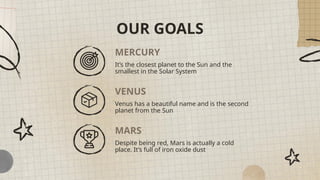
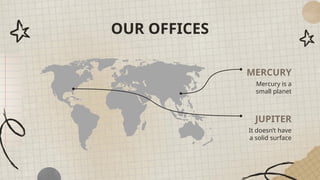
MERCURY
It’s the closestplanet to the Sun and the
smallest in the Solar System
Venus has a beautiful name and is the second
planet from the Sun
Despite being red, Mars is actually a cold
place. It’s full of iron oxide dust
OUR GOALS
VENUS
MARS
55.
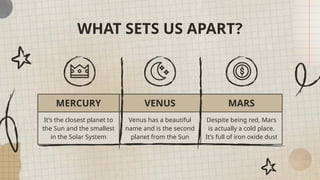
WHAT SETS USAPART?
MERCURY VENUS MARS
It’s the closest planet to
the Sun and the smallest
in the Solar System
Venus has a beautiful
name and is the second
planet from the Sun
Despite being red, Mars
is actually a cold place.
It’s full of iron oxide dust
56.
Images reveal largeamounts of data,
so remember: use an image instead of
a long text. Your audience will
appreciate it for sure
A PICTURE
ALWAYS
REINFORCES
THE CONCEPT
57.
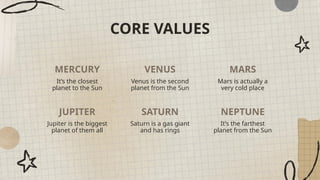
CORE VALUES
It’s theclosest
planet to the Sun
Venus is the second
planet from the Sun
Mars is actually a
very cold place
Jupiter is the biggest
planet of them all
Saturn is a gas giant
and has rings
It’s the farthest
planet from the Sun
MERCURY VENUS MARS
JUPITER SATURN NEPTUNE
58.
MARKET SHARE
30% Mercuryis small
MERCURY
20% Venus is hot
VENUS
50% Mars is cold
MARS
Follow the link in the graph to modify its data and then paste the new one here. For more info, click here
STRENGTHS WEAKNESSES
COMPETITOR ANALYSIS
●You can list your competitor’s
strengths here
● You can list your competitor’s
strengths here
● You can list your competitor’s
strengths here
● You can list your competitor’s
weaknesses here
● You can list your competitor’s
weaknesses here
● You can list your competitor’s
weaknesses here
STEP 1
Venus isthe second
planet from the Sun
It’s the biggest planet
in the Solar System
Despite being red,
Mars is a cold place
Saturn is a gas giant
and has several rings
STRATEGY
STEP 3
STEP 2
STEP 4
PRODUCT DESCRIPTION
Mars isa very
cold place
It’s the planet
with life
Jupiter is a
gas giant
Saturn has
many rings
MARS EARTH
JUPITER SATURN
65.
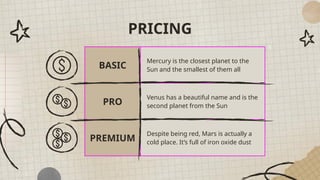
PRICING
BASIC
Mercury is theclosest planet to the
Sun and the smallest of them all
PRO
Venus has a beautiful name and is the
second planet from the Sun
PREMIUM
Despite being red, Mars is actually a
cold place. It’s full of iron oxide dust
PROMOTION
MULTIMEDIA
It’s the closestplanet to
the Sun and the smallest
in the Solar System
Venus has a beautiful
name and is the second
planet from the Sun
Despite being red, Mars
is actually a cold place.
It’s full of iron oxide dust
PRESS PHONE APP
68.
—SOMEONE FAMOUS
“This isa quote, words full of
wisdom that someone
important said and can make
the reader get inspired.”
69.
ADVERTISING CAMPAIGN 1
TV
CHANNEL
GOALS
●List a goal here
● List a goal here
● List a goal here
● List a goal here
BUDGET
$25,000,000
DESCRIPTION
Mercury is the closest planet to the
Sun and the smallest one in the
Solar System—it’s only a bit larger
than the Moon
70.
ADVERTISING CAMPAIGN 2
TV
CHANNELS
GOALS
●List a goal here
● List a goal here
● List a goal here
● List a goal here
BUDGET
$500,000
DESCRIPTION
Venus has a beautiful name
and is the second planet
from the Sun. It’s hot and
has a poisonous atmosphere
Radio
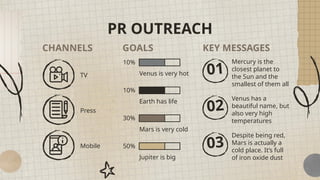
PR OUTREACH
TV
CHANNELS
Venus isvery hot
Mercury is the
closest planet to
the Sun and the
smallest of them all
Press
Mobile
GOALS
10%
Earth has life
10%
Mars is very cold
30%
Jupiter is big
50%
KEY MESSAGES
01
Venus has a
beautiful name, but
also very high
temperatures
02
Despite being red,
Mars is actually a
cold place. It’s full
of iron oxide dust
03
73.
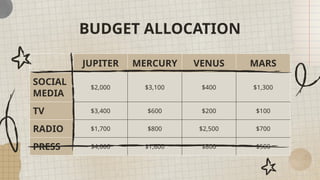
JUPITER MERCURY VENUSMARS
SOCIAL
MEDIA
$2,000 $3,100 $400 $1,300
TV $3,400 $600 $200 $100
RADIO $1,700 $800 $2,500 $700
PRESS $4,000 $1,600 $800 $500
BUDGET ALLOCATION
74.
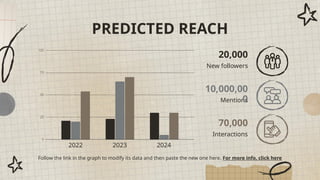
PREDICTED REACH
Follow thelink in the graph to modify its data and then paste the new one here. For more info, click here
New followers
20,000
Mentions
10,000,00
0
Interactions
70,000
2022 2023 2024
75.
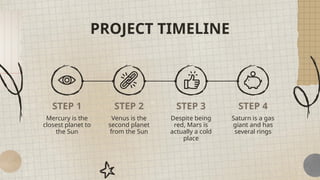
PROJECT TIMELINE
Mercury isthe
closest planet to
the Sun
Venus is the
second planet
from the Sun
Despite being
red, Mars is
actually a cold
place
Saturn is a gas
giant and has
several rings
STEP 1 STEP 2 STEP 3 STEP 4
You can replacethe image on the
screen with your own work. Just right-
click on it and select “Replace image”
MULTIMEDIA
MOCKUP
-
-
80.
TIMMY JIMMY JENNADOE
OUR TEAM
You can speak a bit about
this person here
You can speak a bit about
this person here
81.
CREDITS: This presentationtemplate was created by Slidesgo,
including icons by Flaticon and infographics & images by Freepik
THANKS!
Please keep this slide for attribution
DO YOU HAVE ANY QUESTIONS?
youremail@freepik.com
+91 620 421 838
yourwebsite.com
82.
Here’s an assortmentof alternative resources whose style fits that of this template:
ALTERNATIVE RESOURCES
83.
RESOURCES
Did you likethe resources on this template? Get them for free at our other websites:
VECTORS PHOTOS
● Music template design of instag
ram stories I
● Music template design of instag
ram stories II
● Music template design of instag
ram post
● Creative composition with old b
ook
● Top view of book and flowers
● Close up portrait of senior man l
istening to music
● Beautiful woman sitting on sofa
and looking at photographer
84.
For more informationabout editing slides, please read our FAQs or visit Slidesgo School:
https://slidesgo.com/faqs and https://slidesgo.com/slidesgo-school
Instructions for use
If you have a free account, in order to use this template, you must credit Slidesgo by keeping the Thanks slide. Please
refer to the next slide to read the instructions for premium users.
As a Free user, you are allowed to:
- Modify this template.
- Use it for both personal and commercial projects.
You are not allowed to:
- Sublicense, sell or rent any of Slidesgo Content (or a modified version of Slidesgo Content).
- Distribute Slidesgo Content unless it has been expressly authorized by Slidesgo.
- Include Slidesgo Content in an online or offline database or file.
- Offer Slidesgo templates (or modified versions of Slidesgo templates) for download.
- Acquire the copyright of Slidesgo Content.
85.
As a Premiumuser, you can use this template without attributing Slidesgo or keeping the "Thanks" slide.
You are allowed to:
● Modify this template.
● Use it for both personal and commercial purposes.
● Hide or delete the “Thanks” slide and the mention to Slidesgo in the credits.
● Share this template in an editable format with people who are not part of your team.
You are not allowed to:
● Sublicense, sell or rent this Slidesgo Template (or a modified version of this Slidesgo Template).
● Distribute this Slidesgo Template (or a modified version of this Slidesgo Template) or include it in a database or in
any other product or service that offers downloadable images, icons or presentations that may be subject to
distribution or resale.
● Use any of the elements that are part of this Slidesgo Template in an isolated and separated way from this
Template.
● Register any of the elements that are part of this template as a trademark or logo, or register it as a work in an
intellectual property registry or similar.
For more information about editing slides, please read our FAQs or visit Slidesgo School:
https://slidesgo.com/faqs and https://slidesgo.com/slidesgo-school
Instructions for use (premium users)
86.
This presentation hasbeen made using the following fonts:
#dcd8cd #2c2924 #7e7061 #c8b38b
#a6a6a6 #787b7c
#c7b79c
Fonts & colors used
IM Fell DW Pica
(https://fonts.google.com/specimen/IM+Fell+DW+Pica)
Public Sans
(https://fonts.google.com/specimen/Public+Sans)
87.
Create your Storywith our illustrated concepts. Choose the style you like the most, edit its colors, pick
the background and layers you want to show and bring them to life with the animator panel! It will boost
your presentation. Check out how it works.
Pana Amico Bro Rafiki Cuate
Storyset
88.
You can easilyresize these resources without losing quality. To change the color, just ungroup the resource
and click on the object you want to change. Then, click on the paint bucket and select the color you want.
Group the resource again when you’re done. You can also look for more infographics on Slidesgo.
Use our editable graphic resources...
91.
JANUARY FEBRUARY MARCHAPRIL
PHASE
1
Task 1
Task 2
JANUARY FEBRUARY MARCH APRIL MAY JUNE
PHASE 1
PHASE 2
Task 1
Task 2
Task 1
Task 2
94.
You can resizethese icons without losing quality.
You can change the stroke and fill color; just select the icon and click on the paint bucket/pen.
In Google Slides, you can also use Flaticon’s extension, allowing you to customize and add even more icons.
...and our sets of editable icons