Comprehensive Introduction to Research Methods and Types
Explore the fundamentals of research, including definitions, objectives, characteristics, motivations, and distinctions between basic and applied research, along with quantitative and qualitative approaches.
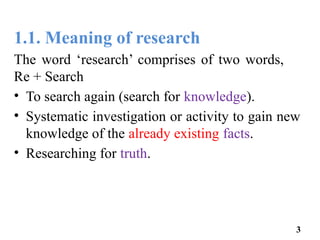
1.1. Meaning ofresearch
The word ‘research’ comprises of two words,
Re + Search
• To search again (search for knowledge).
• Systematic investigation or activity to gain new
knowledge of the already existing facts.
• Researching for truth.
3
4.
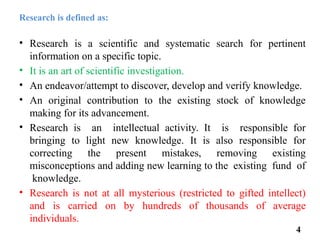
Research is definedas:
• Research is a scientific and systematic search for pertinent
information on a specific topic.
• It is an art of scientific investigation.
• An endeavor/attempt to discover, develop and verify knowledge.
• An original contribution to the existing stock of knowledge
making for its advancement.
• Research is an intellectual activity. It is responsible for
bringing to light new knowledge. It is also responsible for
correcting the present mistakes, removing existing
misconceptions and adding new learning to the existing fund of
knowledge.
• Research is not at all mysterious (restricted to gifted intellect)
and is carried on by hundreds of thousands of average
individuals.
4
5.
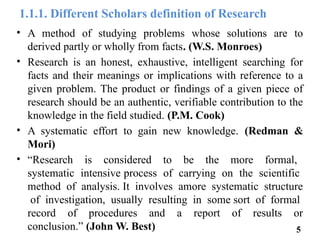
1.1.1. Different Scholarsdefinition of Research
• A method of studying problems whose solutions are to
derived partly or wholly from facts. (W.S. Monroes)
• Research is an honest, exhaustive, intelligent searching for
facts and their meanings or implications with reference to a
given problem. The product or findings of a given piece of
research should be an authentic, verifiable contribution to the
knowledge in the field studied. (P.M. Cook)
• A systematic effort to gain new knowledge. (Redman &
Mori)
• “Research is considered to be the more formal,
systematic intensive process of carrying on the scientific
method of analysis. It involves amore systematic structure
of investigation, usually resulting in some sort of formal
record of procedures and a report of results or
conclusion.” (John W. Best) 5
6.
Cont…
• Research comprisesof defining and redefining problems,
formulating hypothesis or suggested solutions, collecting,
organizing and evaluating data, making deductions and
reaching conclusion and at last careful testing the
conclusions to determine whether they fit the formulated
hypothesis. (Clifford Woody)
• “Social research may be defined as a scientific undertaking
which by means of logical and systematized techniques
aims to discover new facts or verify and test old
facts , analyse their sequences , inter-relationships and
casual explanation which were derived within an
appropriate theoretical frame of reference , develop
new scientific tools , concepts and theories which would
facilitate reliable and valid study of human behavior.”
(P.V. Younge) 6
7.
Cont…
More precisely, researchcan be defined as:
• the creation of new knowledge, and/or
• The use of existing knowledge in a new and creative way so
as to generate new concepts, methodologies and
understanding. This could include synthesis and analysis of
previous research to the extent that it leads to new and
creative outcome.
Example: In mathematics
• New method + Existing problem
• New problem + Existing method
• New method + New problem
• Existing problem + Existing method with some modification
7
8.
1.1.2. Objectives ofResearch
• To discover answers to questions through the application
of scientific procedures.
• To find out the truth which is hidden and which has not
been discovered as yet.
• To gain familiarity with a phenomenon or to achieve
new insights into it. (exploratory or formative)
• To portray accurately the characteristics of a particular
individual, situation or a group. (descriptive )
• To determine the frequency with which something
occurs or with which it is associated with something else.
(diagnostic)
• To test a hypothesis of a causal relationship between
variables. (hypothesis-testing) 8
9.
1.1.3. Characteristics ofResearch:
Following are the characteristics of research;
• Research is directed toward the solution of a problem. (the quest for
answers to un-solved problems.). It requires expertise.
• Research emphasizes the development of generalizations, principles,
or theories that will be helpful in predicting future occurrences,
based upon observable experience or empirical evidences.
• Research demands accurate observation and description.
• Research involves gathering new data from primary or first-hand
sources or using existing data for a new purpose.
• Research is characterized by carefully designed procedures that apply
rigorous analysis.
• Research strives to be objective and logical, applying every possible
test to validate the procedures employed the data collected and the
conclusions reached.
• Research is characterized by patient and unhurried activity.
• Research is carefully recorded and collected.
9
10.
1.1.4. What motivatesto do research?
• To get a research degree (BSc., BED, MSc., PhD)
along with its consequential benefits.
• To get a high teaching position (in a college or
university)
• To become a scientist in a research institution
• to solve the unsolved and challenging problems
and serve the society
• to get intellectual joy of doing some creative work
• to get recognition
• to understand nature and natural phenomena and
so on
10
11.
1.2. Types ofResearch
A. On the basis of utility of content or
nature of subject matter of research:
i. Basic/Fundamental/pure or Theoretical Research: Its
utility is universal.
ii. Experimental or Applied Research: Its utility is
limited.
i. Basic/Fundamental/pure or Theoretical Research
• Basic research is an investigation on basic principles
and reasons for occurrence of a particular event or
process or phenomenon. It is also called theoretical
research.
• It is a study or investigation of some natural
phenomenon or relating to pure science 11
12.
Cont…
• Basic researchessome times may not lead to immediate use or
application.
• It is not concerned with solving any practical problems of immediate
interest.
• But it is original or basic in character.
• It provides a systematic and deep insight into a problem and facilitates
extraction of scientific and logical explanation and conclusion on it.
• It helps build new frontiers of knowledge.
• The outcomes of basic research form the basis for many applied
research.
• Researchers working on applied research have to make use of the
outcomes of basic research and explore the utility of them.
• Research on improving a theory or a method is also referred as
fundamental research.
For example, suppose a theory is applicable to a system provided the
system satisfies certain specific conditions.
12
13.
Cont…
• Modifying thetheory to apply it to a general situation is a
basic research. i.e. modifying/extending the existing
mathematical method so as to make it applicable to solve
the existing problem.
Attempts to find answers to the following questions actually
form basic research.
• Why are materials like that?
• What are they?
• How does a crystal melt?
• Why is sound produced when water is heated?
• Why do we feel difficult when walking on seashore?
• Why are birds arrange them in ‘>’ shape when flying in a
group?
13
14.
Cont…
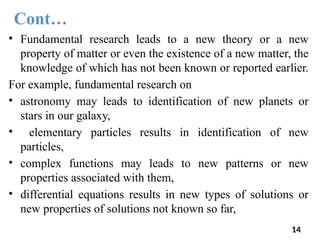
• Fundamental researchleads to a new theory or a new
property of matter or even the existence of a new matter, the
knowledge of which has not been known or reported earlier.
For example, fundamental research on
• astronomy may leads to identification of new planets or
stars in our galaxy,
• elementary particles results in identification of new
particles,
• complex functions may leads to new patterns or new
properties associated with them,
• differential equations results in new types of solutions or
new properties of solutions not known so far,
14
15.
Cont…
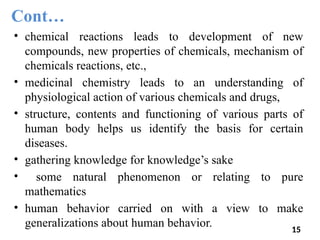
• chemical reactionsleads to development of new
compounds, new properties of chemicals, mechanism of
chemicals reactions, etc.,
• medicinal chemistry leads to an understanding of
physiological action of various chemicals and drugs,
• structure, contents and functioning of various parts of
human body helps us identify the basis for certain
diseases.
• gathering knowledge for knowledge’s sake
• some natural phenomenon or relating to pure
mathematics
• human behavior carried on with a view to make
generalizations about human behavior. 15
16.
Cont…
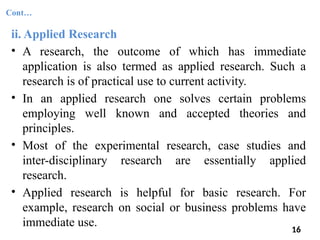
ii. Applied Research
•A research, the outcome of which has immediate
application is also termed as applied research. Such a
research is of practical use to current activity.
• In an applied research one solves certain problems
employing well known and accepted theories and
principles.
• Most of the experimental research, case studies and
inter-disciplinary research are essentially applied
research.
• Applied research is helpful for basic research. For
example, research on social or business problems have
immediate use.
16
17.
Cont…
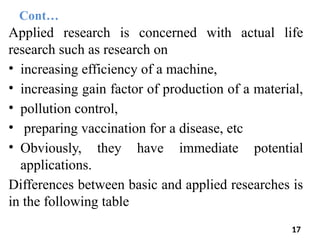
Applied research isconcerned with actual life
research such as research on
• increasing efficiency of a machine,
• increasing gain factor of production of a material,
• pollution control,
• preparing vaccination for a disease, etc
• Obviously, they have immediate potential
applications.
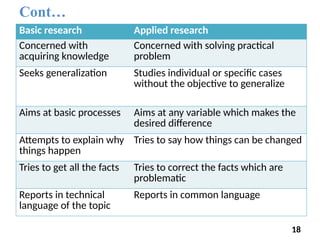
Differences between basic and applied researches is
in the following table
17
18.
Cont…
Basic research Appliedresearch
Concerned with
acquiring knowledge
Concerned with solving practical
problem
Seeks generalization Studies individual or specific cases
without the objective to generalize
Aims at basic processes Aims at any variable which makes the
desired difference
Attempts to explain why
things happen
Tries to say how things can be changed
Tries to get all the facts Tries to correct the facts which are
problematic
Reports in technical
language of the topic
Reports in common language
18
19.
Cont…
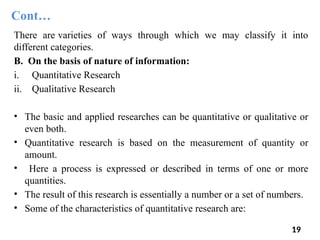
There are varietiesof ways through which we may classify it into
different categories.
B. On the basis of nature of information:
i. Quantitative Research
ii. Qualitative Research
• The basic and applied researches can be quantitative or qualitative or
even both.
• Quantitative research is based on the measurement of quantity or
amount.
• Here a process is expressed or described in terms of one or more
quantities.
• The result of this research is essentially a number or a set of numbers.
• Some of the characteristics of quantitative research are:
19
20.
Cont…
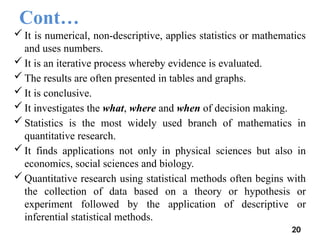
It isnumerical, non-descriptive, applies statistics or mathematics
and uses numbers.
It is an iterative process whereby evidence is evaluated.
The results are often presented in tables and graphs.
It is conclusive.
It investigates the what, where and when of decision making.
Statistics is the most widely used branch of mathematics in
quantitative research.
It finds applications not only in physical sciences but also in
economics, social sciences and biology.
Quantitative research using statistical methods often begins with
the collection of data based on a theory or hypothesis or
experiment followed by the application of descriptive or
inferential statistical methods.
20
21.
Cont…
ii. Qualitative research
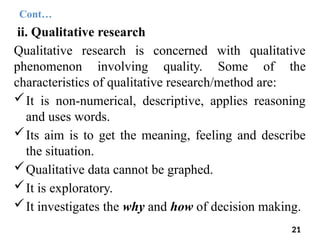
Qualitativeresearch is concerned with qualitative
phenomenon involving quality. Some of the
characteristics of qualitative research/method are:
It is non-numerical, descriptive, applies reasoning
and uses words.
Its aim is to get the meaning, feeling and describe
the situation.
Qualitative data cannot be graphed.
It is exploratory.
It investigates the why and how of decision making.
21
22.
Cont…
• We measureand weigh things in the study of substance or
structure. Can we measure or weigh patterns?
• We cannot measure or weigh patterns.
• But to study patterns we must map a configuration of
relationships. That is, structures involve quantities whereas
patterns involve qualities.
• If one wishes to investigate why certain data are random then
it is a qualitative research.
• If the aim is to study how random the data is, what is the
mean, variance and distribution function then it becomes
quantitative.
• Explaining how digestion of food takes place in our body is a
qualitative description. It does not involve any numbers or
data and quantities.
22
23.
Cont…
• The detectionof a particular compound is a qualitative
analysis. This can be done by carrying out physical or
chemical tests.
• Determination of exact amount of a particular
compound present in a volume is essentially quantitative
analysis. This can be done by volumetric, gravimetric
and colorimetric methods or instrumental methods.
• Experimental and simulation studies are generally
quantitative research.
• In fact, qualitative methods can be used to understand
the meaning of the numbers obtained by quantitative
methods.
23
24.
Cont…
Other types ofresearch include:
• Action research (fact findings to improve the quality of action in the
social world),
• Explanatory research(searching explanations for events and
phenomena, for example finding answer to the question why are the
things like what they are?),
• Exploratory research(getting more information on a topic) and
• Comparative research(obtaining similarities and differences
between events, methods, techniques,
• Experimental Research: This is purely quantitative in nature
and deals with future events.
• Case-Study Research: It deals with unusual events. It may be
qualitative as well as quantitative in nature depending upon the
content.
• etc.
24
25.
2. Research methodsVs. Methodology
• Research methods are the various procedures, schemes and
algorithms used in research.
• Are codified series of steps taken to complete a certain task or
to reach a certain objective.
• All the methods used by a researcher during a research study
are termed as research methods. They are essentially planned,
scientific and value-neutral.
• They include theoretical procedures, experimental studies,
numerical schemes, statistical approaches, etc.
• Research methods help us collect samples, data and find a
solution to a problem. Particularly, scientific research methods
call for explanations based on collected facts, measurements
and observations and not on reasoning alone. They accept only
those explanations which can be verified by experiments.
25
26.
Cont…
• Research methodologyis the analysis of the principles of
methods, rules, and postulates employed by a discipline.
• Is the science of methods that are, can be or have been applied
within a discipline.
• is a systematic way to solve a problem.
• It is a systematic/theoretical analysis whether a method is
accurate, suitable, efficient or not.
• It is a science of studying how research is to be carried out.
Essentially, the procedures by which researchers go about their
work of describing, explaining and predicting phenomena are
called research methodology.
• It is also defined as the study of methods by which knowledge
is gained.
• Its aim is to give the work plan of research. 26
27.
Cont…
• It isnecessary for a researcher to design a methodology for the problem
chosen. One should note that even if the method considered in two
problems are same the methodology may be different.
• It is important for the researcher to know not only the research methods
necessary for the research under taken but also the methodology.
• For example, a researcher not only needs to know how to
i. calculate mean, variance and distribution function for a set of data,
ii. find a solution of a physical system described by mathematical model,
iii. determine the roots of algebraic equations and
iv. apply a particular method
but also need to know
v. which is a suitable method for the chosen problem?,
vi. what is the order of accuracy of the result of a method?,
vii. what is the efficiency of the method? and so on.
27
28.
Cont…
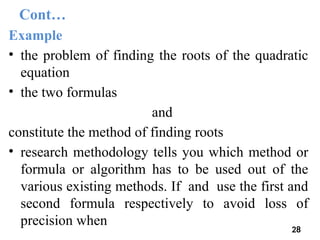
Example
• the problemof finding the roots of the quadratic
equation
• the two formulas
and
constitute the method of finding roots
• research methodology tells you which method or
formula or algorithm has to be used out of the
various existing methods. If and use the first and
second formula respectively to avoid loss of
precision when
28
29.
3. Stages ofa Research
Whenever a scientific problem is to be solved there are
several important steps to follow.
• The problem must be stated clearly, including any
simplifying assumptions.
• Then develop a mathematical statement of the problem.
This process may involve use of one or more mathematical
procedures. Frequently, more advanced text books or
review articles will be needed to learn about the techniques
and procedures.
• Next, the results have to be interpreted to arrive at a
decision. This will require experience and an understanding
of the situation in which the problem is embedded.
29
30.
Cont…
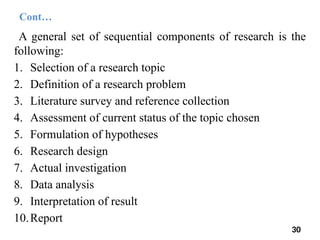
A general setof sequential components of research is the
following:
1. Selection of a research topic
2. Definition of a research problem
3. Literature survey and reference collection
4. Assessment of current status of the topic chosen
5. Formulation of hypotheses
6. Research design
7. Actual investigation
8. Data analysis
9. Interpretation of result
10.Report
30
31.
3.1. Selection ofa research topic/problem
• The starting point of a research is the selection of a research
topic/problem. History teaches the continuity of the development and
progress of science. The point is that every age has its own problems,
numerous in number, which the following age either solves or casts
aside as profitless and replaces by new one.
• If we could obtain an idea of the probable development of scientific
knowledge in the immediate future, we must let the unsettled questions
pass before our minds and look over the problems which the science of
today sets and whose solution we expect from the near future.
• The deep significance of certain problems for the advancement of
science and society must be taken into consideration in choosing a
problem of research.
• There are many ways to do research as there are scientists.
• The choice of a thesis research area and adviser has always been a very
subjective process.
31
32.
Cont…
• Identifying asuitable topic for work is one of the most
difficult parts of a research. Before choosing a research
topic and a problem the young researchers should keep
the following points in mind.
• Topic should be suitable for research.
• The researcher should have interest in it.
• Topic should not be chosen by compulsion/influence
from some one else.
• Topic and problem can be fixed in consultation with the
research supervisor.
• The researcher has to narrow it and define it in an
operational form.
32
33.
Cont…
Steps to befollowed in identifying a research problem;
• Step I Determining the field of research in which a researcher is
keen to do the research work.
• Step II The researcher should develop the mastery on the area
or it should be the field of his specialization.
• Step III He should review the research conducted in area to know
the recent trend and studies are being conducted in the area.
• Step IV On the basis of review, he should consider the priority
field of the study.
• Step V He should draw an analogy and insight in identifying a
problem or employ his personal experience of the field in
locating the problem. He may take help of supervisor or expert of the
field.
• Step VI He should pin point specific aspect of the problem which is
to be investigated.
33
34.
Cont…
Some sources ofidentification of a research topic
and problems are the following:
• Theory of one’s own interest
• The problems lie everywhere around us.
• Daily problems
• Technological changes
• Recent trends
• Unexplored areas
• Discussion with experts and research supervisor
34
35.
3.2. Definition andFormulation of a Problem
After identifying a problem, in order to solve it, it has to be defined and
formulated properly. Defining the problem is more important than its
solution. It is a crucial part of the research study and should not be
defined in hurry.
For this purpose, one can execute the following.
• State the problem in questionnaire form or in an equivalent form
• Specify the problem in detail and in precise terms
• List the assumptions made
• Remove the ambiguities, if any, in the statement of the problem
• Examine the feasibility of a particular solution
• A problem in its first definition may not be appealing. It may require
redefinition in order to make it a good problem. That is, by suitably
rewording or reformulating the chosen problem, it can be made to
meet the criteria of a good problem. This is also important to solve
the problem successfully.
35
36.
Cont…
To this enda researcher can ask a series of questions on the
problem. Some are
• Is the problem really interesting to him and to the scientific
community?
• Is the problem significant to the present status of the topic?
• Is there sufficient supervision/guidance?
• Can the problem be solved in the required time frame?
• Are the necessary equipment, adequate library and
computational facilities, etc. available?
• Is the problem new, researchable, significant, feasible for the
particular researcher?
If the answers to these questions are satisfactory, then the
researcher can initiate work on the chosen problem.
36
37.
Goals and Objectives
•Objectives and goals are conceptually different.
• They must be stated at the very beginning of the study, since
they will guide the investigator during the process of
formulating research questions and hypothesis.
• They will also help in the prioritization process.
• They will enable the reader or consumer of the work to
judge whether the investigator had achieved these objectives
or not.
• Goals describe the aim of the work in broad terms and in the
long run.
• Objective may be thought of as either a solution to a
problem or a step along the way toward achieving a solution.
37
38.
Cont…
Objective
• Is anend state to be achieved in relation to the problem.
• Summarizes what is to be achieved by the study.
• After statement of the general objective, specific objectives may be
mentioned
• May have either social, policy or theoretical relevance
• General objective indicates the central thrust of your study whereas
the specific objectives identify the specific issues the researcher
propose to examine.
• Objective of the study should be clearly stated and specific in nature.
• Each sub/specific objective should delineate only one issue.
• The objectives of a research delineate the ends or aim which the
inquirer seeks to bring about as a result of completing the research
undertaken.
38
39.
Cont…
Use action-oriented verbssuch as
• To determine,
• To find out,
• To describe, to identify, to measure, to compare, etc. to ascertain in
formulating specific objectives, which should be numerically listed
Objectives should be:
• Achievable, taking into consideration the available resources and time.
• Manually exclusive, with no repetitions or overlaps
• Closely related to the statement of the problem and the research question
• Covering all aspects of the problem
• Ordered in a logical sequence
• SMART(specific, measurable, achievable, relevant, time-bounded)
Properly formulated specific objectives
• Will facilitate the development of your research methodology and
• Will help to orient the collection, analysis, interpretation and utilization of
data.
39
40.
3.3. Literature Review
•After defining a problem, the researcher has to do literature survey
connected with the problem.
• It is very essential to know whether the defined problem has already been
solved, status of the problem, techniques that are useful to investigate the
problem and other related details.
• A literature review may constitute an essential chapter of a thesis or
dissertation, or may be a self-contained review of writings on an object. It
constitutes the processes (search, list, learn, write)
• Literature survey is a collection of research publications/scientific
articles, books, conferences and other documents related to the defined
problem.
Journal articles
• are good sources for up-to-date information.
• They can be refereed (reviewed by scholars before publication)
• non-refereed such as trade journals and magazines (not for scientific
literature).
40
41.
Cont…
Books: are lessup-to-date as it takes longer time to be published.
Government/corporate reports: can provide a useful source of
information, depending on your field of study.
Theses and dissertation: are useful source of information,
• can be difficult to obtain since they are not published,
• but are generally available from the library or interlibrary systems.
• The student who carried out the research may not be an experienced
researcher and therefore you might have to treat their findings with more
caution than published research.
Internet:
• is the fastest source of information
• bear in mind that any one can post information on the Internet so the
quality may not be reliable.
• The information you find may be intended for a general audience and so
not be suitable for inclusion in your literature review (information for a
general audience is usually less detailed). 41
42.
Cont…
Assessing each source:consideration should be given to
Provenance
• What are the author’s credentials?
• Are the author’s arguments supported by evidence? (e.g. primary
historical material, case studies, narratives, statistics, recent scientific
findings).
Objectivity
• Is the author’s perspective evenhanded or prejudicial?
• Is contrary data considered or in certain pertinent information ignored
to prove the author’s point?
Persuasiveness
• Is the author’s thesis convincing?
Value
• Does the work ultimately contribute in any significant way to an
understanding of the subject of my research?
42
43.
Cont…
Its purpose isto:
• Place each work in the context of its contribution to the
understanding of the subject under review.
• get proper understanding of the problem chosen,
• acquire proper theoretical and practical knowledge to investigate
the problem,
• show how the problem under study relates to the previous research
studies
• know whether the proposed problem had already been solved and
prevent duplication effort.
• Resolve conflicts amongst seemingly contradictory previous
studies
• place one’s original work (in the case of theses or dissertations) in
the context of existing literature.
• Provide information about people in different research areas. 43
44.
Cont…
Writing literature
There arethree components
The introduction
• Define or identify the general topic, issue, or area of concern.
• Point out overall trends in what has been published about the topic; conflicts
in the theory, methodology, evidence, and conclusion; or gaps in research.
Establish the writer’s reason (point of view) for reviewing the literature;
explain the criteria to be used in analyzing and comparing literature.
The body
• Group literature according to common denominators (approaches,
conclusion of authors, purposes, etc.)
• Summarize individual studies, make comparisons and analyses
The conclusion
• Summarize major contribution, maintain the focus established in the
introduction, evaluate the current ‘state of the art’ pointing gaps,
inconsistencies, area of issue in the future study.
44
45.
3.4. Assessment ofcurrent status of the topic chosen
• The current status of the chosen topic can be identified by
• Reading the relevant journals and the current papers;
discussion in conferences, seminars and workshops
• Rapid communication and Letter sections of international
journals publish articles which are very important and fall in
recent trends category.
• These articles indicate the recent trends in a particular topic.
Some relevant websites are listed below.
http://www.ams.org/global-preprints/
http://front.math.ucdavis.edu/math.AG/
http://front.math.ucdavis.edu/math.NA/
DOI link in sci-hub
45
46.
3.5. Formulation ofhypotheses
• Every research problem is undertaken aiming at certain
outcomes. That is, before starting actual work such as
performing an experiment or theoretical calculation or
numerical analysis, we expect certain outcomes from the study.
• The expectations form the hypothesis.
• Hypotheses are scientifically reasonable predictions.
• They are often stated in terms of if-then sentences in certain
logical forms.
• A hypothesis should provide what we expect to find in the
chosen research problem. That is, the expected or proposed
solutions based on available data and tentative explanations
constitute the hypothesis.
• Hypothesizing is done only after survey of relevant literature
and learning the present status of the field of research.
46
47.
Cont…
• It canbe formulated based on previous research and
observation.
• To formulate a hypothesis the researcher should acquire
enough knowledge in the topic of research and a
reasonably deep insight about the problem.
• In formulating a hypothesis construct operational
definitions of variables in the research problem.
• Hypothesis is due to an intelligent guess or for
inspiration which is to be tested in the research work
rigorously through appropriate methodology.
• Testing of hypothesis leads to explanation of the
associated phenomenon or event.
47
48.
Cont…
Criteria of agood hypothesis
• should have conceptual clarity and a theoretical orientation.
Further, it should be testable.
• should be stated in a suitable way so that it can be tested by
investigation.
• A hypothesis made initially may become incorrect when the
data obtained are analyzed. In this case it has to be revised.
• It is important to state the hypothesis of a research problem in
a research report.
• We note that if a hypothesis withstands the experiments and
provides the required facts to make it acceptable, not only to
the researchers performing the experiments but to others
doing other experiments then when sufficiently reinforced by
continual verification the hypothesis may become a theory.
48
49.
3.6. Research design
•Research design is the conceptual structure within which research
would be conducted.
• Is a mapping strategy.
• Is essentially a statement of the object of the inquiry and the
strategies for collecting the evidences, analyzing the evidences and
reporting the findings.
• It indicates the various approaches to be used in solving the
research problem, sources and information related to the problem
and, time frame and the cost budget.
• It will help perform to the chosen task easily and in a systematic
way.
• Is the work before getting into the actual investigation.
• It includes research method or research strategy, sampling design,
choice of research tools, and choice of statistical techniques.
49
50.
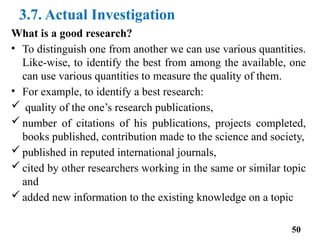
3.7. Actual Investigation
Whatis a good research?
• To distinguish one from another we can use various quantities.
Like-wise, to identify the best from among the available, one
can use various quantities to measure the quality of them.
• For example, to identify a best research:
quality of the one’s research publications,
number of citations of his publications, projects completed,
books published, contribution made to the science and society,
published in reputed international journals,
cited by other researchers working in the same or similar topic
and
added new information to the existing knowledge on a topic
50
51.
Cont…
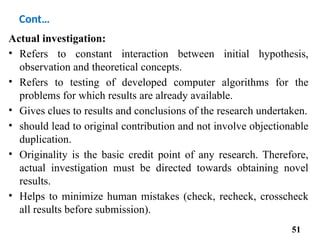
Actual investigation:
• Refersto constant interaction between initial hypothesis,
observation and theoretical concepts.
• Refers to testing of developed computer algorithms for the
problems for which results are already available.
• Gives clues to results and conclusions of the research undertaken.
• should lead to original contribution and not involve objectionable
duplication.
• Originality is the basic credit point of any research. Therefore,
actual investigation must be directed towards obtaining novel
results.
• Helps to minimize human mistakes (check, recheck, crosscheck
all results before submission).
51
52.
Cont…
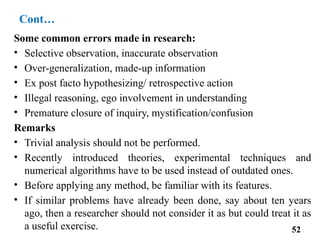
Some common errorsmade in research:
• Selective observation, inaccurate observation
• Over-generalization, made-up information
• Ex post facto hypothesizing/ retrospective action
• Illegal reasoning, ego involvement in understanding
• Premature closure of inquiry, mystification/confusion
Remarks
• Trivial analysis should not be performed.
• Recently introduced theories, experimental techniques and
numerical algorithms have to be used instead of outdated ones.
• Before applying any method, be familiar with its features.
• If similar problems have already been done, say about ten years
ago, then a researcher should not consider it as but could treat it as
a useful exercise. 52
53.
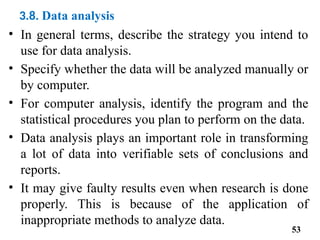
3.8. Data analysis
•In general terms, describe the strategy you intend to
use for data analysis.
• Specify whether the data will be analyzed manually or
by computer.
• For computer analysis, identify the program and the
statistical procedures you plan to perform on the data.
• Data analysis plays an important role in transforming
a lot of data into verifiable sets of conclusions and
reports.
• It may give faulty results even when research is done
properly. This is because of the application of
inappropriate methods to analyze data.
53
54.
3.9. Interpretation ofresult
• Predictions, results and conclusion are ultimate
goals of the research performed.
• Interpretation refers to the task of drawing
inferences from the actual research work.
• It also means drawing of conclusion.
• It would bring out relations and processes that
underlie the findings. The utility of the outcome
of the research greatly lie on proper
interpretations and is the hardest part of solving a
scientific problem.
54
55.
Cont…
Interpretation of resultsis important because it:
• links the present work to the previous,
• leads to identification of future problems,
• opens new avenues of intellectual adventure and stimulates
the quest for more knowledge,
• makes others understand the significance of the research
findings and
• often suggests a possible experimental verification.
The basic rule in preparing results and conclusion is:
• to give all the evidences relevant to the research problem and
its solution.
• Avoid bare statement of the findings.
• Their implications must be pointed out.
55
56.
Cont…
• In orderto properly interpret research results you should
answer the following questions
Are the supporting evidences sufficient?, and if not, What to do?
How many pieces of evidence are required? Instead of producing
all, is it possible to
restrict to one or two pieces of evidence? If so, what are they?
Why are they sufficient?
• If you make a theory, for example, and advertise it, or put it
out, then you must also put down all the facts that disagree
with it, as well as those that agree with it.
• The prepared results and conclusions may be revised based
on the following questions:
Are the quantitative and qualitative analysis performed adequate
for the conclusion drawn?
56
57.
Cont…
Are theresults and conclusions general? Valid only for the particular
situation considered in the present work?
Is the conclusion too broad considering the analysis performed?
Is any evidence which weaken the conclusion omitted?
Remarks:
• Each and every statement made in the results and conclusion sections
must be based on evidence obtained from theoretical or experimental
analysis.
• Baseless statements should never be made.
• Never yield to the temptation of fabrication of results and
interpretation.
• Plagiarism in the form of copying data or findings from others’ report
without acknowledging the source will make you in trouble.
• Don’t attempt to report the already reported findings of others as yours.
57
58.
3.10. Report
• Researchreporting is an oral (meeting, conference, seminar,
symposium, workshop, etc.) or a written (thesis or paper)
presentation of important and useful aspects of the research work
done.
• Is scholarly communications of the formal and informal processes
through which research results and other scholarly work are
evaluated and disseminated to other researchers, and scholars,
students, policy makers and the public.
Scholarly communications
• The process through which scholars exchange information.
• Important process for fostering the growth of science and technology.
• Core-value sharing of knowledge (without price and copy right
restrictions).
• Access limitations (reduced subscriptions) caused by inflated journal
prices.
58
59.
4. Research Proposal
•Is a ‘road map’ in which one outlines the steps that will be taken
during the execution of one’s research project.
• Its size and structure may vary depending on the requirement of
organization (university, faculty, school or department)
• The initial step is to find the guidelines and requirements of your
organization.
• Here we see some elements that any research proposal requires and
make familiar to standard orders of our institution (Wollega
university).
Title/Cover page
• Identifies the research title, the researcher/student, the institution,
the advisors/mentors/supervisors, date, and place.
• The title should be brief and descriptive and may use a colon (:) to
separate the topic from the focus. 60
60.
Cont…
Abstract
• Is abrief summary and describes the purpose and motivation
for the study, statement of the problem, data collection
methodology and analysis, results and implication.
Introduction
• Provides background information for the research.
• Is typically structured from general information to narrow or
focused ideas.
Literature Review
• At this stage you may not likely to have read everything
related to your research questions,
• but you should still be able to identify the key texts with which
you will be in conversation as you write the selected thesis.
61
61.
Cont…
Materials and Methods/Methodology/Research Design
• Include a description and rationale for the methods and analysis
• Include the materials used when solving the problem.
Expected Output(if applicable)
• Results that you may have.
Work Plan
• Is the time table which lists the stages of the research project in time
line, spreadsheet or tabular format, and the deadlines for completion
of these stages or tasks.
• You should include any challenges to completion that anticipate
facing.
Budget Breakdown
• financial and material requirements for the implementation of
the proposed work are indicated in detail.
62
62.
Cont…
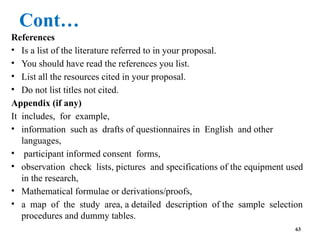
References
• Is alist of the literature referred to in your proposal.
• You should have read the references you list.
• List all the resources cited in your proposal.
• Do not list titles not cited.
Appendix (if any)
It includes, for example,
• information such as drafts of questionnaires in English and other
languages,
• participant informed consent forms,
• observation check lists, pictures and specifications of the equipment used
in the research,
• Mathematical formulae or derivations/proofs,
• a map of the study area, a detailed description of the sample selection
procedures and dummy tables.
63
63.
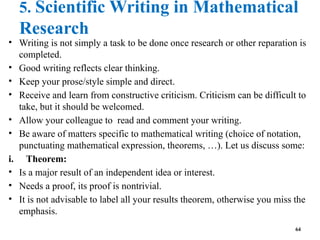
5. Scientific Writingin Mathematical
Research
• Writing is not simply a task to be done once research or other reparation is
completed.
• Good writing reflects clear thinking.
• Keep your prose/style simple and direct.
• Receive and learn from constructive criticism. Criticism can be difficult to
take, but it should be welcomed.
• Allow your colleague to read and comment your writing.
• Be aware of matters specific to mathematical writing (choice of notation,
punctuating mathematical expression, theorems, …). Let us discuss some:
i. Theorem:
• Is a major result of an independent idea or interest.
• Needs a proof, its proof is nontrivial.
• It is not advisable to label all your results theorem, otherwise you miss the
emphasis.
64
64.
Cont…
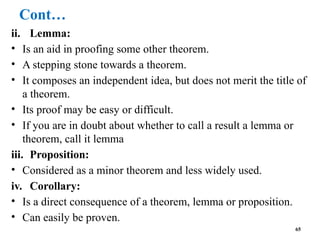
ii. Lemma:
• Isan aid in proofing some other theorem.
• A stepping stone towards a theorem.
• It composes an independent idea, but does not merit the title of
a theorem.
• Its proof may be easy or difficult.
• If you are in doubt about whether to call a result a lemma or
theorem, call it lemma
iii. Proposition:
• Considered as a minor theorem and less widely used.
iv. Corollary:
• Is a direct consequence of a theorem, lemma or proposition.
• Can easily be proven.
65
65.
Cont…
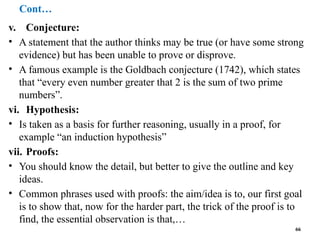
v. Conjecture:
• Astatement that the author thinks may be true (or have some strong
evidence) but has been unable to prove or disprove.
• A famous example is the Goldbach conjecture (1742), which states
that “every even number greater that 2 is the sum of two prime
numbers”.
vi. Hypothesis:
• Is taken as a basis for further reasoning, usually in a proof, for
example “an induction hypothesis”
vii. Proofs:
• You should know the detail, but better to give the outline and key
ideas.
• Common phrases used with proofs: the aim/idea is to, our first goal
is to show that, now for the harder part, the trick of the proof is to
find, the essential observation is that,…
66
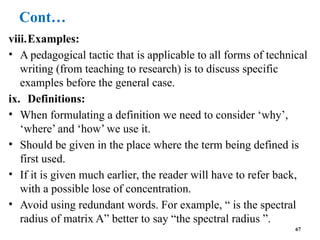
66.
Cont…
viii.Examples:
• A pedagogicaltactic that is applicable to all forms of technical
writing (from teaching to research) is to discuss specific
examples before the general case.
ix. Definitions:
• When formulating a definition we need to consider ‘why’,
‘where’ and ‘how’ we use it.
• Should be given in the place where the term being defined is
first used.
• If it is given much earlier, the reader will have to refer back,
with a possible lose of concentration.
• Avoid using redundant words. For example, “ is the spectral
radius of matrix A” better to say “the spectral radius ”.
67
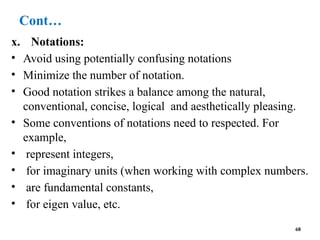
67.
Cont…
x. Notations:
• Avoidusing potentially confusing notations
• Minimize the number of notation.
• Good notation strikes a balance among the natural,
conventional, concise, logical and aesthetically pleasing.
• Some conventions of notations need to respected. For
example,
• represent integers,
• for imaginary units (when working with complex numbers.
• are fundamental constants,
• for eigen value, etc.
68
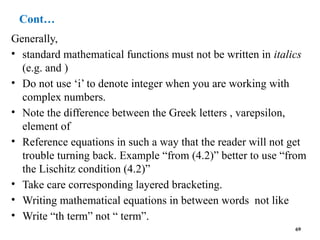
68.
Cont…
Generally,
• standard mathematicalfunctions must not be written in italics
(e.g. and )
• Do not use ‘i’ to denote integer when you are working with
complex numbers.
• Note the difference between the Greek letters , varepsilon,
element of
• Reference equations in such a way that the reader will not get
trouble turning back. Example “from (4.2)” better to use “from
the Lischitz condition (4.2)”
• Take care corresponding layered bracketing.
• Writing mathematical equations in between words not like
• Write “th term” not “ term”.
69
69.
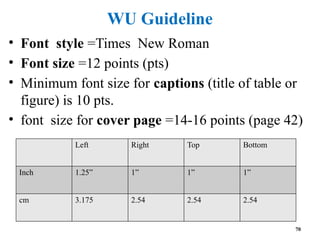
WU Guideline
• Fontstyle =Times New Roman
• Font size =12 points (pts)
• Minimum font size for captions (title of table or
figure) is 10 pts.
• font size for cover page =14-16 points (page 42)
70
Left Right Top Bottom
Inch 1.25” 1” 1” 1”
cm 3.175 2.54 2.54 2.54
70.
Cont…
Heading and subheading
•left-aligned, except chapter headings, which may be
centered.
• Heading 1,2,3
Line spacing
• For all text 1.5 points
• References single-spaced (1.0 point) with space of 5pts
after each reference
• Abstract, long quotations, headings, and captions should
be single-spaced. Multi-lined subdivision headings,
figure, table, and scheme captions, footnotes, and
endnotes should all be single-spaced as well.
71
71.
Cont…
• Page number
•All pages should be numbered except cover page
• Roman numbering (lower case) for preliminary
pages starting at (ii, iii, iv, …)
• Arabic numbering starting from ‘Introduction’ as
(1, 2, 3, …)
• Reference style=APA
• Avoid any misspelled words and grammatical
errors.
• New line equations should be centered, equation
number (if any) aligned right.
72