Introduction to Pharmacognosy: History, Sources, and Scope
Explore the scientific study of natural crude drugs, their historical milestones, sources, classifications, and modern applications in medicine, biotechnology, and herbal standardization.
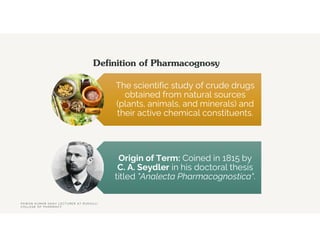
Definition of Pharmacognosy
Thescientific study of crude drugs
obtained from natural sources
(plants, animals, and minerals) and
their active chemical constituents.
Origin of Term: Coined in 1815 by
C. A. Seydler in his doctoral thesis
titled "Analecta Pharmacognostica".
P A W A N K U M A R S A H U L E C T U R E R A T R U D A U L I
C O L L E G E O F P H A R M A C Y
3.
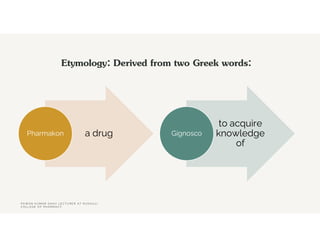
Etymology: Derived fromtwo Greek words:
a drug
Pharmakon
to acquire
knowledge
of
Gignosco
P A W A N K U M A R S A H U L E C T U R E R A T R U D A U L I
C O L L E G E O F P H A R M A C Y
4.
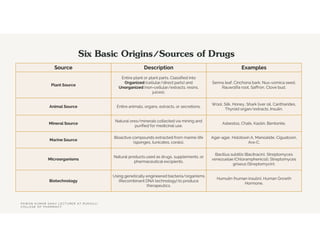
Six Basic Origins/Sourcesof Drugs
Examples
Description
Source
Senna leaf, Cinchona bark, Nux-vomica seed,
Rauwolfia root, Saffron, Clove bud.
Entire plant or plant parts. Classified into
Organized (cellular/direct parts) and
Unorganized (non-cellular/extracts, resins,
juices).
Plant Source
Wool, Silk, Honey, Shark liver oil, Cantharides,
Thyroid organ/extracts, Insulin.
Entire animals, organs, extracts, or secretions.
Animal Source
Asbestos, Chalk, Kaolin, Bentonite.
Natural ores/minerals collected via mining and
purified for medicinal use.
Mineral Source
Agar-agar, Holotoxin A, Manoalide, Ciguatoxin,
Ara-C.
Bioactive compounds extracted from marine life
(sponges, tunicates, corals).
Marine Source
Bacillus subtilis (Bacitracin), Streptomyces
venezuelae (Chloramphenicol), Streptomyces
griseus (Streptomycin).
Natural products used as drugs, supplements, or
pharmaceutical excipients.
Microorganisms
Humulin (human insulin), Human Growth
Hormone.
Using genetically engineered bacteria/organisms
(Recombinant DNA technology) to produce
therapeutics.
Biotechnology
P A W A N K U M A R S A H U L E C T U R E R A T R U D A U L I
C O L L E G E O F P H A R M A C Y
5.
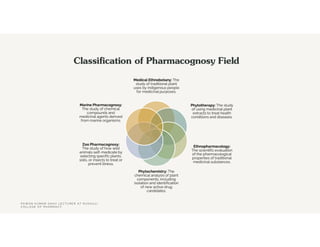
Classification of PharmacognosyField
Medical Ethnobotany: The
study of traditional plant
uses by indigenous people
for medicinal purposes.
Phytotherapy: The study
of using medicinal plant
extracts to treat health
conditions and diseases.
Ethnopharmacology:
The scientific evaluation
of the pharmacological
properties of traditional
medicinal substances.
Phytochemistry: The
chemical analysis of plant
components, including
isolation and identification
of new active drug
candidates.
Zoo Pharmacognosy:
The study of how wild
animals self-medicate by
selecting specific plants,
soils, or insects to treat or
prevent illness.
Marine Pharmacognosy:
The study of chemical
compounds and
medicinal agents derived
from marine organisms.
P A W A N K U M A R S A H U L E C T U R E R A T R U D A U L I
C O L L E G E O F P H A R M A C Y
6.
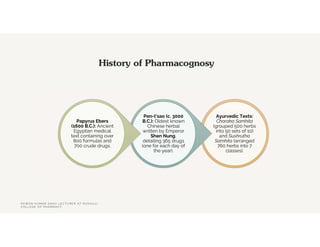
History of Pharmacognosy
AyurvedicTexts:
Charaka Samhita
(grouped 500 herbs
into 50 sets of 10)
and Sushrutha
Samhita (arranged
760 herbs into 7
classes).
Pen-t'sao (c. 3000
B.C.): Oldest known
Chinese herbal
written by Emperor
Shen Nung,
detailing 365 drugs
(one for each day of
the year).
Papyrus Ebers
(1600 B.C.): Ancient
Egyptian medical
text containing over
800 formulas and
700 crude drugs.
P A W A N K U M A R S A H U L E C T U R E R A T R U D A U L I
C O L L E G E O F P H A R M A C Y
7.
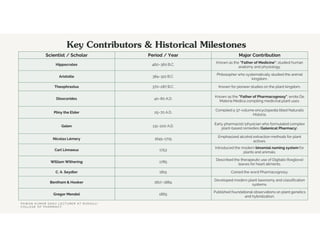
Key Contributors &Historical Milestones
Major Contribution
Period / Year
Scientist / Scholar
Known as the "Father of Medicine"; studied human
anatomy and physiology.
460–360 B.C.
Hippocrates
Philosopher who systematically studied the animal
kingdom.
384–322 B.C.
Aristotle
Known for pioneer studies on the plant kingdom.
370–287 B.C.
Theophrastus
Known as the "Father of Pharmacognosy"; wrote De
Materia Medica compiling medicinal plant uses.
40–80 A.D.
Dioscorides
Compiled a 37-volume encyclopedia titled Naturalis
Historia.
25–70 A.D.
Pliny the Elder
Early pharmacist/physician who formulated complex
plant-based remedies (Galenical Pharmacy).
131–200 A.D.
Galen
Emphasized alcohol extraction methods for plant
actives.
1645–1715
Nicolas Lémery
Introduced the modern binomial naming system for
plants and animals.
1753
Carl Linnaeus
Described the therapeutic use of Digitalis (foxglove)
leaves for heart ailments.
1785
William Withering
Coined the word Pharmacognosy.
1815
C. A. Seydler
Developed modern plant taxonomy and classification
systems.
1817–1884
Bentham & Hooker
Published foundational observations on plant genetics
and hybridization.
1865
Gregor Mendel
P A W A N K U M A R S A H U L E C T U R E R A T R U D A U L I
C O L L E G E O F P H A R M A C Y
8.
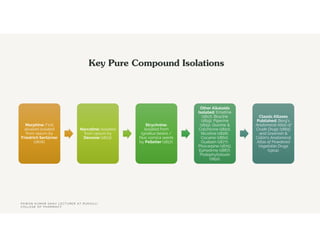
Key Pure CompoundIsolations
Morphine: First
alkaloid isolated
from opium by
Friedrich Sertürner
(1806).
Narcotine: Isolated
from opium by
Derosne (1803).
Strychnine:
Isolated from
Ignatius beans /
Nux vomica seeds
by Pelletier (1817).
Other Alkaloids
Isolated: Emetine
(1817), Brucine
(1819), Piperine
(1819), Quinine &
Colchicine (1820),
Nicotine (1828),
Cocaine (1860),
Ouabain (1877),
Pilocarpine (1875),
Ephedrine (1887),
Podophyllotoxin
(1891).
Classic Atlases
Published: Berg's
Anatomical Atlas of
Crude Drugs (1865)
and Greenish &
Collin's Anatomical
Atlas of Powdered
Vegetable Drugs
(1904).
P A W A N K U M A R S A H U L E C T U R E R A T R U D A U L I
C O L L E G E O F P H A R M A C Y
9.
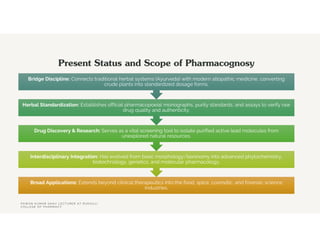
Present Status andScope of Pharmacognosy
Broad Applications: Extends beyond clinical therapeutics into the food, spice, cosmetic, and forensic science
industries.
Interdisciplinary Integration: Has evolved from basic morphology/taxonomy into advanced phytochemistry,
biotechnology, genetics, and molecular pharmacology.
Drug Discovery & Research: Serves as a vital screening tool to isolate purified active lead molecules from
unexplored natural resources.
Herbal Standardization: Establishes official pharmacopoeial monographs, purity standards, and assays to verify raw
drug quality and authenticity.
Bridge Discipline: Connects traditional herbal systems (Ayurveda) with modern allopathic medicine, converting
crude plants into standardized dosage forms.
P A W A N K U M A R S A H U L E C T U R E R A T R U D A U L I
C O L L E G E O F P H A R M A C Y
10.
THANK
YOU
P A WA N K U M A R S A H U L E C T U R E R A T R U D A U L I
C O L L E G E O F P H A R M A C Y