Comprehensive Introduction to Industrial Materials and Manufacturing Processes
Explore the fundamentals of industrial materials, manufacturing systems, product development, and machining processes essential for engineering and production optimization.
Comprehensive Introduction to Industrial Materials and Manufacturing Processes
1.
Introduction to Industrial
Materialsand Processes
University of Santo Tomas
Industrial Engineering Department
Faculty of Engineering
…requires a sound and broad understanding of materials, processes, and
equipment on the part of the decision makers,
…accompanied by an understanding of the manufacturing systems
2.
Learning Objectives
Describethe course of Industrial Materials and
Processes as a scientific discipline
Understand and appreciate the challenges and
complexities involved in the design and
construction of a product (all major classes of
materials)
Introduce the broad spectrum of manufacturing
processes to individual who will be involved in
the design and manufacture of finished products
3.
Learning Objectives
Providea good theoretical background and a
sound practical knowledge to the engineering
students
Be aware of the following terms for better
understanding of the scope of the study
4.
Introduction
All ofus live in a world of dynamic change,
and materials are no exception.
The advancement of civilization has
historically depended on the improvement of
materials to work with.
Over time, they moved from the materials Stone
Age into the newer Copper (Bronze) and Iron Ages.
Today’s competitive manufacturing era of high
industrial development and research, is being
5.
Introduction
called the ageof mechanization, automation and
computer integrated manufacturing.
Manufacturing is the backbone of any
industrialized nation.
Since products require materials, engineers should
be knowledgeable about the internal structure and
properties of materials so that they can choose the
most suitable ones for each application and develop
the best processing methods.
6.
History of Materials
The development of materials and man’s
ability to process them is linked to the history
of man
Stone Age
Copper and Bronze Age
Iron Age
Steel Age
The current age is that of plastics, composite
materials, and exotic alloys
7.
Introduction
Manufacturing andtechnical staff in industry
must know the various manufacturing
processes, materials being processed, tools
and equipment for manufacturing different
components or products with optimal process
plan using proper precautions and specified
safety rules to avoid accidents.
8.
Introduction
Future engineersmust know the basic
requirements of manufacturing activities in
terms of man, machine, material, methods,
money and other infrastructure facilities
needed to be positioned properly for optimal
shop layouts or plant layout and other
support services effectively adjusted or
located in the industry or plant within a well
planned manufacturing organization.
9.
Introduction
In manycases what was impossible
yesterday is a reality today!
Thirty years ago, many people would not have
believed that some day computers would become
a common household item similar to a telephone
or a refrigerator.
And today, we still find it hard to believe that some
day space travel will be commercialized and we
may even colonize Mars.
New Researchers inthe
Manufacturing Field
The advancement has come to this extent
that every different aspect of this technology
has become a full-fledged fundamental and
advanced study in itself.
This has led to introduction of optimized design
and manufacturing of new products.
New developments in manufacturing areas are
deciding to transfer more skill to the machines for
considerably reduction of manual labor.
12.
New Researchers inthe
Manufacturing Field
It specifies the need of greater care for man,
machine, material and other equipment involving
higher initial investment by using proper safety
rule and precautions.
13.
Materials, Manufacturing, andthe
Standard of Living
Standard of living of a society is determined
by the goods and services that are available
to its people
Manufactured goods
Producer goods:
Intermediate goods used to manufacture either producer
or consumer goods
Consumer goods:
Purchased directly by the consumer
14.
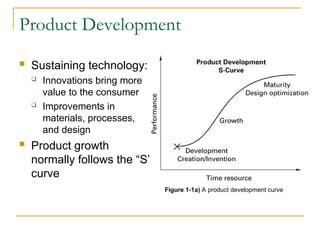
Product Development
Sustainingtechnology:
Innovations bring more
value to the consumer
Improvements in
materials, processes,
and design
Product growth
normally follows the “S”
curve
Figure 1-1a) A product development curve
15.
Simplified Steps ofthe Product Life Cycle
Start up—new product or new company, low
volume, small company
Rapid Growth—products become
standardized and volume increases rapidly.
Company’s ability to meet demand stresses
its capacity
Maturation—standard designs emerge.
Process development is very important.
16.
Simplified Steps ofthe Product Life Cycle
Commodity or Declined
Commodity—long-life, standard-of-the-industry
type of product or
Decline—product is slowly replaced by improved
products
17.
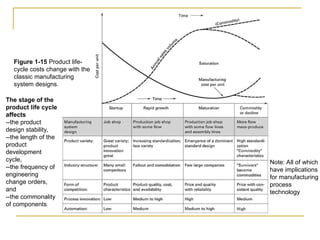
Figure 1-15 Productlife-
cycle costs change with the
classic manufacturing
system designs.
The stage of the
product life cycle
affects
--the product
design stability,
--the length of the
product
development
cycle,
--the frequency of
engineering
change orders,
and
--the commonality
of components
Note: All of which
have implications
for manufacturing
process
technology
18.
Interactive Factors inManufacturing
Factors
Product design
Materials
Labor costs
Equipment
Manufacturing costs
Strategies to reduce
cost
Lean manufacturing
Systems approach
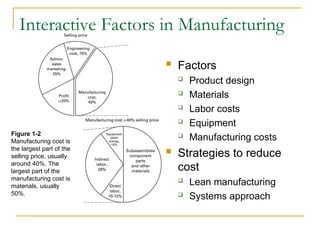
Figure 1-2
Manufacturing cost is
the largest part of the
selling price, usually
around 40%. The
largest part of the
manufacturing cost is
materials, usually
50%.
19.
Materials and Processes
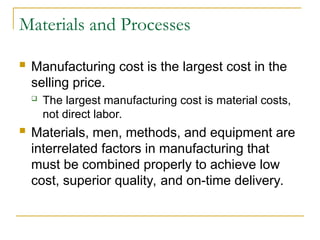
Manufacturing cost is the largest cost in the
selling price.
The largest manufacturing cost is material costs,
not direct labor.
Materials, men, methods, and equipment are
interrelated factors in manufacturing that
must be combined properly to achieve low
cost, superior quality, and on-time delivery.
20.
Materials and Processes
Materials to be used must be selected and
specified to meet the design engineer’s
requirements.
Must have a broad knowledge of manufacturing
processes and of material behavior so that
desired operations can be done effectively and
efficiently without overloading or damaging
machines and without adversely affecting the
materials being processed
21.
Materials and Processes
The elements of design, materials, and
processes are closely related, each having its
effect on the others.
A design change would have a significant impact
on the entire manufacturing process and on the
cost.
Key to Success: To build a Manufacturing
system that can deliver on time to the customer,
superior- quality goods at the lowest possible
cost in a flexible way.
22.
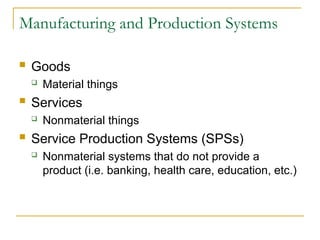
Manufacturing and ProductionSystems
Goods
Material things
Services
Nonmaterial things
Service Production Systems (SPSs)
Nonmaterial systems that do not provide a
product (i.e. banking, health care, education, etc.)
23.
Manufacturing and ProductionSystems
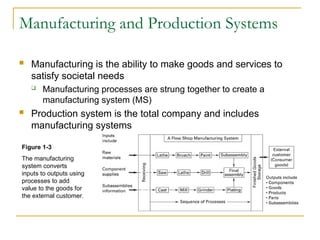
Manufacturing is the ability to make goods and services to
satisfy societal needs
Manufacturing processes are strung together to create a
manufacturing system (MS)
Production system is the total company and includes
manufacturing systems
Figure 1-3
The manufacturing
system converts
inputs to outputs using
processes to add
value to the goods for
the external customer.
24.
Manufacturing and ProductionSystems
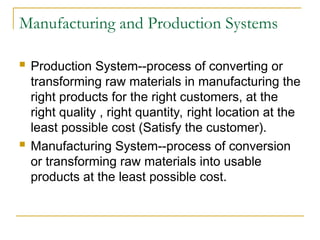
Production System--process of converting or
transforming raw materials in manufacturing the
right products for the right customers, at the
right quality , right quantity, right location at the
least possible cost (Satisfy the customer).
Manufacturing System--process of conversion
or transforming raw materials into usable
products at the least possible cost.
25.
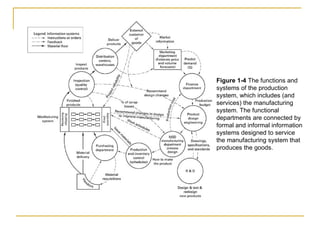
Figure 1-4 Thefunctions and
systems of the production
system, which includes (and
services) the manufacturing
system. The functional
departments are connected by
formal and informal information
systems designed to service
the manufacturing system that
produces the goods.
26.
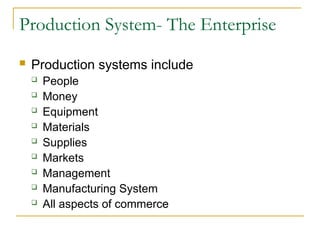
Production System- TheEnterprise
Production systems include
People
Money
Equipment
Materials
Supplies
Markets
Management
Manufacturing System
All aspects of commerce
27.
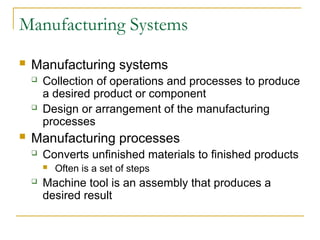
Manufacturing Systems
Manufacturingsystems
Collection of operations and processes to produce
a desired product or component
Design or arrangement of the manufacturing
processes
Manufacturing processes
Converts unfinished materials to finished products
Often is a set of steps
Machine tool is an assembly that produces a
desired result
28.
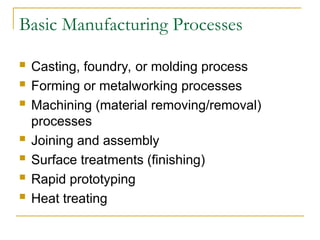
Basic Manufacturing Processes
Casting, foundry, or molding process
Forming or metalworking processes
Machining (material removing/removal)
processes
Joining and assembly
Surface treatments (finishing)
Rapid prototyping
Heat treating
Common Aspects ofManufacturing
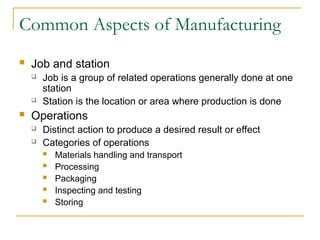
Job and station
Job is a group of related operations generally done at one
station
Station is the location or area where production is done
Operations
Distinct action to produce a desired result or effect
Categories of operations
Materials handling and transport
Processing
Packaging
Inspecting and testing
Storing
32.
Common Aspects ofManufacturing
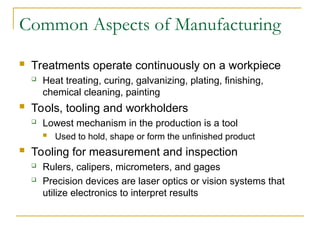
Treatments operate continuously on a workpiece
Heat treating, curing, galvanizing, plating, finishing,
chemical cleaning, painting
Tools, tooling and workholders
Lowest mechanism in the production is a tool
Used to hold, shape or form the unfinished product
Tooling for measurement and inspection
Rulers, calipers, micrometers, and gages
Precision devices are laser optics or vision systems that
utilize electronics to interpret results
33.
Products and Fabrications
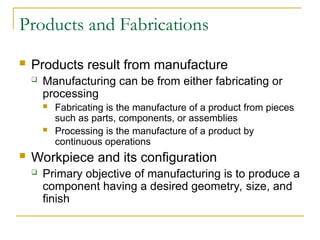
Products result from manufacture
Manufacturing can be from either fabricating or
processing
Fabricating is the manufacture of a product from pieces
such as parts, components, or assemblies
Processing is the manufacture of a product by
continuous operations
Workpiece and its configuration
Primary objective of manufacturing is to produce a
component having a desired geometry, size, and
finish
34.
Roles of Engineersin Manufacturing
Design engineer responsibilities
What the design is to accomplish
Assumptions that can be made
Service environments the product must withstand
Final appearance of the product
Product designed with the knowledge that certain
manufacturing processes will be used
35.
Roles of Engineersin Manufacturing
Manufacturing engineer responsibilities
Select and coordinate specific processes and
equipment
Supervise and manage their use
Industrial (Manufacturing) engineer
Manufacturing systems layout
Materials engineers
Specify ideal materials
Develop new and better materials
36.
3 Major Changesin the World of
Goods Manufacturing
Worldwide or global competition
Advanced technology
New manufacturing systems structure,
strategies, and management
37.
Changing World Competition
Globalization has impacted manufacturing
Worldwide competition for global products and
their manufacture
High tech manufacturing for advanced technology
New manufacturing systems, designs, and
management
38.
Manufacturing Systems Designs
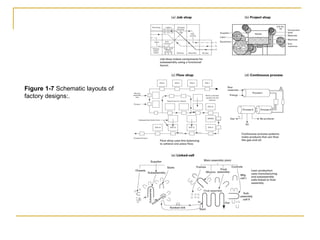
Job shop is characterized by large varieties
of components, general-purpose machines,
and a functional layout.
Machines are collected by function.
Material is moved from machine to machine in
carts or containers and is called the lot or batch.
To be the least cost-efficient of all the systems
because of its design
39.
Manufacturing Systems Designs
Flow shop are characterized by larger
volumes of the same part or assembly,
special-purpose machines and equipment,
less variety, less flexibility, and more
mechanization.
Common light bulb
A transfer line producing an engine block
If interrupted, the line manufactures large lots but is
periodically “changed over” to run a similar but
different component.
40.
Manufacturing Systems Designs
Linked-cell shop is composed of
manufacturing and subassembly cells
connected to final assembly (linked) using a
unique form of inventory and information
control called Kanban.
Used in lean production systems where
manufacturing processes and subassemblies are
restructured into U-shaped cells so they can
operate on a one-piece-flow basis, like final
assembly.
41.
Manufacturing Systems Designs
Project shop is characterized by the
immobility of the item being manufactured.
In the construction industry, bridges and roads
In the manufacture of goods, large airplanes,
ships, large machine tools, and locomotives
Workers, machines, and materials come to the
site
Job shop usually supplies parts and
subassemblies to the project shop in small lots.
42.
Manufacturing Systems Designs
Continuous process are used to manufacture
liquids, oils, gases, and powders.
Usually large plants producing goods for other
producers or mass-producing canned or bottled
goods for consumers.
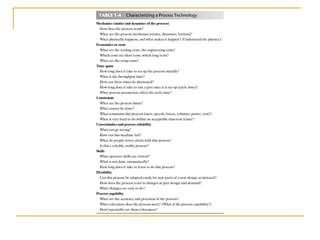
Characteristics of ProcessTechnology
Mechanics (static or dynamic)
Economics or costs
Time Spans
Constraints
Uncertainties and process reliability
Skills
Flexibility
Process capability
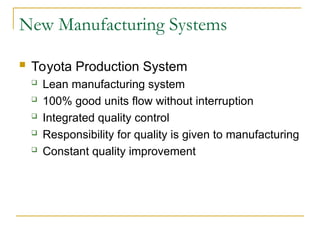
47.
New Manufacturing Systems
Toyota Production System
Lean manufacturing system
100% good units flow without interruption
Integrated quality control
Responsibility for quality is given to manufacturing
Constant quality improvement
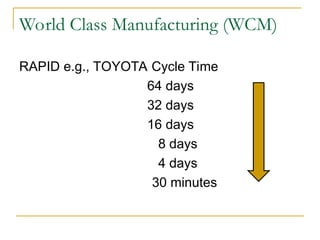
48.
World Class Manufacturing(WCM)
RAPID e.g., TOYOTA Cycle Time
64 days
32 days
16 days
8 days
4 days
30 minutes
49.
World Class Manufacturing(WCM)
Is it a Philosophy?
Concept?
System?
Method?
Techniques?
Tool?
50.
World Class Manufacturing(WCM)
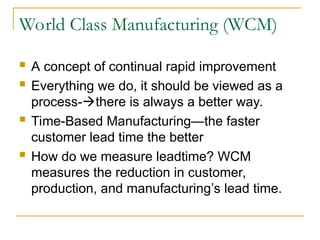
A concept of continual rapid improvement
Everything we do, it should be viewed as a
process-there is always a better way.
Time-Based Manufacturing—the faster
customer lead time the better
How do we measure leadtime? WCM
measures the reduction in customer,
production, and manufacturing’s lead time.
51.
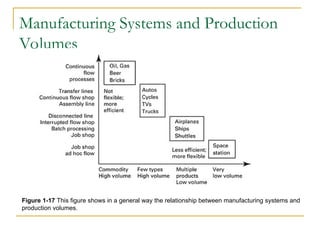
Figure 1-17 Thisfigure shows in a general way the relationship between manufacturing systems and
production volumes.
Manufacturing Systems and Production
Volumes
52.
5 Major Dimensions
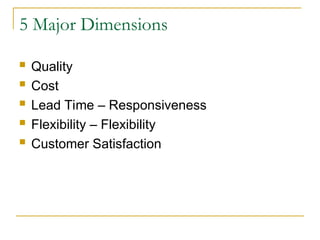
Quality
Cost
Lead Time – Responsiveness
Flexibility – Flexibility
Customer Satisfaction
53.
Summary
Economical andsuccessful manufacturing
requires knowledge of the relationships
between labor, materials, and capital
Design a manufacturing system that
everyone understands
Engineers must possess a knowledge of
design, metallurgy, processing, economics,
accounting, and human relations
54.
Summary
Giving agreat deal of attention to design,
selection of materials, selection of processes,
selection of equipment used for
manufacturing (tooling), and utilization of
personnel could such a result be achieved
55.
Back Up
University ofSanto Tomas
Industrial Engineering Department
Faculty of Engineering
#2 By the end of this teaching, students will be able to . . .
All major classes of materials including metals, polymers, ceramics, composites, and electronic are used in the structure of a product.
#5 The production and processing of materials into finished goods constitutes a large part of our present economy.
To match the properties of a material to the service requirements of a component….
#7 To match the properties of a material to the service requirements of a component….
#11 Due to new researches in the manufacturing field…….
#13 Intermediate good. Intermediate goods or producer goods or semi-finished products are goods , such as partly finished goods, used as inputs in the production of other goods including final goods. A firm may make and then use intermediate goods, or make and then sell, or buy then use them (e.g., machinery, raw materials, etc.,).
Consumer goods include household appliances, cleaning products, food, furniture and electronics. The number of consumer goods is potentially infinite and growing, as any good that a person buys for household use or consumption qualifies. Consumer goods are typically categorized as durable or nondurable.
Common examples of consumer durable goods are automobiles, furniture, household appliances, and mobile homes. (See also capital.) Consumer nondurable goods are purchased for immediate or almost immediate consumption and have a life span ranging from minutes to three years.
#14 Product life-cycle concept provides a framework for thinking about the product’s evolution through time and the kind of market segments that are likely to develop at various time.
#15 The maturation of a product in the marketplace generally leads to fewer competitors, with competition based more on price and on-time delivery than on unique product features.
#17 The stage of the product life cycle affects
the product design stability,
the length of the product development cycle,
the frequency of engineering change orders,
and the commonality of components
--all of which have implications for manufacturing process technology
#22 Types of Service Industries: Advertising and Marketing, Communication (telephone, computer networks), Education, Entertainment (radio, TV, movies, plays), Equipment and furniture rental, Financial (banks, investment companies, loan companies), Health care, Insurance, Transportation and car rental, Travel (hotel, motel, cruise lines)
#26 Production System; the enterprise—all aspects of workers, machines, and information, considered collectively, needed to manufacture parts or products; integration of all units of the system is critical.
#27 Manufacturing System (sequence of operations, collection of processes or factory)—the collection of manufacturing processes and operations resulting in specific end products; an arrangement or layout of many processes, materials-handling equipment, and operators (e.g., a series of connected operations or processes, a job shop, a flow shop, and a continuous process)
Machine or machine tool or manufacturing process—a specific piece of equipment designed to accomplish specific processes, often called a machine tool; machine tools linked together to make a manufacturing systems (spot welding, milling machine, lathe, drill press, forge, drop hammer, die caster, punch press, grinder, etc.,).
#31 Job (sometimes called a station; a collection of tasks)—a collection of operations done on machines or a collection of tasks performed by one worker at one location on the assembly line.
Operation (sometimes called a process) – a specific action or treatment, often done on a machine, the collection of which makes up the job of a worker.
#32 Tools or tooling refers to the implements used to hold, cut, shape, or deform the work materials:
called cutting tools if referring to machining
Can refer to jigs and fixtures in workholding and punches and dies in metal forming
#50 Customer Oder ----- Customer Receipt =Customer Lead Time
Customer Lead Time = Actual Manufacturing Time + Wastes (Queue Times)
#52 As the competitive focus shifts during the different stages of the product cycle, the requirements placed on manufacturing—cost, quality, flexibility, and delivery dependability –also change.