Comprehensive Introduction to Gardening and Landscaping: History, Types, and Aesthetic Values
Explore the history, types, aesthetic principles, and significance of gardening and landscaping, with a focus on Nepal's gardens and career opportunities in ornamental horticulture.
Comprehensive Introduction to Gardening and Landscaping: History, Types, and Aesthetic Values
1.
Introduction to gardeningand landscaping:
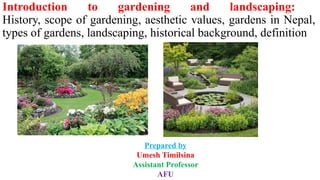
History, scope of gardening, aesthetic values, gardens in Nepal,
types of gardens, landscaping, historical background, definition
Prepared by
Umesh Timilsina
Assistant Professor
AFU
2.
Introduction
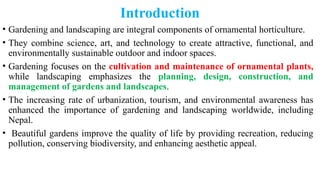
• Gardening andlandscaping are integral components of ornamental horticulture.
• They combine science, art, and technology to create attractive, functional, and
environmentally sustainable outdoor and indoor spaces.
• Gardening focuses on the cultivation and maintenance of ornamental plants,
while landscaping emphasizes the planning, design, construction, and
management of gardens and landscapes.
• The increasing rate of urbanization, tourism, and environmental awareness has
enhanced the importance of gardening and landscaping worldwide, including
Nepal.
• Beautiful gardens improve the quality of life by providing recreation, reducing
pollution, conserving biodiversity, and enhancing aesthetic appeal.
3.
Gardening
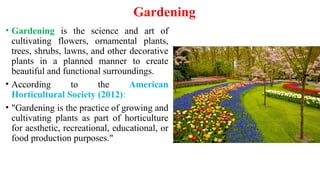
• Gardening isthe science and art of
cultivating flowers, ornamental plants,
trees, shrubs, lawns, and other decorative
plants in a planned manner to create
beautiful and functional surroundings.
• According to the American
Horticultural Society (2012):
• "Gardening is the practice of growing and
cultivating plants as part of horticulture
for aesthetic, recreational, educational, or
food production purposes."
4.
Objectives of Gardening
Beautificationof homes and public places
Environmental protection
Recreation and relaxation
Conservation of biodiversity
Educational and research purposes
Commercial production of ornamental plants
Improvement of physical and mental well-being
5.
Importance of Gardening
1.Environmental Importance
• Gardens help to:
Improve air quality
Produce oxygen
Reduce carbon dioxide
Reduce dust pollution
Reduce noise pollution
Moderate urban temperature
Prevent soil erosion
6.
2. Social Importance
•Gardens are used for:
Public recreation
Religious activities
Community gatherings
Educational purposes
3. Economic Importance
Gardening supports:
Nursery business
Landscaping companies
Floriculture enterprises
Tourism industry
Employment generation
4. Health Benefits
• Scientific studies indicate that gardening:
Reduces stress
Improves mental health
Encourages physical activity
Promotes relaxation
Enhances overall well-being
7.
History of Gardening
•Gardening has evolved over thousands of years.
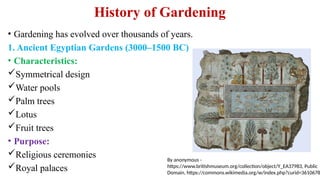
1. Ancient Egyptian Gardens (3000–1500 BC)
• Characteristics:
Symmetrical design
Water pools
Palm trees
Lotus
Fruit trees
• Purpose:
Religious ceremonies
Royal palaces
By anonymous -
https://www.britishmuseum.org/collection/object/Y_EA37983, Public
Domain, https://commons.wikimedia.org/w/index.php?curid=3610678
8.
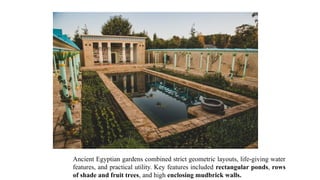
Ancient Egyptian gardenscombined strict geometric layouts, life-giving water
features, and practical utility. Key features included rectangular ponds, rows
of shade and fruit trees, and high enclosing mudbrick walls.
9.
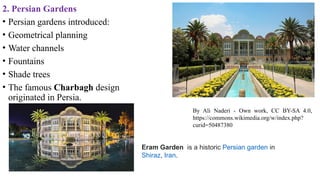
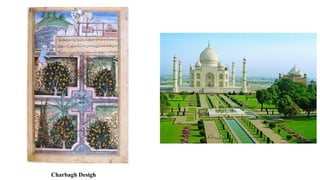
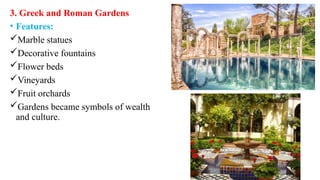
2. Persian Gardens
•Persian gardens introduced:
• Geometrical planning
• Water channels
• Fountains
• Shade trees
• The famous Charbagh design
originated in Persia.
By Ali Naderi - Own work, CC BY-SA 4.0,
https://commons.wikimedia.org/w/index.php?
curid=50487380
Eram Garden is a historic Persian garden in
Shiraz, Iran.
Scope of Gardening
•The scope of gardening has expanded significantly due to urbanization and
environmental concerns.
• Major areas include:
1. Residential Gardening
• Home gardens
• Kitchen gardens
• Roof gardens
• Balcony gardens
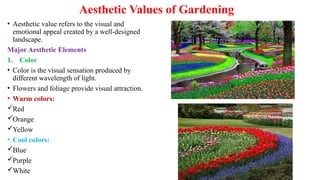
Aesthetic Values ofGardening
• Aesthetic value refers to the visual and
emotional appeal created by a well-designed
landscape.
Major Aesthetic Elements
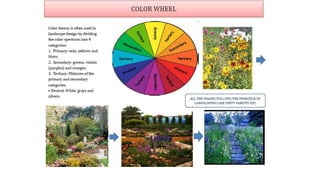
1. Color
• Color is the visual sensation produced by
different wavelength of light.
• Flowers and foliage provide visual attraction.
• Warm colors:
Red
Orange
Yellow
• Cool colors:
Blue
Purple
White
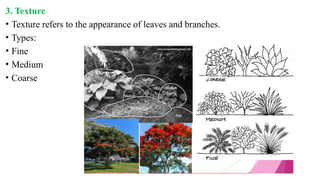
3. Texture
• Texturerefers to the appearance of leaves and branches.
• Types:
• Fine
• Medium
• Coarse
32.
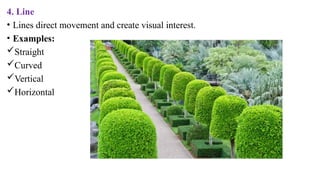
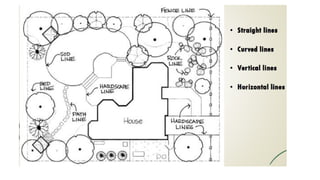
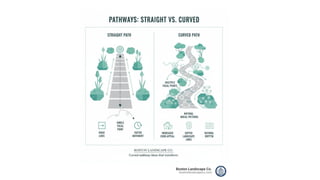
4. Line
• Linesdirect movement and create visual interest.
• Examples:
Straight
Curved
Vertical
Horizontal
35.
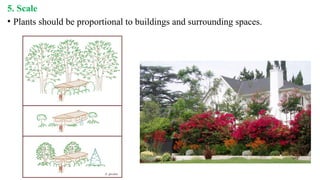
5. Scale
• Plantsshould be proportional to buildings and surrounding spaces.
36.
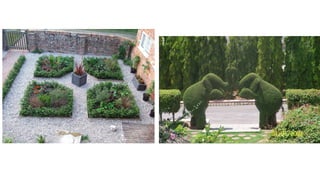
6. Balance
• Thebalance in landscape design is visual equilibrium of different garden
elements.
• The exact duplication of what is on right on the left imposes a balance.
• The balance should be colourwise, texture wise and shape wise.
• Trees as an avenue on one side will not make a balance.
• Two types:
Symmetrical balance
Asymmetrical balance
38.
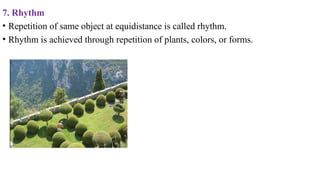
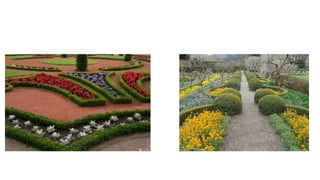
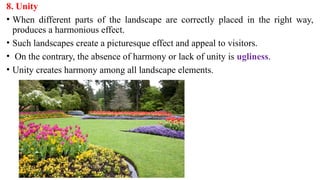
7. Rhythm
• Repetitionof same object at equidistance is called rhythm.
• Rhythm is achieved through repetition of plants, colors, or forms.
40.
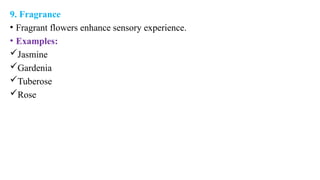
8. Unity
• Whendifferent parts of the landscape are correctly placed in the right way,
produces a harmonious effect.
• Such landscapes create a picturesque effect and appeal to visitors.
• On the contrary, the absence of harmony or lack of unity is ugliness.
• Unity creates harmony among all landscape elements.
Gardens in Nepal
•Nepal possesses diverse climatic conditions ranging from tropical to alpine
regions, allowing cultivation of a wide range of ornamental plants.
• Importance
• Gardens in Nepal contribute to:
Tourism promotion
Urban beautification
Biodiversity conservation
Environmental protection
Recreation
Education
43.
Major Gardens ofNepal
1. National Botanical Garden, Godawari (Lalitpur)
Established in 1962.
Managed by the Department of Plant Resources.
Conserves native and exotic plant species.
Supports research, education, and ecotourism.
2. Garden of Dreams (Kathmandu)
Historic neo-classical garden built in the 1920s.
Features pavilions, fountains, pergolas, and ornamental plantings.
Popular cultural and recreational site.
44.
3. Tribhuvan Park(Thankot)
Public recreational park.
Ornamental landscapes.
Picnic destination.
4. Regional Botanical Gardens
• Located in different ecological zones for conservation, education, and research.
45.
Types of Gardens
•Gardens may be classified based on design, purpose, or location.
A. Based on Design
1. Formal Garden
• Characteristics:
Symmetrical layout
Straight paths
Geometrical flower beds
Trimmed hedges
Fountains
Examples:
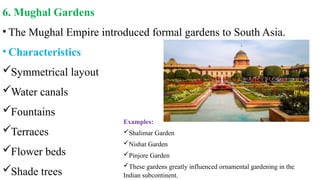
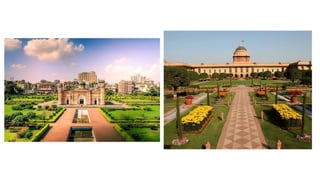
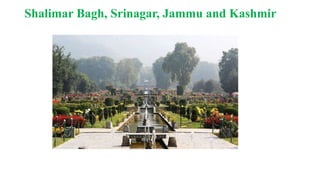
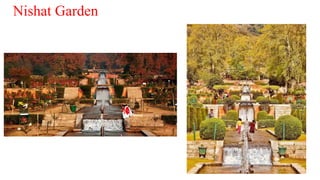
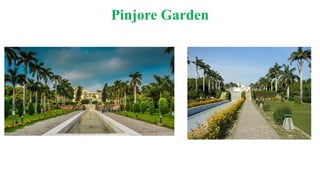
Mughal gardens,
Persian garden,
French garden,
Italian garden
Roman and Greek garden
Advantages:
Elegant appearance
Easy maintenance
Suitable for public institutions
46.
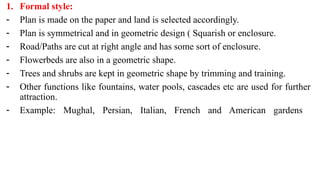
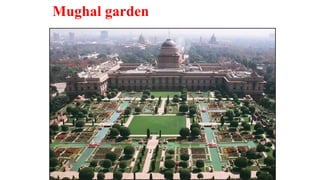
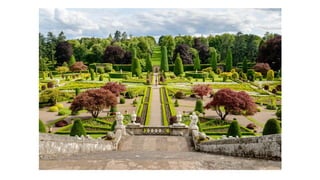
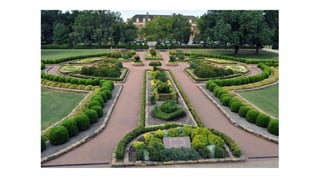
1. Formal style:
-Plan is made on the paper and land is selected accordingly.
- Plan is symmetrical and in geometric design ( Squarish or enclosure.
- Road/Paths are cut at right angle and has some sort of enclosure.
- Flowerbeds are also in a geometric shape.
- Trees and shrubs are kept in geometric shape by trimming and training.
- Other functions like fountains, water pools, cascades etc are used for further
attraction.
- Example: Mughal, Persian, Italian, French and American gardens
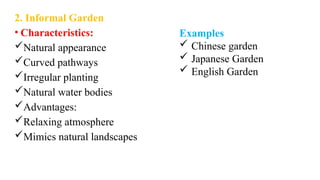
2. Informal Garden
•Characteristics:
Natural appearance
Curved pathways
Irregular planting
Natural water bodies
Advantages:
Relaxing atmosphere
Mimics natural landscapes
Examples
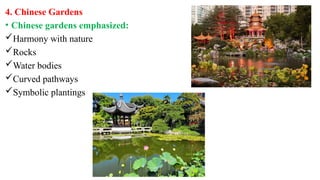
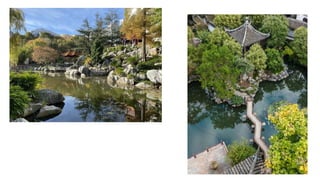
Chinese garden
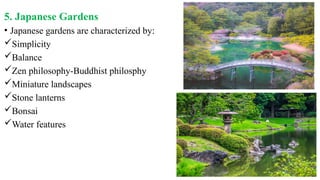
Japanese Garden
English Garden
51.
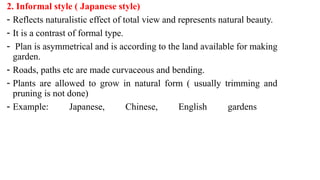
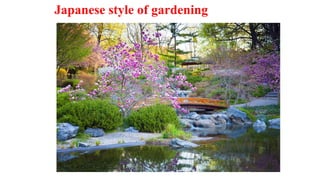
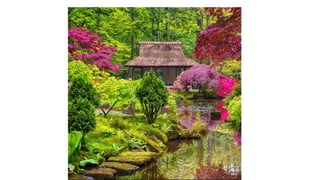
2. Informal style( Japanese style)
- Reflects naturalistic effect of total view and represents natural beauty.
- It is a contrast of formal type.
- Plan is asymmetrical and is according to the land available for making
garden.
- Roads, paths etc are made curvaceous and bending.
- Plants are allowed to grow in natural form ( usually trimming and
pruning is not done)
- Example: Japanese, Chinese, English gardens
3. Mixed Garden
•Combination of formal and informal styles.
Common in:
Residential gardens
Public parks
55.
B. Based onPurpose
• Residential gardens
• Public gardens
• Botanical gardens
• Rock gardens
• Water gardens
• Roof gardens
• Terrace gardens
• Vertical gardens
• Children's gardens
• Memorial gardens
• Butterfly gardens
• Herbal gardens
• Cactus gardens
56.
Landscaping
• Landscaping isthe science and art of planning, designing, constructing, and
maintaining outdoor spaces using plants and structural elements to create
aesthetically pleasing, functional, and environmentally sustainable landscapes.
• According to Booth (1983):
• "Landscape design is the art and science of arranging land, plants, water, and
structures for human use and enjoyment."
57.
Objectives of Landscaping
•Beautification
• Environmental conservation
• Functional land use
• Recreation
• Privacy
• Shade
• Soil conservation
• Urban improvement
58.
Components of Landscaping
A.Softscape
• Living components:
Trees
Shrubs
Lawns
Climbers
Flowers
Ground covers
Benefits of Landscaping
•Increases property value.
• Reduces urban heat island effects.
• Improves air quality.
• Enhances biodiversity.
• Conserves soil and water.
• Creates recreational spaces.
• Improves psychological well-being.
61.
Summary
• Gardening isthe cultivation and maintenance of ornamental plants for beauty,
recreation, and environmental benefits.
• Landscaping integrates plants with structural elements to create functional and
aesthetically pleasing environments.
• Gardening has evolved from ancient civilizations, including Egyptian, Persian,
Chinese, Japanese, and Mughal traditions.
• Nepal has excellent potential for ornamental gardening due to its diverse climate
and rich plant biodiversity.
• Gardens can be classified as formal, informal, mixed, residential, botanical, rock,
water, roof, terrace, butterfly, herbal, and public gardens.
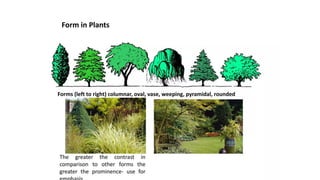
• Aesthetic principles such as color, form, texture, line, balance, rhythm, and unity
are fundamental in successful garden design.
62.
Important Questions
Short Questions
•Define gardening and landscaping.
• State the objectives of gardening.
• What are the aesthetic values of gardening?
• Differentiate between formal and informal gardens.
• Name four important gardens in Nepal.
• What are the major components of landscaping?
Long Questions
• Explain the history and development of gardening from ancient civilizations to modern times.
• Discuss the scope and importance of gardening in Nepal.
• Describe the different types of gardens with suitable examples.
• Define landscaping and explain its objectives, components, and benefits.
• Discuss the role of aesthetic principles in creating attractive and functional gardens.
63.
References
• American HorticulturalSociety. (2012). American Horticultural Society
Encyclopedia of Gardening. DK Publishing.
• Bhattacharjee, S. K. (2012). Advances in Ornamental Horticulture (Vols. 1–6).
Pointer Publishers.
• Bose, T. K., Maiti, R. G., Dhua, R. S., & Das, P. (2003). Floriculture and
Landscaping. Naya Udyog.
• Booth, N. K. (1983). Basic Elements of Landscape Architectural Design.
Waveland Press.
• Chadha, K. L. (Ed.). (2001). Handbook of Horticulture. Indian Council of
Agricultural Research (ICAR).
• Government of Nepal, Department of Plant Resources. (Latest edition). Flora of
Nepal and publications on the National Botanical Garden, Godawari.