Comprehensive Introduction to Family and Reproductive Health Concepts
Explore definitions, components, characteristics, and determinants of family health alongside reproductive health principles, strategies, and services in Ethiopia for improved well-being.
Comprehensive Introduction to Family and Reproductive Health Concepts
1.
By: Firehiwot H.(MPH RH)
Nov, 2022
Introduction to Family
Health
2.
Learning Objectives
At theend of this session the student is expected to:
Define family and family health
List and discuss the major components of family health
Discuss the characteristics of healthy family
Discuss importance of family health
Discuss the determinants of family health
3.
Definition of Family
Whatis family?
A group of two or more persons related by birth, marriage,
or adoption and residing together in a household
It is a smallest social unit
A basic structure of society centered about replacement
Every family is unique and it is affected by every aspect of
community life
4.
Types of family
Nuclear family: a family consisting of a married couples
and their children; the children can be born or adopted
Extended family: a nuclear family plus collateral kinship
consisting of parents like father, mother, and their children,
nieces, nephews, aunts, uncles, cousins, grandparents etc.
Joint family: a family consisting of two or more married
couples staying together with children
5.
Definition of FamilyHealth
Health : a state of complete physical, mental and social
well-being and not merely/only the absence of disease and
infirmity (WHO, 1958)
Family Health: a state of positive interaction between family
members which enables each members of the family to enjoy
optimum physical, mental, and social well being
Is part of community health
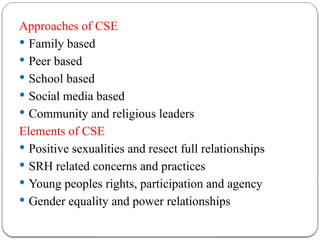
Is a unit of health care
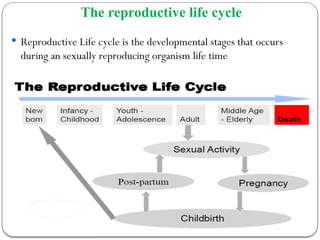
6.
Major components offamily health
Reproductive health
Safe motherhood (family planning, antenatal care,
obstetric care, post natal care, abortion care and
control of STI/HIV/AIDS)
Nutritional deficiencies,
LBW
RTIs
Infertility
Adolescent health (suicide, depression, STIs)
7.
Major components offamily health …
Child health
Child bearing, rearing
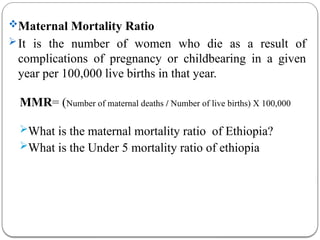
Child health services: nutrition,
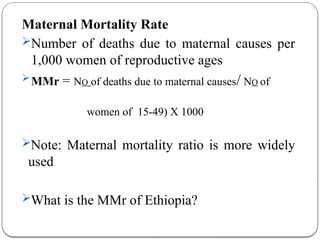
immunization, Growth monitoring
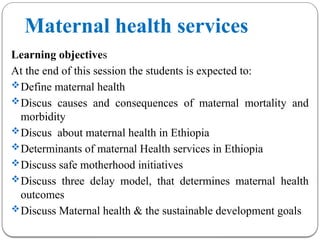
Mortality and morbidity of children
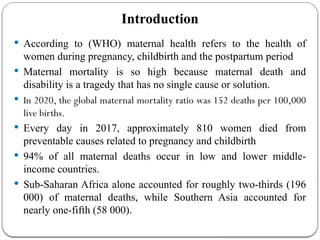
Social health problems of children: Child
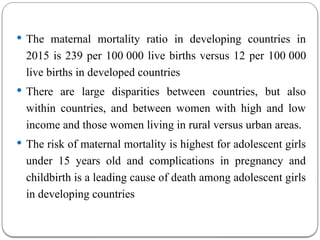
abuse , street children, child labour , Juvenile
delinquency, and battered baby syndrome
8.
Major components offamily health …
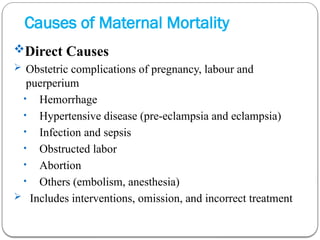
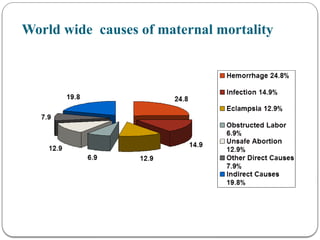
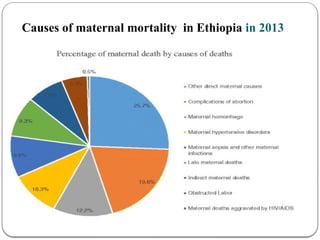
Gender issues in family: Girls trafficking, Gender
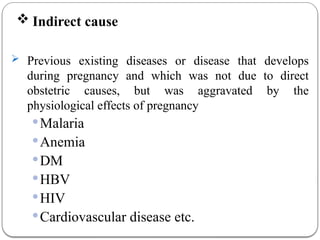
mainstreaming, Female Genital Mutilation , female feticide
(sex-selective abortion)
Aging: Problems of ageing, active ageing
Mental health: situation of mental health, its causes and
prevention, National mental health policy
9.
Characteristics of healthyfamily
A healthy family is a stress effective family in that such a family
is able to function at its fullest capacity, and is able to cope with
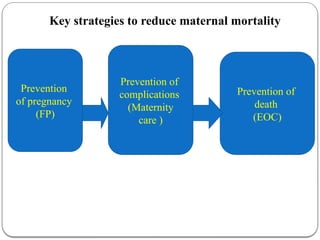
demands of daily life
Commitment : A family is like an organism, with life and
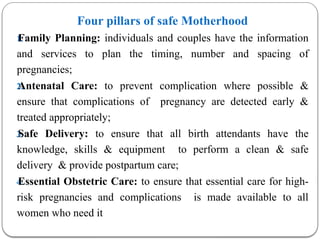
vitality. It is made of many interdependent parts. For the family to
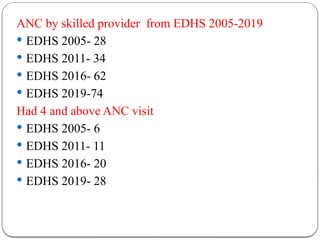
survive, those interdependent parts (different roles in the family)
must work together, coordinate, and be supportive of each other
Togetherness: the family should spend time together in such
activities as playing games, taking family vacations, and
celebrating birthdays together
Appreciation: high degree of mutual admiration and appreciation
between members of families for their job plays important role to
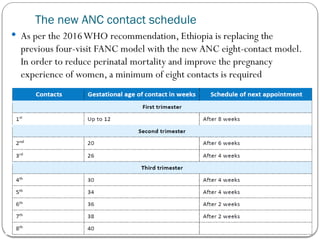
have healthy family
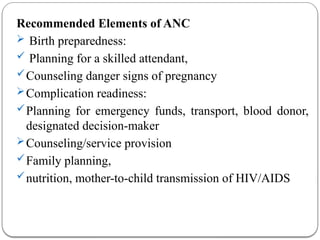
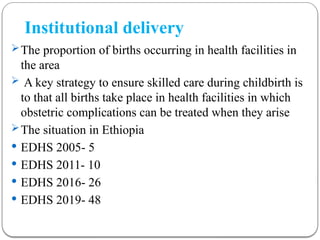
10.
Characteristics of healthfamily…
Good communication: Good communication creates a sense of
belonging, reduces frustration, reduce redundancy, and enhances
marital relationships
Spiritual well-being: When family members share a common
faith, it reassures their mutual support, and tends to be more
patient, forgiving, and broadly accepting of each other
Our differences in faith create distance between us
Coping with crisis and stress : Healthy families are able to face
reality and creatively, systematically, and rationally overcome
crises together, family members must depend on each other’s
mutual trust and interdependence
11.
Importance of familyhealth
Aside from disease cures, it offers a variety of activities and programs for
disease prevention, rehabilitation, and health promotion for all family
members
It is more than the sum of these members’ individual health because it
considers their interactions with one another as well as the family’s
human, biological, and physical environment
It can be described using specific markers such as demographics,
genetics, physical, mental, and social health, socioeconomics, and culture
Many health issues emerge and are treated at this level, and women, in
particular, are primary health care providers everywhere
As a result, it serves to bridge the gap between individual health and
community/public health
12.
The determinants offamily health
Income and Social Status: Healthy families are those in societies
which are prosperous and have an equitable distribution of wealth
Education: Health status a family improves with level of
education , Effective education for children and lifelong learning for
adults are key contributors to health and prosperity of the family
Employment and Working Conditions: unemployment,
stressful or unsafe work are associated with poorer health outcome
Social Support Networks: Support from families, friends and
communities helps families to solve problems, associated with
better health outcome
13.
The determinants offamily health…
Social Factor : Availability of resources to meet daily
needs, Social norms and attitudes, such as
discrimination ,Exposure to crime, violence
Physical Environments: an exposure to toxic substances
and other physical hazards and , contaminants of air, water,
food and soil can cause a variety of adverse health effects
Health Services: Lack of access, or limited access, to
health services greatly impacts an individual’s health status
Genetics: Hereditary disease such as sickle-cell anemia,
hemophilia, heart disease, and cystic fibrosis Carrying the
gene, which increases risk for breast and ovarian cancer
14.
The determinants offamily health…
Lifestyle/ individual behaviors: Dietary practice, physical
activity , Hygiene , alcohol consumption , cigarette smoking
, and other drug use plays a role in family health outcomes
Gender: Gender based domestic violence, male dominating
societies, lack of women participation in health decision
making process will affect greatly on overall concept of
healthy family
Culture: Marginalization, stigmatization, loss or
devaluation of language and culture and lack of access to
culturally appropriate health care and services badly affect
the family health
Learning Objectives
At theend of this session the learners will be able to:
Define RH
Discuss the concept and principles of RH
Discuss the components of RH
Discuss reproductive health strategy of Ethiopia
Discuss youth friendly health services
17.
Definition of RH
RHis a “state of complete physical, mental & social
wellbeing & not merely the absence of disease or
infirmity, in all matters related to reproductive
systems & to its functions & process (ICPD,1994)
RH encompasses three main points :
1. Sexual health
2. Reproductive freedom (access to information, methods
and services in reproductive health matters) and
3. Safe motherhood.(safe pregnancy, safe childbirth and
healthy children)
18.
Sexual Health
Astate of physical, emotional, mental, and social
wellbeing in relation to sexuality; it is not merely the
absence of disease, dysfunction, or infirmity
It includes a positive and respectful approach to sexuality
and sexual relationships that are free of coercion,
discrimination, and violence
Sexuality?
Sensuality; enables us to feel good about how our bodies
look and feel and what they can do
Sexualization?
19.
Sexuality
It is acentral aspects of humanity which includes:
Sex
Gender identities and roles
Sexual orientation
Sexual pleasure
Sexual intimacy and Reproduction
Sexuality is experienced and expressed in thoughts, fantasies,
desires, beliefs, attitudes, values, behaviors, practices, roles and
relationships
Sensuality:Awareness and feeling with one’s own body and other people’s
bodies, especially the body of a sexual partner: – Sensuality enables us to
feel good about how our bodies look and feel and what they can do
20.
Concept and principlesof RH
Reproductive health implies
A responsible, satisfying and safe sex life
Successful maternal and infant survival
Freedom to control reproduction
Ability to minimize gynecological disease throughout
life
21.
Women and menhave the right:
To be informed and have access to safe, effective,
affordable and acceptable Family Planning services
To have access to appropriate health care services that
enable women to go safely through pregnancy and
childbirth and provide couples with the best chance of
having a healthy infant
22.
The concept ofreproductive health is based on the
equality between men and women
Human health, especially women’s right is central to
reproductive health
Reproductive health service is a means to realize
reproductive health
The definition of RH is not merely about reproduction
It must be viewed as three interconnected domains:-
Universal rights,
Women’s empowerment, and
Health service provision
23.
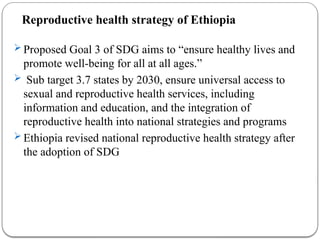
Reproductive health strategyof Ethiopia
Proposed Goal 3 of SDG aims to “ensure healthy lives and
promote well-being for all at all ages.”
Sub target 3.7 states by 2030, ensure universal access to
sexual and reproductive health services, including
information and education, and the integration of
reproductive health into national strategies and programs
Ethiopia revised national reproductive health strategy after
the adoption of SDG
24.
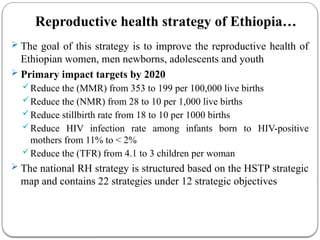
Reproductive health strategyof Ethiopia…
The goal of this strategy is to improve the reproductive health of
Ethiopian women, men newborns, adolescents and youth
Primary impact targets by 2020
Reduce the (MMR) from 353 to 199 per 100,000 live births
Reduce the (NMR) from 28 to 10 per 1,000 live births
Reduce stillbirth rate from 18 to 10 per 1000 births
Reduce HIV infection rate among infants born to HIV-positive
mothers from 11% to < 2%
Reduce the (TFR) from 4.1 to 3 children per woman
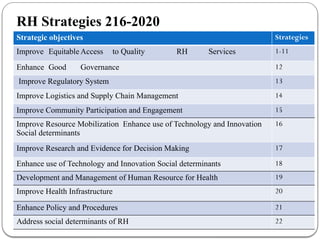
The national RH strategy is structured based on the HSTP strategic
map and contains 22 strategies under 12 strategic objectives
25.
RH Strategies 216-2020
Strategicobjectives Strategies
Improve Equitable Access to Quality RH Services 1-11
Enhance Good Governance 12
Improve Regulatory System 13
Improve Logistics and Supply Chain Management 14
Improve Community Participation and Engagement 15
Improve Resource Mobilization Enhance use of Technology and Innovation
Social determinants
16
Improve Research and Evidence for Decision Making 17
Enhance use of Technology and Innovation Social determinants 18
Development and Management of Human Resource for Health 19
Improve Health Infrastructure 20
Enhance Policy and Procedures 21
Address social determinants of RH 22
26.
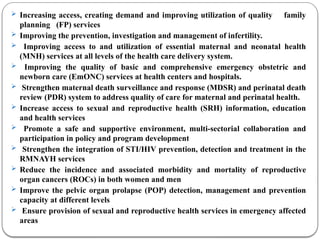
Increasing access,creating demand and improving utilization of quality family
planning (FP) services
Improving the prevention, investigation and management of infertility.
Improving access to and utilization of essential maternal and neonatal health
(MNH) services at all levels of the health care delivery system.
Improving the quality of basic and comprehensive emergency obstetric and
newborn care (EmONC) services at health centers and hospitals.
Strengthen maternal death surveillance and response (MDSR) and perinatal death
review (PDR) system to address quality of care for maternal and perinatal health.
Increase access to sexual and reproductive health (SRH) information, education
and health services
Promote a safe and supportive environment, multi-sectorial collaboration and
participation in policy and program development
Strengthen the integration of STI/HIV prevention, detection and treatment in the
RMNAYH services
Reduce the incidence and associated morbidity and mortality of reproductive
organ cancers (ROCs) in both women and men
Improve the pelvic organ prolapse (POP) detection, management and prevention
capacity at different levels
Ensure provision of sexual and reproductive health services in emergency affected
areas
27.
Enhance coordinationand effective monitoring of RH programs
Improve the standards of premises, products, practice and professionals for appropriate
provision of RH/EmONC services
Improve capacity and coordination of logistics and supply chain management for
increased availability of RH commodities
Improve community engagement in RH program with particular focus on men and
young boys
Improve resource mobilization, allocation and utilization for MNH
Improving use of research and evidence for decision-making for better RH care
Improving use of technologies and innovation for better RH outcomes
Improve availability, motivation and retention of compassionate, respectful and
competent RH care providers across all regions and all levels of health facilities.
Performance targets by 2020:
Improve health infrastructure as per norms for proper RH service delivery
Ensure availability and implementation of enabling policy environment for the RH
services.
Improving advocacy and partnership to improve women’s decision making power on RH
matters.
Advocating for the enforcement of the implementations of the legal frameworks that
protect and advance women’s RH rights, including harmful traditional practices
elimination.
28.
Youth friendly healthservices
Learning Objectives
At the end of this session the learners will be able to:
Define YFS
Discuss implementation strategies of YFS
Discuss characteristic features of YFS
Discuss the barriers of YFS
29.
YFS…
Youth referto people aged between 15 and 24 years
Are characterized by unique physical, psychological,
social, and emotional changes that put their life at high
risk.
They account for 22 % of the total population of Ethiopia
Designed to address the barriers faced by youth in
accessing high-quality sexual and reproductive health
(SRH) services.
The services include counseling, family planning,
Voluntary Counseling and Testing (VCT) and treatment
of Sexually Transmitted Infections (STIs)
30.
YFS…
YFS: representan approach which brings together the qualities
that young people demand, with the high standards that have to
be achieved in the best public services.
YFS are: Accessible, acceptable and appropriate for youth ,In
the right place, at the right time and at the right price ,
Comprehensive because they deliver an essential package of
services
Equitable and do not discriminate against any sector of youth on
grounds of gender, ethnicity, religion, disability, social status or
any other reason
Reach out to those who are most vulnerable and those who lack
services
Effective because they are delivered by trained and motivated
health care providers
31.
Characteristics of YFSProviders
Well trained
Demonstrate respect and concern for young people
Knowledgeable of normal adolescent development
Have the skills to diagnose and treat common conditions
Have access to the correct drugs and supplies, Know
where to refer youth
Respect the confidentiality and privacy
32.
Strategies for ImplementingYFS
Service provider must see the person (the client) not the
problem
Training and staff support
Making the service facilities acceptable
Confidentiality and Privacy
Services that are acceptable to the local communities
Involving youth
33.
Characteristics of YFS
1.Youthfriendly policies that:
Fulfill the rights
Address the special needs of different sectors of the population
Avoid discrimination
Pay special attention to gender factors
Guarantee privacy and confidentiality
Ensure affordability to young people
2. Youth friendly procedures to facilitate:
Easy and confidential registration of clients, retrieval and
storage of records
Short waiting time and (where necessary) swift referral
Consultation with or without an appointment
34.
3. Youth friendlyhealth care providers who are:
Technically competent
Have interpersonal and communication skills
Motivated and supported
Non-judgmental
Devote adequate time to clients or patients
Provide information and support to enable adolescent’s
voluntary and informed choices
4. Youth friendly support staff who are:
Understanding and considerate, treating all youth clients with
equal care and respect
Competent, motivated and well supported
35.
5. Youth friendlyhealth facilities that:
Provide a safe environment at a convenient location
Have convenient working hours
Offer privacy and avoid stigma
Provide information and education material
6. Youth involvement in planning, implementing and
evaluating YFS so that they become:
Well informed about the services and their rights
Encouraged to respect the rights of others
Involved in service assessment and provision
36.
7.Community involvement anddialogue to:
Promote the value of SRH for youth
Encourage parental and community support
8. Community based outreach and peer-to-peer services to
increase coverage and accessibility
9. Appropriate and comprehensive services that:
Address each youth's physical, social and psychological
health and development needs
Provide a comprehensive package of SRH care and referral to
other relevant services
Do not carry out unnecessary procedures (i.e. doing unnecessary
pelvic exam)
37.
Barriers
Structural barriers,such as laws and policies requiring parental
or partner consent, distance from facilities, costs of services and/or
transportation, long wait times for services, inconvenient hours,
lack of necessary commodities at health facilities, and lack of
privacy and confidentiality.
Sociocultural barriers, such as restrictive norms and stigma
around adolescent and youth sexuality; inequitable or harmful
gender norms; and discrimination and judgment by communities,
families, partners, and providers.
Individual barriers, such as incomplete or incorrect knowledge
of SRH, including myths and misconceptions around
contraception; limited self-efficacy and individual agency;
constrained ability to navigate internalized social and gender
norms; and lack of access to information about what SRH services
are available and where to seek services.
38.
Adolescent sex education
Adolescence (10-19) is a period of transition from childhood to
adulthood
it is a period of dynamic change marked by profound physical,
emotional, mental & social changes, and health risk behaviors
From all the stages of the adolescent’s growth, the most intense
is the increase of sexual urge and the
new and often mysterious emotions and thoughts accompanying
them
Conducive time for transferring knowledge, information and
skills about sexuality, relationships, marriage, and future life
(most of them are in schools)
Adolescent are exposed to many challenges that need to be
handled carefully
39.
Adolescent sex education…
Sexual and reproductive health problems are the second
common causes of adolescent morbidity and mortality.
Why do they engage in health risk behaviors?
1. Adolescents take risks because they lack knowledge.
2. Adolescents engage in health risking behaviors because
they think they are not vulnerable
So to prevent the conscience of health risk behaviors
adolescent sex education is very important.
40.
Why to Adolescents?
Sex education should be provided to all. However, our resources are limited.
Priority is given to adolescents because:
They have a maximum sex drive.
They form a high risk group.
They are eager to get information because of the physical and physiological changes.
Their common sources of information (misinformation) are their friends, blue films
and pornographic literature.
They are easily influenced and therefore likely to go astray and land in problems of
unmarried motherhood, abortions, STD/HIV infections, sexual abuse.
They are going to be the responsible citizens of tomorrow.
41.
Adolescent sex education…
Sex education is the provision of information about bodily
development, sex, sexuality, and relationships, along with
skills-building to help young people communicate about and
make informed decisions regarding sex and their sexual health.
Comprehensive sexuality education (CSE) has been defined as
“rights-based and gender-focused approach to sexuality
education, whether in school or out of school”
Comprehensive sexuality education enables young people to
protect and advocate for their health, well-being and dignity by
providing them with a necessary toolkit of knowledge,
attitudes and skills.
42.
Comprehensive sexuality education(CSE) helps to
Avoid negative health consequences
Communicate about sexuality and sexual health
Understand healthy and unhealthy relationships
Understand, value, and feel autonomy over their bodies
Respect others’right to bodily autonomy
Protect adolescents success
43.
Approaches of CSE
Family based
Peer based
School based
Social media based
Community and religious leaders
Elements of CSE
Positive sexualities and resect full relationships
SRH related concerns and practices
Young peoples rights, participation and agency
Gender equality and power relationships
44.
The reproductive lifecycle
Reproductive Life cycle is the developmental stages that occurs
during an sexually reproducing organism life time
45.
Life cycle approachin reproductive health
Actions, both positive and negative, taken at one stage
in a woman’s life can and will affect her throughout her
life
women’s health needs have been addressed through
maternal and child health programs, focusing primarily
on narrow aspect of their lives
women’s health is now being viewed holistically – as a
continuum of care that starts before birth and progresses
cumulatively throughout her life
Life cycle approach defines women's life time health
problems
46.
A life cycleapproach in reproductive health examines
how biological, behavioral and social factors throughout
life, and across generations, act independently,
cumulatively and interactively to influence reproductive
health
This lifecycle approach extends beyond women’s
reproductive role to encompass women’s health at every
stage and in every aspect of their lives
Through this approach, other health issues affecting
women that were previously overlooked, or thought not
to exist, have become more apparent
47.
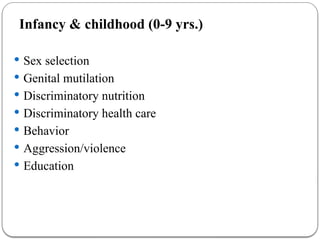
Infancy & childhood(0-9 yrs.)
Sex selection
Genital mutilation
Discriminatory nutrition
Discriminatory health care
Behavior
Aggression/violence
Education
48.
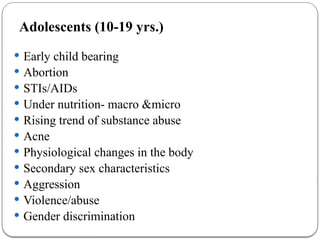
Adolescents (10-19 yrs.)
Early child bearing
Abortion
STIs/AIDs
Under nutrition- macro µ
Rising trend of substance abuse
Acne
Physiological changes in the body
Secondary sex characteristics
Aggression
Violence/abuse
Gender discrimination
49.
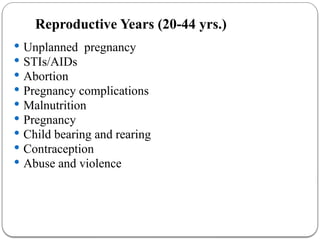
Reproductive Years (20-44yrs.)
Unplanned pregnancy
STIs/AIDs
Abortion
Pregnancy complications
Malnutrition
Pregnancy
Child bearing and rearing
Contraception
Abuse and violence
50.
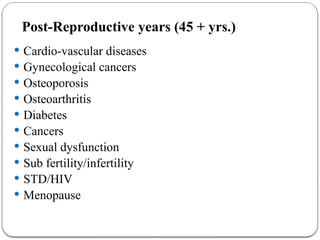
Post-Reproductive years (45+ yrs.)
Cardio-vascular diseases
Gynecological cancers
Osteoporosis
Osteoarthritis
Diabetes
Cancers
Sexual dysfunction
Sub fertility/infertility
STD/HIV
Menopause
51.
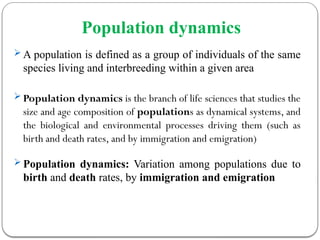
Population dynamics
Apopulation is defined as a group of individuals of the same
species living and interbreeding within a given area
Population dynamics is the branch of life sciences that studies the
size and age composition of populations as dynamical systems, and
the biological and environmental processes driving them (such as
birth and death rates, and by immigration and emigration)
Population dynamics: Variation among populations due to
birth and death rates, by immigration and emigration
52.
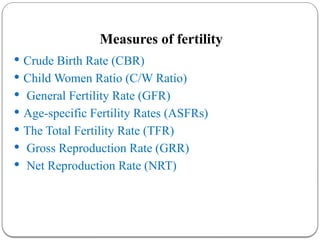
Measures of fertility
Crude Birth Rate (CBR)
Child Women Ratio (C/W Ratio)
General Fertility Rate (GFR)
Age-specific Fertility Rates (ASFRs)
The Total Fertility Rate (TFR)
Gross Reproduction Rate (GRR)
Net Reproduction Rate (NRT)
53.
08/20/2026
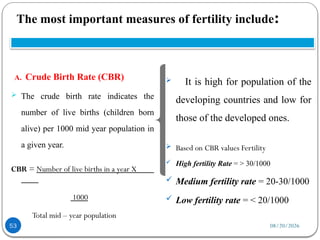
The most importantmeasures of fertility include:
53
A. Crude Birth Rate (CBR)
The crude birth rate indicates the
number of live births (children born
alive) per 1000 mid year population in
a given year.
CBR = Number of live births in a year X
1000
Total mid – year population
It is high for population of the
developing countries and low for
those of the developed ones.
Based on CBR values Fertility
High fertility Rate = > 30/1000
Medium fertility rate = 20-30/1000
Low fertility rate = < 20/1000
54.
08/20/2026
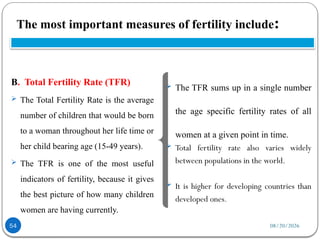
The most importantmeasures of fertility include:
54
B. Total Fertility Rate (TFR)
The Total Fertility Rate is the average
number of children that would be born
to a woman throughout her life time or
her child bearing age (15-49 years).
The TFR is one of the most useful
indicators of fertility, because it gives
the best picture of how many children
women are having currently.
The TFR sums up in a single number
the age specific fertility rates of all
women at a given point in time.
Total fertility rate also varies widely
between populations in the world.
It is higher for developing countries than
developed ones.
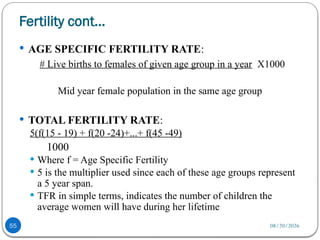
55.
08/20/2026
Fertility cont…
55
AGESPECIFIC FERTILITY RATE:
# Live births to females of given age group in a year X1000
Mid year female population in the same age group
TOTAL FERTILITY RATE:
5(f(15 - 19) + f(20 -24)+...+ f(45 -49)
1000
Where f = Age Specific Fertility
5 is the multiplier used since each of these age groups represent
a 5 year span.
TFR in simple terms, indicates the number of children the
average women will have during her lifetime
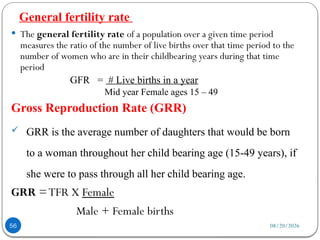
56.
08/20/2026
General fertility rate
56
The general fertility rate of a population over a given time period
measures the ratio of the number of live births over that time period to the
number of women who are in their childbearing years during that time
period
GFR = # Live births in a year
Mid year Female ages 15 – 49
Gross Reproduction Rate (GRR)
GRR is the average number of daughters that would be born
to a woman throughout her child bearing age (15-49 years), if
she were to pass through all her child bearing age.
GRR =TFR X Female
Male + Female births
57.
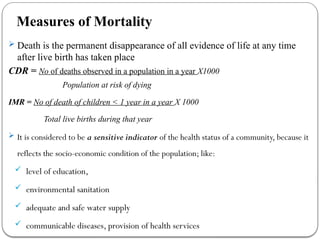
Measures of Mortality
Death is the permanent disappearance of all evidence of life at any time
after live birth has taken place
CDR = No of deaths observed in a population in a year X1000
Population at risk of dying
IMR = No of death of children < 1 year in a year X 1000
Total live births during that year
It is considered to be a sensitive indicator of the health status of a community, because it
reflects the socio-economic condition of the population; like:
level of education,
environmental sanitation
adequate and safe water supply
communicable diseases, provision of health services
58.
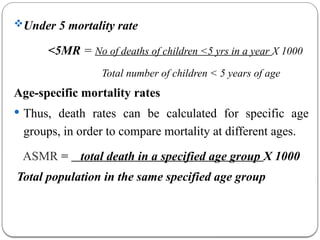
Under 5 mortalityrate
<5MR = No of deaths of children <5 yrs in a year X 1000
Total number of children < 5 years of age
Age-specific mortality rates
Thus, death rates can be calculated for specific age
groups, in order to compare mortality at different ages.
ASMR = total death in a specified age group X 1000
Total population in the same specified age group
59.
Maternal Mortality Ratio
Itis the number of women who die as a result of
complications of pregnancy or childbearing in a given
year per 100,000 live births in that year.
MMR= (Number of maternal deaths / Number of live births) X 100,000
What is the maternal mortality ratio of Ethiopia?
What is the Under 5 mortality ratio of ethiopia
60.
Maternal Mortality Rate
Numberof deaths due to maternal causes per
1,000 women of reproductive ages
MMr = NO of deaths due to maternal causes/ NO of
women of 15-49) X 1000
Note: Maternal mortality ratio is more widely
used
What is the MMr of Ethiopia?
61.
Maternal health services
Learningobjectives
At the end of this session the students is expected to:
Define maternal health
Discus causes and consequences of maternal mortality and
morbidity
Discus about maternal health in Ethiopia
Determinants of maternal Health services in Ethiopia
Discuss safe motherhood initiatives
Discuss three delay model, that determines maternal health
outcomes
Discuss Maternal health & the sustainable development goals
62.
Introduction
According to(WHO) maternal health refers to the health of
women during pregnancy, childbirth and the postpartum period
Maternal mortality is so high because maternal death and
disability is a tragedy that has no single cause or solution.
In 2020, the global maternal mortality ratio was 152 deaths per 100,000
live births.
Every day in 2017, approximately 810 women died from
preventable causes related to pregnancy and childbirth
94% of all maternal deaths occur in low and lower middle-
income countries.
Sub-Saharan Africa alone accounted for roughly two-thirds (196
000) of maternal deaths, while Southern Asia accounted for
nearly one-fifth (58 000).
63.
The maternalmortality ratio in developing countries in
2015 is 239 per 100 000 live births versus 12 per 100 000
live births in developed countries
There are large disparities between countries, but also
within countries, and between women with high and low
income and those women living in rural versus urban areas.
The risk of maternal mortality is highest for adolescent girls
under 15 years old and complications in pregnancy and
childbirth is a leading cause of death among adolescent girls
in developing countries
Causes and consequencesof maternal mortality
and morbidity
Maternal Mortality: The death of a woman while pregnant or
within 42 days of termination of pregnancy, irrespective of the
duration and site of the pregnancy, from any cause related to or
aggravated by the pregnancy or its management but not from
accidental or incidental causes.
66.
Maternal morbidity: Anydeviation, subjective or objective, from a
state of physiological or psychological well being of women.
Late maternal death: the death of a woman from direct or indirect
obstetric causes, more than 42 days, but less than one year after
termination of pregnancy
67.
Causes of MaternalMortality
Direct Causes
Obstetric complications of pregnancy, labour and
puerperium
• Hemorrhage
• Hypertensive disease (pre-eclampsia and eclampsia)
• Infection and sepsis
• Obstructed labor
• Abortion
• Others (embolism, anesthesia)
Includes interventions, omission, and incorrect treatment
68.
Indirect cause
Previous existing diseases or disease that develops
during pregnancy and which was not due to direct
obstetric causes, but was aggravated by the
physiological effects of pregnancy
Malaria
Anemia
DM
HBV
HIV
Cardiovascular disease etc.
Burden of Disease
Infertility
Uterine prolapse
Infection
Incontinence
Nerve damage
Pain during intercourse
72.
Determinants of MaternalHealth Outcomes
Three delay model
1. Delay in deciding to seek care
– Failure to recognize signs of complications
– Failure to perceive severity of illness
– Cost consideration
– Negative experience with health system
– Transportation difficulties
73.
2. Delay inreaching care
Lengthy distance to a facility
Conditions of roads
Lack of available transportation
3. Delay in receiving appropriate care
Uncaring attitudes of providers
Shortages of supplies and basic equipment
Non-availability or poor skills of health personnel
74.
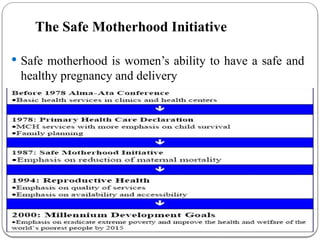
The Safe MotherhoodInitiative
Safe motherhood is women’s ability to have a safe and
healthy pregnancy and delivery
75.
The global SafeMotherhood Initiative was launched in
1987 to improve maternal health and cut the number of
maternal deaths in half by the year 2000
It was seen as a major milestone in the race to reduce the
burden of maternal mortality throughout the world,
particularly in developing countries
Gave greater visibility to the hidden inequity of maternal
ill-health
comprehensive understanding of the roots and causes of
the unacceptable charge of MM in developing countries
Put maternal MM at the forefront of international public
health issue
76.
Interventions on reductionof maternal
mortality focused on the three areas
Reduction of the likelihood that a woman will
become pregnant
Reduction of the likelihood that a pregnant
woman will experience a serious complication
of pregnancy or childbirth;
Reduction of the likelihood of death among
women who experience complications
77.
Key strategies toreduce maternal mortality
Prevention of
complications
(Maternity
care )
Prevention
of pregnancy
(FP)
Prevention of
death
(EOC)
78.
Essential Services forSafe Motherhood
1. Community education on safe motherhood
2. Prenatal care
3. Skilled assistance during childbirth
4. Care for obstetric complications
5. Postpartum care
6. Post-abortion care
7. Family planning
8. RH education and services for adolescents
79.
Four pillars ofsafe Motherhood
1.
Family Planning: individuals and couples have the information
and services to plan the timing, number and spacing of
pregnancies;
2.
Antenatal Care: to prevent complication where possible &
ensure that complications of pregnancy are detected early &
treated appropriately;
3.
Safe Delivery: to ensure that all birth attendants have the
knowledge, skills & equipment to perform a clean & safe
delivery & provide postpartum care;
4.
Essential Obstetric Care: to ensure that essential care for high-
risk pregnancies and complications is made available to all
women who need it
80.
ANTENATAL CARE (ANC)
ANCis a care given to pregnant women with the aim of
improving the maternal and perinatal out come
All pregnant women should have a minimum of four
antenatal visits (at least 20 minutes duration each) for:
Prevention,
Early detection and
Management of complications
81.
Objective of ANC
healthypregnancy
A healthy outcome for mother and newborn
Promotion of physical, mental and social health
82.
Benefits of AntenatalCare
Used as an opportunity to provide information to women
and their families about:
Danger signs and symptoms during pregnancy and delivery
Developing an appropriate delivery/birth plan, based on the
woman's history and health status
Unique opportunity for early diagnosis and treatment of
problems like:
Maternal problems: anemia, vaginal bleeding,
preeclampsia/eclampsia, infection
Fetal problems: Abnormal fetal growth or movement, abnormal
fetal position
HIV, syphilis, malaria, malnutrition
83.
Models of ANC
Traditional(Risk) Approach
It is not rational
Emphasis of visits is on frequency and numbers of visits,
rather than on essential goal-directed elements of each visit
Emphasis on risk screening
Identifying women who would face problems through
history taking, physical and laboratory examination
84.
Focused (Goal Directed)Approach
FANC: is a care routinely provided to all pregnant
women from screening to intensive life support provided
to any woman while pregnant and up to delivery.
“Having one or more visits with a trained person during
pregnancy” can detect early signs of disease or risk
factors and timely intervention
85.
Approach of FANC
Anapproach of ANC that emphasizes:
Individualized care
Client-centered
Fewer but comprehensive visits
Disease detection, not risk
Care by a skilled provider
86.
Goals of FANC
Early detection and treatment of problems and complications
Prevention of complications and disease
Birth preparedness & complication readiness
Health promotion
Focused ANC Visit Schedule For The Healthy Client
Four visit
• FIRST <16 Weeks-30min
• SECOND 24-28 Wks-20 min
• THIRD 30-32 Wks.- 20 min
• FOURTH 36-40 wks.- 20 min
87.
The new ANCcontact schedule
As per the 2016WHO recommendation, Ethiopia is replacing the
previous four-visit FANC model with the new ANC eight-contact model.
In order to reduce perinatal mortality and improve the pregnancy
experience of women, a minimum of eight contacts is required
88.
Recommended Elements ofANC
Birth preparedness:
Planning for a skilled attendant,
Counseling danger signs of pregnancy
Complication readiness:
Planning for emergency funds, transport, blood donor,
designated decision-maker
Counseling/service provision
Family planning,
nutrition, mother-to-child transmission of HIV/AIDS
Institutional delivery
The proportionof births occurring in health facilities in
the area
A key strategy to ensure skilled care during childbirth is
to that all births take place in health facilities in which
obstetric complications can be treated when they arise
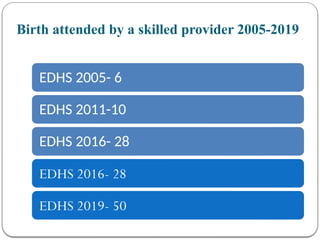
The situation in Ethiopia
EDHS 2005- 5
EDHS 2011- 10
EDHS 2016- 26
EDHS 2019- 48
91.
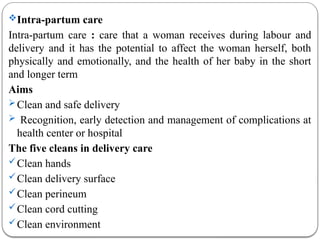
Intra-partum care
Intra-partum care: care that a woman receives during labour and
delivery and it has the potential to affect the woman herself, both
physically and emotionally, and the health of her baby in the short
and longer term
Aims
Clean and safe delivery
Recognition, early detection and management of complications at
health center or hospital
The five cleans in delivery care
Clean hands
Clean delivery surface
Clean perineum
Clean cord cutting
Clean environment
92.
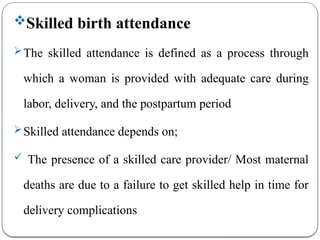
Skilled birth attendance
Theskilled attendance is defined as a process through
which a woman is provided with adequate care during
labor, delivery, and the postpartum period
Skilled attendance depends on;
The presence of a skilled care provider/ Most maternal
deaths are due to a failure to get skilled help in time for
delivery complications
93.
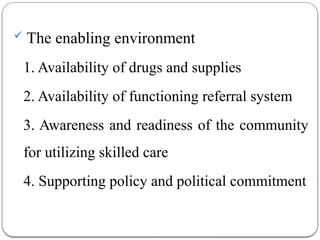
The enablingenvironment
1. Availability of drugs and supplies
2. Availability of functioning referral system
3. Awareness and readiness of the community
for utilizing skilled care
4. Supporting policy and political commitment
Postpartum care
The postpartumperiod refers to the first six weeks after
childbirth. This is a joyous time, but it’s also a period of
adjustment and healing for mothers.
A large proportion of maternal and neonatal deaths occur
during the first 48 hours after delivery.
Thus, prompt postnatal care (PNC) for both the mother and
the child is important to treat any complications
96.
Maternal care
IncludesManagement of complications at health center or hospital
(for example, hemorrhage, sepsis and PHT)
Promotion and support to breastfeeding and management of breast
complications)
Information and services for family planning
STD/HIV prevention and management
Tetanus toxoid immunization
Postnatal Health Check for Mothers
EDHS 2016- 17
EDHS 2019- 34
97.
Newborn care
Resuscitation
Preventionand management of hypothermia
Early and exclusive breastfeeding
Prevention and management of infections including cord
infections
Recording of birth weight and referral of newborn
Immunizations and growth monitoring
Postnatal Health Check for Newborns
EDHS 2016- 13
EDHS 2019- 35
98.
Maternal health &the SDGs
The Sustainable Development Goals (SDGs) establish a
transformative new agenda for maternal health
SDG 3
Target 3.1, aims to ending preventable maternal
mortality; and reduce the global MMR to less than 70
per 100 000 live births by 2030
Target 3.7, aims to ensure universal access to sexual
and reproductive health-care services, including for
family planning, information and education, and the
integration of reproductive health into national
strategies and programs by 2030
99.
Determinants of maternalHealth services in Ethiopia
No physical access
High costs
Poor information
Cultural preferences
Lack of decision-making power by women
Poor quality of care
Delays in referring women from community health
facilities to hospitals
100.
HIV/AIDS and ReproductiveHealth
HIV, the virus that causes AIDS, has become one of the world’s
most serious health and development challenges since the first
cases were reported in 1981.
Approximately 84 million people have become infected with HIV
since the start of the epidemic
Today, there are approximately 38 million people currently living
with HIV, and tens of millions of people have died ofAIDS-related
causes since the beginning of the epidemic.
.
Editor's Notes
#7 BBS: collection of injuries sustained by a child as a result of repeated mistreatment or beating
#8 GMS: Is the process of assessing the implications for women and men of any planned action to insure the needs of both men and women.
#13 Physical environment: maybe natural or built environments
#18 Sensuality: Awareness and feeling with one’s own body and other people’s bodies, especially the body of a sexual partner: – Sensuality enables us to feel good about how our bodies look and feel and what they can do
#19 Gender identity: a person’s internal sense of being a man or a woman, which may or may not correspond with the sex assigned at birth
– Gender expression: how one’s characteristics and behaviors conform to or transgress gender norms and roles of femininity and masculinity
– Sexual orientation: whether a person’s primary attraction is to the opposite sex (heterosexuality), the same-sex (homosexuality), or both sexes (bisexuality)
#56 Note: GFR is a refinement of the CBR, but still conceals a great deal of variation in the fertility rates of the various age groups. For this reason, Age Specific Fertility rates may give a clear picture of the pattern of fertility in a population
#70 Other direct causes: anesthesia, embolism (air, amniotic fluid, and blood clot), and the condition of peripartum cardiomyopathy
#95 More than half of maternal deaths occurs in the postpartum period
#114 Males are generally more symptomatic than females.
Most STIs are asymptomatic! Think about it: if everyone with a STI had pain, discharge, etc., most people would seek treatment and the amount of STIs in the general population would drop dramatically. Asymptomatic infection exists as a large “reservoir” that perpetuates STI.
This emphasizes the need to screen, diagnose, and treat asymptomatic cases.
Source: http://www.gfmer.ch/Endo/Lectures_11/Pdf/STI-HIV.pdf
#140 Monophasic pills contain the same dose of estrogen and progestin in each of the 21 hormonally active pills
Multiphasic pills vary the dose of either or both hormones during the active pill phase
Suppress releasing of Gonadotropins LH and FSH no action on the ovary ovulation is prevented.
Inhibit implantation by causing abnormal contraction of the fallopian tubes & uterine musculature ovum will be expelled rather than implanted
Increase viscosity of the cervical mucus making it sperm penetration difficult
 Most read
 Most read
 Most read