Sanjivani Rural Education Society’s
Sanjivani College of Engineering, Kopargaon-423603
(An Autonomous Institute Affiliated to Savitribai Phule Pune University, Pune)
NAAC ‘A’ Grade Accredited, ISO 9001:2015 Certified
Department of Mechanical Engineering
Subject : Electric Vehicle Design
Class : T.Y. Mechanical
Subject Code : ME 311D
Unit 2 : Introduction to Electric and Hybrid
Vehicle
By
V. P. Bhaurkar
Department of Mechanical Engineering
2026 – 27 (sem - 5)
V. P. Bhaurkar EV (T. Y. Mechanical)
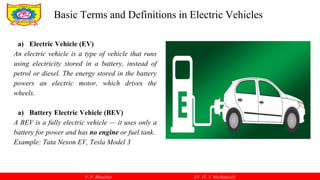
a) Electric Vehicle (EV)
An electric vehicle is a type of vehicle that runs
using electricity stored in a battery, instead of
petrol or diesel. The energy stored in the battery
powers an electric motor, which drives the
wheels.
a) Battery Electric Vehicle (BEV)
A BEV is a fully electric vehicle — it uses only a
battery for power and has no engine or fuel tank.
Example: Tata Nexon EV, Tesla Model 3
Basic Terms and Definitions in Electric Vehicles
V. P. Bhaurkar EV (T. Y. Mechanical)
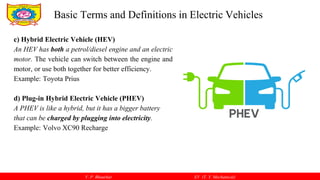
c) Hybrid Electric Vehicle (HEV)
An HEV has both a petrol/diesel engine and an electric
motor. The vehicle can switch between the engine and
motor, or use both together for better efficiency.
Example: Toyota Prius
d) Plug-in Hybrid Electric Vehicle (PHEV)
A PHEV is like a hybrid, but it has a bigger battery
that can be charged by plugging into electricity.
Example: Volvo XC90 Recharge
Basic Terms and Definitions in Electric Vehicles
V. P. Bhaurkar EV (T. Y. Mechanical)
e) Electric Motor
This is the main machine that converts electrical
energy into mechanical power to move the
vehicle. EVs typically use motors like:
1. BLDC (Brushless DC Motor)
2. PMSM (Permanent Magnet Synchronous
Motor)
3. Induction Motor
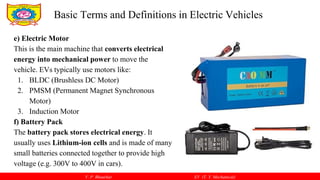
f) Battery Pack
The battery pack stores electrical energy. It
usually uses Lithium-ion cells and is made of many
small batteries connected together to provide high
voltage (e.g. 300V to 400V in cars).
Basic Terms and Definitions in Electric Vehicles
V. P. Bhaurkar EV (T. Y. Mechanical)
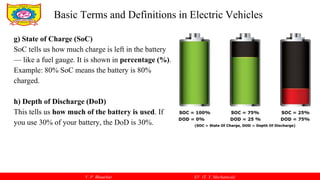
g) State of Charge (SoC)
SoC tells us how much charge is left in the battery
— like a fuel gauge. It is shown in percentage (%).
Example: 80% SoC means the battery is 80%
charged.
h) Depth of Discharge (DoD)
This tells us how much of the battery is used. If
you use 30% of your battery, the DoD is 30%.
Basic Terms and Definitions in Electric Vehicles
V. P. Bhaurkar EV (T. Y. Mechanical)
i) Range
This is the total distance the EV can travel on a
full charge.
Example: ―This EV has a range of 312 km.‖
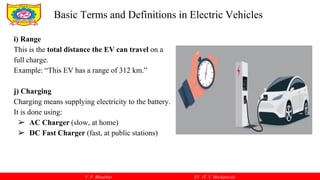
j) Charging
Charging means supplying electricity to the battery.
It is done using:
➢ AC Charger (slow, at home)
➢ DC Fast Charger (fast, at public stations)
Basic Terms and Definitions in Electric Vehicles
V. P. Bhaurkar EV (T. Y. Mechanical)
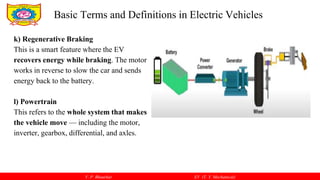
k) Regenerative Braking
This is a smart feature where the EV
recovers energy while braking. The motor
works in reverse to slow the car and sends
energy back to the battery.
l) Powertrain
This refers to the whole system that makes
the vehicle move — including the motor,
inverter, gearbox, differential, and axles.
Basic Terms and Definitions in Electric Vehicles
V. P. Bhaurkar EV (T. Y. Mechanical)
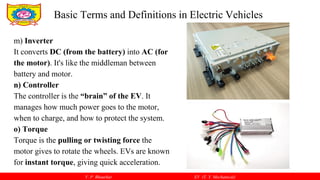
m) Inverter
It converts DC (from the battery) into AC (for
the motor). It's like the middleman between
battery and motor.
n) Controller
The controller is the “brain” of the EV. It
manages how much power goes to the motor,
when to charge, and how to protect the system.
o) Torque
Torque is the pulling or twisting force the
motor gives to rotate the wheels. EVs are known
for instant torque, giving quick acceleration.
Basic Terms and Definitions in Electric Vehicles
V. P. Bhaurkar EV (T. Y. Mechanical)
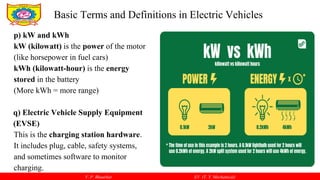
p) kW and kWh
kW (kilowatt) is the power of the motor
(like horsepower in fuel cars)
kWh (kilowatt-hour) is the energy
stored in the battery
(More kWh = more range)
q) Electric Vehicle Supply Equipment
(EVSE)
This is the charging station hardware.
It includes plug, cable, safety systems,
and sometimes software to monitor
charging.
Basic Terms and Definitions in Electric Vehicles
V. P. Bhaurkar EV (T. Y. Mechanical)
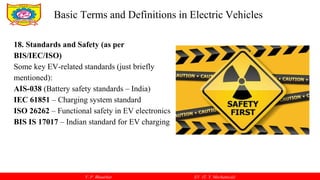
18. Standards and Safety (as per
BIS/IEC/ISO)
Some key EV-related standards (just briefly
mentioned):
AIS-038 (Battery safety standards – India)
IEC 61851 – Charging system standard
ISO 26262 – Functional safety in EV electronics
BIS IS 17017 – Indian standard for EV charging
Basic Terms and Definitions in Electric Vehicles
V. P. Bhaurkar AI and ML (T. Y. Mechanical)
Thank You !