Comprehensive Introduction to Artificial Intelligence: Concepts, History, and Modern Applications
Explore AI fundamentals, history, core subfields, learning paradigms, generative AI, LLMs, RAG, autonomous agents, engineering practices, and a learning roadmap for aspiring AI practitioners.
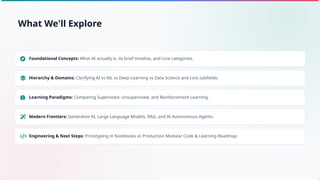
Foundational Concepts: WhatAI actually is, its brief timeline, and core categories.
Hierarchy & Domains: Clarifying AI vs ML vs Deep Learning vs Data Science and core subfields.
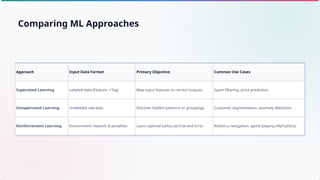
Learning Paradigms: Comparing Supervised, Unsupervised, and Reinforcement Learning.
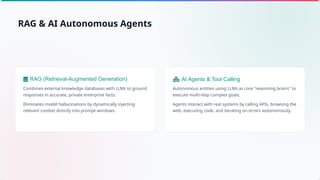
Modern Frontiers: Generative AI, Large Language Models, RAG, and AI Autonomous Agents.
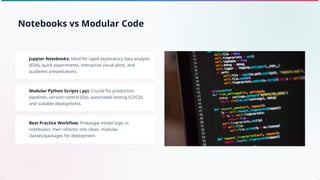
Engineering & Next Steps: Prototyping in Notebooks vs Production Modular Code & Learning Roadmap.
What We'll Explore
3.
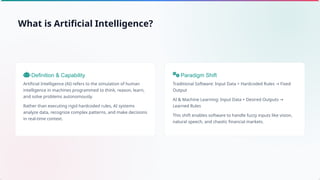
Definition & Capability
ArtificialIntelligence (AI) refers to the simulation of human
intelligence in machines programmed to think, reason, learn,
and solve problems autonomously.
Rather than executing rigid hardcoded rules, AI systems
analyze data, recognize complex patterns, and make decisions
in real-time context.
Paradigm Shift
Traditional Software: Input Data + Hardcoded Rules Fixed
→
Output
AI & Machine Learning: Input Data + Desired Outputs →
Learned Rules
This shift enables software to handle fuzzy inputs like vision,
natural speech, and chaotic financial markets.
What is Artificial Intelligence?
4.
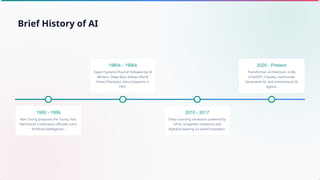
1950 - 1956
AlanTuring proposes the Turing Test.
Dartmouth Conference officially coins
"Artificial Intelligence".
1980s - 1990s
Expert Systems flourish followed by AI
Winters. Deep Blue defeats World
Chess Champion Garry Kasparov in
1997.
2010 - 2017
Deep Learning revolution powered by
GPUs. ImageNet milestone and
AlphaGo beating Go world champion.
2020 - Present
Transformer architecture, LLMs
(ChatGPT, Claude), multimodal
Generative AI, and Autonomous AI
Agents.
Brief History of AI
5.
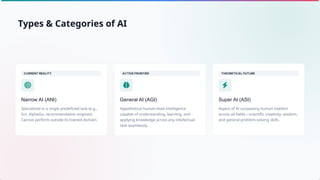
Narrow AI (ANI)
Specializedin a single predefined task (e.g.,
Siri, AlphaGo, recommendation engines).
Cannot perform outside its trained domain.
General AI (AGI)
Hypothetical human-level intelligence
capable of understanding, learning, and
applying knowledge across any intellectual
task seamlessly.
Super AI (ASI)
Aspect of AI surpassing human intellect
across all fields—scientific creativity, wisdom,
and general problem-solving skills.
Types & Categories of AI
6.
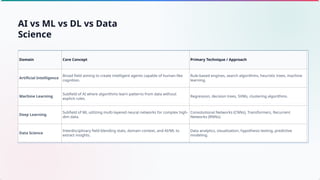
Domain Core ConceptPrimary Technique / Approach
Artificial Intelligence
Broad field aiming to create intelligent agents capable of human-like
cognition.
Rule-based engines, search algorithms, heuristic trees, machine
learning.
Machine Learning
Subfield of AI where algorithms learn patterns from data without
explicit rules.
Regression, decision trees, SVMs, clustering algorithms.
Deep Learning
Subfield of ML utilizing multi-layered neural networks for complex high-
dim data.
Convolutional Networks (CNNs), Transformers, Recurrent
Networks (RNNs).
Data Science
Interdisciplinary field blending stats, domain context, and AI/ML to
extract insights.
Data analytics, visualization, hypothesis testing, predictive
modeling.
AI vs ML vs DL vs Data
Science
7.
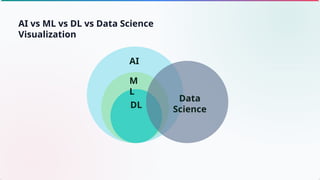
AI vs MLvs DL vs Data Science
Visualization
AI
M
L
DL
Data
Science
8.
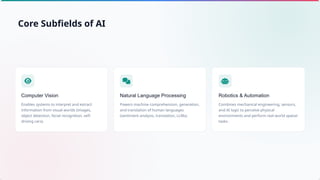
Computer Vision
Enables systemsto interpret and extract
information from visual worlds (images,
object detection, facial recognition, self-
driving cars).
Natural Language Processing
Powers machine comprehension, generation,
and translation of human languages
(sentiment analysis, translation, LLMs).
Robotics & Automation
Combines mechanical engineering, sensors,
and AI logic to perceive physical
environments and perform real-world spatial
tasks.
Core Subfields of AI
9.
Approach Input DataFormat Primary Objective Common Use Cases
Supervised Learning Labeled data (Feature + Tag) Map input features to correct outputs. Spam filtering, price prediction.
Unsupervised Learning Unlabeled raw data Discover hidden patterns or groupings. Customer segmentation, anomaly detection.
Reinforcement Learning Environment rewards & penalties Learn optimal policy via trial and error. Robotics navigation, game playing (AlphaZero).
Comparing ML Approaches
10.
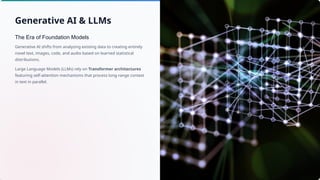
Generative AI &LLMs
The Era of Foundation Models
Generative AI shifts from analyzing existing data to creating entirely
novel text, images, code, and audio based on learned statistical
distributions.
Large Language Models (LLMs) rely on Transformer architectures
featuring self-attention mechanisms that process long-range context
in text in parallel.
11.
RAG (Retrieval-Augmented Generation)
Combinesexternal knowledge databases with LLMs to ground
responses in accurate, private enterprise facts.
Eliminates model hallucinations by dynamically injecting
relevant context directly into prompt windows.
AI Agents & Tool Calling
Autonomous entities using LLMs as core "reasoning brains" to
execute multi-step complex goals.
Agents interact with real systems by calling APIs, browsing the
web, executing code, and iterating on errors autonomously.
RAG & AI Autonomous Agents
12.
Jupyter Notebooks: Idealfor rapid exploratory data analysis
(EDA), quick experiments, interactive visual plots, and
academic presentations.
Modular Python Scripts (.py): Crucial for production
pipelines, version control (Git), automated testing (CI/CD),
and scalable deployments.
Best Practice Workflow: Prototype model logic in
notebooks, then refactor into clean, modular
classes/packages for deployment.
Notebooks vs Modular Code
13.
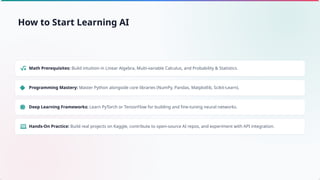
Math Prerequisites: Buildintuition in Linear Algebra, Multi-variable Calculus, and Probability & Statistics.
Programming Mastery: Master Python alongside core libraries (NumPy, Pandas, Matplotlib, Scikit-Learn).
Deep Learning Frameworks: Learn PyTorch or TensorFlow for building and fine-tuning neural networks.
Hands-On Practice: Build real projects on Kaggle, contribute to open-source AI repos, and experiment with API integration.
How to Start Learning AI