Comprehensive Insights into the Ethics of Artificial Intelligence: Fairness, Safety, and Accountability
Explores AI ethics history, principles, challenges, applications, and architectural design to ensure fair, safe, and responsible AI use across sectors like healthcare, education, and autonomous vehicles.
Comprehensive Insights into the Ethics of Artificial Intelligence: Fairness, Safety, and Accountability
1.
A
Presentation
on
“Ethics of Artificial
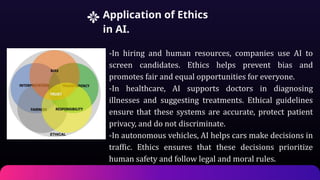
Intelligence”
Presented by :
Yash Bhisade
2025-
26
SIPNA COET,
Sipna College of Engineering &
Technology, Amravati.
Guided by
Prof .N. B.
Chavan
Department of Computer Science &
Engineering
Ethics of Artificial
intelligence
1
2.
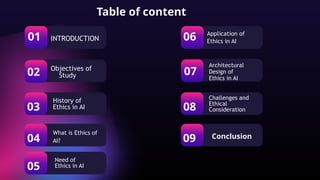
Table of content
Historyof
Ethics in AI
03
04
05
08
09
INTRODUCTION
01 06
Objectives of
Study
02 07
Need of
Ethics in AI
What is Ethics of
AI?
Challenges and
Ethical
Consideration
Application of
Ethics in AI
Architectural
Design of
Ethics in AI
Conclusion
3.
Introduction
Ethics in AIis very important because it helps
make sure that technology is used in a fair, safe,
and responsible way. As AI becomes more
common in our lives—in areas like healthcare,
transport, education, it’s important that it
doesn’t harm people or treat anyone unfairly.
Sometimes, AI can make wrong decisions if it
learns from biased data. Ethics helps us stop this
by making sure AI is fair to everyone, no matter
their gender, or background..
.
4.
The main goalof this study is to
understand how to use Artificial
Intelligence (AI) in a way that is fair,
safe, and responsible. As AI is being
used more and more in areas like
healthcare, education, banking, and
law, it is important to make sure it
does not harm people or create
unfair results.
Objectives of
Study.
5.
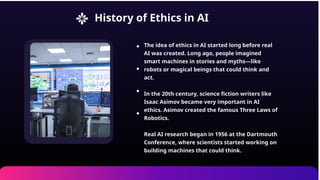
The idea ofethics in AI started long before real
AI was created. Long ago, people imagined
smart machines in stories and myths—like
robots or magical beings that could think and
act.
In the 20th century, science fiction writers like
Isaac Asimov became very important in AI
ethics. Asimov created the famous Three Laws of
Robotics.
Real AI research began in 1956 at the Dartmouth
Conference, where scientists started working on
building machines that could think.
History of Ethics in AI
6.
Ethics of AIis a set of rules and values that guide how AI
should be created and used.
Ethics of AI is a set of rules and values that guide how AI
should be created and used.
Promotes ideas like transparency, accountability, fairness,
and respect for human rights.
Promotes ideas like transparency, accountability, fairness,
and respect for human rights.
Helps governments and companies make rules for the safe
use of AI.
What is Ethics of AI?
7.
1. Prevent Harm& Ensure Safety
Ethics helps avoid risks and unintended consequences in areas like
healthcare, law, and transportation.
2. Eliminate Bias & Ensure Fairness
AI can reflect human biases—ethics ensures just and equal treatment for
all.
3. Protect Privacy & Data Rights
Ethical AI respects user consent and safeguards personal data from
misuse.
4. Promote Accountability & Transparency
Ethical principles demand clear, explainable AI decisions and assign
responsibility.
5. Build Public Trust
When AI is ethical, people are more likely to trust and adopt it.
Need of Ethics in AI
8.
-In hiring andhuman resources, companies use AI to
screen candidates. Ethics helps prevent bias and
promotes fair and equal opportunities for everyone.
-In healthcare, AI supports doctors in diagnosing
illnesses and suggesting treatments. Ethical guidelines
ensure that these systems are accurate, protect patient
privacy, and do not discriminate.
-In autonomous vehicles, AI helps cars make decisions in
traffic. Ethics ensures that these decisions prioritize
human safety and follow legal and moral rules.
Application of Ethics
in AI.
9.
Architectural Design ofEthics in AI
1. Ethical Framework Layer->
Defines core values: fairness, transparency, accountability, privacy, and human dignity.
2. Governance & Regulatory Layer->
Applies laws, policies, and audits to ensure responsible AI development and use.
3. Design & Development Layer->
Integrates ethics into AI creation—using bias detection, explainable AI, and privacy
tools.
4. Human-Centered Interface Layer->
Ensures users have control, clarity, and the ability to understand or override AI
decisions.
5. Monitoring & Feedback Layer->
Continuously evaluates AI performance, collects user feedback, and updates
ethical compliance.
10.
Explainable AI (XAI)
MakingAI decisions understandable to build trust and ensure accountability.
Bias Detection & Fairness
Reducing bias in data and algorithms to avoid discrimination.
Teaching Ethics to Developers
People who build AI should learn about ethics and responsibility.
Using Fair Data
AI should be trained with data from all kinds of people to avoid unfair results.
Challenges and Ethical
Consideration
11.
Ethics in AIis very important to make sure AI is fair,
safe, and respects people’s rights.
We must build AI that helps everyone and does not
harm or discriminate.
With strong rules, teamwork, and public awareness,
we can create AI that supports a better and more
equal future.
Conclusion