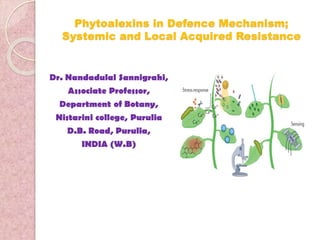
Phytoalexins in Defence Mechanism;
Systemic and Local Acquired Resistance
Dr. Nandadulal Sannigrahi,
Associate Professor,
Department of Botany,
Nistarini college, Purulia
D.B. Road, Purulia,
INDIA (W.B)
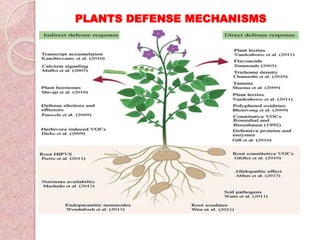
PLANTS DEFENSE MECHANISMS
 Stress either from physical or biological issues is inevitable in every
living organisms including plants; reflected in the form of diseases.
 Plants develop the counter mechanisms against the pathogens and
herbivores in order to ensure their survival against the harsh
environment both the biotic and abiotic conditions ,
 To survive, plants have developed a diverse array of defense
mechanisms, ranging from pre-formed structural barriers to complex
molecular and cellular responses that are activated upon pathogen attack,
 Mechanisms underlying disease resistance, such as gene-for-gene
resistance, quantitative resistance, systemic acquired resistance (SAR),
and induced systemic resistance (ISR),
 Pre-formed structural defenses include physical barriers such as the
cuticle, cell walls, and stomata, which prevent pathogen entry. The
cuticle, composed of waxes and Cutin, acts as the first line of defense by
creating a hydrophobic barrier that pathogens find difficult to penetrate.
Cell walls, rich in cellulose, hemicelluloses, and lignin, provide
structural support and are fortified with antimicrobial compounds,
 The defense mechanisms may be of two types- localized and systemic,
 Localized defense mechanisms-
PLANTS DEFENSE MECHANISMS
 Physical barriers largely involve properties of the plant surface, that
is, the cuticle, stomata and cell walls. Pathogens produce a range of
Cutin-degrading enzymes, which are often crucial to the successful
penetration of the plant tissue.
 The thickness of the cuticle, the presence of secondary cell wall, and
the size of stomata pores can all affect the success with which a
pathogen invades a host.
 Some plants invest in very thick walls and/or cuticles, and bark
(where present) can also provide a physical impediment to infection.
 The vertical orientation of leaves can also add to plant resistance, by
preventing the formation of moisture films of the leaf surfaces,
inhibiting infection by pathogens reliant on water for motility.
 The disease occurrence is the most important issue and this is being
regulated by the different mechanisms to counter the infection caused
by the microorganisms.
PLANTS DEFENSE MECHANISMS
 Induced Structural Defenses
 When a pathogen breaches the pre-formed defenses, plants can
reinforce their cell walls by depositing callose, a polysaccharide, at
the site of infection.
 This process, known as callose deposition, helps to seal off infected
areas and prevent the spread of the pathogen. Additionally, plants can
produce papillae, which are localized cell wall thickenings that serve
as physical barriers to pathogen entry.
 Chemical Defenses
 Plants produce a wide array of chemical compounds that act as
antimicrobial agents. These include Phenolics compounds, alkaloids,
Terpenoid, and phytoalexins.
 Phytoalexins, in particular, are low-molecular-weight antimicrobial
compounds synthesized de novo in response to pathogen attack. For
example, camalexin is a well-known phytoalexin in Arabidopsis that
is effective against a range of pathogens.
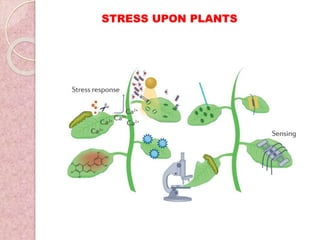
STRESS UPON PLANTS
PHYTOALEXINS
 Phytoalexins are low molecular weight antimicrobial compounds that
are produced by plants as a response to biotic and abiotic stresses. As
such they take part in an intricate defense system which enables
plants to control invading microorganisms .
 Phytoalexins’ derived from the Greek words phyton = plant and
alexin = warding off compound, coined by Muller (1961),
 When plants are stimulated physically, chemically or biologically ,
some compounds are produced as a normal metabolites in appreciable
amounts called phytoalexin like Phaeseolin, pistatin etc,
 They are not produced by plants being healthy on nature,
 Beside the structural defence, in the tissues and cells of the plants
having visible manifestations, the plants also experiences some
biochemical changes and this leads to the production of some
compounds asa part of biochemical defenses . Phytoalexins are set of
chemical produced by the plants in the defence activities.
PHYTOALEXINS
 Plant pathogens fall into two broad categories: necrotrophs (those that kill
plant cells before parasitizing them), and biotrophs (those that obtain
nutrients from living cells). Failure of pathogens to invade suitable host
cells (dead in the case of necrotrophs; alive for biotrophs) will prevent
them from infecting the host and the plant will be resistant.
 Additionally, the establishment of a parasitic relationship is dependent on
the responses of the plant under attack.
 Protection from a pathogen's initial invasion is achieved via passive
defenses, such as physical or chemical barriers.
 Despite the pre-existing structural or biochemical defense, the plants may
either involved in induced structural or biochemical defense to inhibit the
mechanisms or signaling mechanisms,
 The phytoalexins are the set of induced biochemical defense mechanisms
to kill or inhibit pathogens at the onset of host-pathogens interactions.
 The basic idea of all these issues have been addressed here with special
reference to phyoalexins.
PHYTOALEXINS
 Chemical barriers include compounds, such as "phytoanticipins" (Any
pre-existing phytoalexin that interacts with a plant pathogen), that
have antimicrobial activity and compounds that affect the vectors of
plant viruses.
 Phenols and quinones are two classes of antimicrobial compounds
produced by some plants Inhibiting compounds may be excreted into
the external environment, accumulate in dead cells or be sequestered
into vacuoles in an inactive form.
 The young fruit of numerous plants (e.g. mangoes, avocado) contain
antifungal or antimicrobial compounds that are gradually metabolized
during fruit ripening, making unripe fruit less susceptible to disease
than ripe fruit.
 Lactones, cyanogenic glycosides, saponins, Terpenoid, stilbenes and
tannins are also plant-produced compounds associated with pathogen
resistance.
PHYTOALEXINS
 Almost every host-parasite interaction is unique in the details of the
activation, localization, timing and magnitude of the defence
responses. At the membrane.
 The host membrane appears to be involved in the earliest stages of
pathogen recognition and signal transduction.
 A change in membrane permeability after exposure to a pathogen
causes fluxes in ions, such as K+, H+ and Ca2+ and results in
changes to gene activation and the triggering of the defence
responses.
 Also at the membrane, the 'oxidative burst', which involves the
generation of reactive oxygen species, such as hydrogen peroxide,
triggers signals that affect gene expression, cross-linking in the host
cell wall and initiation of later defence responses.
 The reactive oxygen species at the site of infection are also produced
in quantities that capable of killing micro-organisms directly.
PHYTOALEXINS
 At the cell wall Preparations for the reinforcement of the cell wall,
which can improve host resistance, begin very quickly after a
pathogen attempts to penetrate a host cell.
 This is characterized by an intensification of cytoplasmic streaming
and the accumulation of host cytoplasm around the site of attempted
penetration.
 The cytoplasmic aggregates are thought to contain cellular apparatus
for the synthesis of cell wall fortifications. If the host cell can repair
and reinforce its cell walls quickly enough, it might reduce the
penetration efficiency of the pathogen.
 Several types of reinforcement are produced by host cells.
 A papilla (A small rounded protuberance on a part or organ of the
body) is a deposit of callose (Callose is a plant polysaccharide),
silicon, lignin and proteins between the cell wall and cell membrane,
directly below the point of attempted penetration, while lignotubers
are lignified callose reinforcements that ensheath invading hyphal tips.
PHYTOALEXINS
 The hypersensitive response Hypersensitive cell death is another
widespread mechanism used by hosts to prevent the spread of a
pathogen. Infected cells and those surrounding them "suicide",
preventing further spread, and in some cases, killing the pathogen. It
is often associated with the initiation of other responses, such as
lignification and the synthesis of anti-microbial compounds.
 The success of hypersensitive cell death as a resistance mechanism
depends on the nutritional requirements of the specific pathogen and
the timing, magnitude and location of the host response.
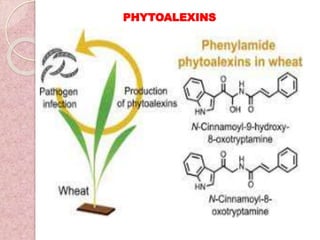
 Phytoalexin Phytoalexins are low molecular weight antibiotics
produced by many (but not all) plants in response to infection.
 There are many biotic elicitors of phytoalexin production, such as cell
wall components, as well as abiotic elicitors, such as heavy metals
and ultraviolet light.
 Phytoalexins inhibit the growth of bacteria and fungi in vivo and in
vitro, and production of these antibiotics during an infection can
induce resistance to subsequent infections by that pathogen.
PHYTOALEXINS
PHYTOALEXINS
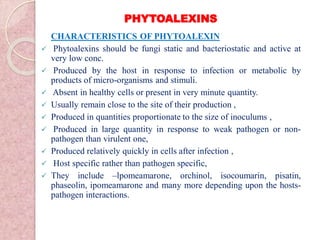
CHARACTERISTICS OF PHYTOALEXIN
 Phytoalexins should be fungi static and bacteriostatic and active at
very low conc.
 Produced by the host in response to infection or metabolic by
products of micro-organisms and stimuli.
 Absent in healthy cells or present in very minute quantity.
 Usually remain close to the site of their production ,
 Produced in quantities proportionate to the size of inoculums ,
 Produced in large quantity in response to weak pathogen or non-
pathogen than virulent one,
 Produced relatively quickly in cells after infection ,
 Host specific rather than pathogen specific,
 They include –lpomeamarone, orchinol, isocoumarin, pisatin,
phaseolin, ipomeamarone and many more depending upon the hosts-
pathogen interactions.
PHYTOALEXINS
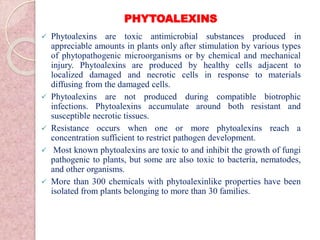
 Phytoalexins are toxic antimicrobial substances produced in
appreciable amounts in plants only after stimulation by various types
of phytopathogenic microorganisms or by chemical and mechanical
injury. Phytoalexins are produced by healthy cells adjacent to
localized damaged and necrotic cells in response to materials
diffusing from the damaged cells.
 Phytoalexins are not produced during compatible biotrophic
infections. Phytoalexins accumulate around both resistant and
susceptible necrotic tissues.
 Resistance occurs when one or more phytoalexins reach a
concentration sufficient to restrict pathogen development.
 Most known phytoalexins are toxic to and inhibit the growth of fungi
pathogenic to plants, but some are also toxic to bacteria, nematodes,
and other organisms.
 More than 300 chemicals with phytoalexinlike properties have been
isolated from plants belonging to more than 30 families.
PHYTOALEXINS
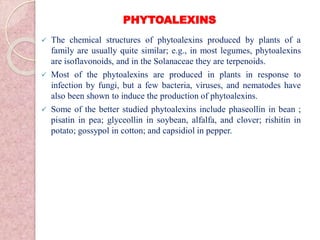
 The chemical structures of phytoalexins produced by plants of a
family are usually quite similar; e.g., in most legumes, phytoalexins
are isoflavonoids, and in the Solanaceae they are terpenoids.
 Most of the phytoalexins are produced in plants in response to
infection by fungi, but a few bacteria, viruses, and nematodes have
also been shown to induce the production of phytoalexins.
 Some of the better studied phytoalexins include phaseollin in bean ;
pisatin in pea; glyceollin in soybean, alfalfa, and clover; rishitin in
potato; gossypol in cotton; and capsidiol in pepper.
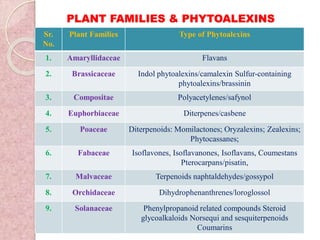
PLANT FAMILIES & PHYTOALEXINS
Sr.
No.
Plant Families Type of Phytoalexins
1. Amaryllidaceae Flavans
2. Brassicaceae Indol phytoalexins/camalexin Sulfur-containing
phytoalexins/brassinin
3. Compositae Polyacetylenes/safynol
4. Euphorbiaceae Diterpenes/casbene
5. Poaceae Diterpenoids: Momilactones; Oryzalexins; Zealexins;
Phytocassanes;
6. Fabaceae Isoflavones, Isoflavanones, Isoflavans, Coumestans
Pterocarpans/pisatin,
7. Malvaceae Terpenoids naphtaldehydes/gossypol
8. Orchidaceae Dihydrophenanthrenes/loroglossol
9. Solanaceae Phenylpropanoid related compounds Steroid
glycoalkaloids Norsequi and sesquiterpenoids
Coumarins
PHYTOALEXINS BIOSYTHESIS
 Various pathways are utilized for producing different phytoalexins.
The majority of the phytoalexins discovered come from the
phenylpropanoid biosynthetic pathway, which produces organic
compounds from the amino acid phenylalanine.
 Phenylpropanoids are involved in a variety of functions and play an
important role in the plant-environment interaction. Isoflavones,
dihydrophenanthrene, stilbenes, coumarins, lignin, and other phenols
are among the secondary metabolites implicated in plant disease
resistance.
 Isopentenyldiphosphate and dimethylallyl pyrophosphate (DMAPP)
are isoprenoid precursors that may be made in plants from
mevalonate or metileritritol phosphate.
 The most distinctive ones are:
 1) Thephenylpropanoic-polymalonic acid route,
 2) Themethylerythritol phosphate geranyldiphosphate pathway,
 3) Theindolephytoalexin pathway
THEPHENYL PROPANOIC-POLYMALONIC ACID
ROUTE
 Thephenylpropanoic-polymalonic acid route
 The universal phenylpropanoic polymalonic acid route produces all
flavonoid phytoalexins(isoflavans, isoflavones, isoflavonoids,
pterocarpans, arylbenzofurans, and coumestans), as well as stilbene.
 It all starts with phenylalanine and phenylalanine ammonia-lyase
(PAL), or to a lesser extent, tyrosine and tyrosine ammonia lyase
(TAL). The resulting para-coumaric acid is activated in para-
coumaroyl-CoA by 4coumaryl: CoA (C4L) ligase ligation to a
coenzyme A.
 Chalcone synthase (CHS) and stilbene synthase (STS) utilise the
same substrate and combine it with three consecutive units of
malonyl-CoA, producing naringenin chalcone, the first C15
intermediate in the flavonoid pathway, and resveratrol, the precursor
of all stilbenes, respectively.
 The major route of this compond- principal flavonoid and stilbene-
like phytoalexins from the Leguminosae family.
PHYTOALEXINS DERIVED FROM MEVALONOID
 Phytoalexins Derived from Mevalonoid Members of the carboxylic
sesquiterpene, monoterpene, diterpene, and sesquiterpene families
make up this group of phytoalexins. In elicitor-induced rice (Oryza
sativa) cells, synchronized accumulation of seven MEP pathway gene
transcripts (OsDXS3, OsDXR, OsCMS, OsCMK, OsMCS, OsHDS,
and OsHDR) is expected, with the following stages of biosynthesis
taking place in plastids.
 Diterpenoids are formed when a variety of enzymes react with GGDP
as a starting material.
 Copalyldiphosphate synthases (CPS) are the first diterpene cyclases
to act on GGDP, initiating the first cyclization of the latter to
copalyldiphosphate (CDP). Class I diterpene synthases such as
kaurene synthase-like (KSL) require CDP as a substrate.
 The olefin precursors of the main diterpene phytoalexin families are
produced by the sequential action of CPS and KSL.
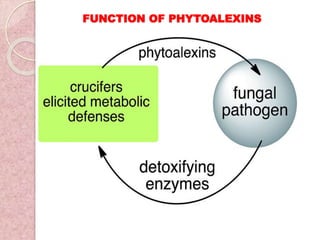
FUNCTION OF PHYTOALEXINS
 Phytoalexins are used by plants as part of a massive defence system
against pests and illnesses. Plants develop and accumulate
antimicrobial compounds with a low molecular weight in response to
biotic and abiotic stresses.
 Phytoalexins are chemicals that are synthesized from distant sources
by enzyme de novo synthesis. Because of this characteristic,
deciphering their biosynthesis and regulatory processes is extremely
difficult. Phosphorylation cascades, defence-related marker genes,
calcium sensors and elicitors, as well as hormone signaling, may all
play a role in phytoalexin synthesis and pathogen resistance
regulation.
 Its accumulation has paved the way for genetic modification of those
molecules in designed plants to improve disease resistance.
 It accumulates at infection sites and limit the growth of fungi and
bacteria in vitro, suggesting that they could be utilized to protect
plants from fungi and bacteria caused illnesses.
 Phytoalexins are significantly less toxic than chemical fungicides.
FUNCTION OF PHYTOALEXINS
 Phytoalexin control Fungi:
 By the inhibition of plant surfaces-fungal growth on young leaves
may be restricted by phytoalexins produced by underlying cells
in response to fungal metabolites diffusing from germinating
spores.
 Inhibition during attempted penetration to the host plants-
 Different sorts of deposit (Papillae) have been discovered to
aggregate inside living cells underneath destinations of endeavored
entrance, The different types of external boundaries to delimit fungal
infection is partially modified by the presence of phytoalexins.
 Inhibition after penetration- Phytoalexins play a very significant role
in the inhibition of the penetration of the fungal spores after the
counter attack in the initial stages by epidermal cells or intercellular
spaces.
 Phytoalexin control Bacteria- Phytoalexins play a very significant
role in controlling the pathogens being bacterial in nature in this
regard.
CONCLUSION
 Plants use an intricate defense system against pests and pathogens,
including the production of low molecular mass secondary metabolites
with antimicrobial activity, which are synthesized de novo after stress
and are collectively known as phytoalexins.
 They are not produced by the healthy plants but it can trigger the
production in response to the stress signals,
 They are structurally diverse including the diverse chemicals including
isoflavonoids, terpenoides and polyacetelenes,
 Although some pathogens have the potential ability to detoxify
phytoalexins by reducing their effectiveness,
 A strong correlation has been found in between the high
concentrations of phytoalexins and disease resistance,
 Phyoalexins are the natural defence mechanisms operated by plants in
order to avoid stress signals come from the different physical and
biochemical exposures.
THANKS FOR YOUR VISIT
 ACKNOWLEDGEMENTS:
a. Google for images,
b. Different websites for enriching the course content,
c. Science Direct pages,
d. Plant Pathology- Dr. B. P. Pandey,
e. Plant diseases, insects and pests- NCBI-NH,
f. Topics in Mycology and Pathology-L.N. Nair
g. www.nature.com
h. www.spruce.com
i. www.aphis.usda.gov
j. Puregreensaz.com
k. www.fao.org
l. Many more websites for references.
 This presentation has been designed to address the academic fraternity
without any financial interest. This is absolutely free to use . The
author does not claim any kind of financial benefits from this content.