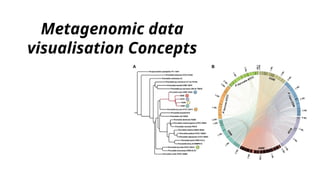
Comprehensive Insights into Metagenomics: Techniques, Tools, and Applications
Explore metagenomics concepts, methodologies, sequencing technologies, bioinformatics tools, and diverse applications in environmental monitoring, biotechnology, medicine, and agriculture.
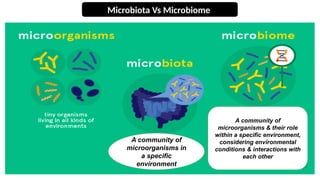
A community of
microorganismsin
a specific
environment
Microbiota Vs Microbiome
A community of
microorganisms & their role
within a specific environment,
considering environmental
conditions & interactions with
each other
3.
What is metagenomics?
•1998- Jo Handelsman coined the term “Metagenomics”.
• Greek word, Meta means "transcendent" (combination of separate analysis) Genomics -study of the
genome/ Metagenomics (meta: beyond; beyond the simple genome study)
• Definition- “The genomics analysis of microorganism by direct extraction and cloning DNA from
an assemblage of microorganisms.“
• Other terms- Community genomics/ Environmental genomics/ Population genomics.
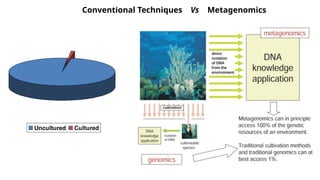
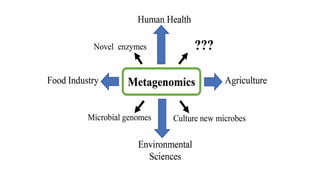
• Metagenomics is a strategy to analyse genomes acquired from the community of environmental
microorganisms without culturing them.
• Read the diversity of microorganisms up to 99% of the total microorganisms in environmental
samples.
• Introduces a new concept in microbiology to discover natural biochemical compounds for
biotechnology applications.
• Two basic approaches:
Taxonomic application (Sequence-based analysis)
Functional application (Function driven analysis)
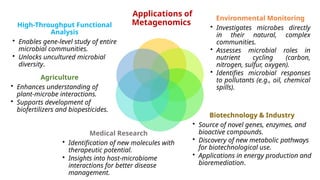
Applications of
Metagenomics
Environmental Monitoring
•Investigates microbes directly
in their natural, complex
communities.
• Assesses microbial roles in
nutrient cycling (carbon,
nitrogen, sulfur, oxygen).
• Identifies microbial responses
to pollutants (e.g., oil, chemical
spills).
Biotechnology & Industry
• Source of novel genes, enzymes, and
bioactive compounds.
• Discovery of new metabolic pathways
for biotechnological use.
• Applications in energy production and
bioremediation.
Medical Research
• Identification of new molecules with
therapeutic potential.
• Insights into host-microbiome
interactions for better disease
management.
Agriculture
• Enhances understanding of
plant-microbe interactions.
• Supports development of
biofertilizers and biopesticides.
High-Throughput Functional
Analysis
• Enables gene-level study of entire
microbial communities.
• Unlocks uncultured microbial
diversity.
9.
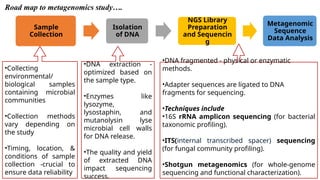
Road map tometagenomics study….
Sample
Collection
Isolation
of DNA
NGS Library
Preparation
and Sequencin
g
Metagenomic
Sequence
Data Analysis
•Collecting
environmental/
biological samples
containing microbial
communities
•Collection methods
vary depending on
the study
•Timing, location, &
conditions of sample
collection -crucial to
ensure data reliability.
•DNA extraction -
optimized based on
the sample type.
•Enzymes like
lysozyme,
lysostaphin, and
mutanolysin lyse
microbial cell walls
for DNA release.
•The quality and yield
of extracted DNA
impact sequencing
success.
•DNA fragmented - physical or enzymatic
methods.
•Adapter sequences are ligated to DNA
fragments for sequencing.
•Techniques include
•16S rRNA amplicon sequencing (for bacterial
taxonomic profiling).
•ITS(internal transcribed spacer) sequencing
(for fungal community profiling).
•Shotgun metagenomics (for whole-genome
sequencing and functional characterization).
10.
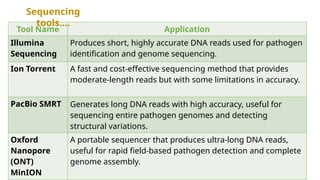
Tool Name Application
Illumina
Sequencing
Producesshort, highly accurate DNA reads used for pathogen
identification and genome sequencing.
Ion Torrent A fast and cost-effective sequencing method that provides
moderate-length reads but with some limitations in accuracy.
PacBio SMRT Generates long DNA reads with high accuracy, useful for
sequencing entire pathogen genomes and detecting
structural variations.
Oxford
Nanopore
(ONT)
MinION
A portable sequencer that produces ultra-long DNA reads,
useful for rapid field-based pathogen detection and complete
genome assembly.
Sequencing
tools….
11.
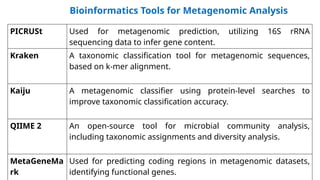
PICRUSt Used formetagenomic prediction, utilizing 16S rRNA
sequencing data to infer gene content
.
Kraken A taxonomic classification tool for metagenomic sequences,
based on k-mer alignment
.
Kaiju A metagenomic classifier using protein-level searches to
improve taxonomic classification accuracy
.
QIIME 2 An open-source tool for microbial community analysis,
including taxonomic assignments and diversity analysis
.
MetaGeneMa
rk
Used for predicting coding regions in metagenomic datasets,
identifying functional genes.
Bioinformatics Tools for Metagenomic Analysis
12.
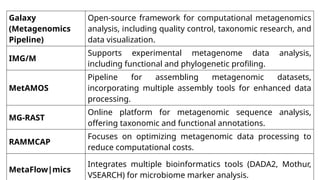
Galaxy
(Metagenomics
Pipeline)
Open-source framework forcomputational metagenomics
analysis, including quality control, taxonomic research, and
data visualization.
IMG/M
Supports experimental metagenome data analysis,
including functional and phylogenetic profiling.
MetAMOS
Pipeline for assembling metagenomic datasets,
incorporating multiple assembly tools for enhanced data
processing.
MG-RAST
Online platform for metagenomic sequence analysis,
offering taxonomic and functional annotations.
RAMMCAP
Focuses on optimizing metagenomic data processing to
reduce computational costs.
MetaFlow|mics
Integrates multiple bioinformatics tools (DADA2, Mothur,
VSEARCH) for microbiome marker analysis
.
13.
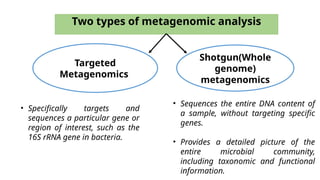
Two types ofmetagenomic analysis
Targeted
Metagenomics
Shotgun(Whole
genome)
metagenomics
• Specifically targets and
sequences a particular gene or
region of interest, such as the
16S rRNA gene in bacteria.
• Sequences the entire DNA content of
a sample, without targeting specific
genes.
• Provides a detailed picture of the
entire microbial community,
including taxonomic and functional
information.
14.
Targeted Metagenomic Analyses
Targetedmetagenomics is a technique that allows for the selective
enrichment and sequencing of specific microbial species or communities
within a complex sample
15.
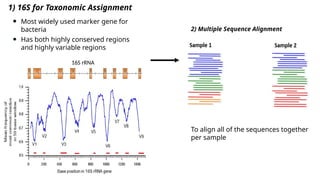
Most widely usedmarker gene for
bacteria
Has both highly conserved regions
and highly variable regions
16S rRNA
1) 16S for Taxonomic Assignment
2) Multiple Sequence Alignment
To align all of the sequences together
per sample
16.
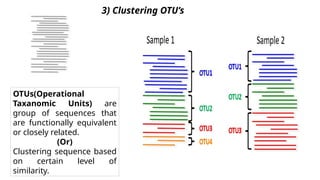
3) Clustering OTU’s
OTUs(Operational
TaxanomicUnits) are
group of sequences that
are functionally equivalent
or closely related.
(Or)
Clustering sequence based
on certain level of
similarity.
17.
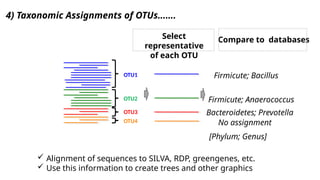
OTU1
OTU2
OTU3
OTU4
Select
representative
of each OTU
Compareto databases
[Phylum; Genus]
Firmicute; Bacillus
Firmicute; Anaerococcus
Bacteroidetes; Prevotella
No assignment
Alignment of sequences to SILVA, RDP, greengenes, etc.
Use this information to create trees and other graphics
4) Taxonomic Assignments of OTUs…….
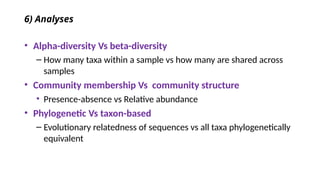
• Alpha-diversity Vsbeta-diversity
– How many taxa within a sample vs how many are shared across
samples
• Community membership Vs community structure
• Presence-absence vs Relative abundance
• Phylogenetic Vs taxon-based
– Evolutionary relatedness of sequences vs all taxa phylogenetically
equivalent
6) Analyses
20.
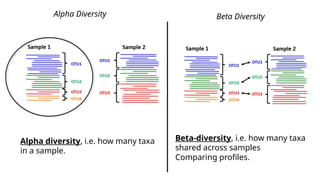
Alpha Diversity BetaDiversity
Alpha diversity, i.e. how many taxa
in a sample.
Beta-diversity, i.e. how many taxa
shared across samples
Comparing profiles.
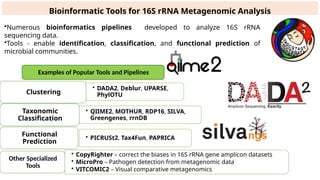
•Numerous bioinformatics pipelinesdeveloped to analyze 16S rRNA
sequencing data.
•Tools - enable identification, classification, and functional prediction of
microbial communities.
Examples of Popular Tools and Pipelines
• DADA2, Deblur, UPARSE,
PhylOTU
Clustering
• QIIME2, MOTHUR, RDP16, SILVA,
Greengenes, rrnDB
Taxonomic
Classification
• PICRUSt2, Tax4Fun, PAPRICA
Functional
Prediction
• CopyRighter – correct the biases in 16S rRNA gene amplicon datasets
• MicroPro – Pathogen detection from metagenomic data
• VITCOMIC2 – Visual comparative metagenomics
Other Specialized
Tools
Bioinformatic Tools for 16S rRNA Metagenomic Analysis
24.
Shotgun metagenomics
Shotgun metagenomics,is the untargeted ('shotgun')
sequencing of all ('meta-') microbial genomes 'genomics'
present in a sample.
It can be used to profile taxonomic composition and
functional potential of microbial communities and to
recover whole genome sequences.
25.
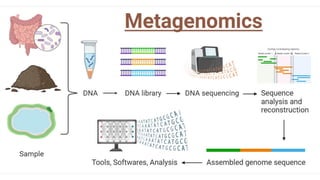
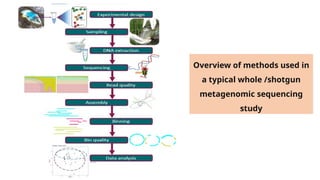
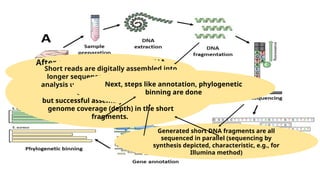
Overview of methodsused in
a typical whole /shotgun
metagenomic sequencing
study
26.
After sample collectionand DNA
extraction, genetic material
needs to be fragmented.
Generated short DNA fragments are all
sequenced in parallel (sequencing by
synthesis depicted, characteristic, e.g., for
Illumina method)
Short reads are digitally assembled into
longer sequences for gene or genome
analysis using either a reference genome
or de novo assembly
but successful assembly requires enough
genome coverage (depth) in the short
fragments.
Next, steps like annotation, phylogenetic
binning are done
27.
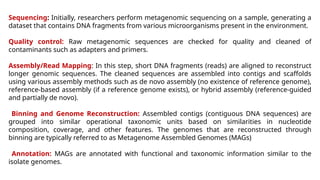
Sequencing: Initially, researchersperform metagenomic sequencing on a sample, generating a
dataset that contains DNA fragments from various microorganisms present in the environment.
Quality control: Raw metagenomic sequences are checked for quality and cleaned of
contaminants such as adapters and primers.
Assembly/Read Mapping: In this step, short DNA fragments (reads) are aligned to reconstruct
longer genomic sequences. The cleaned sequences are assembled into contigs and scaffolds
using various assembly methods such as de novo assembly (no existence of reference genome),
reference-based assembly (if a reference genome exists), or hybrid assembly (reference-guided
and partially de novo).
Binning and Genome Reconstruction: Assembled contigs (contiguous DNA sequences) are
grouped into similar operational taxonomic units based on similarities in nucleotide
composition, coverage, and other features. The genomes that are reconstructed through
binning are typically referred to as Metagenome Assembled Genomes (MAGs)
Annotation: MAGs are annotated with functional and taxonomic information similar to the
isolate genomes.
28.
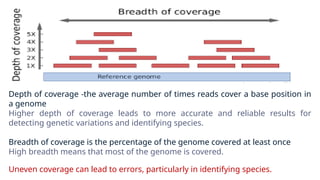
Depth of coverage-the average number of times reads cover a base position in
a genome
Higher depth of coverage leads to more accurate and reliable results for
detecting genetic variations and identifying species.
Breadth of coverage is the percentage of the genome covered at least once
High breadth means that most of the genome is covered.
Uneven coverage can lead to errors, particularly in identifying species.
29.
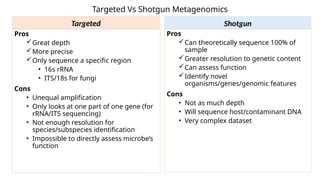
Targeted Vs ShotgunMetagenomics
Targeted
Pros
Great depth
More precise
Only sequence a specific region
• 16s rRNA
• ITS/18s for fungi
Cons
• Unequal amplification
• Only looks at one part of one gene (for
rRNA/ITS sequencing)
• Not enough resolution for
species/subspecies identification
• Impossible to directly assess microbe’s
function
Shotgun
Pros
Can theoretically sequence 100% of
sample
Greater resolution to genetic content
Can assess function
Identify novel
organisms/genes/genomic features
Cons
• Not as much depth
• Will sequence host/contaminant DNA
• Very complex dataset
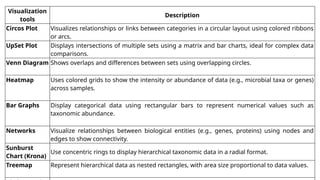
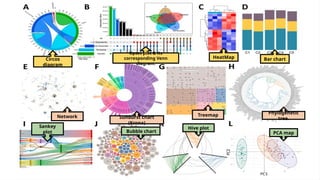
Visualization
tools
Description
Circos Plot Visualizesrelationships or links between categories in a circular layout using colored ribbons
or arcs.
UpSet Plot Displays intersections of multiple sets using a matrix and bar charts, ideal for complex data
comparisons.
Venn Diagram Shows overlaps and differences between sets using overlapping circles.
Heatmap Uses colored grids to show the intensity or abundance of data (e.g., microbial taxa or genes)
across samples.
Bar Graphs Display categorical data using rectangular bars to represent numerical values such as
taxonomic abundance.
Networks Visualize relationships between biological entities (e.g., genes, proteins) using nodes and
edges to show connectivity.
Sunburst
Chart (Krona)
Use concentric rings to display hierarchical taxonomic data in a radial format.
Treemap Represent hierarchical data as nested rectangles, with area size proportional to data values.
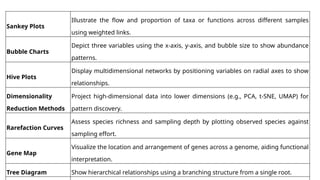
32.
Sankey Plots
Illustrate theflow and proportion of taxa or functions across different samples
using weighted links.
Bubble Charts
Depict three variables using the x-axis, y-axis, and bubble size to show abundance
patterns.
Hive Plots
Display multidimensional networks by positioning variables on radial axes to show
relationships.
Dimensionality
Reduction Methods
Project high-dimensional data into lower dimensions (e.g., PCA, t-SNE, UMAP) for
pattern discovery.
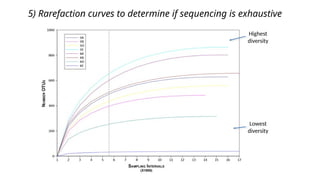
Rarefaction Curves
Assess species richness and sampling depth by plotting observed species against
sampling effort.
Gene Map
Visualize the location and arrangement of genes across a genome, aiding functional
interpretation.
Tree Diagram Show hierarchical relationships using a branching structure from a single root.
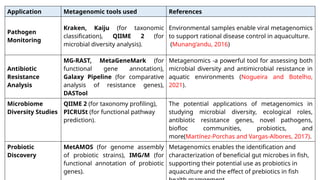
Application Metagenomic toolsused References
Pathogen
Monitoring
Kraken, Kaiju (for taxonomic
classification), QIIME 2 (for
microbial diversity analysis).
Environmental samples enable viral metagenomics
to support rational disease control in aquaculture.
(Munang’andu, 2016)
Antibiotic
Resistance
Analysis
MG-RAST, MetaGeneMark (for
functional gene annotation),
Galaxy Pipeline (for comparative
analysis of resistance genes),
DASTool
Metagenomics -a powerful tool for assessing both
microbial diversity and antimicrobial resistance in
aquatic environments (Nogueira and Botelho,
2021).
Microbiome
Diversity Studies
QIIME 2 (for taxonomy profiling),
PICRUSt (for functional pathway
prediction).
The potential applications of metagenomics in
studying microbial diversity, ecological roles,
antibiotic resistance genes, novel pathogens,
biofloc communities, probiotics, and
more(Martínez-Porchas and Vargas-Albores, 2017).
Probiotic
Discovery
MetAMOS (for genome assembly
of probiotic strains), IMG/M (for
functional annotation of probiotic
genes).
Metagenomics enables the identification and
characterization of beneficial gut microbes in fish,
supporting their potential use as probiotics in
aquaculture and the effect of prebiotics in fish
36.
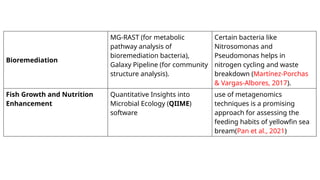
Bioremediation
MG-RAST (for metabolic
pathwayanalysis of
bioremediation bacteria),
Galaxy Pipeline (for community
structure analysis).
Certain bacteria like
Nitrosomonas and
Pseudomonas helps in
nitrogen cycling and waste
breakdown (Martínez-Porchas
& Vargas-Albores, 2017).
Fish Growth and Nutrition
Enhancement
Quantitative Insights into
Microbial Ecology (QIIME)
software
use of metagenomics
techniques is a promising
approach for assessing the
feeding habits of yellowfin sea
bream(Pan et al., 2021)
37.
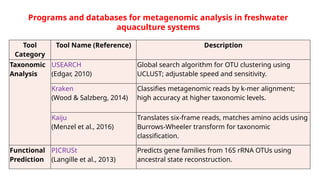
Tool
Category
Tool Name (Reference)Description
Taxonomic
Analysis
USEARCH
(Edgar, 2010)
Global search algorithm for OTU clustering using
UCLUST; adjustable speed and sensitivity.
Kraken
(Wood & Salzberg, 2014)
Classifies metagenomic reads by k-mer alignment;
high accuracy at higher taxonomic levels.
Kaiju
(Menzel et al., 2016)
Translates six-frame reads, matches amino acids using
Burrows-Wheeler transform for taxonomic
classification.
Functional
Prediction
PICRUSt
(Langille et al., 2013)
Predicts gene families from 16S rRNA OTUs using
ancestral state reconstruction.
Programs and databases for metagenomic analysis in freshwater
aquaculture systems
38.
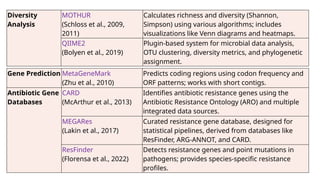
Gene Prediction MetaGeneMark
(Zhuet al., 2010)
Predicts coding regions using codon frequency and
ORF patterns; works with short contigs.
Antibiotic Gene
Databases
CARD
(McArthur et al., 2013)
Identifies antibiotic resistance genes using the
Antibiotic Resistance Ontology (ARO) and multiple
integrated data sources.
MEGARes
(Lakin et al., 2017)
Curated resistance gene database, designed for
statistical pipelines, derived from databases like
ResFinder, ARG-ANNOT, and CARD.
ResFinder
(Florensa et al., 2022)
Detects resistance genes and point mutations in
pathogens; provides species-specific resistance
profiles.
Diversity
Analysis
MOTHUR
(Schloss et al., 2009,
2011)
Calculates richness and diversity (Shannon,
Simpson) using various algorithms; includes
visualizations like Venn diagrams and heatmaps.
QIIME2
(Bolyen et al., 2019)
Plugin-based system for microbial data analysis,
OTU clustering, diversity metrics, and phylogenetic
assignment.
39.
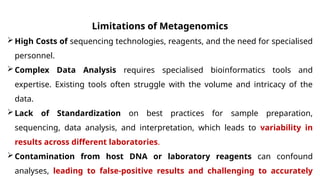
Limitations of Metagenomics
HighCosts of sequencing technologies, reagents, and the need for specialised
personnel.
Complex Data Analysis requires specialised bioinformatics tools and
expertise. Existing tools often struggle with the volume and intricacy of the
data.
Lack of Standardization on best practices for sample preparation,
sequencing, data analysis, and interpretation, which leads to variability in
results across different laboratories.
Contamination from host DNA or laboratory reagents can confound
analyses, leading to false-positive results and challenging to accurately
40.
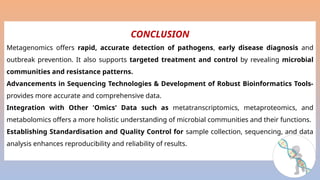
CONCLUSION
Metagenomics offers rapid,accurate detection of pathogens, early disease diagnosis and
outbreak prevention. It also supports targeted treatment and control by revealing microbial
communities and resistance patterns.
Advancements in Sequencing Technologies & Development of Robust Bioinformatics Tools-
provides more accurate and comprehensive data.
Integration with Other 'Omics' Data such as metatranscriptomics, metaproteomics, and
metabolomics offers a more holistic understanding of microbial communities and their functions.
Establishing Standardisation and Quality Control for sample collection, sequencing, and data
analysis enhances reproducibility and reliability of results.
41.
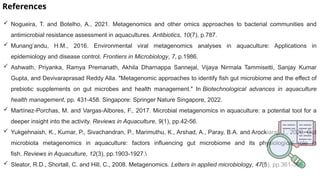
Nogueira, T.and Botelho, A., 2021. Metagenomics and other omics approaches to bacterial communities and
antimicrobial resistance assessment in aquacultures. Antibiotics, 10(7), p.787.
Munang’andu, H.M., 2016. Environmental viral metagenomics analyses in aquaculture: Applications in
epidemiology and disease control. Frontiers in Microbiology, 7, p.1986.
Ashwath, Priyanka, Ramya Premanath, Akhila Dharnappa Sannejal, Vijaya Nirmala Tammisetti, Sanjay Kumar
Gupta, and Devivaraprasad Reddy Alla. "Metagenomic approaches to identify fish gut microbiome and the effect of
prebiotic supplements on gut microbes and health management." In Biotechnological advances in aquaculture
health management, pp. 431-458. Singapore: Springer Nature Singapore, 2022.
Martínez Porchas, M. and Vargas Albores, F., 2017. Microbial metagenomics in aquaculture: a potential tool for a
‐ ‐
deeper insight into the activity. Reviews in Aquaculture, 9(1), pp.42-56.
Yukgehnaish, K., Kumar, P., Sivachandran, P., Marimuthu, K., Arshad, A., Paray, B.A. and Arockiaraj, J., 2020. Gut
microbiota metagenomics in aquaculture: factors influencing gut microbiome and its physiological role in
fish. Reviews in Aquaculture, 12(3), pp.1903-1927.
Sleator, R.D., Shortall, C. and Hill, C., 2008. Metagenomics. Letters in applied microbiology, 47(5), pp.361-366.
References
42.
Pan, W., Qin,C., Zuo, T., Yu, G., Zhu, W., Ma, H. and Xi, S., 2021. Is metagenomic analysis an effective way to
analyze fish feeding habits? A case of the yellowfin sea bream Acanthopagrus latus (Houttuyn) in Daya
bay. Frontiers in Marine Science, 8, p.634651.
Hemamalini, N., Shanmugam, S.A., Kathirvelpandian, A., Deepak, A., Kaliyamurthi, V. and Suresh, E., 2022. A
critical review on the antimicrobial resistance, antibiotic residue and metagenomics assisted antimicrobial resistance
‐
gene detection in freshwater aquaculture environment. Aquaculture Research, 53(2), pp.344-366.
Navgire, G.S., Goel, N., Sawhney, G., Sharma, M., Kaushik, P., Mohanta, Y.K., Mohanta, T.K. and Al-Harrasi, A.,
2022. Analysis and Interpretation of metagenomics data: An approach. Biological Procedures Online, 24(1), p.18.
Miller, S. and Chiu, C., 2022. The role of metagenomics and next-generation sequencing in infectious disease
diagnosis. Clinical chemistry, 68(1), pp.115-124.
Macedo, D.B., dos Anjos, T.M.C., De Los Santos, E.F.F., Rodrigues, M.D.N., Alegria, O.V.C. and Ramos, R.T.J.,
2024. New perspectives on metagenomic analysis for pathogen monitoring in sustainable freshwater aquaculture
production: a systematic review. Frontiers in Freshwater Science, 2, p.1459233.
Aplakidou, E., Vergoulidis, N., Chasapi, M., Venetsianou, N.K., Kokoli, M., Panagiotopoulou, E., Iliopoulos, I.,
Karatzas, E., Pafilis, E., Georgakopoulos-Soares, I. and Kyrpides, N.C., 2024. Visualizing metagenomic and
metatranscriptomic data: A comprehensive review. Computational and Structural Biotechnology Journal.
#15 The peaks represent conservation, the valleys represent variability.
Variation is generally greater across species than within, making species identification much easier
Similar profile to 18s gene for fungus
#17 As I mentioned earlier, when going forward it is very useful to reduce the size of the dataset. Since everything within an OTU is similar, picking a representative is trivial.
Once you pick your OTU representative you can query that against a database to assign taxonomy.
#18 A common graph used in metagenomics is a rarefaction curve.
To see how well you sequenced your sample, you can use this to show the number of OTUs determined in each sample for a set number of sequence reads. The dashed line indicates the number of OTUs we see with only 5,500 reads.
The ideal scenario is high number of OTUs at a low sampling intervals.
This is a good way to see if you should have sampled enough
#19 Once you’ve established your profiles you can go forward with comparing samples.
There are several comparisons that are generally used
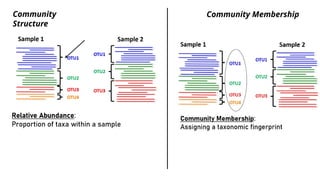
Community membership is assigning a fingerprint to your OTU whereas structure is looking at the proportions within that fingerprint
phylogenetic based is looking at how related these organisms are and taxon based is looking at what kinds of bacteria are there
#20 is beta diversity – look at the difference in presence absence/abundance of OTUs
#21 Community structure looks at the proportions of taxa compared to the rest
Community membership identifies only the organisms that are there
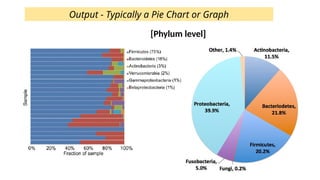
#22 In making these comparisons, these graphs are normally the end result.
The top graph is looking at the relative abundance of each organism within a sample across all samples
The bottom is looking at the proportions within a sample
These the typical end result for 16s analysis
#29 Each method has its own pros and cons.
targeted:
Pros:
Great depth – you sequence hundreds of copies of a specific region
Will sequence only this region, assuming your primers work
Cons:
Due to many factors, certain targeted regions will be amplified at different rates
Since you’re only sequencing one small part of an organism’s you do not know what other genes its genome contains
Shotgun
Pros
Sequencing more genes and more of the genome, so you can infer a lot
Cons:
Rarely comes close to sequencing everything in the sample.
More horizontal coverage than vertical
It’s more expensive than targeted sequencing