Comprehensive History and Business Overview of Reliance Group
An in-depth presentation covering Reliance Group's history, diversification, key subsidiaries, products, and its evolution from textiles to digital services and renewable energy.
Comprehensive History and Business Overview of Reliance Group
1.
SHREEYASH PRATISHTHAN’S
Shreeyash Instituteof Management Studies and Research
Department of MBA
Chh. Sambhaji Nagar-431010
Academic Year -2024-25
SUB : Organizational Behaviour
Submitted by,
Name of student : Sudam Balasaheb Kurhe
Roll No. : MB24134
2.
History of RelianceGroup
• Reliance Industries Limited is an Indian multinational conglomerate
company headquartered in Mumbai, Maharashtra.
• It was founded by Dhirubhai Ambani in 1958 and is currently led by his
son, Mukesh Ambani. It operates in various sectors, including
petrochemicals, refining, oil and gas exploration, retail,
telecommunications, and media.
• The company is one of the largest conglomerates in India and operates
through a network of subsidiaries, joint ventures, and associate companies.
• Its subsidiary companies include Reliance Retail, Reliance Jio Infocomm,
and Reliance Petroleum. RIL is known for its focus on technology and
innovation and has been at the forefront of the digital transformation of
India through its telecom and internet businesses.
• Reliance Group of Industries is also one of the most valuable companies in
India and is listed on the Bombay Stock Exchange and the National Stock
Exchange.
3.
The Early Days(1958-1966)
• The history of Reliance begins with Dhirubhai Ambani, a
visionary entrepreneur from Gujarat. In 1958, Dhirubhai
started a small textile trading business with just 15,000 in
₹
Mumbai. He began by exporting spices and other commodities
to Yemen.
• In 1966, Dhirubhai took a significant step by establishing
Reliance Commercial Corporation. This company focused on
importing polyester yarn and exporting spices. During this
time, Dhirubhai saw the potential in the textile business,
particularly in synthetic fabrics.
4.
Entering Manufacturing (1966-1977)
•Recognizing the opportunity in synthetic textiles, Dhirubhai
decided to move from trading to manufacturing. In 1966, he
set up a textile mill in Naroda, Gujarat. This marked Reliance's
entry into the manufacturing sector.
The company quickly gained a reputation for quality products.
Its brand, 'Vimal', became a household name in India for
fabrics and garments.
5.
Going Public (1977)
•In 1977, Reliance Industries held its Initial Public Offering
(IPO), marking a turning point in the company's history. This
move allowed Reliance to raise capital from the public and
expand its operations further.
Interestingly, the Reliance IPO was oversubscribed seven
times, showing the public's faith in the company. This IPO
created a new class of retail investors in India, many of whom
were first-time investors in the stock market.
6.
Expansion and Diversification(1980s-1990s)
• The 1980s and 1990s saw Reliance expanding rapidly and diversifying
into new areas:
• ● 1981: Reliance entered the textiles and polyester filament yarn
business.
• ● 1985: The company started a polyester staple fibre plant.
• ● 1991: Reliance entered the petrochemicals business with a plant at
Hazira, Gujarat.
• ● 1993: Reliance Petroleum Limited was incorporated.
• ● 1997: Reliance introduced packaged LPG in India.
• Reliance was also integrated backward during this period, moving from
textiles to fiber to petrochemicals. This strategy helped the company
control costs and improve efficiency.
7.
The New Millennium(2000-2010)
• The early 2000s brought both challenges and opportunities for
Reliance:
• ● 2002: Dhirubhai Ambani passed away, leaving the company
in the hands of his sons, Mukesh and Anil.
• ● 2005: The company split between the two brothers, with
Mukesh retaining control of Reliance Industries.
• ● 2007: Reliance acquired a stake in various companies
abroad, marking its global expansion. 2009: Reliance
commissioned the world's largest petroleum refinery in
Jamnagar, Gujarat.
8.
The Digital Revolution(2010-Present)
• The most recent chapter in Reliance's history has been marked by its entry
into digital services:
• ● 2016: Reliance Jio was launched, revolutionizing India's telecom sector
with its affordable data plans.
• ● 2019: Reliance became debt-free, nine months ahead of its March 2021
target.
• ● 2020: During the COVID-19 pandemic, Reliance raised over $20 billion
by selling stakes in Jio Platforms to global tech giants like Facebook and
Google.
• ● 2021: Reliance announced its plans to invest in renewable energy,
aiming to become a net carbon-zero company by 2035.
• Throughout its history, Reliance has shown a knack for identifying
emerging opportunities and adapting to changing market conditions. From
textiles to petrochemicals to digital services, the company has consistently
reinvented itself to stay at the forefront of India's economic growth.
9.
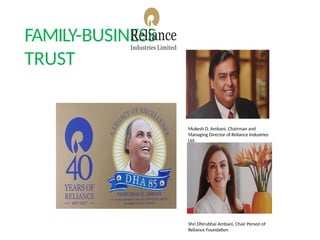
FAMILY-BUSINESS
TRUST
Mukesh D. Ambani,Chairman and
Managing Director of Reliance Industries
Ltd.
Shri Dhirubhai Ambani, Chair Person of
Reliance Foundation
10.
Products and Brandsunder Reliance Industries
• Petrochemicals
• RIL is the largest producer of petrochemicals in India and offers a range of products like polyethylene,
polypropylene, polyester, PVC, and others. Some of the brands under petrochemicals are Relene, Recron,
and Novex.
• Refining
• RIL has the world's largest refining complex, producing gasoline, diesel, and aviation fuels. The brands under
refining are RelPet and RelDiesel.
• Oil and Gas Exploration
• RIL is one of India's leading oil and gas sector players and has interests in exploration, production, and
refining. The major brands under this segment are KG-D6 and MA.
• Telecom
• RIL's telecom arm, Reliance Jio, has become one of the largest telecom operators in India, offering high-
speed internet, voice, and data services. Some popular brands under Reliance Jio are JioFiber, JioMart, and
JioSaavn.
• Retail
• RIL's retail arm, Reliance Retail, is India's most significant organized retail player and offers a range of
products like groceries, electronics, apparel, and footwear. Some popular brands under Reliance Retail are
Reliance Fresh, Reliance Digital, and AJIO.
• Textiles
• RIL's textiles division produces a range of products like fabrics, apparel, and home textiles. Some popular
brands under textiles are Vimal, Only Vimal, and Recron.
11.
List of MajorSubsidiaries of Reliance
• Jio Platforms Limited
• A digital services company that provides a wide range of services, including mobile and broadband services, digital content, and e-commerce
platforms. It is amongst the highest profit-grossing Reliance company products.
• Reliance Retail Ventures Limited
• A subsidiary of Reliance Industries, which operates one of the largest retail chains in India. The company offers various products, including
groceries, electronics, fashion, and lifestyle products.
• Reliance Jio Infocomm Limited
• A telecommunications company that provides 4G LTE services across India. The company also offers a suite of digital services, including JioTV,
JioCinema, and JioMusic. It is one of the top Reliance group of companies.
• Reliance Industrial Infrastructure Limited
• A subsidiary of Reliance Industries that operates in the infrastructure sector. The company provides infrastructure facilities, including
transportation, storage, and handling of petroleum products.
• Reliance Petroleum Limited
• A subsidiary of Reliance Industries, which operates one of the largest oil refineries in India. The company produces a wide range of petroleum
products, including petrol, diesel, and aviation fuel.
• Reliance Life Sciences Limited
• A biotechnology company that develops advanced therapeutics, diagnostics, and stem cell technologies. The company also operates in the areas of
regenerative medicine and genomics.
• Reliance Solar
• RIL's solar energy subsidiary operates in the areas of solar power generation and solar panel manufacturing.
• Reliance Logistics
12.
Conclusion
• The historyof Reliance is a remarkable story of
vision, perseverance, and adaptability. Reliance has
consistently demonstrated an ability to evolve with
changing times and seize new opportunities, from its
humble beginnings as a small textile trading business
to its current status as one of India's largest
conglomerates.
•