Comprehensive Guide to Water Softening and Demineralization Processes for Engineering Students
Detailed overview of demineralization softening, ion exchange resins, cation and anion exchange columns, regeneration processes, and comparison with other water softening methods.
Comprehensive Guide to Water Softening and Demineralization Processes for Engineering Students
1.
1
Water Softening -3(Demineralization Process) 1st Year B Tech Students
Dr. Vivek Pandey
Rajasthan Technical University Kota
Rawatbhata Road, Akelgargh, Kota-324010
2.
Demineralization Softening Process
Demineralization(DM)process is the ultimate technology for softening hard water. This is also called Deionization softening process. Water
obtained from DM softener is mineral free, means water without any cationic and anionic impurities. Treated water is called Demineralized
Water in which all the soluble salts of Na/K/Ca/Mg/Al/Fe etc. present in hard water has been totally removed. The efficiency of DM
softening process is best among all the available softening processes and the soft water has hardness up to 0 to 2 ppm only. Demineralized
water finds wide application in generating steam in boilers, electricity and in different process industries and also as coolants.
Demineralization is a physical process which works on the principle of reversible ion exchange where all types of, cationic impurities
(Na+/K+/Ca2+/Mg2+/Fe2+/ Al3+ etc.) and anionic impurities (Cl-/HCO3
-/SO4
2-etc.), are replaced by H+ and OH- ions, respectively, available in
the softening material of DM plant. Softening material used in DM softeners are ion exchange polymeric resins and commonly used resin is
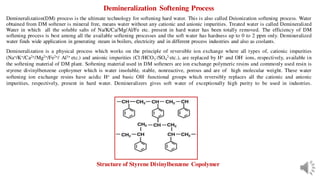
styrene divinylbenzene coploymer which is water insoluble, stable, nonreactive, porous and are of high molecular weight. These water
softening ion exchange resins have acidic H+ and basic OH- functional groups which reversibly replaces all the cationic and anionic
impurities, respectively, present in hard water. Demineralizers gives soft water of exceptionally high purity to be used in industries.
Structure of Styrene Divinylbenzene Copolymer
3.
Softening Process
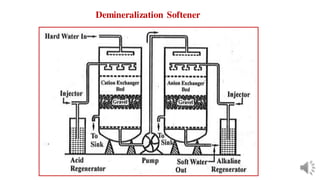
DM softeneris a two column softener where one is cation exchange used to replace cationic impurities with its acidic H+
function group while other is anion exchange column used to replace anionic impurities with its OH- functional groups. The
working of cation and anion exchange column's can be described as:
CationExchange Column
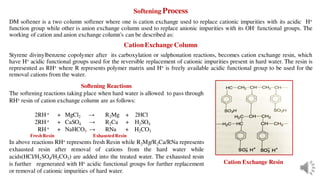
Styrene divinylbenzene copolymer after its carboxylation or sulphonation reactions, becomes cation exchange resin, which
have H+ acidic functional groups used for the reversible replacement of cationic impurities present in hard water. The resin is
represented as RH+ where R represents polymer matrix and H+ is freely available acidic functional group to be used for the
removal cations from the water.
Cation Exchange Resin
Softening Reactions
The softening reactions taking place when hard water is allowed to pass through
RH+ resin of cation exchange column are as follows:
2RH + + MgCl2 → R2Mg + 2HCl
2RH + + CaSO4 → R2Ca + H2SO4
RH + + NaHCO3 → RNa + H2CO3
FreshResin ExhaustedResin
In above reactions RH+ represents fresh Resin while R2Mg/R2Ca/RNa represents
exhausted resin after removal of cations from the hard water while
acids(HCl/H2SO4/H2CO3) are added into the treated water. The exhausted resin
is further regenerated with H+ acidic functional groups for further replacement
or removal of cationic impurities of hard water.
4.
Regeneration of CationExchange Resin
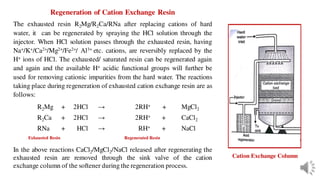
The exhausted resin R2Mg/R2Ca/RNa after replacing cations of hard
water, it can be regenerated by spraying the HCl solution through the
injector. When HCl solution passes through the exhausted resin, having
Na+/K+/Ca2+/Mg2+/Fe2+/ Al3+ etc. cations, are reversibly replaced by the
H+ ions of HCl. The exhausted/ saturated resin can be regenerated again
and again and the available H+ acidic functional groups will further be
used for removing cationic impurities from the hard water. The reactions
taking place during regeneration of exhausted cation exchange resin are as
follows:
R2Mg + 2HCl → 2RH+ + MgCl2
R2Ca + 2HCl → 2RH+ + CaCl2
RNa + HCl → RH+ + NaCl
Exhausted Resin Regenerated Resin
In the above reactions CaCl2/MgCl2/NaCl released after regenerating the
exhausted resin are removed through the sink valve of the cation
exchange column of the softener during the regeneration process.
Cation Exchange Column
5.
Anion Exchange Column
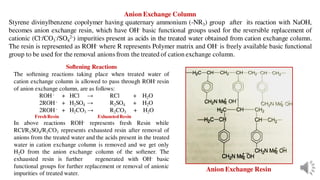
Styrenedivinylbenzene copolymer having quaternary ammonium (-NR3) group after its reaction with NaOH,
becomes anion exchange resin, which have OH- basic functional groups used for the reversible replacement of
cationic (Cl-/CO3
-/SO4
2-) impurities present as acids in the treated water obtained from cation exchange column.
The resin is represented as ROH- where R represents Polymer matrix and OH- is freely available basic functional
group to be used for the removal anions from the treated of cation exchange column.
Softening Reactions
The softening reactions taking place when treated water of
cation exchange column is allowed to pass through ROH- resin
of anion exchange column, are as follows:
ROH - + HCl → RCl + H2O
2ROH - + H2SO4 → R2SO4 + H2O
2ROH - + H2CO3 → R2CO3 + H2O
FreshResin ExhaustedResin
In above reactions ROH- represents fresh Resin while
RCl/R2SO4/R2CO3 represents exhausted resin after removal of
anions from the treated water and the acids present in the treated
water in cation exchange column is removed and we get only
H2O from the anion exchange column of the softener. The
exhausted resin is further regenerated with OH- basic
functional groups for further replacement or removal of anionic
impurities of treated water.
Anion Exchange Resin
6.
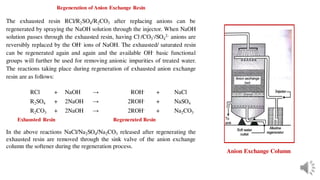
Regeneration of AnionExchange Resin
The exhausted resin RCl/R2SO4/R2CO3 after replacing anions can be
regenerated by spraying the NaOH solution through the injector. When NaOH
solution passes through the exhausted resin, having Cl-/CO3
-/SO4
2- anions are
reversibly replaced by the OH- ions of NaOH. The exhausted/ saturated resin
can be regenerated again and again and the available OH- basic functional
groups will further be used for removing anionic impurities of treated water.
The reactions taking place during regeneration of exhausted anion exchange
resin are as follows:
RCl + NaOH → ROH- + NaCl
R2SO4 + 2NaOH → 2ROH- + NaSO4
R2CO3 + 2NaOH → 2ROH- + Na2CO3
Exhausted Resin Regenerated Resin
In the above reactions NaCl/Na2SO4/Na2CO3 released after regenerating the
exhausted resin are removed through the sink valve of the anion exchange
column the softener during the regeneration process.
Anion Exchange Column