Comprehensive Guide to UNESCO World Heritage Sites and Criteria for Selection
Explore UNESCO's World Heritage Convention, criteria for site selection, Outstanding Universal Value, and the process of nomination and inscription of archaeological sites in India.
Comprehensive Guide to UNESCO World Heritage Sites and Criteria for Selection
1.
BA 5th
Sem. Minor(Vocational)
World Heritage Archaeological Sites & Monuments in India
Sachin Kr.Tiwary
sachintiwary@bhu.ac.in
2. Criteria for selection of World Heritage Sites, Operational
Guidelines for the Implementation of the World Heritage
Convention
2.
Unit 1: Introductionto UNESCO & World Heritage
Sites
1. World Heritage Convention (Introduction to
the World Heritage Convention (1972)
2. Criteria for selection of World Heritage
Sites, Operational Guidelines for the
Implementation of the World Heritage
Convention)
3. World Heritage Sites List (Tentative List:
Definition and significance, final List: Process
of inclusion, Differences between the Tentative
and Final Lists)
4. Importance of World Heritage Sites (Cultural
and natural heritage, Role in education,
tourism, and international cooperation)
3.
Learning
Objectives
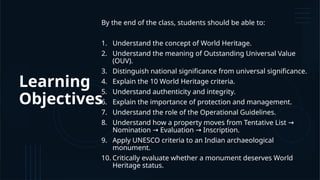
By the endof the class, students should be able to:
1. Understand the concept of World Heritage.
2. Understand the meaning of Outstanding Universal Value
(OUV).
3. Distinguish national significance from universal significance.
4. Explain the 10 World Heritage criteria.
5. Understand authenticity and integrity.
6. Explain the importance of protection and management.
7. Understand the role of the Operational Guidelines.
8. Understand how a property moves from Tentative List →
Nomination Evaluation Inscription.
→ →
9. Apply UNESCO criteria to an Indian archaeological
monument.
10. Critically evaluate whether a monument deserves World
Heritage status.
4.
Opening Question
Answer:
NO.
A World
Heritage
property
must
demonstrat
e:
Outstanding
UniversalValue
+ at least one
criterion +
authenticity/
integrity as
applicable +
adequate
protection and
management.
UNESCO specifically
states that inclusion
requires OUV and at
least one of the ten
criteria, together with
relevant
authenticity/integrity
and protection-
management
requirements.
“If a monument is 1,000 years old, architecturally beautiful and
historically important, does that automatically make it a World
Heritage Site?”
INTRODUCTION
5.
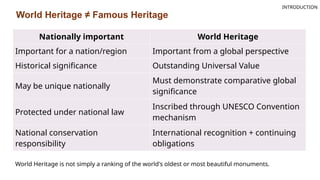
Nationally important WorldHeritage
Important for a nation/region Important from a global perspective
Historical significance Outstanding Universal Value
May be unique nationally
Must demonstrate comparative global
significance
Protected under national law
Inscribed through UNESCO Convention
mechanism
National conservation
responsibility
International recognition + continuing
obligations
World Heritage ≠ Famous Heritage
World Heritage is not simply a ranking of the world's oldest or most beautiful monuments.
INTRODUCTION
6.
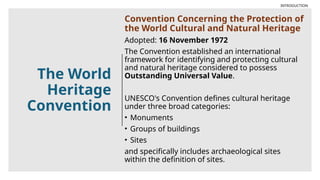
The World
Heritage
Convention
Convention Concerningthe Protection of
the World Cultural and Natural Heritage
Adopted: 16 November 1972
The Convention established an international
framework for identifying and protecting cultural
and natural heritage considered to possess
Outstanding Universal Value.
UNESCO's Convention defines cultural heritage
under three broad categories:
• Monuments
• Groups of buildings
• Sites
and specifically includes archaeological sites
within the definition of sites.
INTRODUCTION
7.
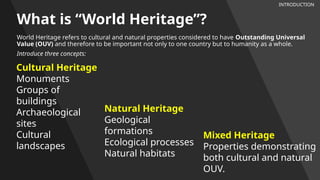
What is “WorldHeritage”?
World Heritage refers to cultural and natural properties considered to have Outstanding Universal
Value (OUV) and therefore to be important not only to one country but to humanity as a whole.
Introduce three concepts:
INTRODUCTION
Cultural Heritage
Monuments
Groups of
buildings
Archaeological
sites
Cultural
landscapes
Mixed Heritage
Properties demonstrating
both cultural and natural
OUV.
Natural Heritage
Geological
formations
Ecological processes
Natural habitats
8.
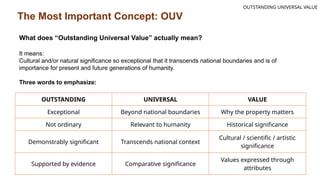
The Most ImportantConcept: OUV
What does “Outstanding Universal Value” actually mean?
It means:
Cultural and/or natural significance so exceptional that it transcends national boundaries and is of
importance for present and future generations of humanity.
Three words to emphasize:
OUTSTANDING UNIVERSAL VALUE
Exceptional Beyond national boundaries Why the property matters
Not ordinary Relevant to humanity Historical significance
Demonstrably significant Transcends national context
Cultural / scientific / artistic
significance
Supported by evidence Comparative significance
Values expressed through
attributes
9.
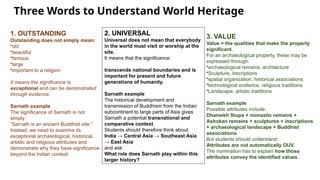
Three Words toUnderstand World Heritage
1. OUTSTANDING
Outstanding does not simply mean:
•old
•beautiful
•famous
•large
•important to a religion
It means the significance is
exceptional and can be demonstrated
through evidence.
Sarnath example
The significance of Sarnath is not
simply:
“Sarnath is an ancient Buddhist site.”
Instead, we need to examine its
exceptional archaeological, historical,
artistic and religious attributes and
demonstrate why they have significance
beyond the Indian context.
2. UNIVERSAL
Universal does not mean that everybody
in the world must visit or worship at the
site.
It means that the significance:
transcends national boundaries and is
important for present and future
generations of humanity.
Sarnath example
The historical development and
transmission of Buddhism from the Indian
subcontinent to large parts of Asia gives
Sarnath a potential transnational and
comparative context.
Students should therefore think about:
India → Central Asia → Southeast Asia
→ East Asia
and ask:
What role does Sarnath play within this
larger history?
3. VALUE
Value = the qualities that make the property
significant.
For an archaeological property, these may be
expressed through:
•archaeological remains, architecture
•Sculpture, inscriptions
•spatial organization, historical associations
•technological evidence, religious traditions
•Landscape, artistic traditions
Sarnath example
Possible attributes include:
Dhamekh Stupa + monastic remains +
Ashokan remains + sculptures + inscriptions
+ archaeological landscape + Buddhist
associations
But students should understand:
Attributes are not automatically OUV.
The nomination has to explain how those
attributes convey the identified values.
10.
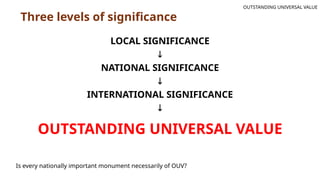
Three levels ofsignificance
LOCAL SIGNIFICANCE
↓
NATIONAL SIGNIFICANCE
↓
INTERNATIONAL SIGNIFICANCE
↓
Is every nationally important monument necessarily of OUV?
OUTSTANDING UNIVERSAL VALUE
11.
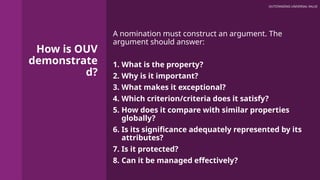
How is OUV
demonstrate
d?
Anomination must construct an argument. The
argument should answer:
1. What is the property?
2. Why is it important?
3. What makes it exceptional?
4. Which criterion/criteria does it satisfy?
5. How does it compare with similar properties
globally?
6. Is its significance adequately represented by its
attributes?
7. Is it protected?
8. Can it be managed effectively?
OUTSTANDING UNIVERSAL VALUE
12.
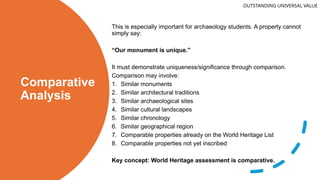
Comparative
Analysis
This is especiallyimportant for archaeology students. A property cannot
simply say:
“Our monument is unique.”
It must demonstrate uniqueness/significance through comparison.
Comparison may involve:
1. Similar monuments
2. Similar architectural traditions
3. Similar archaeological sites
4. Similar cultural landscapes
5. Similar chronology
6. Similar geographical region
7. Comparable properties already on the World Heritage List
8. Comparable properties not yet inscribed
Key concept: World Heritage assessment is comparative.
OUTSTANDING UNIVERSAL VALUE
13.
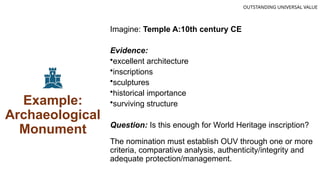
Example:
Archaeological
Monument
Imagine: Temple A:10thcentury CE
Evidence:
•excellent architecture
•inscriptions
•sculptures
•historical importance
•surviving structure
Question: Is this enough for World Heritage inscription?
The nomination must establish OUV through one or more
criteria, comparative analysis, authenticity/integrity and
adequate protection/management.
OUTSTANDING UNIVERSAL VALUE
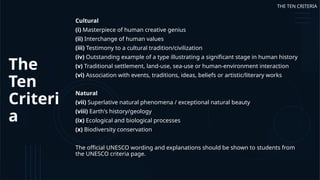
The
Ten
Criteri
a
Cultural
(i) Masterpiece ofhuman creative genius
(ii) Interchange of human values
(iii) Testimony to a cultural tradition/civilization
(iv) Outstanding example of a type illustrating a significant stage in human history
(v) Traditional settlement, land-use, sea-use or human-environment interaction
(vi) Association with events, traditions, ideas, beliefs or artistic/literary works
Natural
(vii) Superlative natural phenomena / exceptional natural beauty
(viii) Earth's history/geology
(ix) Ecological and biological processes
(x) Biodiversity conservation
The official UNESCO wording and explanations should be shown to students from
the UNESCO criteria page.
THE TEN CRITERIA
16.
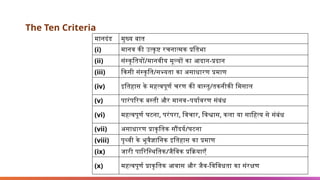
The Ten Criteria
मानदंडमुख्य बात
(i) मानव की उत्कृष्ट रचनात्मक प्रतिभा
(ii) संस्कृतियों/मानवीय मूल्यों का आदान-प्रदान
(iii) किसी संस्कृति/सभ्यता का असाधारण प्रमाण
(iv) इतिहास के महत्वपूर्ण चरण की वास्तु/तकनीकी मिसाल
(v) –
पारंपरिक बस्ती और मानव पर्यावरण संबंध
(vi) महत्वपूर्ण घटना, परंपरा, विचार, विश्वास, कला या साहित्य से संबंध
(vii) असाधारण प्राकृतिक सौंदर्य/घटना
(viii) पृथ्वी के भूवैज्ञानिक इतिहास का प्रमाण
(ix) जारी पारिस्थितिक/जैविक प्रक्रियाएँ
(x) महत्वपूर्ण प्राकृतिक आवास और जैव-विविधता का संरक्षण
17.
The 10
Criteria
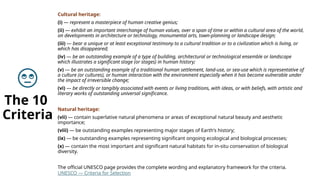
Cultural heritage:
(i)— represent a masterpiece of human creative genius;
(ii) — exhibit an important interchange of human values, over a span of time or within a cultural area of the world,
on developments in architecture or technology, monumental arts, town-planning or landscape design;
(iii) — bear a unique or at least exceptional testimony to a cultural tradition or to a civilization which is living, or
which has disappeared;
(iv) — be an outstanding example of a type of building, architectural or technological ensemble or landscape
which illustrates a significant stage (or stages) in human history;
(v) — be an outstanding example of a traditional human settlement, land-use, or sea-use which is representative of
a culture (or cultures), or human interaction with the environment especially when it has become vulnerable under
the impact of irreversible change;
(vi) — be directly or tangibly associated with events or living traditions, with ideas, or with beliefs, with artistic and
literary works of outstanding universal significance.
Natural heritage:
(vii) — contain superlative natural phenomena or areas of exceptional natural beauty and aesthetic
importance;
(viii) — be outstanding examples representing major stages of Earth's history;
(ix) — be outstanding examples representing significant ongoing ecological and biological processes;
(x) — contain the most important and significant natural habitats for in-situ conservation of biological
diversity.
The official UNESCO page provides the complete wording and explanatory framework for the criteria.
UNESCO — Criteria for Selection
18.
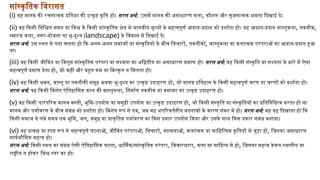
सांस्कृतिक विरासत
(i) वहमानव की रचनात्मक प्रतिभा की उत्कृष्ट कृति हो। सरल अर्थ: :उसमें मानव की असाधारण कला, कौशल और सृजनात्मक क्षमता दिखाई दे।
(ii) वह किसी निश्चित समय या विश्व के किसी सांस्कृतिक क्षेत्र में मानवीय मूल्यों के महत्वपूर्ण आदान-प्रदान को दर्शाता हो। यह आदान-प्रदान वास्तुकला, तकनीक,
स्मारक कला, नगर-योजना या भू-दृश्य (landscape) के विकास में दिखाई दे।
सरल अर्थ: उस स्थल से पता चलता हो कि अलग-अलग समाजों या संस्कृतियों के बीच विचारों, तकनीकों, वास्तुकला या कलात्मक परंपराओं का आदान-प्रदान हुआ
था।
(iii) वह किसी जीवित या विलुप्त सांस्कृतिक परंपरा या सभ्यता का अद्वितीय या असाधारण प्रमाण हो। सरल अर्थ: वह किसी संस्कृति या सभ्यता के बारे में ऐसा
महत्वपूर्ण प्रमाण देता हो, जो कहीं और बहुत कम या बिल्कुल न मिलता हो।
(iv) वह किसी भवन, वास्तु या तकनीकी समूह अथवा भू-दृश्य का उत्कृष्ट उदाहरण हो, जो मानव इतिहास के किसी महत्वपूर्ण चरण या चरणों को दर्शाता हो।
सरल अर्थ: वह किसी विशेष ऐतिहासिक काल की वास्तुकला, निर्माण तकनीक या बसावट का उत्कृष्ट उदाहरण हो।
(v) वह किसी पारंपरिक मानव बस्ती, भूमि-उपयोग या समुद्री उपयोग का उत्कृष्ट उदाहरण हो, जो किसी संस्कृति या संस्कृतियों का प्रतिनिधित्व करता हो या
मानव और पर्यावरण के बीच संबंध को दर्शाता हो। विशेष रूप से तब, जब वह अपरिवर्तनीय बदलावों के कारण संकट में हो। सरल अर्थ: वह यह दिखाता हो कि
किसी समाज ने लंबे समय तक भूमि, जल, समुद्र या प्राकृतिक पर्यावरण का किस प्रकार उपयोग किया और उसके साथ किस प्रकार संबंध बनाया।
(vi) वह प्रत्यक्ष या स्पष्ट रूप से महत्वपूर्ण घटनाओं, जीवित परंपराओं, विचारों, मान्यताओं, कलात्मक या साहित्यिक कृतियों से जुड़ा हो, जिनका असाधारण
सार्वभौमिक महत्व हो।
सरल अर्थ: किसी स्थल का संबंध ऐसी ऐतिहासिक घटना, धार्मिक/सांस्कृतिक परंपरा, विचारधारा, कला या साहित्य से हो, जिसका महत्व केवल स्थानीय या
राष्ट्रीय न होकर विश्व स्तर का हो।
19.
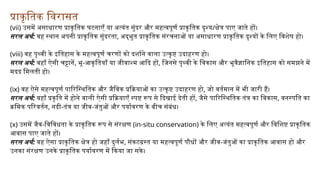
प्राकृतिक विरासत
(vii) उसमेंअसाधारण प्राकृतिक घटनाएँ या अत्यंत सुंदर और महत्वपूर्ण प्राकृतिक दृश्य/क्षेत्र पाए जाते हों।
सरल अर्थ: वह स्थान अपनी प्राकृतिक सुंदरता, अद्भुत प्राकृतिक संरचनाओं या असाधारण प्राकृतिक दृश्यों के लिए विशेष हो।
(viii) वह पृथ्वी के इतिहास के महत्वपूर्ण चरणों को दर्शाने वाला उत्कृष्ट उदाहरण हो।
सरल अर्थ: वहाँ ऐसी चट्टानें, भू-आकृतियाँ या जीवाश्म आदि हों, जिनसे पृथ्वी के विकास और भूवैज्ञानिक इतिहास को समझने में
मदद मिलती हो।
(ix) वह ऐसे महत्वपूर्ण पारिस्थितिक और जैविक प्रक्रियाओं का उत्कृष्ट उदाहरण हो, जो वर्तमान में भी जारी हैं।
सरल अर्थ: वहाँ प्रकृति में होने वाली ऐसी प्रक्रियाएँ स्पष्ट रूप से दिखाई देती हों, जैसे पारिस्थितिक तंत्र का विकास, वनस्पति का
क्रमिक परिवर्तन, नदी-तंत्र या जीव-जंतुओं और पर्यावरण के बीच संबंध।
(x) उसमें जैव-विविधता के प्राकृतिक रूप से संरक्षण (in-situ conservation) के लिए अत्यंत महत्वपूर्ण और विशिष्ट प्राकृतिक
आवास पाए जाते हों।
सरल अर्थ: वह ऐसा प्राकृतिक क्षेत्र हो जहाँ दुर्लभ, संकटग्रस्त या महत्वपूर्ण पौधों और जीव-जंतुओं का प्राकृतिक आवास हो और
उनका संरक्षण उनके प्राकृतिक पर्यावरण में किया जा सके।
20.
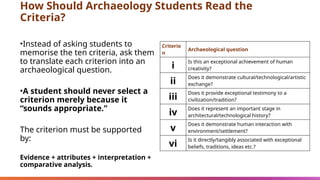
How Should ArchaeologyStudents Read the
Criteria?
•Instead of asking students to
memorise the ten criteria, ask them
to translate each criterion into an
archaeological question.
•A student should never select a
criterion merely because it
“sounds appropriate.”
The criterion must be supported
by:
Evidence + attributes + interpretation +
comparative analysis.
Criterio
n
Archaeological question
i
Is this an exceptional achievement of human
creativity?
ii
Does it demonstrate cultural/technological/artistic
exchange?
iii
Does it provide exceptional testimony to a
civilization/tradition?
iv
Does it represent an important stage in
architectural/technological history?
v
Does it demonstrate human interaction with
environment/settlement?
vi
Is it directly/tangibly associated with exceptional
beliefs, traditions, ideas etc.?
21.
Criterion (i):
Masterpiece ofHuman
Creative Genius
“represent a masterpiece of human
creative genius”
Think about:
1. extraordinary artistic achievement
2. architectural innovation
3. exceptional craftsmanship
4. technological achievement
5. creative originality
Indian discussion examples
Possible examples to discuss: Taj Mahal,
Ajanta, Konark, Chola temples
Question: What makes something a
“masterpiece” rather than simply “beautiful”?
22.
Criterion (ii):
Interchange
of Human
Values
Focuson:
1. cultural interaction
2. transmission of ideas
3. technological exchange
4. architectural influence
5. artistic interaction
6. movement of people and knowledge
Archaeological examples
India Central Asia Persia Southeast Asia
↔ ↔ ↔
Discussion
• Was an architectural form:
invented independently or transmitted through cultural
interaction?
23.
Criterion (iii):
Exceptional
Testimony
A propertyshould:
bear a unique or exceptional testimony to a cultural tradition
or civilization.
Possible archaeological evidence:
1. architecture
2. inscriptions
3. settlement remains
4. ritual structures
5. burial traditions
6. material culture
Important distinction
“Old” ≠ “Criterion iii”
The evidence must demonstrate an exceptional testimony.
24.
Criterion (iv):
Significant
Stage in
HumanHistory
This is particularly important for archaeology and
architectural history.
The property should be:
an outstanding example of a type of building,
architectural or technological ensemble or
landscape illustrating significant stage(s) in human
history.
Think:
Technology Architecture Society Historical
→ → →
transformation
25.
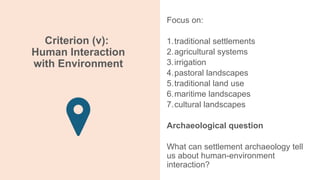
Criterion (v):
Human Interaction
withEnvironment
Focus on:
1.traditional settlements
2.agricultural systems
3.irrigation
4.pastoral landscapes
5.traditional land use
6.maritime landscapes
7.cultural landscapes
Archaeological question
What can settlement archaeology tell
us about human-environment
interaction?
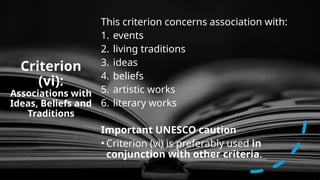
26.
Criterion
(vi):
Associations with
Ideas, Beliefsand
Traditions
This criterion concerns association with:
1. events
2. living traditions
3. ideas
4. beliefs
5. artistic works
6. literary works
Important UNESCO caution
• Criterion (vi) is preferably used in
conjunction with other criteria.
27.
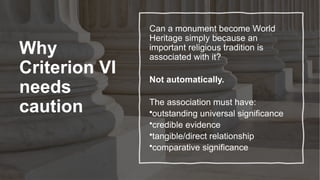
Why
Criterion VI
needs
caution
Can amonument become World
Heritage simply because an
important religious tradition is
associated with it?
Not automatically.
The association must have:
•outstanding universal significance
•credible evidence
•tangible/direct relationship
•comparative significance
28.
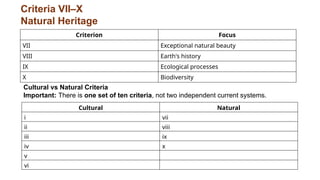
Criterion Focus
VII Exceptionalnatural beauty
VIII Earth's history
IX Ecological processes
X Biodiversity
Criteria VII–X
Natural Heritage
Cultural Natural
i vii
ii viii
iii ix
iv x
v
vi
Cultural vs Natural Criteria
Important: There is one set of ten criteria, not two independent current systems.
29.
Can one
property
satisfy
multiple
criteria?
A propertymay demonstrate OUV under:
(i) + (ii) + (iii) + (iv) for example.
But:
More criteria ≠ automatically better nomination.
The criteria selected must be demonstrated
convincingly.
30.
Exercise:
Identify
the
Criterion
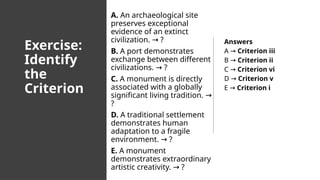
A. An archaeologicalsite
preserves exceptional
evidence of an extinct
civilization. ?
→
B. A port demonstrates
exchange between different
civilizations. ?
→
C. A monument is directly
associated with a globally
significant living tradition. →
?
D. A traditional settlement
demonstrates human
adaptation to a fragile
environment. ?
→
E. A monument
demonstrates extraordinary
artistic creativity. ?
→
Answers
A → Criterion iii
B → Criterion ii
C → Criterion vi
D → Criterion v
E → Criterion i
31.
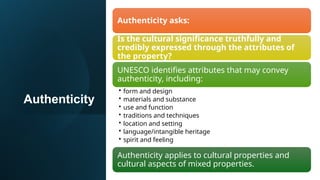
Authenticity
Authenticity asks:
Is thecultural significance truthfully and
credibly expressed through the attributes of
the property?
UNESCO identifies attributes that may convey
authenticity, including:
• form and design
• materials and substance
• use and function
• traditions and techniques
• location and setting
• language/intangible heritage
• spirit and feeling
Authenticity applies to cultural properties and
cultural aspects of mixed properties.
32.
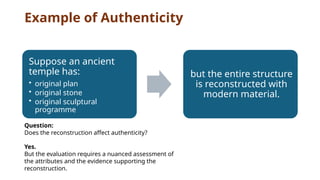
Example of Authenticity
Supposean ancient
temple has:
• original plan
• original stone
• original sculptural
programme
but the entire structure
is reconstructed with
modern material.
Question:
Does the reconstruction affect authenticity?
Yes.
But the evaluation requires a nuanced assessment of
the attributes and the evidence supporting the
reconstruction.
33.
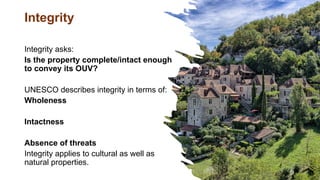
Integrity
Integrity asks:
Is theproperty complete/intact enough
to convey its OUV?
UNESCO describes integrity in terms of:
Wholeness
Intactness
Absence of threats
Integrity applies to cultural as well as
natural properties.
34.
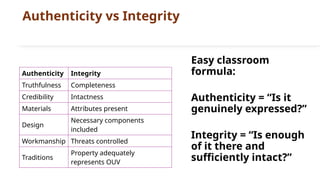
Authenticity vs Integrity
Easyclassroom
formula:
Authenticity = “Is it
genuinely expressed?”
Integrity = “Is enough
of it there and
sufficiently intact?”
Authenticity Integrity
Truthfulness Completeness
Credibility Intactness
Materials Attributes present
Design
Necessary components
included
Workmanship Threats controlled
Traditions
Property adequately
represents OUV
35.
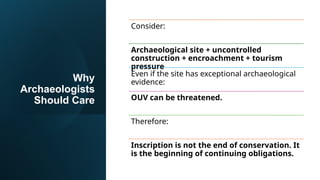
Why
Archaeologists
Should Care
Consider:
Archaeological site+ uncontrolled
construction + encroachment + tourism
pressure
Even if the site has exceptional archaeological
evidence:
OUV can be threatened.
Therefore:
Inscription is not the end of conservation. It
is the beginning of continuing obligations.
36.
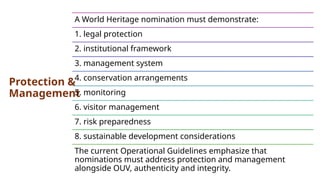
Protection &
Management
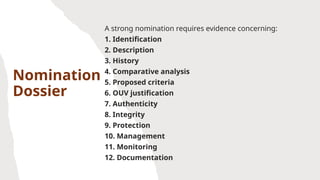
A WorldHeritage nomination must demonstrate:
1. legal protection
2. institutional framework
3. management system
4. conservation arrangements
5. monitoring
6. visitor management
7. risk preparedness
8. sustainable development considerations
The current Operational Guidelines emphasize that
nominations must address protection and management
alongside OUV, authenticity and integrity.
37.
What are
Operational
Guidelines?
Operational Guidelinesfor the Implementation
of the World Heritage Convention
They are the principal working framework for
implementing the Convention.
UNESCO states that they are regularly revised to
reflect new concepts, knowledge, decisions and
experience. The current version is WHC.25/01, 16
July 2025.
38.
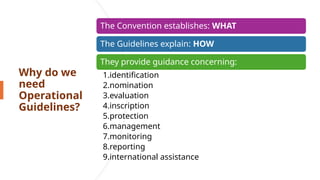
Why do we
need
Operational
Guidelines?
TheConvention establishes: WHAT
The Guidelines explain: HOW
They provide guidance concerning:
1.identification
2.nomination
3.evaluation
4.inscription
5.protection
6.management
7.monitoring
8.reporting
9.international assistance
39.
The
Nominatio
n Cycle
State Party
↓
Identificationof property
↓
Tentative List
↓
Preliminary Assessment / preparatory work
↓
Nomination dossier
↓
Advisory Body evaluation
↓
World Heritage Committee
↓
Inscription / referral / deferral / not inscribed
↓
Monitoring & Periodic Reporting
The 2025 Guidelines now include a mandatory Preliminary
Assessment process for sites that may be nominated, under
the current framework.
40.
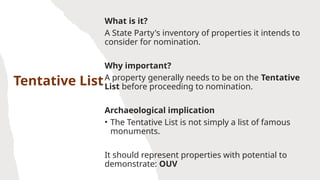
Tentative List
What isit?
A State Party's inventory of properties it intends to
consider for nomination.
Why important?
A property generally needs to be on the Tentative
List before proceeding to nomination.
Archaeological implication
• The Tentative List is not simply a list of famous
monuments.
It should represent properties with potential to
demonstrate: OUV
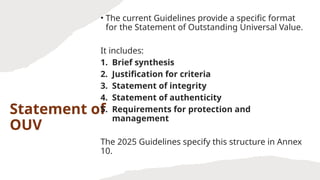
Statement of
OUV
• Thecurrent Guidelines provide a specific format
for the Statement of Outstanding Universal Value.
It includes:
1. Brief synthesis
2. Justification for criteria
3. Statement of integrity
4. Statement of authenticity
5. Requirements for protection and
management
The 2025 Guidelines specify this structure in Annex
10.
43.
Advisor
y
Bodies
Introduce: ICOMOS_International
Council onMonuments and Sites
Mainly evaluates: Cultural heritage
• IUCN_International Union for
Conservation of Nature
Mainly evaluates: Natural heritage
• ICCROM_International Centre for the
Study of the Preservation and
Restoration of Cultural Property
Provides conservation expertise and
capacity building.
44.
India & WorldHeritage
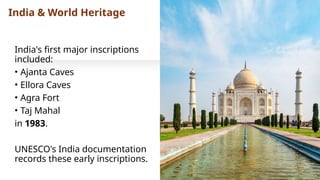
India's first major inscriptions
included:
• Ajanta Caves
• Ellora Caves
• Agra Fort
• Taj Mahal
in 1983.
UNESCO's India documentation
records these early inscriptions.
45.
A Case Study:
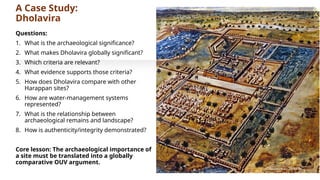
Dholavira
Questions:
1.What is the archaeological significance?
2. What makes Dholavira globally significant?
3. Which criteria are relevant?
4. What evidence supports those criteria?
5. How does Dholavira compare with other
Harappan sites?
6. How are water-management systems
represented?
7. What is the relationship between
archaeological remains and landscape?
8. How is authenticity/integrity demonstrated?
Core lesson: The archaeological importance of
a site must be translated into a globally
comparative OUV argument.
46.
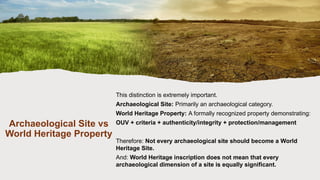
Archaeological Site vs
WorldHeritage Property
This distinction is extremely important.
Archaeological Site: Primarily an archaeological category.
World Heritage Property: A formally recognized property demonstrating:
OUV + criteria + authenticity/integrity + protection/management
Therefore: Not every archaeological site should become a World
Heritage Site.
And: World Heritage inscription does not mean that every
archaeological dimension of a site is equally significant.
47.
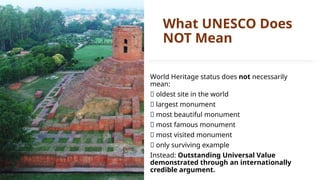
What UNESCO Does
NOTMean
World Heritage status does not necessarily
mean:
❌ oldest site in the world
❌ largest monument
❌ most beautiful monument
❌ most famous monument
❌ most visited monument
❌ only surviving example
Instead: Outstanding Universal Value
demonstrated through an internationally
credible argument.
48.
Common Problems inWorld Heritage Nominations
Problem 1 “It's very
old.” Age alone is
→
insufficient.
Problem 2 “It's
unique.” →
Comparative
analysis is required.
Problem 3 “It is
beautiful.” →
Aesthetic value
alone may not
establish OUV.
Problem 4 “People
worship here.” →
Association needs to
meet the
requirements of
Criterion VI.
Problem 5 “The
monument is
protected.” →
Protection alone
does not establish
OUV.
Problem 6 “It is
already nationally
important.” →
National importance
≠ OUV.
Group
Exercise
Divide students into4
groups.
Assign:
Group 1: Sanchi
Group 2: Dholavira
Group 3: Khajuraho
Group 4: Mahabalipuram
Each group gets 7 minutes.
Ask them to prepare:
1. Why is the property
significant?
2. Which criterion/criteria?
3. What are the attributes?
4. What demonstrates OUV?
5. What is the comparative
argument?
6. What are the threats?
7. What management issues
exist?
51.
Present Your Argument
Eachgroup gets:
2 minutes
to answer:
“Why should this property be
considered of Outstanding Universal
Value?”
And:
“Which evidence would you put into the
nomination dossier?”
This is much more useful at Ph.D. level
than simply asking students to memorize
the criteria.
52.
Five
Concepts
to
Remembe
r
1. OUV
Why doeshumanity as a whole need to care?
2. Criteria
What exactly makes the property outstanding?
3. Authenticity
Is its value truthfully expressed?
4. Integrity
Is the property sufficiently complete and intact?
5. Protection & Management
Can its OUV be sustained?
53.
Question If youwere asked to nominate one
archaeological site from Uttar Pradesh
for the World Heritage List, which site
would you choose—and how would you
prove its Outstanding Universal Value?”
“Because it is ancient.”
Construct:
Criterion + Attribute + Evidence +
Comparison + Authenticity/Integrity +
Management
54.
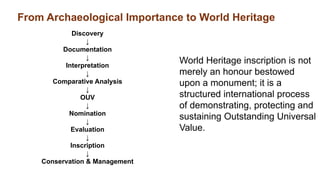
From Archaeological Importanceto World Heritage
Discovery
↓
Documentation
↓
Interpretation
↓
Comparative Analysis
↓
OUV
↓
Nomination
↓
Evaluation
↓
Inscription
↓
Conservation & Management
World Heritage inscription is not
merely an honour bestowed
upon a monument; it is a
structured international process
of demonstrating, protecting and
sustaining Outstanding Universal
Value.
55.
Recommende
d Reading
1. UNESCO— Criteria for Selection
UNESCO: Criteria for Selection
2. UNESCO — 2025 Operational
Guidelines
UNESCO: Operational Guidelines for the I
mplementation of the World Heritage Con
vention
3. UNESCO — World Heritage
Convention
UNESCO: Convention Concerning the Prot
ection of the World Cultural and Natural H
eritage
4. UNESCO — India
UNESCO: India – World Heritage Conventi
on Documents