Comprehensive Guide to TF-IDF Calculation with Examples and NLP Preprocessing
Detailed walkthrough of TF-IDF computation including tokenization, vocabulary building, BoW, DF, IDF, and TF-IDF matrices with practical NLP preprocessing tips and exam-style problems.
Comprehensive Guide to TF-IDF Calculation with Examples and NLP Preprocessing
1.
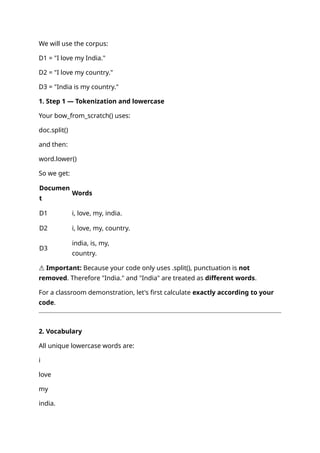
We will usethe corpus:
D1 = "I love my India."
D2 = "I love my country."
D3 = "India is my country."
1. Step 1 — Tokenization and lowercase
Your bow_from_scratch() uses:
doc.split()
and then:
word.lower()
So we get:
Documen
t
Words
D1 i, love, my, india.
D2 i, love, my, country.
D3
india, is, my,
country.
⚠️Important: Because your code only uses .split(), punctuation is not
removed. Therefore "India." and "India" are treated as different words.
For a classroom demonstration, let's first calculate exactly according to your
code.
2. Vocabulary
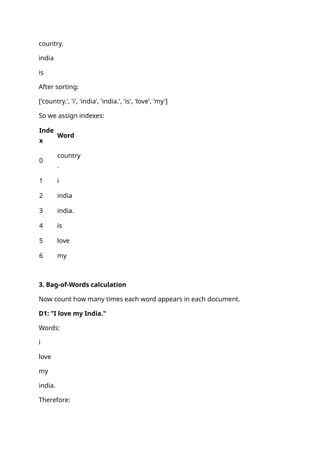
All unique lowercase words are:
i
love
my
india.
2.
country.
india
is
After sorting:
['country.', 'i','india', 'india.', 'is', 'love', 'my']
So we assign indexes:
Inde
x
Word
0
country
.
1 i
2 india
3 india.
4 is
5 love
6 my
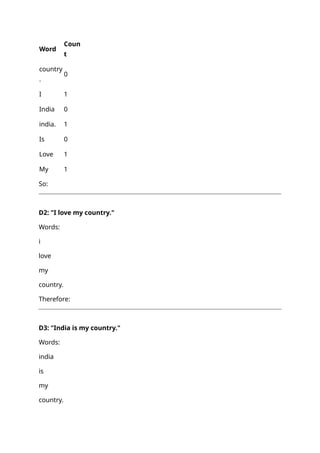
3. Bag-of-Words calculation
Now count how many times each word appears in each document.
D1: "I love my India."
Words:
i
love
my
india.
Therefore:
3.
Word
Coun
t
country
.
0
I 1
India 0
india.1
Is 0
Love 1
My 1
So:
D2: "I love my country."
Words:
i
love
my
country.
Therefore:
D3: "India is my country."
Words:
india
is
my
country.
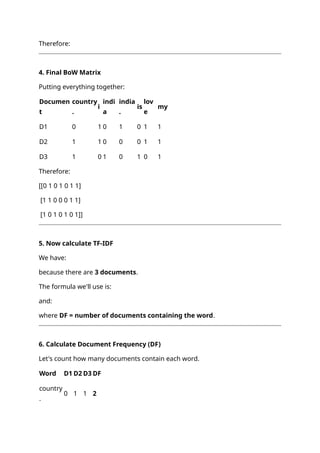
4.
Therefore:
4. Final BoWMatrix
Putting everything together:
Documen
t
country
.
i
indi
a
india
.
is
lov
e
my
D1 0 1 0 1 0 1 1
D2 1 1 0 0 0 1 1
D3 1 0 1 0 1 0 1
Therefore:
[[0 1 0 1 0 1 1]
[1 1 0 0 0 1 1]
[1 0 1 0 1 0 1]]
5. Now calculate TF-IDF
We have:
because there are 3 documents.
The formula we'll use is:
and:
where DF = number of documents containing the word.
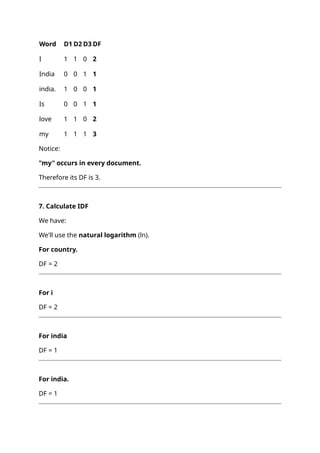
6. Calculate Document Frequency (DF)
Let's count how many documents contain each word.
Word D1 D2 D3 DF
country
.
0 1 1 2
5.
Word D1 D2D3 DF
I 1 1 0 2
India 0 0 1 1
india. 1 0 0 1
Is 0 0 1 1
love 1 1 0 2
my 1 1 1 3
Notice:
"my" occurs in every document.
Therefore its DF is 3.
7. Calculate IDF
We have:
We'll use the natural logarithm (ln).
For country.
DF = 2
For i
DF = 2
For india
DF = 1
For india.
DF = 1
6.
For is
DF =1
For love
DF = 2
For my
DF = 3
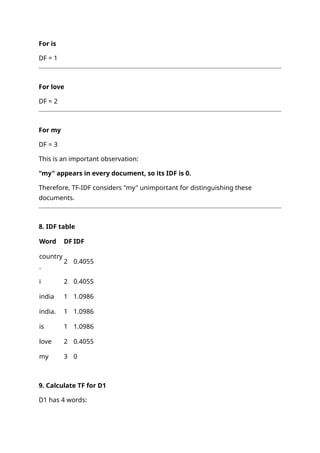
This is an important observation:
"my" appears in every document, so its IDF is 0.
Therefore, TF-IDF considers "my" unimportant for distinguishing these
documents.
8. IDF table
Word DF IDF
country
.
2 0.4055
i 2 0.4055
india 1 1.0986
india. 1 1.0986
is 1 1.0986
love 2 0.4055
my 3 0
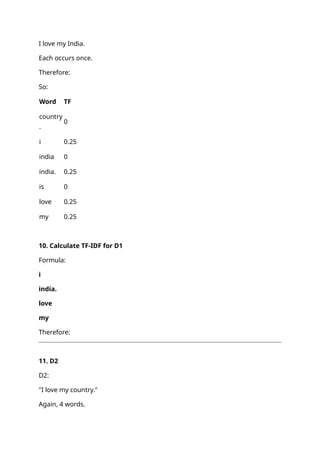
9. Calculate TF for D1
D1 has 4 words:
7.
I love myIndia.
Each occurs once.
Therefore:
So:
Word TF
country
.
0
i 0.25
india 0
india. 0.25
is 0
love 0.25
my 0.25
10. Calculate TF-IDF for D1
Formula:
i
india.
love
my
Therefore:
11. D2
D2:
"I love my country."
Again, 4 words.
8.
TF for eachoccurring word:
Now calculate:
country.
i
love
my
Therefore:
12. D3
D3:
"India is my country."
Four words.
Again:
country.
india
is
my
Therefore:
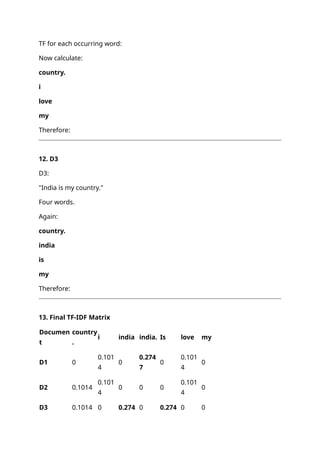
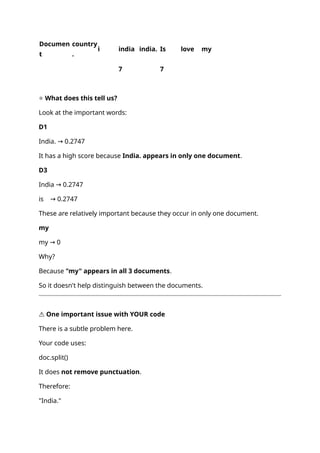
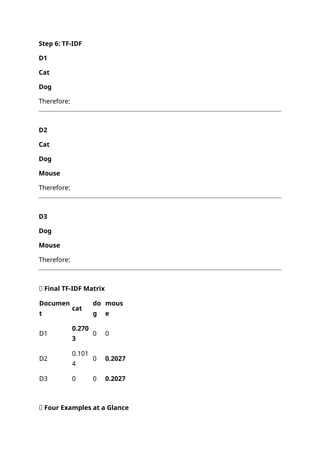
13. Final TF-IDF Matrix
Documen
t
country
.
i india india. Is love my
D1 0
0.101
4
0
0.274
7
0
0.101
4
0
D2 0.1014
0.101
4
0 0 0
0.101
4
0
D3 0.1014 0 0.274 0 0.274 0 0
9.
Documen
t
country
.
i india india.Is love my
7 7
⭐ What does this tell us?
Look at the important words:
D1
India. 0.2747
→
It has a high score because India. appears in only one document.
D3
India 0.2747
→
is 0.2747
→
These are relatively important because they occur in only one document.
my
my 0
→
Why?
Because "my" appears in all 3 documents.
So it doesn't help distinguish between the documents.
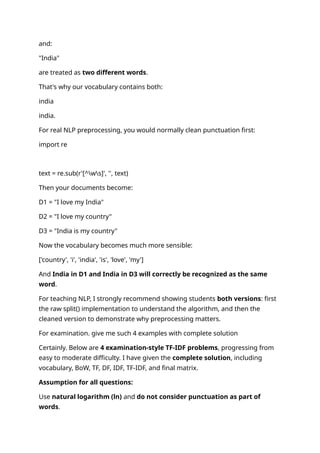
⚠️One important issue with YOUR code
There is a subtle problem here.
Your code uses:
doc.split()
It does not remove punctuation.
Therefore:
"India."
10.
and:
"India"
are treated astwo different words.
That's why our vocabulary contains both:
india
india.
For real NLP preprocessing, you would normally clean punctuation first:
import re
text = re.sub(r'[^ws]', '', text)
Then your documents become:
D1 = "I love my India"
D2 = "I love my country"
D3 = "India is my country"
Now the vocabulary becomes much more sensible:
['country', 'i', 'india', 'is', 'love', 'my']
And India in D1 and India in D3 will correctly be recognized as the same
word.
For teaching NLP, I strongly recommend showing students both versions: first
the raw split() implementation to understand the algorithm, and then the
cleaned version to demonstrate why preprocessing matters.
For examination. give me such 4 examples with complete solution
Certainly. Below are 4 examination-style TF-IDF problems, progressing from
easy to moderate difficulty. I have given the complete solution, including
vocabulary, BoW, TF, DF, IDF, TF-IDF, and final matrix.
Assumption for all questions:
Use natural logarithm (ln) and do not consider punctuation as part of
words.
11.
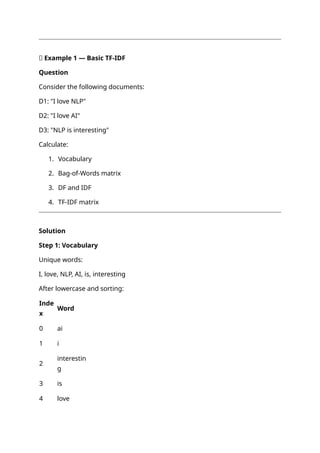
📝 Example 1— Basic TF-IDF
Question
Consider the following documents:
D1: "I love NLP"
D2: "I love AI"
D3: "NLP is interesting"
Calculate:
1. Vocabulary
2. Bag-of-Words matrix
3. DF and IDF
4. TF-IDF matrix
Solution
Step 1: Vocabulary
Unique words:
I, love, NLP, AI, is, interesting
After lowercase and sorting:
Inde
x
Word
0 ai
1 i
2
interestin
g
3 is
4 love
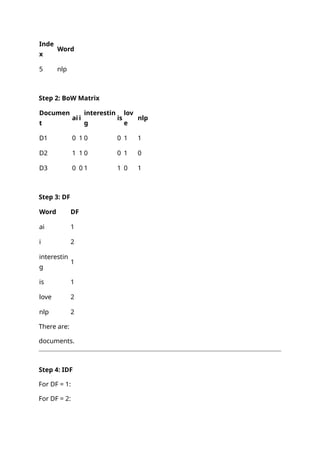
12.
Inde
x
Word
5 nlp
Step 2:BoW Matrix
Documen
t
ai i
interestin
g
is
lov
e
nlp
D1 0 1 0 0 1 1
D2 1 1 0 0 1 0
D3 0 0 1 1 0 1
Step 3: DF
Word DF
ai 1
i 2
interestin
g
1
is 1
love 2
nlp 2
There are:
documents.
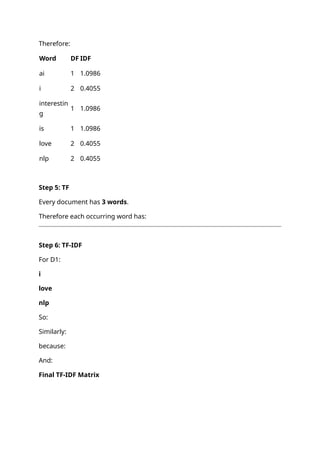
Step 4: IDF
For DF = 1:
For DF = 2:
13.
Therefore:
Word DF IDF
ai1 1.0986
i 2 0.4055
interestin
g
1 1.0986
is 1 1.0986
love 2 0.4055
nlp 2 0.4055
Step 5: TF
Every document has 3 words.
Therefore each occurring word has:
Step 6: TF-IDF
For D1:
i
love
nlp
So:
Similarly:
because:
And:
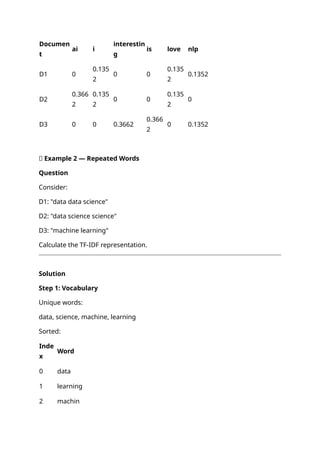
Final TF-IDF Matrix
14.
Documen
t
ai i
interestin
g
is lovenlp
D1 0
0.135
2
0 0
0.135
2
0.1352
D2
0.366
2
0.135
2
0 0
0.135
2
0
D3 0 0 0.3662
0.366
2
0 0.1352
📝 Example 2 — Repeated Words
Question
Consider:
D1: "data data science"
D2: "data science science"
D3: "machine learning"
Calculate the TF-IDF representation.
Solution
Step 1: Vocabulary
Unique words:
data, science, machine, learning
Sorted:
Inde
x
Word
0 data
1 learning
2 machin
15.
Inde
x
Word
e
3 science
Step 2:BoW
Documen
t
dat
a
learnin
g
machin
e
science
D1 2 0 0 1
D2 1 0 0 2
D3 0 1 1 0
Step 3: DF
Word DF
data 2
learning 1
machin
e
1
science 2
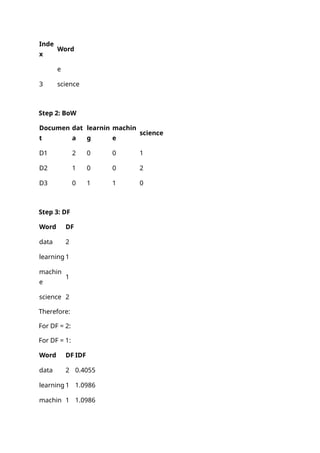
Therefore:
For DF = 2:
For DF = 1:
Word DF IDF
data 2 0.4055
learning 1 1.0986
machin 1 1.0986
16.
Word DF IDF
e
science2 0.4055
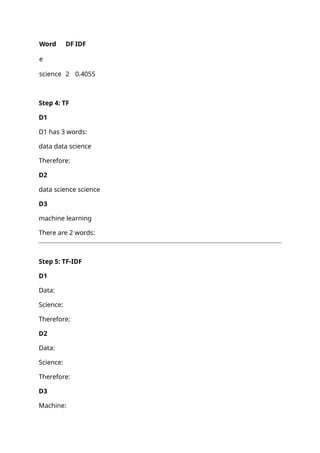
Step 4: TF
D1
D1 has 3 words:
data data science
Therefore:
D2
data science science
D3
machine learning
There are 2 words:
Step 5: TF-IDF
D1
Data:
Science:
Therefore:
D2
Data:
Science:
Therefore:
D3
Machine:
17.
Learning:
Therefore:
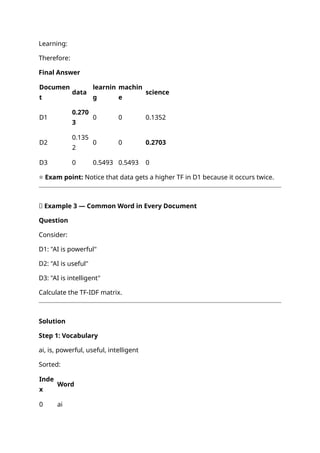
Final Answer
Documen
t
data
learnin
g
machin
e
science
D1
0.270
3
0 00.1352
D2
0.135
2
0 0 0.2703
D3 0 0.5493 0.5493 0
⭐ Exam point: Notice that data gets a higher TF in D1 because it occurs twice.
📝 Example 3 — Common Word in Every Document
Question
Consider:
D1: "AI is powerful"
D2: "AI is useful"
D3: "AI is intelligent"
Calculate the TF-IDF matrix.
Solution
Step 1: Vocabulary
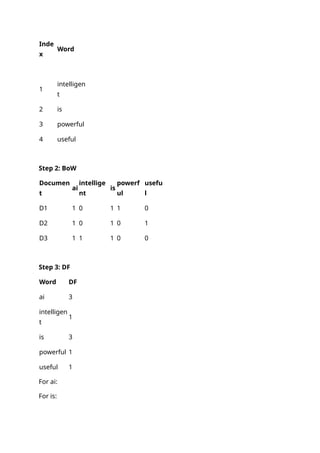
ai, is, powerful, useful, intelligent
Sorted:
Inde
x
Word
0 ai
18.
Inde
x
Word
1
intelligen
t
2 is
3 powerful
4useful
Step 2: BoW
Documen
t
ai
intellige
nt
is
powerf
ul
usefu
l
D1 1 0 1 1 0
D2 1 0 1 0 1
D3 1 1 1 0 0
Step 3: DF
Word DF
ai 3
intelligen
t
1
is 3
powerful 1
useful 1
For ai:
For is:
19.
For words occurringonce:
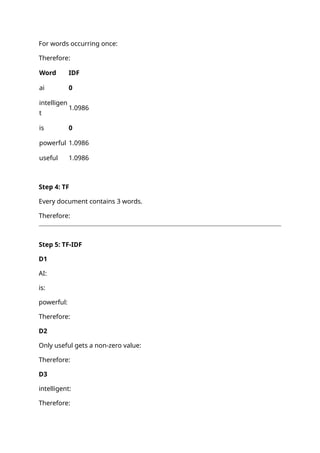
Therefore:
Word IDF
ai 0
intelligen
t
1.0986
is 0
powerful 1.0986
useful 1.0986
Step 4: TF
Every document contains 3 words.
Therefore:
Step 5: TF-IDF
D1
AI:
is:
powerful:
Therefore:
D2
Only useful gets a non-zero value:
Therefore:
D3
intelligent:
Therefore:
20.
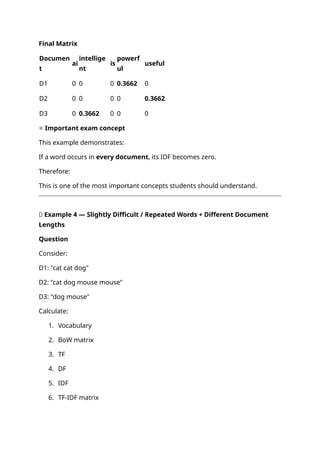
Final Matrix
Documen
t
ai
intellige
nt
is
powerf
ul
useful
D1 00 0 0.3662 0
D2 0 0 0 0 0.3662
D3 0 0.3662 0 0 0
⭐ Important exam concept
This example demonstrates:
If a word occurs in every document, its IDF becomes zero.
Therefore:
This is one of the most important concepts students should understand.
📝 Example 4 — Slightly Difficult / Repeated Words + Different Document
Lengths
Question
Consider:
D1: "cat cat dog"
D2: "cat dog mouse mouse"
D3: "dog mouse"
Calculate:
1. Vocabulary
2. BoW matrix
3. TF
4. DF
5. IDF
6. TF-IDF matrix
21.
Solution
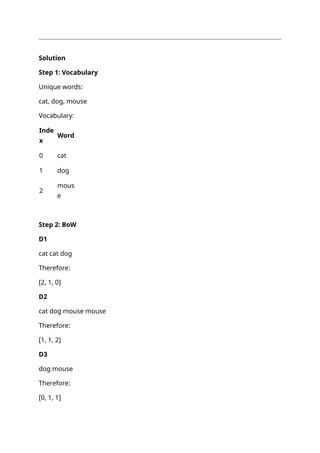
Step 1: Vocabulary
Uniquewords:
cat, dog, mouse
Vocabulary:
Inde
x
Word
0 cat
1 dog
2
mous
e
Step 2: BoW
D1
cat cat dog
Therefore:
[2, 1, 0]
D2
cat dog mouse mouse
Therefore:
[1, 1, 2]
D3
dog mouse
Therefore:
[0, 1, 1]
22.
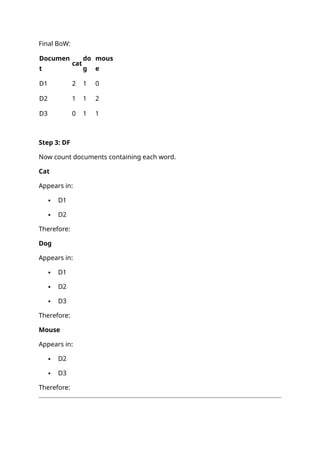
Final BoW:
Documen
t
cat
do
g
mous
e
D1 21 0
D2 1 1 2
D3 0 1 1
Step 3: DF
Now count documents containing each word.
Cat
Appears in:
D1
D2
Therefore:
Dog
Appears in:
D1
D2
D3
Therefore:
Mouse
Appears in:
D2
D3
Therefore:
23.
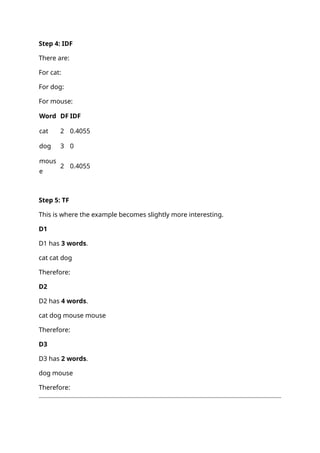
Step 4: IDF
Thereare:
For cat:
For dog:
For mouse:
Word DF IDF
cat 2 0.4055
dog 3 0
mous
e
2 0.4055
Step 5: TF
This is where the example becomes slightly more interesting.
D1
D1 has 3 words.
cat cat dog
Therefore:
D2
D2 has 4 words.
cat dog mouse mouse
Therefore:
D3
D3 has 2 words.
dog mouse
Therefore:
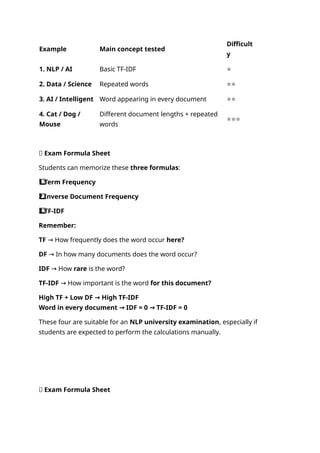
Example Main concepttested
Difficult
y
1. NLP / AI Basic TF-IDF ⭐
2. Data / Science Repeated words ⭐⭐
3. AI / Intelligent Word appearing in every document ⭐⭐
4. Cat / Dog /
Mouse
Different document lengths + repeated
words
⭐⭐⭐
🧠 Exam Formula Sheet
Students can memorize these three formulas:
1️
⃣ Term Frequency
2️
⃣ Inverse Document Frequency
3️
⃣ TF-IDF
Remember:
TF How frequently does the word occur
→ here?
DF In how many documents does the word occur?
→
IDF How
→ rare is the word?
TF-IDF How important is the word
→ for this document?
High TF + Low DF High TF-IDF
→
Word in every document IDF = 0 TF-IDF = 0
→ →
These four are suitable for an NLP university examination, especially if
students are expected to perform the calculations manually.
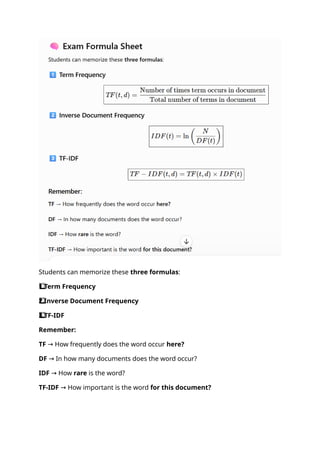
🧠 Exam Formula Sheet
26.
Students can memorizethese three formulas:
1️
⃣ Term Frequency
2️
⃣ Inverse Document Frequency
3️
⃣ TF-IDF
Remember:
TF How frequently does the word occur
→ here?
DF In how many documents does the word occur?
→
IDF How
→ rare is the word?
TF-IDF How important is the word
→ for this document?
27.
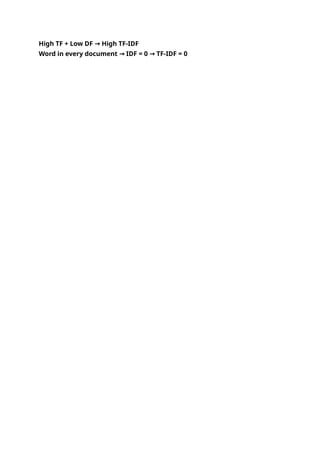
High TF +Low DF High TF-IDF
→
Word in every document IDF = 0 TF-IDF = 0
→ →