Comprehensive Guide to Testing, Measurement, and Evaluation in Education
Explore key concepts, purposes, types, and methods of testing, measurement, assessment, and evaluation to enhance student learning and instructional effectiveness.
Aim(s) of theStudy
• To provide students with knowledge of testing, measurement and evaluation
for the development and management of different ways of measuring student’s
learning behaviour.
3.
Course Objectives
By theend of the course students should be able to:-
• Define the terms testing, measurement and evaluation
• Explain reasons for testing, measuring and evaluating students’ learning behaviours
• Describe ways of measuring students’ learning achievements.
• Construct tests
• Administer tests
• Interpret test scores correctly
• Explain factors affecting student performance in relation to interpretation of test
results.
• Relate measurement concept to guidance and counseling
4.
Topics of Study
•Meaning of testing, measurement and evaluation
• Purposes of evaluation
• Assessment and classroom tests
• Purpose of assessment
• The concept of continuous assessment
• Taxonomy of educational objectives
• Old and modern practices of assessment
• Tests in the classroom
5.
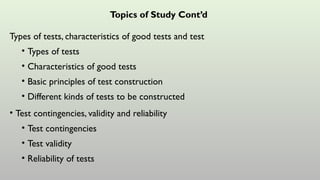
Topics of StudyCont’d
Types of tests, characteristics of good tests and test
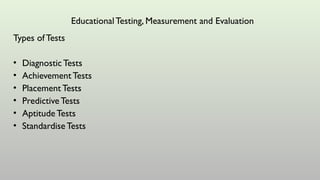
• Types of tests
• Characteristics of good tests
• Basic principles of test construction
• Different kinds of tests to be constructed
• Test contingencies, validity and reliability
• Test contingencies
• Test validity
• Reliability of tests
6.
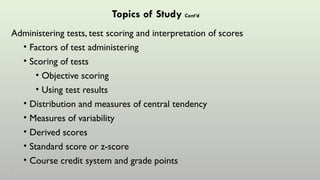
Topics of StudyCont’d
Administering tests, test scoring and interpretation of scores
• Factors of test administering
• Scoring of tests
• Objective scoring
• Using test results
• Distribution and measures of central tendency
• Measures of variability
• Derived scores
• Standard score or z-score
• Course credit system and grade points
•
7.
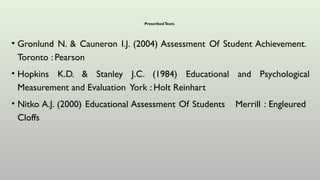
PrescribedTexts
• Gronlund N.& Cauneron I.J. (2004) Assessment Of Student Achievement.
Toronto : Pearson
• Hopkins K.D. & Stanley J.C. (1984) Educational and Psychological
Measurement and Evaluation York : Holt Reinhart
• Nitko A.J. (2000) Educational Assessment Of Students Merrill : Engleured
Cloffs
8.
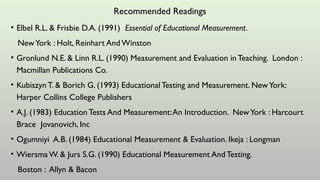
Recommended Readings
• ElbelR.L. & Frisbie D.A. (1991) Essential of Educational Measurement.
NewYork : Holt, Reinhart AndWinston
• Gronlund N.E. & Linn R.L. (1990) Measurement and Evaluation in Teaching. London :
Macmillan Publications Co.
• KubiszynT. & Borich G. (1993) EducationalTesting and Measurement. NewYork:
Harper Collins College Publishers
• A.J. (1983) Education Tests And Measurement:An Introduction. NewYork : Harcourt
Brace Jovanovich, Inc
• Ogumniyi A.B. (1984) Educational Measurement & Evaluation. Ikeja : Longman
• Wiersma W. & Jurs S.G. (1990) Educational Measurement And Testing.
Boston : Allyn & Bacon
OBJECTIVE
By the endof the lesson, you should be able to distinguish clearly
between test, measurement, assessment and evaluation.
11.
Measurement
• Measurement isa process of assigning numerals to objects, quantities or
events in order to give quantitative meaning to such qualities.
• It is the process of quantifying the degree to which someone or something
possesses a given characteristic, quality or feature.
• Measurement process involves four steps
1. Define the characteristics that you want to measure.
2. Select the appropriate test.This may also mean to select the appropriate
testing instrument.
3. Administer the test.
4. Collect and record the measurement from the test.
12.
Measurement Cont’d
• Whatdo you measure in a classroom?
• Individual differences on a specific trait (behavior).
• How do you get measurement data?
13.
Testing
• Test: aninstrument or activity used to accumulate data on a person’s ability
to perform a specified task.
• Data: the translation of behavior into a numerical or verbal descriptor
which is then recorded in written form.
• Testing is a technique for obtaining information.
14.
Assessment
• Assessment refersto all the processes and products which are used to
describe the nature and the extent of pupils’ learning.
• This also takes cognisance of the degree of correspondence of such learning
with the objectives of instruction.
15.
Evaluation
• It isthe estimation of the worth of a thing, process or programme in order to
reach meaningful decisions about that thing, process or programme.
• The process of making judgments about the results of measurement in terms of
the purpose of the measurement.
• Evaluation often includes recommendations for constructive action.
• Teachers evaluate how well or to what extent their students are achieving
instructional outcomes.
• Teachers also evaluate students at the end of the year to determine whether
they are suitably prepared for the work expected at the next grade level.
• Good evaluation requires data gathering for informed decision making
16.
Evaluation cont’d
Steps involvedin making an evaluation;
1. Define the objective or the purpose of the test.
2. Measure the performance or administer the test.
3. Find or develop a standard.
4. Compare a person’s performance on the test to a standard.
5. Make the evaluation then discuss and distribute the results in the most
appropriate manner.
REVIEW: Distinguish clearly between testing, assessment, measurement and
evaluation.
Objective
By the endof the lesson, you should be able to explain the purposes of
evaluation in education.
19.
Evaluation
• Evaluation isconcerned with the application of measurement findings, and
implies some judgement.
• It often includes recommendations for constructive action.
• It calls for evidence of effectiveness, suitability, or goodness of the programme.
• In other words, evaluation is the estimation of the worth of a thing, process or
programme in order to reach meaningful decisions about that thing, process
or programme.
• A systematic process of determining what the actual outcomes are but it also
involves judgement of desirability of whatever outcomes are demonstrated.
20.
The Purposes ofEvaluation
• To determine the relative effectiveness of the programme in terms of students’ behavioural output;
• To make reliable decisions about educational planning;
• To ascertain the worth of time, energy and resources invested in a programme;
• To identify students’ growth or lack of growth in acquiring desirable knowledge, skills, attitudes and societal
values;
• To help teachers determine the effectiveness of their teaching techniques and learning materials;
• To help motivate students to want to learn more as they discover their progress or lack of progress in given
tasks;
• To encourage students to develop a sense of discipline and systematic study habits;
• To provide educational administrators with adequate information about teachers’ effectiveness and school
need;
• To acquaint parents or guardians with their children’s performances;
21.
The Purposes ofEvaluation Cont’d
• To identify problems that might hinder or prevent the achievement of set
goals;
• To predict the general trend in the development of the teaching-learning
process;
• To ensure an economical and efficient management of scarce resources;
• To provide an objective basis for determining the promotion of students from
one class to another as well as the award of certificates;
• To provide a just basis for determining at what level of education the
possessor of a certificate should enter a career.
Formative Evaluation
• Thepurpose of formative evaluation is to find out whether after a learning
experience, students are able to do what they were previously unable to do.
• Its ultimate goal is usually to help students perform well at the end of a
programme.
• Formative evaluation enables the teacher to:
• Draw more reliable inference about his students than an external
assessor, although he may not be as objective as the latter;
• Identify the levels of cognitive process of his students;
• Choose the most suitable teaching techniques and materials;
24.
Formative Evaluation
Formative evaluationalso enables the teacher to:
• Determine the feasibility of a programme within the classroom setting;
• Determine areas needing modifications or improvement in the teaching-learning
process; and
• Determine to a great extent the outcome of summative evaluation. (Ogunniyi,
1984)
Thus, formative evaluation attempts to:
• Identify the content (i.e. Knowledge or skill) which has not been mastered by the
students;
• Appraise the level of cognitive abilities such as memorization, classification, comparison,
analysis, explanation, quantification, application and so on; and
• Specify the relationships between content and levels of cognitive abilities.
25.
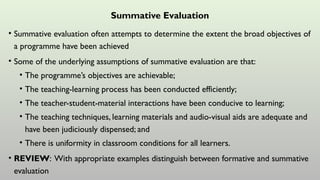
Summative Evaluation
• Summativeevaluation often attempts to determine the extent the broad objectives of
a programme have been achieved
• Some of the underlying assumptions of summative evaluation are that:
• The programme’s objectives are achievable;
• The teaching-learning process has been conducted efficiently;
• The teacher-student-material interactions have been conducive to learning;
• The teaching techniques, learning materials and audio-visual aids are adequate and
have been judiciously dispensed; and
• There is uniformity in classroom conditions for all learners.
• REVIEW: With appropriate examples distinguish between formative and summative
evaluation
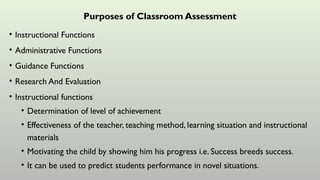
Purposes of ClassroomAssessment
• Instructional Functions
• Administrative Functions
• Guidance Functions
• Research And Evaluation
• Instructional functions
• Determination of level of achievement
• Effectiveness of the teacher, teaching method, learning situation and instructional
materials
• Motivating the child by showing him his progress i.e. Success breeds success.
• It can be used to predict students performance in novel situations.
28.
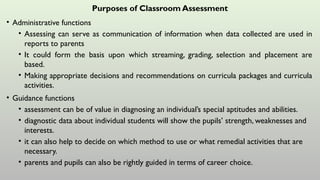
Purposes of ClassroomAssessment
• Administrative functions
• Assessing can serve as communication of information when data collected are used in
reports to parents
• It could form the basis upon which streaming, grading, selection and placement are
based.
• Making appropriate decisions and recommendations on curricula packages and curricula
activities.
• Guidance functions
• assessment can be of value in diagnosing an individual’s special aptitudes and abilities.
• diagnostic data about individual students will show the pupils’ strength, weaknesses and
interests.
• it can also help to decide on which method to use or what remedial activities that are
necessary.
• parents and pupils can also be rightly guided in terms of career choice.
29.
Purposes of ClassroomAssessment
• Research and Evaluation
• Assessments are useful for programme evaluation and research
• Outcome measures are necessary to determine whether an
innovative programme is better or poorer than the conventional
one in facilitating the attainment of specific curricular objectives.
Old Practices ofAssessment
• Comprised mainly of tests and examinations administered periodically, either
fortnightly or monthly.Terminal assessment were administered at the end of
term, year or course; hence its being called a ‘one-shot’ assessment.
• Problems associated with this type of assessment
• It put so much into a single examination.
• It was unable to cover all that was taught within the period the
examination covered.
• Schools depended so much on the result to determine the fate of pupils.
• It caused a lot of emotional strains on the students.
• It was limited to students cognitive gains only.
• Its administration periodically, tested knowledge only.
32.
Old Assessment
• Problemsassociated with this type of assessment
• Learning and teaching were regarded as separate processes in which, only
learning could be assessed.
• It did not reveal students’ weakness early enough to enable teacher to
help students overcome them.
• Achievements were as a result of comparing marks obtained.
• It created unhealthy competition which led to all forms of malpractices.
33.
Modern Assessment
• Thisis a method of improving teaching and learning processes.
• It forms the basis for guidance and counselling in the school.
• Teaching and learning are mutually related.
• Teaching is assessed when learning is and vice-versa.
• Assessment is an integral and indispensable part of the teaching-learning
process.
• The attainment of objectives of teaching and learning can be perceived and
confirmed through continuous assessment.
• It evaluates students in areas of learning other than the cognitive
34.
Concept of ContinuousAssessment
• For any form of assessment to be able to serve the above functions, it
cannot be a one shot kind of assessment. It has to be an on-going exercise
throughout the teaching and learning processes. This is why continuations
assessment is advocated in the classroom.
• “A mechanism whereby the final grading of a student in the cognitive,
affective and psychomotor domains of behaviour takes account in a
systematic way, of all his performances during a given period of schooling”.
• It involves the use of a great variety of models of evaluation for the purpose
of finding and improving the learning and performance of the students.”
35.
Concept of ContinuousAssessment
• Continuous assessment, means assessing or weighing performance of students
periodically to be able to determine progress made in teaching-learning
activities.
• Continuous assessment tests can be done daily, weekly, monthly, depending on
the goals of teaching and learning.
36.
Continuous Assessment
• Advantagesof CA
• It provides useful information about the academic progress of the
learner;
• It makes the learner to keep on working in a progressive manner;
• It informs the teacher about the teaching-learning effectiveness achieved;
• It gives a true picture of the student academic performance since it is a
continuous process rather than one duration type of test which may be
affected by many variables such as sickness, fatigue, stress, etc; and
• It makes learning an active rather than a passive process.
37.
• Characteristics ofCA
• In most cases, continuous assessment tests are periodical, systematic, and well
planned.They should not be tests organized in a haphazard manner.
• Continuous assessment tests can be in any form. They may be oral, written,
practical, announced, or unannounced, multiple choice objective, essay, or
subjective and so on.
• Continuous assessment tests are often based on what has been learnt within a
particular period.Thus, they should be a series of tests.
• Invariably, continuous assessment tests are designed and produced by the
classroom teacher.
• All continuous assessment tests should meet the criteria for a good test: e.G.,
Validity and reliability.
38.
Taxonomy of EducationalObjectives
Objective:
by the end of the lesson, you should be able to explain bloom’s taxonomy of
educational objectives.
39.
Taxonomy of EducationalObjectives
• Classification of educational objectives
• Cognitive;
• Affective; and
• Psychomotor domains
• The focus of assessment is on these three domains of educational
objectives.
40.
Cognitive Domain
Involves rememberingpreviously learnt matter
Has the following levels
• Knowledge of specifics
Remember previously learned information.
• Comprehension
Demonstrate an understanding of the facts.
• Application
Apply knowledge to actual situations.
• Analysis
Break down objects or ideas into simpler parts and find evidence to support generalization
• Synthesis
Compile component ideas into a new whole or propose alternative solutions.
• Evaluation
Make and defend judgments based on internal evidence or external criteria.
41.
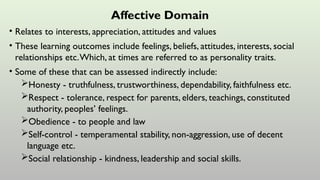
Affective Domain
• Relatesto interests, appreciation, attitudes and values
• These learning outcomes include feelings, beliefs, attitudes, interests, social
relationships etc.Which, at times are referred to as personality traits.
• Some of these that can be assessed indirectly include:
Honesty - truthfulness, trustworthiness, dependability, faithfulness etc.
Respect - tolerance, respect for parents, elders, teachings, constituted
authority, peoples’ feelings.
Obedience - to people and law
Self-control - temperamental stability, non-aggression, use of decent
language etc.
Social relationship - kindness, leadership and social skills.
42.
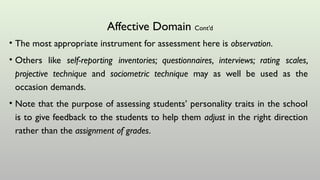
Affective Domain Cont’d
•The most appropriate instrument for assessment here is observation.
• Others like self-reporting inventories; questionnaires, interviews; rating scales,
projective technique and sociometric technique may as well be used as the
occasion demands.
• Note that the purpose of assessing students’ personality traits in the school
is to give feedback to the students to help them adjust in the right direction
rather than the assignment of grades.
43.
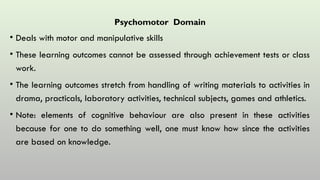
Psychomotor Domain
• Dealswith motor and manipulative skills
• These learning outcomes cannot be assessed through achievement tests or class
work.
• The learning outcomes stretch from handling of writing materials to activities in
drama, practicals, laboratory activities, technical subjects, games and athletics.
• Note: elements of cognitive behaviour are also present in these activities
because for one to do something well, one must know how since the activities
are based on knowledge.
Different Kinds ofTests
• Diagnostic tests
• Usually administered on an individual basis.
• These tests are very good for determining problems in learning for
individual students.
• Diagnostic tests also bring out areas of difficulty of a student for the
purpose of remediation.
• Typically, these types of tests are administered by the school psychologist,
counsellor, or trained in its administration and scoring.
46.
Different Kinds ofTests
• Achievement tests
• For measuring the achievement of a candidate in a particular course either
during or at the end of the course.
• Placement tests
• For placing students at a particular level, school, or college.
• Predictive tests
• Designed to be able to predict the learning outcomes of the candidate. A
predictive test is able to predict or forecast that if the candidate is able to
• Pass a particular test, he/she will be able to carry out a particular task, skill,
course, action, or programme.
47.
DIFFERENT KINDS OFTESTS
• Aptitude tests
Are designed to determine the aptitude (fitness) of a student for a particular
task, course, programme, job, etc.
• Standardized tests:
Are any of the above mentioned tests that have been tried out with
large groups of individuals, whose scores provide standard norms or
reference points for interpreting any scores that anybody who writes the
tests has attained.
Standardized tests are to be administered in a standard manner under
uniform positions.
They are tested and re-tested and have been proved to produce valid
or reliable scores.
48.
Characteristics of GoodTests
•A good test should be valid: by this we mean it should measure what it is supposed to
measure or be suitable for the purpose for which it is intended.
• A good test should be reliable: reliability simply means measuring what it purports to
measure consistently. On a reliable test, you can be confident that someone will get more
or less the same score on different occasions or when it is used by different people.
• A good test must be capable of accurate measurement of the academic ability of the
learner: a good test should give a true picture of the learner. It should point out clearly
areas that are learnt and areas not learnt. All being equal, a good test should isolate the
good from the bad. A good student should not fail a good test, while a poor student
passes with flying colours.
49.
Characteristics of GoodTests
•A good test must represent teaching-learning objectives and goals: the test should
be conscious of the objectives of learning and objectives of testing. For example, if the
objective of learning is to master a particular skill and apply the skill, testing should be
directed towards the mastery and application of the skill.
• Test materials must be properly and systematically selected: the test materials
must be selected in such a way that they cover the syllabus, teaching course outlines or the
subject area.The materials should be of mixed difficulty levels (not too easy or too difficult)
which represent the specific targeted learners’ needs that were identified at the beginning
of the course.
50.
Characteristics of GoodTests
•Variety is also a characteristic of a good test.
• This includes a variety of test type: multiple choice tests, subjective tests
and so on. It also includes variety of tasks and so on. It also includes variety
of tasks within each test: writing, reading, speaking, listening, re-writing,
transcoding, solving, organizing and presenting extended information,
interpreting, black filling, matching, extracting points, distinguishing,
identifying, constructing, producing, designing, etc. In most cases, both the
tasks and the materials to be used in the tests should be real to the life
situation of what the learner is being trained for.
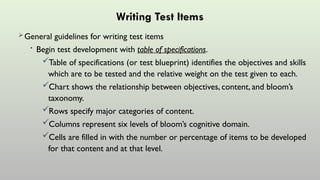
Writing Test Items
Generalguidelines for writing test items
• Begin test development with table of specifications.
Table of specifications (or test blueprint) identifies the objectives and skills
which are to be tested and the relative weight on the test given to each.
Chart shows the relationship between objectives, content, and bloom’s
taxonomy.
Rows specify major categories of content.
Columns represent six levels of bloom’s cognitive domain.
Cells are filled in with the number or percentage of items to be developed
for that content and at that level.
54.
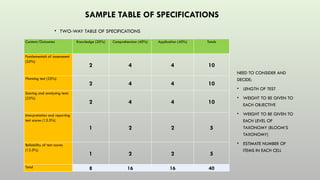
SAMPLE TABLE OFSPECIFICATIONS
• TWO-WAY TABLE OF SPECIFICATIONS
NEED TO CONSIDER AND
DECIDE:
• LENGTH OF TEST
• WEIGHT TO BE GIVEN TO
EACH OBJECTIVE
• WEIGHT TO BE GIVEN TO
EACH LEVEL OF
TAXONOMY (BLOOM’S
TAXONOMY)
• ESTIMATE NUMBER OF
ITEMS IN EACH CELL
Content/Outcomes Knowledge (20%) Comprehension (40%) Application (40%) Totals
Fundamentals of assessment
(25%)
2 4 4 10
Planning test (25%)
2 4 4 10
Scoring and analysing tests
(25%)
2 4 4 10
Interpretation and reporting
test scores (12.5%)
1 2 2 5
Reliability of test scores
(12.5%)
1 2 2 5
Total 8 16 16 40
55.
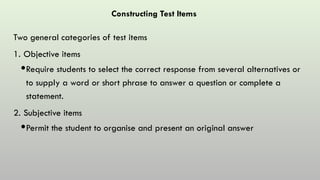
Constructing Test Items
Twogeneral categories of test items
1. Objective items
Require students to select the correct response from several alternatives or
to supply a word or short phrase to answer a question or complete a
statement.
2. Subjective items
Permit the student to organise and present an original answer
56.
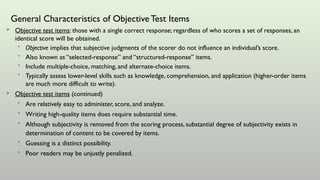
General Characteristics ofObjectiveTest Items
Objective test items: those with a single correct response; regardless of who scores a set of responses, an
identical score will be obtained.
• Objective implies that subjective judgments of the scorer do not influence an individual’s score.
• Also known as “selected-response” and “structured-response” items.
• Include multiple-choice, matching, and alternate-choice items.
• Typically assess lower-level skills such as knowledge, comprehension, and application (higher-order items
are much more difficult to write).
Objective test items (continued)
• Are relatively easy to administer, score, and analyze.
• Writing high-quality items does require substantial time.
• Although subjectivity is removed from the scoring process, substantial degree of subjectivity exists in
determination of content to be covered by items.
• Guessing is a distinct possibility.
• Poor readers may be unjustly penalized.
57.
General Characteristics ofObjectiveTest Items
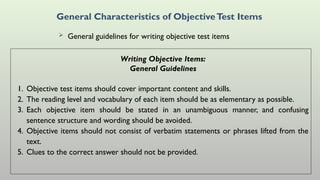
General guidelines for writing objective test items
Writing Objective Items:
General Guidelines
1. Objective test items should cover important content and skills.
2. The reading level and vocabulary of each item should be as elementary as possible.
3. Each objective item should be stated in an unambiguous manner, and confusing
sentence structure and wording should be avoided.
4. Objective items should not consist of verbatim statements or phrases lifted from the
text.
5. Clues to the correct answer should not be provided.
58.
General Characteristics ofObjectiveTest Items
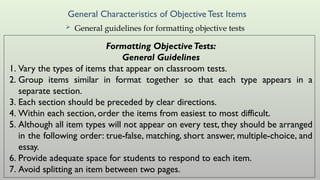
General guidelines for formatting objective tests
Formatting ObjectiveTests:
General Guidelines
1. Vary the types of items that appear on classroom tests.
2. Group items similar in format together so that each type appears in a
separate section.
3. Each section should be preceded by clear directions.
4. Within each section, order the items from easiest to most difficult.
5. Although all item types will not appear on every test, they should be arranged
in the following order: true-false, matching, short answer, multiple-choice, and
essay.
6. Provide adequate space for students to respond to each item.
7. Avoid splitting an item between two pages.
59.
General Characteristics ofObjectiveTest Items
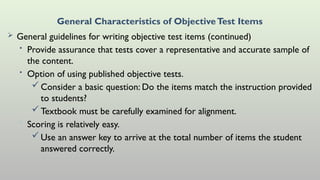
General guidelines for writing objective test items (continued)
• Provide assurance that tests cover a representative and accurate sample of
the content.
• Option of using published objective tests.
Consider a basic question: Do the items match the instruction provided
to students?
Textbook must be carefully examined for alignment.
• Scoring is relatively easy.
Use an answer key to arrive at the total number of items the student
answered correctly.
60.
Types of ObjectiveTest Items
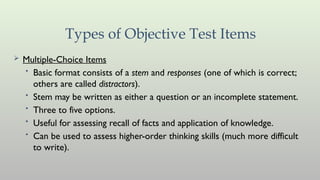
Multiple-Choice Items
• Basic format consists of a stem and responses (one of which is correct;
others are called distractors).
• Stem may be written as either a question or an incomplete statement.
• Three to five options.
• Useful for assessing recall of facts and application of knowledge.
• Can be used to assess higher-order thinking skills (much more difficult
to write).
61.
Types of ObjectiveTestItems
Multiple-Choice Items (continued)
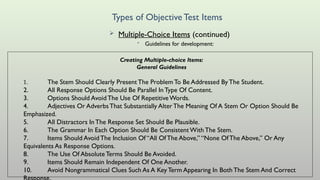
• Guidelines for development:
Creating Multiple-choice Items:
General Guidelines
1. The Stem Should Clearly Present The Problem To Be Addressed By The Student.
2. All Response Options Should Be Parallel In Type Of Content.
3. Options Should AvoidThe Use Of RepetitiveWords.
4. Adjectives Or AdverbsThat Substantially AlterThe Meaning Of A Stem Or Option Should Be
Emphasized.
5. All Distractors In The Response Set Should Be Plausible.
6. The Grammar In Each Option Should Be Consistent With The Stem.
7. Items Should AvoidThe Inclusion Of “All Of The Above,” “None OfThe Above,” Or Any
Equivalents As Response Options.
8. The Use Of AbsoluteTerms Should Be Avoided.
9. Items Should Remain Independent Of One Another.
10. Avoid Nongrammatical Clues Such As A Key Term Appearing In Both The Stem And Correct
62.
Types of ObjectiveTestItems
Multiple-Choice Items (continued)
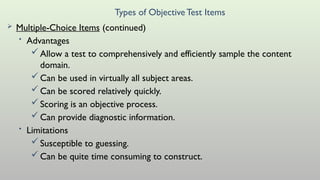
• Advantages
Allow a test to comprehensively and efficiently sample the content
domain.
Can be used in virtually all subject areas.
Can be scored relatively quickly.
Scoring is an objective process.
Can provide diagnostic information.
• Limitations
Susceptible to guessing.
Can be quite time consuming to construct.
63.
Types of ObjectiveTestItems
Matching Items
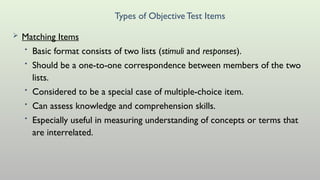
• Basic format consists of two lists (stimuli and responses).
• Should be a one-to-one correspondence between members of the two
lists.
• Considered to be a special case of multiple-choice item.
• Can assess knowledge and comprehension skills.
• Especially useful in measuring understanding of concepts or terms that
are interrelated.
64.
Types of ObjectiveTestItems
Matching Items (continued)
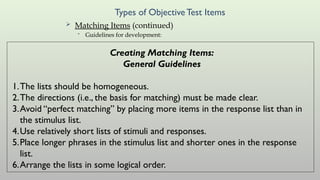
• Guidelines for development:
Creating Matching Items:
General Guidelines
1.The lists should be homogeneous.
2.The directions (i.e., the basis for matching) must be made clear.
3.Avoid “perfect matching” by placing more items in the response list than in
the stimulus list.
4.Use relatively short lists of stimuli and responses.
5.Place longer phrases in the stimulus list and shorter ones in the response
list.
6.Arrange the lists in some logical order.
65.
Types of ObjectiveTestItems
Matching Items (continued)
• Advantages
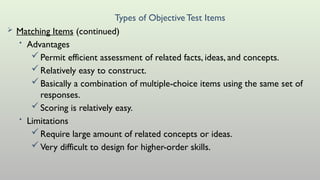
Permit efficient assessment of related facts, ideas, and concepts.
Relatively easy to construct.
Basically a combination of multiple-choice items using the same set of
responses.
Scoring is relatively easy.
• Limitations
Require large amount of related concepts or ideas.
Very difficult to design for higher-order skills.
66.
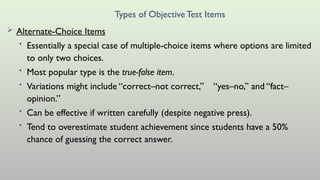
Types of ObjectiveTestItems
Alternate-Choice Items
• Essentially a special case of multiple-choice items where options are limited
to only two choices.
• Most popular type is the true-false item.
• Variations might include “correct–not correct,” “yes–no,” and “fact–
opinion.”
• Can be effective if written carefully (despite negative press).
• Tend to overestimate student achievement since students have a 50%
chance of guessing the correct answer.
67.
Types of ObjectiveTestItems
Alternate-Choice Items (continued)
• Guidelines for development:
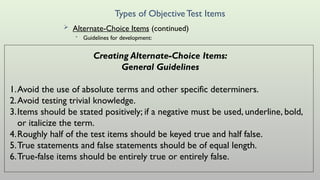
Creating Alternate-Choice Items:
General Guidelines
1.Avoid the use of absolute terms and other specific determiners.
2.Avoid testing trivial knowledge.
3.Items should be stated positively; if a negative must be used, underline, bold,
or italicize the term.
4.Roughly half of the test items should be keyed true and half false.
5.True statements and false statements should be of equal length.
6.True-false items should be entirely true or entirely false.
68.
Types of ObjectiveTestItems
Alternate-Choice Items (continued)
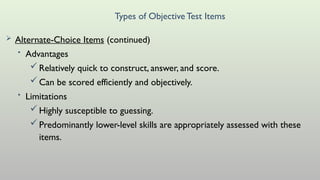
• Advantages
Relatively quick to construct, answer, and score.
Can be scored efficiently and objectively.
• Limitations
Highly susceptible to guessing.
Predominantly lower-level skills are appropriately assessed with these
items.
69.
Types of ObjectiveTestItems
Alternate-Choice Items (continued)
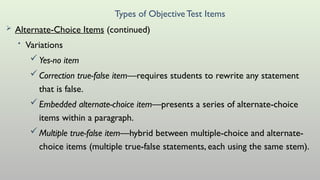
• Variations
Yes-no item
Correction true-false item—requires students to rewrite any statement
that is false.
Embedded alternate-choice item—presents a series of alternate-choice
items within a paragraph.
Multiple true-false item—hybrid between multiple-choice and alternate-
choice items (multiple true-false statements, each using the same stem).
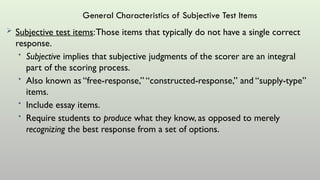
General Characteristics ofSubjective Test Items
Subjective test items:Those items that typically do not have a single correct
response.
• Subjective implies that subjective judgments of the scorer are an integral
part of the scoring process.
• Also known as “free-response,” “constructed-response,” and “supply-type”
items.
• Include essay items.
• Require students to produce what they know, as opposed to merely
recognizing the best response from a set of options.
72.
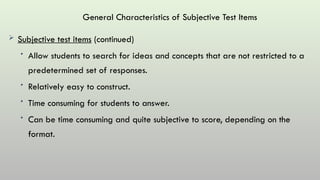
General Characteristics ofSubjective Test Items
Subjective test items (continued)
• Allow students to search for ideas and concepts that are not restricted to a
predetermined set of responses.
• Relatively easy to construct.
• Time consuming for students to answer.
• Can be time consuming and quite subjective to score, depending on the
format.
73.
Types of SubjectiveTestItems
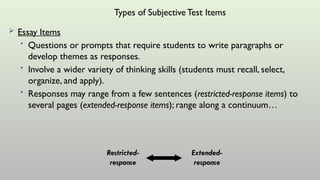
Essay Items
• Questions or prompts that require students to write paragraphs or
develop themes as responses.
• Involve a wider variety of thinking skills (students must recall, select,
organize, and apply).
• Responses may range from a few sentences (restricted-response items) to
several pages (extended-response items); range along a continuum…
Restricted-
response
Extended-
response
74.
Types of SubjectiveTestItems
Essay Items (continued)
• Appropriately used to assess complex thinking skills (i.e., analysis, synthesis,
and evaluation).
• Sometimes used exclusively or as part of a larger performance assessment.
• Not appropriately used to assess lower-level skills.
• Scoring is complex and typically unreliable (due to influence of response
characteristics).
• Scoring can be quite time consuming.
75.
Types of SubjectiveTestItems
Essay Items (continued)
• Guidelines for development:
Creating Essay Items:
General Guidelines
1. Essays should consist of the application of essential knowledge to new
situations.
2. Essays should present a clear and focused task to students.
3. Specify for students the desired length, time limits, and evaluative
criteria.
4. Develop a model response.
76.
Types of SubjectiveTest Items
Essay Items (continued)
• Advantages
Can be used to elicit a wide variety of responses.
Students are permitted to create their own responses.
Probability of guessing is substantially reduced.
• Limitations
Very time consuming to score.
Content coverage may be restricted.
Packaging Guidelines
• Grouptogether all items of similar format
• Arrange test items from easy to hard
• Space the items for easy reading
• Keep items and options on the same page
• Position illustrations near descriptions
• Check your answer key
• Determine how students record answers
• Provide space for name and date
• Check test directions
• Proofread the test
80.
Reproducing the Test
•Know the photocopying machine
• Specify copying instructions
• File original test
81.
Administering the Test
•Suggestions to help students psychologically prepare for the test:
• Maintain a positive attitude
• Maximize achievement motivation
• Equalize advantages
• Avoid surprises
• Clarify the rules
• Rotate distributions
• Remind students to check their copies
• Monitor students
• Minimize distractions
• Give time warnings
• Collect tests uniformly
82.
Scoring the Test
•General suggestions to save scoring time and improve scoring accuracy
and consistency
• Prepare an answers key
• Check the answer key
• Score blindly
• Check machine-scored answer sheets
• Check scoring
• Record scores
83.
Analysing the Test
•Classroom tests can include inappropriate, invalid or otherwise deficient
items.
• Item analysis is used to identify items that are deficient in some way.
• Item analysis may result in improving some items, and eliminating others.
• Item analysis is a technique that enables the examiner to assess the quality or
utility of an item.
84.
Item Analysis
• Theitem analysis is an important phase in the development of an exam programme.
• In this phase statistical methods are used to identify any test items that are not working well. If an item is too
easy, too difficult, failing to show a difference between skilled and unskilled examinees, or even scored
incorrectly, an item analysis will reveal it.
• The two most common statistics reported in an item analysis are the item difficulty, which is a measure of the
proportion of examinees who responded to an item correctly and the item discrimination, which is a measure
of how well the item discriminates between examinees who are knowledgeable in the content area and those
who are not.
• An additional analysis that is often reported is the distractor analysis.The distractor analysis provides a
measure of how well each of the incorrect options contributes to the quality of a multiple choice item. Once
the item analysis information is available, an item review is often conducted.
85.
Analysing the Test
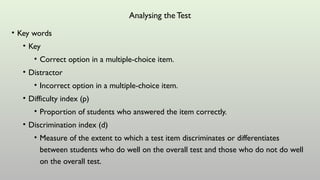
•Key words
• Key
• Correct option in a multiple-choice item.
• Distractor
• Incorrect option in a multiple-choice item.
• Difficulty index (p)
• Proportion of students who answered the item correctly.
• Discrimination index (d)
• Measure of the extent to which a test item discriminates or differentiates
between students who do well on the overall test and those who do not do well
on the overall test.
86.
Item Difficulty Index
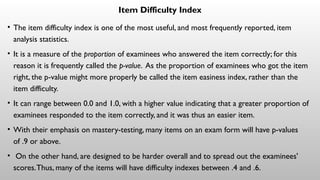
•The item difficulty index is one of the most useful, and most frequently reported, item
analysis statistics.
• It is a measure of the proportion of examinees who answered the item correctly; for this
reason it is frequently called the p-value. As the proportion of examinees who got the item
right, the p-value might more properly be called the item easiness index, rather than the
item difficulty.
• It can range between 0.0 and 1.0, with a higher value indicating that a greater proportion of
examinees responded to the item correctly, and it was thus an easier item.
• With their emphasis on mastery-testing, many items on an exam form will have p-values
of .9 or above.
• On the other hand, are designed to be harder overall and to spread out the examinees'
scores.Thus, many of the items will have difficulty indexes between .4 and .6.
87.
Analysing the Test
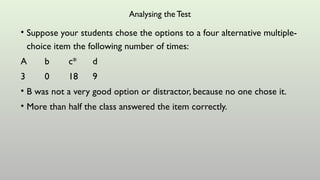
•Suppose your students chose the options to a four alternative multiple-
choice item the following number of times:
A b c* d
3 0 18 9
• B was not a very good option or distractor, because no one chose it.
• More than half the class answered the item correctly.
88.
Analysing the Test
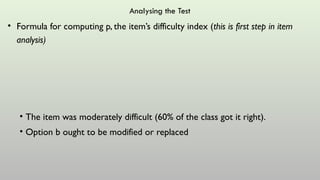
•Formula for computing p, the item’s difficulty index (this is first step in item
analysis)
• The item was moderately difficult (60% of the class got it right).
• Option b ought to be modified or replaced
89.
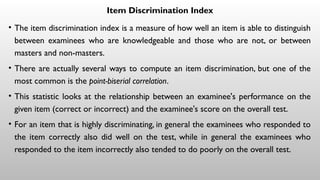
Item Discrimination Index
•The item discrimination index is a measure of how well an item is able to distinguish
between examinees who are knowledgeable and those who are not, or between
masters and non-masters.
• There are actually several ways to compute an item discrimination, but one of the
most common is the point-biserial correlation.
• This statistic looks at the relationship between an examinee's performance on the
given item (correct or incorrect) and the examinee's score on the overall test.
• For an item that is highly discriminating, in general the examinees who responded to
the item correctly also did well on the test, while in general the examinees who
responded to the item incorrectly also tended to do poorly on the overall test.
90.
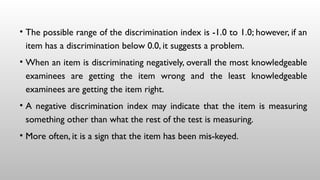
• The possiblerange of the discrimination index is -1.0 to 1.0; however, if an
item has a discrimination below 0.0, it suggests a problem.
• When an item is discriminating negatively, overall the most knowledgeable
examinees are getting the item wrong and the least knowledgeable
examinees are getting the item right.
• A negative discrimination index may indicate that the item is measuring
something other than what the rest of the test is measuring.
• More often, it is a sign that the item has been mis-keyed.
91.
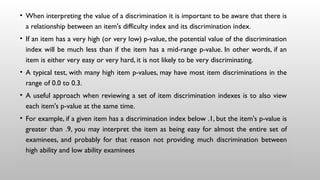
• When interpretingthe value of a discrimination it is important to be aware that there is
a relationship between an item's difficulty index and its discrimination index.
• If an item has a very high (or very low) p-value, the potential value of the discrimination
index will be much less than if the item has a mid-range p-value. In other words, if an
item is either very easy or very hard, it is not likely to be very discriminating.
• A typical test, with many high item p-values, may have most item discriminations in the
range of 0.0 to 0.3.
• A useful approach when reviewing a set of item discrimination indexes is to also view
each item's p-value at the same time.
• For example, if a given item has a discrimination index below .1, but the item's p-value is
greater than .9, you may interpret the item as being easy for almost the entire set of
examinees, and probably for that reason not providing much discrimination between
high ability and low ability examinees
92.
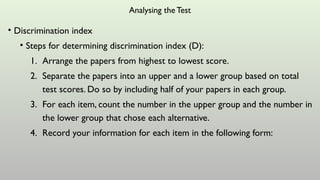
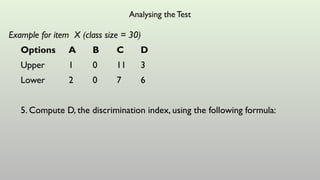
Analysing the Test
•Discrimination index
• Steps for determining discrimination index (D):
1. Arrange the papers from highest to lowest score.
2. Separate the papers into an upper and a lower group based on total
test scores. Do so by including half of your papers in each group.
3. For each item, count the number in the upper group and the number in
the lower group that chose each alternative.
4. Record your information for each item in the following form:
93.
Analysing the Test
Examplefor item X (class size = 30)
Options A B C D
Upper 1 0 11 3
Lower 2 0 7 6
5. Compute D, the discrimination index, using the following formula:
94.
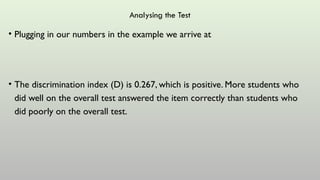
Analysing the Test
•Plugging in our numbers in the example we arrive at
• The discrimination index (D) is 0.267, which is positive. More students who
did well on the overall test answered the item correctly than students who
did poorly on the overall test.
Outline What Constitutesa Good or Acceptable Answer As a Scoring
Key
This Calls For a Marking Scheme
97.
Marking Scheme
• Markingscheme provides the criteria for making judgments about the different levels
of student performance and the marks to be awarded.
• Mainly concerned with “supply response item format”, e.g., Essay questions.
Why A Marking Scheme?
• Provides a clear basis for distinguishing between different levels of achievement.
• Supports consistency in marking, both over the time of the marking and where more
than one marker is involved.
• Provides the basis for useful feedback to students on their demonstrated achievement
98.
Checklist For aGood Marking Scheme
• Provide clear criteria to identify and differentiate students’ achievement of
the course objectives
• Reflect the relative importance and difficulty of parts of a task where it
consists of a number of parts
• Describe the range of student achievement in relation to what is expected to
be demonstrated
• Indicate the quality of response required to gain marks or a sub-range of
marks
Holistic Scoring
• Oneglobal, holistic score for a product or behaviour
• Method where a piece of writing is evaluated for its overall quality.
• Requires the examiner to evaluate the work as a whole.
• Assigns a single score to represent a weighting of the whole work.
• The score is based on a general impression
• Often accomplished by placing essays in designated piles that represent
different degrees of quality
• Most appropriate for extended-response essays in which responses are not
limited and are generally long