Comprehensive Guide to Solid Waste Handling, Collection, and Storage
Detailed overview of solid waste logistics, collection methods, segregation, storage practices, and types of collection systems for effective waste management.
Comprehensive Guide to Solid Waste Handling, Collection, and Storage
2.
Unit-2: Solid WasteHandling,
Collection and Storage
By
Dr. Vrushali V. Sasane
Ph. D. (Civil Engg.), M.E. (Env Engg.)
B.E. (Civil)
Department of Civil Engineering
Assistant Professor
3.
Waste Logistics
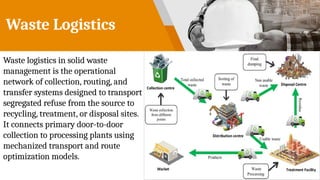
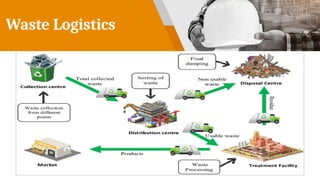
Waste logisticsin solid waste
management is the operational
network of collection, routing, and
transfer systems designed to transport
segregated refuse from the source to
recycling, treatment, or disposal sites.
It connects primary door-to-door
collection to processing plants using
mechanized transport and route
optimization models.
Solid Waste CollectionServices
• Solid waste collection services safely gather, move, and treat household, business, and factory
garbage. Main steps include door-to-door pickup, sorting, and recycling or composting
• The most common types of solid waste collection services include:
• Door-to-Door Collection: Collectors visit each individual residence or apartment complex
to retrieve waste directly, requiring minimal effort from the generator.
• Curbside Pick-Up: Residents are responsible for placing pre-sorted bins, carts, or bags
directly on the curb at specified scheduled times.
• Block Collection: No community bins are provided. Residents wait for a designated
collection vehicle (such as an automated or semi-automated truck) that travels a strict,
scheduled route.
6.
Solid Waste CollectionServices
• Community/Communal Bins: Commonly used in densely populated urban areas, where
residents carry their segregated waste to large, shared neighborhood dumpsters or collection
points.
• Backyard/Carry Collection: Workers retrieve containers directly from the resident's
property (e.g., backyard or alley), eliminating the need for the homeowner to move the bins
themselves.
• Setout-Setback Collection: Workers enter the property to retrieve full containers, return
them after the collection vehicle has emptied them, and place them back on the property.
• Commercial/Industrial Contracted Services: Large businesses and commercial properties
hire private waste management companies to handle industrial, hazardous, or high-volume
non-hazardous refuse
7.
Solid Waste Handlingand Separation
• Importance of Separation/Segregation:
• Separating solid waste at the point of origin is the most critical step in an effective
waste management system. It:
• Reduces Landfill Volume: Diverting organic and recyclable materials extends the
lifespan of landfills and prevents toxic runoff.
• Improves Recycling Quality: Uncontaminated, source-separated recyclables are
much more valuable and easier to process.
• Protects Public Health: Isolating hazardous, infectious, or domestic medical waste
prevents exposure and environmental contamination.
8.
Solid Waste Handlingand Separation
• Handling & Storage Practices: Proper interim handling ensures that separated
waste does not become a nuisance before collection:
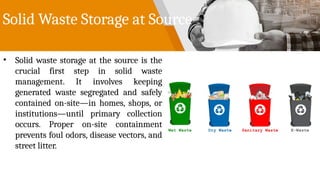
• Containerization: Store separated waste in closed, labeled containers (often color-coded,
e.g., green for wet, blue for dry, yellow for hazardous) to prevent vector access.
• Collection: Utilize door-to-door collection systems to prevent the indiscriminate dumping of
waste in central neighborhood areas.
• Processing: Post-collection, larger facilities use mechanized separation (e.g., magnetic
separators for ferrous metals or air classifiers for light plastics) to fine-tune the purity of
recyclable batches.
9.
Solid Waste Handlingand Separation
• Separation Practices: Under contemporary waste management guidelines, solid waste
should be separated into these four distinct streams:
• Wet Waste: Biodegradable organic waste, food scraps, and yard trimmings. Best processed via
composting or vermiculture to produce organic manure.
• Dry Waste: Non-biodegradable items like paper, cardboard, glass, plastics, and metals. These
are sent to materials recovery facilities (MRF) or recycling plants to be converted into new
products.
• Sanitary Waste: Diapers, sanitary napkins, and biomedical materials. This requires
specialized disposal to avoid infectious outbreaks.
• Special Care / Domestic Hazardous Waste: E-waste, discarded medicines, paints, batteries,
and chemical cleaners. Requires strict, separate handling so they do not leach into soil or
water.
10.
Solid Waste Storageat Source
• Solid waste storage at the source is the
crucial first step in solid waste
management. It involves keeping
generated waste segregated and safely
contained on-site—in homes, shops, or
institutions—until primary collection
occurs. Proper on-site containment
prevents foul odors, disease vectors, and
street litter.
11.
Solid Waste Storageat Source
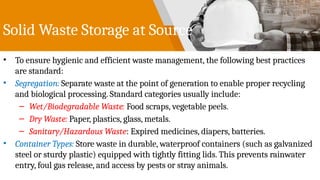
• To ensure hygienic and efficient waste management, the following best practices
are standard:
• Segregation: Separate waste at the point of generation to enable proper recycling
and biological processing. Standard categories usually include:
– Wet/Biodegradable Waste: Food scraps, vegetable peels.
– Dry Waste: Paper, plastics, glass, metals.
– Sanitary/Hazardous Waste: Expired medicines, diapers, batteries.
• Container Types: Store waste in durable, waterproof containers (such as galvanized
steel or sturdy plastic) equipped with tightly fitting lids. This prevents rainwater
entry, foul gas release, and access by pests or stray animals.
12.
Solid Waste Storageat Source
• Size and Capacity: For a standard household (about 5 members), a 15-liter
container is generally sufficient for daily food waste, though having extra capacity
allows for unforeseen delays in collection.
• Liners: Using reusable or compostable liners can greatly reduce the need to wash
bins frequently and helps control odors.
• Storage Location: Place containers in a cool, shaded area on a platform at least 30
cm above ground level to keep them dry and away from rodents.
13.
Collection of SolidWaste
Primary Collection
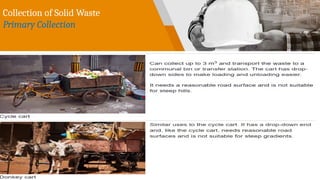
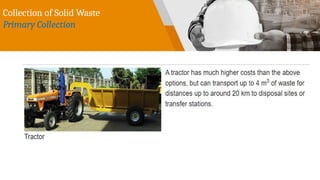
• After on-site storage, the next step is collection. Primary collection is the collection of
waste from the point where it is placed by the person or organization that has produced it.
These collection points could be located outside each individual household and business,
communal containers serving a number of households, or waste skips taking waste from
households and businesses in the surrounding area. Depending on the collection vehicle and
the distance to the waste treatment/disposal site, the waste at this stage may be taken to the
final disposal site or to a transfer station
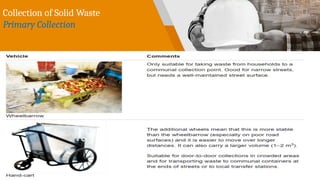
• Primary collection can be done in many ways. Table below shows the lower-technology
options that are suitable for collecting waste from households and transporting it to a
transfer station or local disposal site. These all have the benefit of being able to serve narrow
streets in crowded areas
Collection of SolidWaste
Secondary Collection
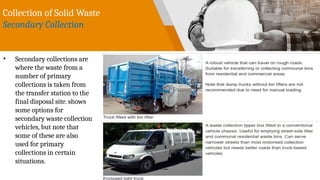
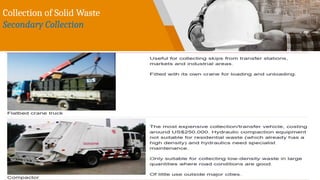
• Secondary collections are
where the waste from a
number of primary
collections is taken from
the transfer station to the
final disposal site. shows
some options for
secondary waste collection
vehicles, but note that
some of these are also
used for primary
collections in certain
situations.
Types of CollectionSystems
• Solid waste collection system may be classified from several point of view such
as the mode of operation, the equipment used, and the types of waste collected.
In this text collection, system has been classified according to their mode of
operation.
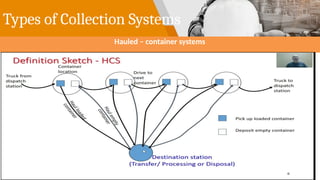
• Hauled – container systems
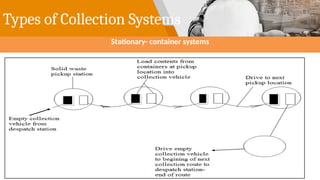
• Stationary- container systems
Types of CollectionSystems
• Hauled Container Systems (HCS)
• Hauled Collection system in which the containers used for the storage of waste are hauled
to the processing, transfer or disposal site, emptied and returned to either their original
location or some other location.
• Hauled Container System and equipment Hauled Container Systems are ideally suited for
the removal of wastes from sources, where the rate of generation is high, because relatively
large containers are used. The use of large containers eliminates time as well as the
unsightly accumulations and unsanitary conditions associated with the use of numerous
smaller containers. Another advantage of hauler container system is flexibility: Containers
of many different sizes and shapes are available for the collection of all types of wastes.
23.
Types of CollectionSystems
• Stationary –Container System (SCS)
• Stationary Collection system in which the containers used for the storage of
wastes remain at the point of waste generation, except when moved for
collection.
• There are two main types of stationary- container systems :
• (1) those in which self-loading compactors are used, and
• (2) those in which manually loaded vehicles are used
24.
Hauled– container systemStationary– container system
Pick-ups
The time spent picking up the loaded
container, the time required to redeposit the
container after its contents have been
emptied, and the time spent driving to the
next container.
The time spent loading the collection vehicle
beginning with the stopping of the vehicle
point to load the content of the first
container and ending when the contents of
the last container to be emptied have been
loaded.
25.
Hauled– container systemStationary– container system
Haul (h)
The time required to reach the disposal site,
starting after the container whose contents are
to be emptied has been loaded on the truck ,
plus the time after leaving the disposal site
until the truck arrives at the location where
the empty container is to be redeposited. Time
spent at the disposal site is not included.
The time required to reach the disposal site,
starting after the last container on the route
has been emptied or the collection vehicle is
filled , plus the time after leaving the disposal
site until the truck arrives at the location of
the first container to be emptied on the next
collection route. Time spent at the disposal site
is not included.
26.
Hauled– container systemStationary– container system
At-site (s)
The time spent at the disposal site including the time spent waiting to unload as well as
the time spent unloading
Off-route (W)
All time spent on activities that are nonproductive from the point of view of the overall
collection operation. Necessary off-route time includes
(1) Time spent checking in and out in the morning and at the end of the day
(2) Time lost due to unavoidable congestion
(3) Time spent on equipment repairs and maintenance.
Unnecessary off-rout time includes time spent for lunch in excess of the stated lunch
27.
Collection Route
• Collectionroutes must be laid so both the work force and equipment are used effectively. In general, the
layout of collection routes is a trial –and error process. There is no fixed rules that can be applied to all
situations. Some of the factors that should be taken into consideration when laying out routes:
• 1. Existing company policies and regulations such as the point of collection and frequency of collection.
• 2. Existing system conditions such as crew size and vehicle types
• 3. Waste generated at traffic-congested locations, should be collected as early in the day as possible.
• 4. Sources at which extremely large quantities of wastes are generated should be serviced during the first
part of the day,
• 5. Scattered pick-up points where small quantities of solid wastes are generated should, if possible be
serviced during one trip or on the same day.
28.
Route Optimization
• Definition:Route optimization in solid waste management is the process of planning the
most efficient paths for garbage collection fleets
• Purpose of Route Optimization
• Lower Costs: Reduce total fuel consumption, vehicle wear-and-tear, and labor hours.
• Environmental Protection: Lower greenhouse gas emissions by eliminating unnecessary
mileage and idle time.
• Resource Efficiency: Maximize the number of bins collected per shift while respecting truck
weight limits and depot schedules.
• Improved Service Quality: Prevent missed pickups and maintain consistent collection
schedules across urban and rural zones.
29.
Route Optimization
• Techniquesand Models for Optimization
• Capacitated Vehicle Routing Problem (CVRP): A mathematical model used to design paths
for a fleet with limited carrying capacity serving a set of demand points (bins).
• Geographic Information Systems (GIS): Platforms like ArcGIS Network Analyst model real
road networks, turn restrictions, and spatial layouts to compute shortest or fastest paths.
• Heuristic and Metaheuristic Algorithms: Algorithms such as Ant Colony Optimization,
Genetic Algorithms, and Tabu Search handle large-scale, complex routing problems where
exact mathematical solutions take too long to compute.
• Real-Time Dynamic Rerouting: Integrates live GPS tracking and real-time traffic data to
adjust routes on the fly when accidents or congestion occur.
30.
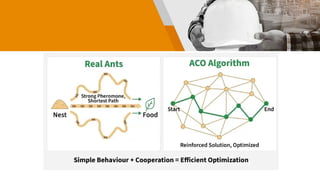
• Ant ColonyOptimization (ACO) is a nature-inspired algorithm that learns from how real
ants collectively find the shortest path to food without any central control. Instead of fixed
rules, it improves solutions over time through simple behaviour and cooperation making it
effective for complex optimization problems. In nature, ants follow a simple process like:
• They move randomly and leave a pheromone trail
• Shorter paths gather pheromones faster
• More ants follow stronger trails
• Over time, the shortest path becomes dominant
32.
• Key Components
•Ant Colony Optimization is built on a few core components that work together to guide the
search toward optimal solutions.
• Ants: Simple agents that explore the problem space and construct solutions step by step.
• Pheromone trails: Numerical values that store past experience and indicate which paths are
more promising.
• Heuristic information: Problem specific knowledge such as distance, cost or time that helps
ants make informed decisions.
• Probability based movement: Ants choose paths using probabilities influenced by
pheromones and heuristic values, rather than fixed rules.
• Pheromone evaporation: Pheromone levels gradually decrease over time, preventing
premature convergence and encouraging continued exploration.
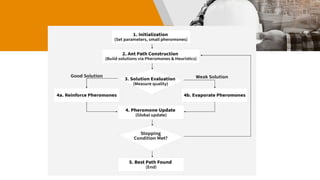
34.
• Initialization: Setinitial parameters and assign small pheromone values to all
paths.
• Ant path construction: Each ant builds a solution by moving through the
problem space based on pheromones and heuristic information.
• Solution evaluation: The quality of each solution is measured using a fitness or
cost function.
• Pheromone update: Good solutions receive more pheromone reinforcement,
while pheromones on other paths evaporate.
• Iteration until best path is found: The process repeats until a stopping condition
is met or the best path is discovered.
35.
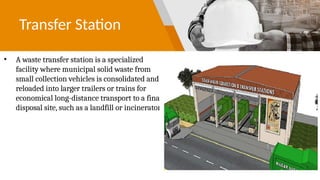
Transfer Station
• Awaste transfer station is a specialized
facility where municipal solid waste from
small collection vehicles is consolidated and
reloaded into larger trailers or trains for
economical long-distance transport to a final
disposal site, such as a landfill or incinerator
36.
Transfer Station
• Necessityof Transfer Stations
• Long Haul Distances: Required when the distance to final disposal or processing sites
exceeds 30–40 kilometers, making direct hauling with small collection trucks uneconomical.
• Cost and Time Efficiency: Keeps local collection crews within their service zones rather
than spending hours driving to distant landfills.
• Traffic and Emissions Reduction: Reduces total heavy vehicle traffic on highways and
local roads by combining loads into high-capacity transport vehicles.
• Dumping Deterrent: Minimizes illegal dumping by offering a local, accessible drop-off
point for regional users
37.
Transfer Station
• Typesof Transfer Stations
• Direct-Load/Discharge: Collection vehicles empty waste directly down into open-top or
waiting large transport trailers. Ideal for low-volume or smaller community setups.
• Storage-Load/Discharge: Waste is dumped onto a reinforced concrete tipping floor or
into a storage pit first, then pushed or loaded into transport vehicles using heavy
equipment like front-end loaders or excavators.
• Combined Stations: Utilize a hybrid approach of both direct tipping and temporary
floor/pit storage depending on daily volume fluctuations.
• Compaction-Based: Equipped with hydraulic compactors to crush and densify waste
before loading it into trailers, maximizing payload weight.
38.
Transfer Station
• LocationCriteria
• Zoning: Ideally placed within industrial or heavy commercial zones, well-
buffered and isolated from dense residential sectors.
• Accessibility: Must feature direct access to major arterial roads, multi-lane
highways, or major transport networks so heavy trucks avoid narrow residential
streets.
• Environmental Safety: Positioned away from sensitive ecological areas, high
water tables, or flood zones to prevent groundwater and surface contamination.
• Centralized Geography: Located centrally relative to the target waste generation
catchment areas to minimize total collection vehicle transit times
39.
Economic Analysis
• Aneconomic analysis of a solid waste transfer station weighs capital construction and
ongoing operational costs against savings in long-distance hauling and collection labor.
Financial viability typically depends on a break-end hauling distance exceeding 35 miles
(one-way) to the final disposal site, allowing smaller trucks to consolidate waste onto
high-capacity trailers
40.
Economic Analysis
• Capitaland Operating Costs
• Capital expenditures (CapEx): Land acquisition, site prep, civil works, paving
tipping floors, scale houses, and heavy machinery like compactors or front-end
loaders.
• Operating expenditures (OpEx): Facility staff salaries, equipment maintenance,
fuel, insurance, and direct landfill tipping/disposal fees.
• Fixed vs. Variable costs: Debt service and baseline facility maintenance form
fixed costs, while long-haul transportation and disposal scale directly with total
tonnage
41.
Economic Analysis
• FinancialBenefits and Savings
• Hauling efficiency: Consolidating three smaller packer truck loads into one large
semitrailer reduces total trips, fuel usage, and highway wear.
• Labor optimization: Collection crews spend less time driving to distant disposal
sites and more time actively picking up curbside waste.
• Additional revenue: Modern facilities often integrate recycling and material
recovery areas to offset baseline operational costs.
42.
Transportation of SolidWaste: Means and Methods
Solid waste transportation involves
moving collected refuse from sources or
transfer points to processing, recycling,
or disposal sites. Primary means include
motor vehicles (trucks, compactors),
rail, water transport, and
pneumatic/hydraulic conduits. Methods
are split into primary collection,
intermediate transfer buffering, and
bulk secondary hauling
Means of Transportation
• Road Vehicles: Garbage trucks, tipper trucks,
dumper placers, and compactors handle local
and secondary transport.
• Railways: Used for long-distance bulk hauling of
large municipal waste volumes.
• Water Transport: Barges and ships move waste
across coastal, river, or island areas economically.
• Pneumatic and Hydraulic Systems: Vacuum tubes
or pressurized water streams move waste
through underground conduits from high-
density buildings.
43.
Transportation of SolidWaste: Means and Methods
Methods of Transportation
Primary Collection: Small vehicles, handcarts, or tricycles pick up waste directly from households
and local bins.
Transfer Stations: Facilities where small loads are consolidated into larger trailers or rail cars to
cut long-distance fuel and labor costs.
Secondary Hauling: Heavy-duty transport vehicles move consolidated waste from transfer
stations directly to final disposal sites like landfills or waste-to-energy plants.


 Most read