Comprehensive Guide to Simple Annuities: Terminologies, Types, and Problem Solving Techniques
Explore key concepts, formulas, and examples to understand simple annuities, including payment types, interest calculations, and solving real-world financial problems.
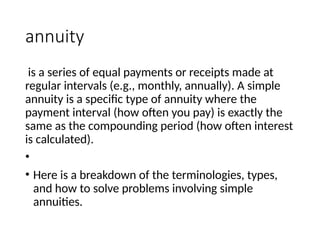
annuity
is a seriesof equal payments or receipts made at
regular intervals (e.g., monthly, annually). A simple
annuity is a specific type of annuity where the
payment interval (how often you pay) is exactly the
same as the compounding period (how often interest
is calculated).
•
• Here is a breakdown of the terminologies, types,
and how to solve problems involving simple
annuities.
3.
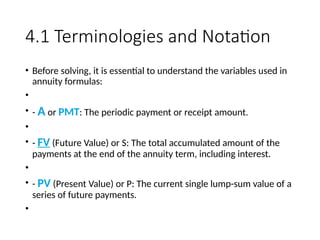
4.1 Terminologies andNotation
• Before solving, it is essential to understand the variables used in
annuity formulas:
•
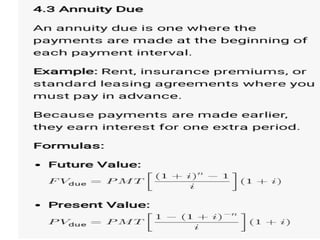
• - A or PMT: The periodic payment or receipt amount.
•
• - FV (Future Value) or S: The total accumulated amount of the
payments at the end of the annuity term, including interest.
•
• - PV (Present Value) or P: The current single lump-sum value of a
series of future payments.
•
4.
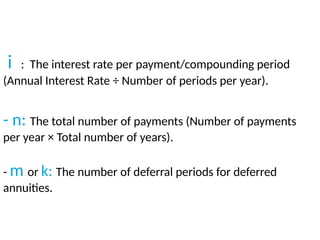
i : Theinterest rate per payment/compounding period
(Annual Interest Rate ÷ Number of periods per year).
- n: The total number of payments (Number of payments
per year × Total number of years).
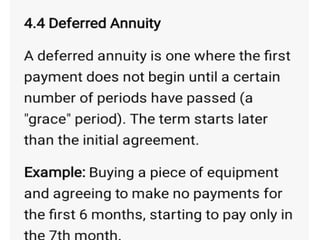
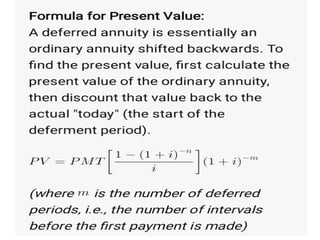
- m or k: The number of deferral periods for deferred
annuities.
6.
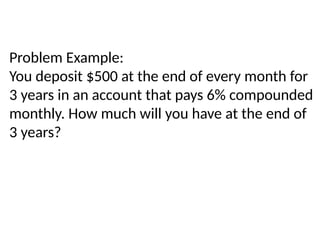
Problem Example:
You deposit$500 at the end of every month for
3 years in an account that pays 6% compounded
monthly. How much will you have at the end of
3 years?
8.
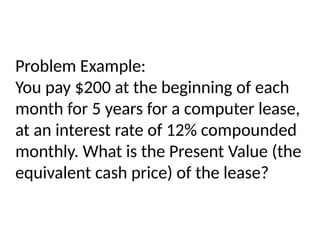
Problem Example:
You pay$200 at the beginning of each
month for 5 years for a computer lease,
at an interest rate of 12% compounded
monthly. What is the Present Value (the
equivalent cash price) of the lease?
11.
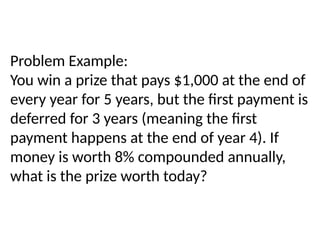
Problem Example:
You wina prize that pays $1,000 at the end of
every year for 5 years, but the first payment is
deferred for 3 years (meaning the first
payment happens at the end of year 4). If
money is worth 8% compounded annually,
what is the prize worth today?
![Simple Annuities:
Terminologies, Types, and
Problem Solving
Submitted by: Leonard L. Ancajas]
Grade & Section: math ll C
Date:August 4, 2026](https://image.slidesharecdn.com/simpleannuities-260820101402-78e1287a/85/Comprehensive-Guide-to-Simple-Annuities-Terminologies-Types-and-Problem-Solving-Techniques-1-320.jpg)