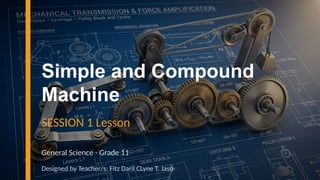
Comprehensive Guide to Simple and Compound Machines in Grade 11 Science
Explore mechanical motion, force, work, and the differences between simple and compound machines with hands-on activities and real-life examples for Grade 11 students.
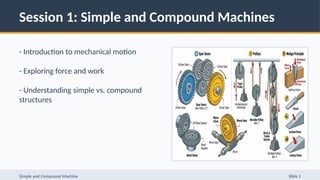
Session 1: Simpleand Compound Machines
- Introduction to mechanical motion
- Exploring force and work
- Understanding simple vs. compound
structures
Simple and Compound Machine Slide 1
3.
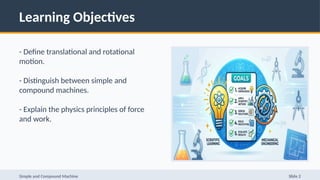
Learning Objectives
- Definetranslational and rotational
motion.
- Distinguish between simple and
compound machines.
- Explain the physics principles of force
and work.
Simple and Compound Machine Slide 2
4.
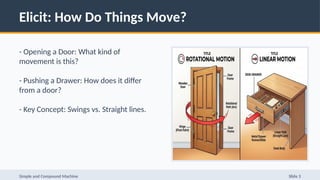
Elicit: How DoThings Move?
- Opening a Door: What kind of
movement is this?
- Pushing a Drawer: How does it differ
from a door?
- Key Concept: Swings vs. Straight lines.
Simple and Compound Machine Slide 3
5.
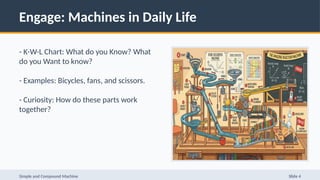
Engage: Machines inDaily Life
- K-W-L Chart: What do you Know? What
do you Want to know?
- Examples: Bicycles, fans, and scissors.
- Curiosity: How do these parts work
together?
Simple and Compound Machine Slide 4
6.
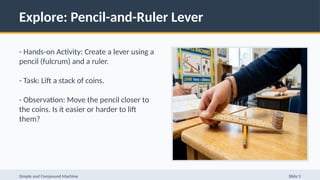
Explore: Pencil-and-Ruler Lever
-Hands-on Activity: Create a lever using a
pencil (fulcrum) and a ruler.
- Task: Lift a stack of coins.
- Observation: Move the pencil closer to
the coins. Is it easier or harder to lift
them?
Simple and Compound Machine Slide 5
7.
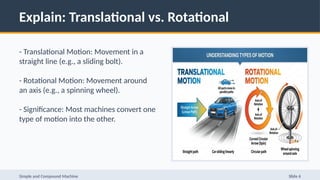
Explain: Translational vs.Rotational
- Translational Motion: Movement in a
straight line (e.g., a sliding bolt).
- Rotational Motion: Movement around
an axis (e.g., a spinning wheel).
- Significance: Most machines convert one
type of motion into the other.
Simple and Compound Machine Slide 6
8.
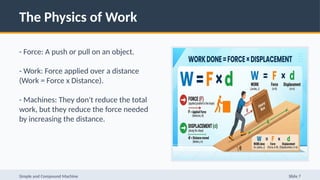
The Physics ofWork
- Force: A push or pull on an object.
- Work: Force applied over a distance
(Work = Force x Distance).
- Machines: They don't reduce the total
work, but they reduce the force needed
by increasing the distance.
Simple and Compound Machine Slide 7
9.
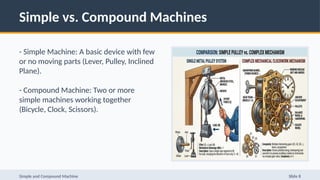
Simple vs. CompoundMachines
- Simple Machine: A basic device with few
or no moving parts (Lever, Pulley, Inclined
Plane).
- Compound Machine: Two or more
simple machines working together
(Bicycle, Clock, Scissors).
Simple and Compound Machine Slide 8
10.
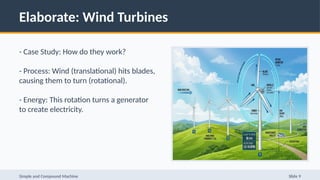
Elaborate: Wind Turbines
-Case Study: How do they work?
- Process: Wind (translational) hits blades,
causing them to turn (rotational).
- Energy: This rotation turns a generator
to create electricity.
Simple and Compound Machine Slide 9
11.
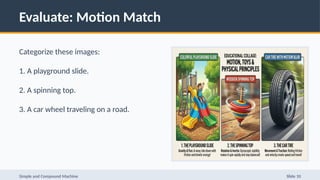
Evaluate: Motion Match
Categorizethese images:
1. A playground slide.
2. A spinning top.
3. A car wheel traveling on a road.
Simple and Compound Machine Slide 10
12.
Formative Assessment -Part 1
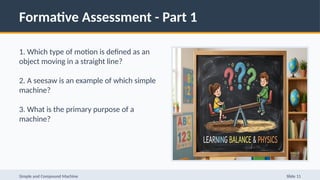
1. Which type of motion is defined as an
object moving in a straight line?
2. A seesaw is an example of which simple
machine?
3. What is the primary purpose of a
machine?
Simple and Compound Machine Slide 11
13.
Formative Assessment -Part 2
4. Identify the motion of a spinning top.
5. True or False: A compound machine
consists of only one simple machine.
Simple and Compound Machine Slide 12
14.
Assessment: Answer Key
1.Translational Motion
2. Lever
3. To make work easier by changing force
or direction
4. Rotational Motion
5. False
Simple and Compound Machine Slide 13
15.
Extend: Math &Home Discovery
- Math Integration: How do angles affect a
lever's efficiency?
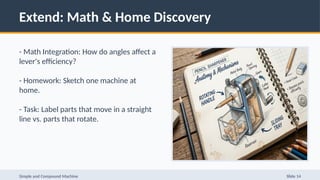
- Homework: Sketch one machine at
home.
- Task: Label parts that move in a straight
line vs. parts that rotate.
Simple and Compound Machine Slide 14
Editor's Notes
#1 Welcome the class. Today's topic is Simple and Compound Machine.
#2 Welcome students! Today we begin our journey into the world of machines. We aren't just talking about computers; we are looking at the fundamental physics that makes work easier. By the end of this session, you will understand how simple motions like sliding and spinning power the world around us.
#3 Our goals today are clear: we need to master the two types of motion, categorize machines based on their complexity, and understand the basic math—force and work—that explains why we use machines in the first place.
#4 Let's start with a simple observation. Think about opening a door. It swings around a hinge, right? Now, think about pulling out a drawer. It moves in a straight line. These are our two primary types of motion: rotational and translational. Can you think of other examples in this classroom?
#5 I want you to fill out the 'K' column of your K-W-L charts. List every machine you used this morning—from your toothbrush to the bus. We'll also watch a short clip of a Rube Goldberg machine to see how simple movements can create a complex result. Pay attention to how one part moves another.
#6 In your pairs, use your ruler and pencil to create a simple lever. The pencil is your fulcrum. Try lifting the coins with the pencil in the middle, then move it closer to the coins. You'll notice that the amount of effort you need changes based on the position of that pencil. This is the heart of mechanical advantage!
#7 To be scientific: Translational motion is when every point of an object moves the same distance in the same direction. Rotational motion happens when the object moves around a fixed point or axis. A car wheel does both—it rotates, which causes the car to translate down the road!
#8 Physics tells us that Work equals Force times Distance. Machines are clever; they allow us to use less force over a longer distance to achieve the same amount of work. It’s a trade-off! This is why a long ramp is easier to climb than a vertical ladder.
#9 A simple machine is a single tool, like a hammer or a screw. But when you combine them, you get a compound machine. Look at a bicycle: it has levers (brakes), wheel and axles, and pulleys (the chain and gears). It's a collection of simple machines working in harmony.
#10 Let's look at wind turbines. The wind moves in a straight path—that's translational. It hits the angled blades, which forces them to spin—that's rotational. Without that conversion of motion, we couldn't generate the mechanical energy needed for electricity. Could a turbine work if the blades only moved in a straight line? Think about it.
#11 Let's test your knowledge. Look at these three images. For each one, tell me if it represents translational motion, rotational motion, or both. Think about the path the object takes through space.
#12 Please take out a piece of paper for a quick check. Answer these first three questions based on what we've discussed so far. Think back to our drawer example and our lever activity with the ruler.
#13 Two more questions. Think about the spinning top we just saw and the definition of 'compound.' Remember the bicycle example!
#14 Let's check your work! 1. Straight line is translational. 2. A seesaw is a lever. 3. Machines make work easier. 4. A top rotates. 5. False—compound machines need two or more simple ones. How did you do?
#15 For homework, I want you to be a science detective. Find a machine at home—it could be a manual can opener or a stapler. Sketch it and label where the rotational and translational motions happen. Also, consider the geometry: how does the angle of a lever or ramp change the work? We will discuss the math of angles in our next session!