SBLC PROVIDER IN HONG KONG: A COMPLETE GUIDE TO STANDBY LETTERS OF CREDIT, TRADE
FINANCE AND STRUCTURED FUNDING
Headline: SBLC Provider in Hong Kong | Trade Finance & SBLC Solutions
Suggested URL Slug: https://blog.bailifinancelimited.com/2026/08/09/sblc-provider-in-hong-
kong-a-complete-guide-to-standby-letters-of-credit-trade-finance-and-structured-funding/
Businesses operating across borders often need more than conventional bank lending to
complete transactions, secure contracts, support international trade or demonstrate financial
capacity. A Standby Letter of Credit (SBLC) can provide the financial assurance required by a
beneficiary while giving the applicant access to a structured banking instrument that supports
a wider financing strategy.
For companies searching for an SBLC provider in Hong Kong, the choice of provider requires
careful consideration. The transaction involves more than obtaining a document. It requires
appropriate structuring, banking relationships, compliance checks, documentation, credit
assessment and a clear understanding of the SBLC's intended purpose.
Hong Kong remains an important international financial centre, with extensive connections to
Asian, European, Middle Eastern and global markets. Its banking infrastructure also supports
sophisticated trade finance activity, including the processing of letters of credit and other
international banking transactions. The Hong Kong Monetary Authority has published
guidance and regulatory material concerning banking activities, credit risk and trade finance.
For businesses considering an SBLC for trade finance, project funding, credit enhancement,
contract security or structured financing, working with an experienced financial services
provider can help clarify the transaction structure and the requirements of the relevant banks
and counterparties.
keywords: SBLC provider in Hong Kong Standby Letter of Credit Hong Kong SBLC services
Hong Kong SBLC issuance Hong Kong SBLC financing Hong Kong SBLC monetization Hong
Kong Hong Kong SBLC provider SBLC trade finance SBLC funding SBLC financing provider
Standby Letter of Credit provider SBLC bank SBLC financial services SBLC solutions
What Is an SBLC?
A Standby Letter of Credit is an independent financial undertaking issued by a bank for the
benefit of a beneficiary. It generally provides payment assurance if the applicant fails to meet
specified contractual or financial obligations.
Unlike a conventional commercial letter of credit, which normally supports a specific trade
transaction and documentary presentation, an SBLC primarily serves as a form of financial
assurance or performance support.
The exact obligations depend on the wording of the instrument, applicable law and the rules
incorporated into it.
The International Standby Practices 1998 (ISP98) provides a dedicated framework for standby
letters of credit. The International Chamber of Commerce explains that ISP98 was developed
specifically for standby transactions and provides detailed rules covering areas such as
obligations, presentation, examination, cancellation, reimbursement and timing.
A properly structured SBLC can therefore support several commercial objectives, including:
• International trade transactions
• Project financing
• Contract performance
• Payment obligations
• Credit enhancement
• Supplier and counterparty assurance
• Financing arrangements
• Structured investment transactions
• Certain forms of SBLC monetization
• Corporate financial commitments
The instrument doesn't automatically create funding. Instead, it can strengthen a transaction
by providing a bank-backed undertaking that may satisfy the requirements of a lender,
investor, supplier or contractual counterparty.
“An SBLC provides financial assurance, but its value depends on the issuing bank, instrument
terms and beneficiary requirements.”
Why Businesses Search for an SBLC Provider in Hong Kong
Companies looking for an SBLC provider in Hong Kong often operate internationally. They may
have suppliers in one jurisdiction, customers in another and financing requirements in a third.
Hong Kong's position within the Asian financial system makes it relevant to cross-border
commercial transactions. Banks operating in Hong Kong participate in international trade
finance and process instruments such as letters of credit. The HKMA has also identified trade
finance as an area where banking institutions use financial and commercial data to improve
financing processes, including through initiatives supporting SME trade finance.
For an international business, using a Hong Kong-based financial services partner may provide
practical advantages when the transaction involves:
• Asian counterparties
• International suppliers
• Cross-border project financing
• Import and export transactions
• Commodity trading
• Infrastructure projects
• International contractors
• Corporate expansion
• Structured financing requirements
However, geographical location alone doesn't establish credibility. The underlying bank,
transaction structure, documentation, compliance process and contractual terms remain
critical.
What Does an SBLC Provider Actually Do?
The term "SBLC provider" can refer to different types of participants in the transaction.
Understanding this distinction is important.
A bank may act as the issuing bank, assuming the independent payment obligation under the
SBLC.
A financial services company or arranger may assist the applicant with transaction structuring,
documentation, banking coordination and financing arrangements.
An intermediary may introduce a client to an appropriate financial institution.
A monetization provider or financing institution may evaluate whether an existing SBLC can
support a financing structure.
Therefore, a company advertising itself as an SBLC provider in Hong Kong should be evaluated
according to the exact role it performs.
A professional provider should be able to explain:
1. Who will issue the SBLC.
2. Which bank will receive or transmit the instrument.
3. Which rules govern the instrument.
4. What the beneficiary requires.
5. What the applicant must provide.
6. What collateral or security may be required.
7. What fees apply.
8. What due diligence is required.
9. What the expected transaction sequence involves.
10. Whether the SBLC is intended for direct commercial use or a financing structure.
Clear answers to these questions reduce uncertainty before a company commits capital or
signs transaction documents.
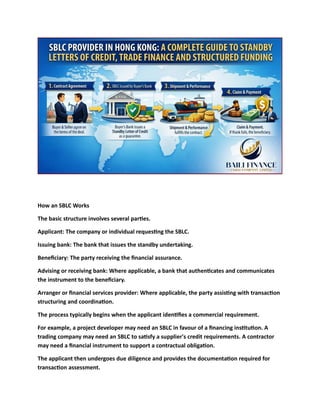
How an SBLC Works
The basic structure involves several parties.
Applicant: The company or individual requesting the SBLC.
Issuing bank: The bank that issues the standby undertaking.
Beneficiary: The party receiving the financial assurance.
Advising or receiving bank: Where applicable, a bank that authenticates and communicates
the instrument to the beneficiary.
Arranger or financial services provider: Where applicable, the party assisting with transaction
structuring and coordination.
The process typically begins when the applicant identifies a commercial requirement.
For example, a project developer may need an SBLC in favour of a financing institution. A
trading company may need an SBLC to satisfy a supplier's credit requirements. A contractor
may need a financial instrument to support a contractual obligation.
The applicant then undergoes due diligence and provides the documentation required for
transaction assessment.
Once the transaction receives the required approvals, the issuing structure is established. The
SBLC is issued according to its agreed terms and transmitted through the appropriate banking
channels.
Where the SBLC contains an SWIFT-based delivery requirement, the exact SWIFT message
type and banking process should be confirmed by the relevant financial institutions. A
provider should never rely on vague claims about "SWIFT delivery" without explaining the
actual banking structure.
SBLC Issuance and SBLC Monetization Are Not the Same
One of the most important distinctions for prospective clients involves SBLC
issuance versus SBLC monetization.
SBLC issuance means arranging for a bank to issue a standby letter of credit for a specified
beneficiary and amount.
SBLC monetization refers to a financing structure in which an eligible financial instrument may
be used to support access to liquidity, subject to the requirements of the financing institution.
An SBLC shouldn't be treated as guaranteed cash.
The availability of financing depends on numerous factors, including the issuing bank,
instrument wording, beneficiary, transaction purpose, applicant profile, collateral structure,
compliance assessment, jurisdiction, financing institution and overall risk.
A responsible provider should therefore avoid presenting SBLC monetization as automatic
funding.
Common Uses of an SBLC
1. Trade Finance
Importers and exporters may use standby instruments to support payment obligations or
provide assurance to international counterparties.
For example, an importer purchasing substantial quantities of goods from an overseas
supplier may need to demonstrate that its payment obligations have adequate financial
support.
An SBLC can form part of the overall transaction structure, depending on the supplier's
requirements and the banks involved.
2. Project Finance
Project developers frequently require substantial financing before revenue begins.
A project may involve construction costs, equipment purchases, land development,
engineering contracts and long-term operational expenses.
An SBLC may support a financing structure by providing additional contractual or financial
assurance to a relevant counterparty.
The instrument doesn't replace project due diligence. Lenders still evaluate the project's cash
flows, sponsors, contracts, collateral, risks and repayment capacity.
3. Credit Enhancement
Some transactions require stronger financial support before a lender or counterparty
proceeds.
A suitable SBLC may strengthen the credit structure by introducing an independent bank
obligation.
This can become particularly relevant where the underlying applicant doesn't meet a
counterparty's preferred credit profile without additional support.
4. Contract Performance
Performance-related standby instruments can support contractual obligations.
For example, an infrastructure contractor may need to provide financial assurance to a project
owner. The SBLC can be structured around the contractual requirements, subject to the
issuing bank's approval and the applicable rules.
5. Financial Obligations
A financial SBLC may support obligations such as repayment of a loan or other financial
commitment.
The exact structure matters because the rights of the beneficiary depend on the wording of
the undertaking.
The HKMA has published material recognising standby letters of credit as potential credit-risk
mitigation instruments when specific conditions are satisfied, including requirements
concerning the issuer and the nature of the undertaking.
External link:
International Standby Practices (ISP98) — International Chamber of Commerce
ISP98 and Why It Matters
Anyone evaluating an SBLC provider in Hong Kong should understand ISP98.
ISP98 was specifically developed for standby letters of credit. The ICC states that the rules
address standbys used for financial, performance and direct-pay purposes.
The framework covers important areas such as:
• Scope and application
• Issuer obligations
• Beneficiary presentation
• Document examination
• Notice of dishonour
• Cancellation
• Reimbursement
• Timing
• Transfer and assignment
• Syndication and participation
This matters because the wording of an SBLC determines how the instrument operates.
The ICC's published material also demonstrates why precise wording matters. Its examples
and dispute decisions address issues involving presentations, discrepancies, expiry and
notices of dishonour.
Consequently, companies shouldn't evaluate an SBLC solely according to its face value. A USD
10 million SBLC isn't necessarily equivalent to another USD 10 million SBLC if the issuing bank,
beneficiary, conditions, governing rules, presentation requirements and contractual structure
differ.
How to Choose the Right SBLC Provider in Hong Kong
Selecting a provider requires financial and commercial due diligence.
Verify the Company's Identity
Check the company's legal name, registration information, business address and corporate
documentation.
For example, Baili Finance identifies itself as BAILI FINANCE (ASIA) COMPANY LIMITED, a Hong
Kong-registered financial services company with company registration number 2315541.
Businesses should independently verify registration and regulatory information relevant to
the precise service being offered.
Identify the Issuing Bank
One of the most important questions is:
Which bank will actually issue the SBLC?
The provider should be able to explain the banking structure applicable to the proposed
transaction, subject to confidentiality and bank approval.
Examine the Instrument Terms
Review:
• Face value
• Currency
• Expiry date
• Beneficiary
• Applicant
• Issuing bank
• Governing rules
• Governing law
• Presentation requirements
• Payment terms
• Transfer provisions
• Amendment provisions
These terms determine how the SBLC functions.
Review Compliance Requirements
International financial transactions require due diligence.
Expect requests for corporate registration documents, ownership information, identification
documents, financial statements, transaction agreements, source-of-funds information and
information concerning the purpose of the transaction.
A provider that avoids meaningful compliance questions should receive additional scrutiny.
Understand the Fee Structure
Ask for a written explanation of all applicable charges.
Potential costs may include arrangement fees, bank charges, legal costs, due diligence costs,
SWIFT-related banking charges, collateral costs and financing-related fees.
No legitimate provider should rely on unclear or unexplained payment demands.
“Choosing an SBLC provider in Hong Kong requires more than comparing fees; businesses
should evaluate the issuing bank, compliance process, documentation and transaction
structure.”
Documents Commonly Required for an SBLC Transaction
Requirements vary by provider, issuing bank and transaction structure. However, businesses
may be asked for:
• Certificate of incorporation
• Company registration documents
• Shareholder information
• Director information
• Passport or identification documents for relevant individuals
• Proof of address
• Corporate profile
• Audited or management financial statements
• Bank statements
• Business plan
• Underlying contract
• Purchase agreement
• Sales agreement
• Project documentation
• Financing proposal
• Proof of funds or source-of-funds documentation
• Beneficiary information
• Details of the requested instrument
The objective is to establish the applicant's identity, financial position, transaction purpose
and ability to meet its obligations.
Real-World Example: An International Import Transaction
Consider a Hong Kong-based trading company purchasing industrial equipment from a
manufacturer in Europe.
The purchase contract has a value of USD 8 million. The supplier requires additional financial
assurance before manufacturing begins because the buyer has limited trading history with the
supplier.
The buyer approaches an SBLC provider to explore an appropriate structure.
The transaction could involve the following stages:
Stage 1: Transaction assessment
The provider reviews the buyer's corporate profile, financial position, purchase contract and
supplier requirements.
Stage 2: Compliance and due diligence
The relevant parties conduct identity, ownership, source-of-funds and transaction checks.
Stage 3: Banking structure
The issuing bank and required instrument terms are established, subject to approval.
Stage 4: Instrument drafting
The SBLC terms are aligned with the underlying contract and beneficiary requirements.
Stage 5: Issuance
The bank issues the SBLC through the agreed banking channels.
Stage 6: Commercial execution
The supplier receives the required financial assurance and proceeds according to the
commercial contract.
In this example, the SBLC doesn't represent an automatic USD 8 million cash payment to the
buyer. Its function is to provide a specified form of financial assurance to the beneficiary.
Illustrative Case Study: SBLC for a Project Funding Structure
The following case study is illustrative rather than a representation of a specific client
transaction.
A renewable energy developer has secured a project opportunity requiring approximately
USD 25 million in development and construction financing.
The project sponsor has a viable business plan and commercial agreements but requires
additional financial support to satisfy the proposed financing structure.
The sponsor approaches an SBLC provider in Hong Kong.
Initial Challenge
The project requires:
• Significant capital expenditure
• International equipment suppliers
• Contractor commitments
• Financing from an external institution
• Additional credit support
The sponsor cannot rely solely on conventional working capital.
Proposed Approach
The financial services provider reviews the project structure and determines whether an SBLC
could form part of the proposed financing framework.
The review includes:
• Project ownership
• Corporate structure
• Financial statements
• Contracts
• Project economics
• Beneficiary requirements
• Requested SBLC amount
• Proposed issuing bank
• Financing institution
• Compliance requirements
Structuring
Suppose the relevant financial institution requires a standby instrument with a defined
amount and expiry period.
The SBLC is then structured around the financing requirement rather than being treated as a
generic financial product.
The parties establish the beneficiary, amount, currency, expiry, governing rules and
presentation conditions.
Outcome
If the issuing bank approves the transaction and the financing institution accepts the
instrument, the SBLC may become part of the broader project financing structure.
The key lesson is that the instrument supports a wider transaction. It doesn't eliminate the
need for project due diligence, repayment analysis or contractual review.
Common Mistakes When Searching for an SBLC Provider
Businesses can encounter problems when they focus only on price or promised transaction
speed.
Mistake 1: Choosing Based Only on Fees
A lower quoted fee doesn't necessarily mean a better transaction.
The relevant questions concern the issuing bank, instrument terms, compliance standards,
transaction structure and beneficiary acceptance.
Mistake 2: Assuming Every SBLC Can Be Monetized
Not every instrument will qualify for financing.
The financing institution determines whether it accepts the instrument and under what
conditions.
Mistake 3: Ignoring the Beneficiary's Requirements
An SBLC must meet the beneficiary's requirements.
An instrument that doesn't satisfy the beneficiary's banking, legal or documentary
requirements may have limited practical value.
Mistake 4: Treating "Bank Instrument" as Sufficient Evidence
A professional transaction requires verifiable banking information and documentation.
Companies should distinguish between marketing claims and evidence.
Mistake 5: Failing to Review the Underlying Contract
The SBLC should correspond appropriately with the commercial obligation it supports.
Legal and financial professionals should review significant transactions before execution.
Why Hong Kong Is Relevant to International Trade Finance
Hong Kong's banking environment has long supported cross-border financial activity.
The HKMA has published information concerning trade finance operations and banking
processes, while its current initiatives include efforts to improve digital access to trade finance
for SMEs through commercial data infrastructure.
For companies conducting international business, this infrastructure can be relevant when
transactions involve multiple jurisdictions, banks, currencies and counterparties.
An SBLC provider in Hong Kong therefore operates within a market where international
banking relationships and trade finance capabilities can be important components of a
transaction.
Nevertheless, businesses should evaluate each provider independently. Hong Kong
registration, for example, doesn't by itself guarantee that every proposed transaction will
receive bank approval.
Baili Finance and SBLC Solutions in Hong Kong
Baili Finance provides financial services focused on SBLCs, bank guarantees, trade finance,
business loans, structured finance and related funding solutions.
According to its published company information, BAILI FINANCE (ASIA) COMPANY LIMITED is
registered in Hong Kong and works with international clients seeking financial instruments
and structured financing solutions. Its published SBLC service covers applications involving
trade finance, project funding, credit enhancement and monetization structures.
For businesses evaluating an SBLC transaction, the appropriate first step is to discuss the
underlying commercial requirement rather than requesting an instrument without a defined
purpose.
The transaction team can then assess factors such as:
• Required SBLC amount
• Currency
• Beneficiary
• Transaction jurisdiction
• Intended purpose
• Underlying contract
• Project or trade structure
• Funding requirement
• Proposed timeline
• Applicant profile
• Available documentation
This approach allows the financial structure to be evaluated against the actual commercial
requirement.
Frequently Asked Questions About SBLC Providers in Hong Kong
What is an SBLC provider in Hong Kong?
An SBLC provider in Hong Kong may be a financial services company, arranger or intermediary
that assists businesses in structuring and arranging standby letters of credit. The actual issuing
obligation is generally undertaken by a bank. Businesses should establish exactly which entity
performs each role before entering a transaction.
How much does an SBLC cost?
There isn't a universal SBLC price. Costs depend on the amount, issuing bank, applicant's
financial profile, transaction structure, duration, collateral, jurisdiction, beneficiary
requirements and banking charges. A professional provider should explain applicable costs
before the transaction proceeds.
Can an SBLC be used for project financing?
Yes, an SBLC may form part of a project financing structure where the relevant financing
institution accepts it. However, an SBLC doesn't guarantee project financing. Lenders normally
evaluate the complete project, sponsor, contracts, cash flow, security and repayment
structure.
Can an SBLC be monetized?
Some SBLCs may potentially support a financing or monetization structure, but acceptance
isn't automatic. The financing institution evaluates the issuing bank, instrument terms,
beneficiary, transaction structure and risk profile before deciding whether financing is
available.
What is ISP98?
ISP98 stands for International Standby Practices 1998. It is an ICC framework specifically
designed for standby letters of credit and addresses matters including presentation,
examination, obligations, cancellation and reimbursement.
What is the difference between an SBLC and a commercial letter of credit?
A commercial letter of credit generally supports payment for an underlying trade transaction
against specified documents. An SBLC primarily provides financial or performance assurance
and typically becomes relevant when the applicant fails to meet an obligation or when the
beneficiary makes a complying demand under the instrument's terms.
How long does it take to obtain an SBLC?
The timeline varies according to the applicant, transaction complexity, due diligence,
documentation, bank approval, beneficiary requirements and instrument structure. A
provider should give a realistic timeline after reviewing the transaction rather than promising
an identical turnaround for every applicant.
What information should I provide when contacting an SBLC provider?
Start with the purpose of the SBLC, required amount and currency, beneficiary, transaction
jurisdiction, underlying contract, preferred timeframe and information about your company.
Providing complete information allows the provider to assess the transaction more efficiently.
How to Start an SBLC Transaction in Hong Kong
A practical approach involves five steps.
1. Define the purpose.
Determine whether the SBLC supports trade finance, project financing, contract performance,
credit enhancement or another legitimate commercial requirement.
2. Identify the beneficiary.
Understand exactly what the beneficiary requires and whether it has specific banking or
documentary conditions.
3. Prepare your corporate documents.
Gather company registration documents, financial information, identification documents,
contracts and transaction details.
4. Request a structured assessment.
Ask the provider to explain the proposed issuing bank, instrument terms, costs, compliance
requirements and transaction sequence.
5. Conduct independent professional review.
For significant transactions, obtain appropriate legal, financial and compliance advice before
signing binding agreements or transferring funds.
Why Professional Structuring Matters
The largest SBLC transactions rarely involve a single document and a single decision.
They can involve applicants, beneficiaries, banks, lawyers, financial institutions, compliance
teams, project sponsors and other counterparties.
Each party has different requirements.
The applicant wants an efficient financial solution.
The beneficiary wants enforceable financial assurance.
The issuing bank wants acceptable credit and compliance risk.
The financing institution wants a bankable instrument.
The legal advisers want enforceable documentation.
A professional SBLC structure must address these requirements simultaneously.
That is why selecting an SBLC provider in Hong Kong should be treated as a financial decision
rather than a simple service purchase.
Final Summary
An SBLC can provide meaningful financial support for international businesses when the
instrument matches a genuine commercial requirement and the transaction receives
appropriate banking and compliance approval.
For companies seeking an SBLC provider in Hong Kong, the most important considerations
include the identity and role of the provider, the issuing bank, instrument wording, governing
rules, beneficiary requirements, transaction purpose, due diligence and total costs.
ISP98 provides an established framework for standby letters of credit, while Hong Kong's
financial infrastructure supports a broad range of international trade and financing activities.
The correct SBLC structure can support trade finance, project funding, contractual obligations
and credit enhancement. It can also form part of certain financing structures where the
relevant financial institution accepts the instrument.
However, no responsible provider should present an SBLC as automatic funding. Every
transaction requires proper assessment, documentation and banking approval.
If your company is considering an SBLC, the most effective next step is to define the
transaction first and then determine whether an SBLC is appropriate.
Ready to Discuss Your SBLC Requirement?
Don't request a generic instrument when your transaction requires a structured financial
solution.
Contact Baili Finance to discuss your SBLC requirement, transaction amount, beneficiary,
project or trade finance objective and preferred structure.
The Baili Finance team can assess the information you provide and discuss the potential
structure, documentation, banking requirements and next steps for your transaction.
Visit: www.bailifinancelimited.com
Email: info@bailifinancelimited.com
Phone: +852 3098 4537
Hong Kong Office: 3/F, Kong Ling Building, 100 Jervois Street, Hong Kong
If you're looking for an SBLC provider in Hong Kong, start with the transaction details that
matter: amount, currency, beneficiary, purpose and timeline. Contact Baili Finance today and
request a transaction assessment.
Intermediaries/Consultants/Brokers are welcome to bring their clients 100% protected. Our
brokers receive 2% commission for referral. We assist Clients and brokers in their attempt to
secure funding by working on their funding requests that may require innovative financing. In
complete confidence, we will work together for the benefits of all parties involved.
#SBLC #TradeFinance #HongKongFinance #ProjectFinance #StructuredFinance
#BankGuarantee