MICROSOFT OFFICE
EXCEL
P R O F. D R . P O O N A M T H A K U R
P R O F E S S O R / H O D, O B G N U R S I N G
P O S T G R A D U AT E C O L L E G E O F N U R S I N G , C H R I ,
G WA L I O R
WHAT IS MICROSOFT OFFICE EXCEL ?
•Microsoft Office Excel is a powerful spreadsheet
software application developed by Microsoft and a
core component of the Microsoft Office suite. It is
advanced electronic spreadsheet programme to
save, assemble, organizing, calculating, formatting,
and analyzing data using a grid of rows and columns.
WHAT DO YOU MEAN BY SPREADSHEET ?
•A spreadsheet is a digital ledger or grid file
used to organize, store, calculate, and analyze
data. It mimics traditional paper accounting
worksheets but functions dynamically through
a computer, tablet, or smartphone.
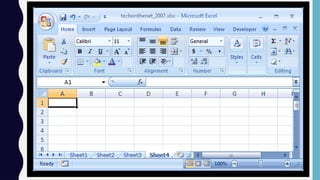
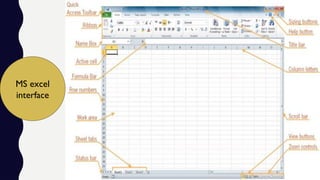
MS excel
interface
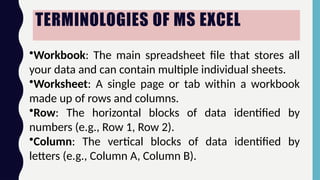
TERMINOLOGIES OF MS EXCEL
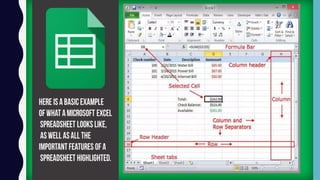
•Workbook: The main spreadsheet file that stores all
your data and can contain multiple individual sheets.
•Worksheet: A single page or tab within a workbook
made up of rows and columns.
•Row: The horizontal blocks of data identified by
numbers (e.g., Row 1, Row 2).
•Column: The vertical blocks of data identified by
letters (e.g., Column A, Column B).
CONT……..
•Cell: The rectangular box formed by the intersection
of a row and a column.
•Active Cell: The currently selected cell, highlighted
by a dark border, where text or numbers are entered.
•Ribbon: The command bar at the top of Excel that
contains tabs filled with tools and features.
CONT….
•Formula Bar: The bar located above the worksheet
area used to enter or view the data or formulas
inside an active cell.
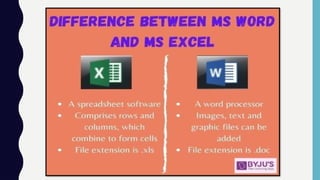
•An MS Excel file is saved with an extension of .xls
USE OF MS EXCEL IN NURSING
•MS Excel is a vital administrative tool in nursing that
helps healthcare professionals track patient data,
manage schedules, and improve hospital efficiency. By
organizing complex health information into clean grids,
it allows nursing staff to focus more time on direct
patient care.
Following is a comprehensive breakdown of how MS Excel is utilized in the nursing profession-
1. Patient Care & Clinical Tracking
• Vitals Logs: Tracking patient blood pressure, heart rates, blood
sugar levels, and oxygen saturation over time to spot trends.
• Medication Administration: Maintaining detailed inventories,
dosage schedules, and timing logs to prevent medication errors.
• Intake & Output (I/O): Recording strict fluid balances for critical
patients, including IV fluids, oral intake, and urine output.
• Wound Care Progress: Monitoring the healing stages, dimensions,
and treatment dates of chronic wounds or surgical incisions.
2. Staffing & Management
• Shift Scheduling: Creating monthly rotation rosters for
nurses, nurse practitioners, and assistants to ensure proper
floor coverage.
• Resource Allocation: Balancing the nurse-to-patient ratio
based on acuity levels (how sick the patients are) across
different wards.
• Attendance Tracking: Managing sick leave, vacation
requests, and overtime hours for payroll or HR purposes.
3. Quality Assurance & Compliance
• Incident Reports: Documenting hospital accidents, patient
falls, or needle-stick injuries to analyze safety trends.
• Infection Control: Tracking rates of hospital-acquired
infections (like MRSA or UTIs) to measure the success of
sanitization protocols.
• Audit Preparation: Keeping credential records, license
expiration dates, and mandatory training logs up to date
for hospital accreditation.
Research & Education
•Data Collection: Gathering anonymous patient
statistics for clinical trials, academic nursing
research, or case studies.
•Budget Tracking: Managing department expenses,
training budgets, and the purchasing of medical
supplies.