Comprehensive Guide to Limit Tests for Impurities in Substances
Detailed overview of limit tests for chlorides, sulfates, iron, and lead impurities using Nessler's cylinder and chemical reactions to ensure substance purity and compliance with pharmacopeial standards.
Introduction
• Limit testsare quantitative or semiquantitative tests designed to
identify & control small quantities of impurities likely to
present in the substance.
• It involved comparison of opalescence, turbidity or color
produced in a test with that of standard.
• To design the limit test following three factors are consider.
3.
1. Specificity ofthe test
2. Sensitivity
3. Selectivity
Specificity of the test: A test employed as a limit test should imply some salt of
selective reaction with the traced impurity.
e.g. contamination of lead and other heavy metals in alum is precipitated by
thioacetamide at PH 2.5 thus less specific test which limits several impurities in
single test.
Sensitivity: It depends on reproducibility of result.
e.g. in precipitation of insoluble sub. The factors such as concentration of solute,
precipitating agent, duration of reactions, temp. are likely to be consider.
4.
• Usually colddilute solutions give light precipitate where as hot conc.
Solution gives granular precipitate.
Selectivity: it depends on personal error and chemical nature.
• Importance:
• To find out harmful amount of impurity.
• To find out permissible or impermissible amount of impurities.
5.
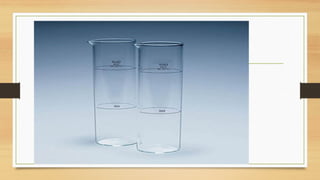
Nessler’s cylinder
• Specialapparatus design to carryout limit test.
• These are match tubes of clear colorless glass with uniform in diameter &
flat transparent base.
• They have normal capacity of 50ml, height is 150mm & external height to
the 50ml mark is about 110mm
• The comparison is made by placing the tubes Nessler's cylinder side by
side & view transparently against proper background in case of limit test
of chloride, sulphate & iron.
7.
Limit test forchlorides
Principle:
1. It is used to control chloride impurity in the inorganic sub.
2. It involves the reaction between silver nitrate & soluble chloride to give insoluble silver chloride in
presence of dil. Nitric acid.
3. Insoluble chloride makes the solution opalescence & the extent of opalescence depends upon the
amount of chloride present in sub. i.e. compared with standard opalescence produced in standard
solution.
4. If the turbidity from the sample has been less than the standard turbidity, the sample will pass the
limit test and vice versa.
Procedure:
• For standardsolution:
• 1. Take 50 ml of Nessler's cylinder, label as standard.
• 2. Placed 10ml of sodium chloride solution in N. cylinder. And 5ml water.
• 3. Add 10ml of water.
• 4. Add 1 ml of HNO3 ( Nitric acid).
• 5. Dilute to 50ml in Nessler cylinder.
• 6. Add 1 ml of 0.1 M AgNO3( Silver Nitrate)
• 7. Stir and allow it to stand for 5 min.
10.
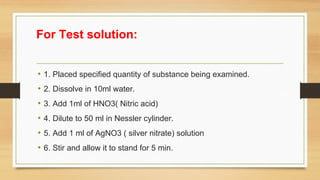
For Test solution:
•1. Placed specified quantity of substance being examined.
• 2. Dissolve in 10ml water.
• 3. Add 1ml of HNO3( Nitric acid)
• 4. Dilute to 50 ml in Nessler cylinder.
• 5. Add 1 ml of AgNO3 ( silver nitrate) solution
• 6. Stir and allow it to stand for 5 min.
11.
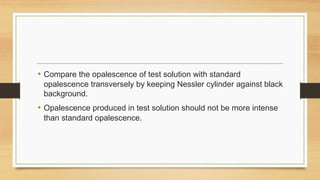
• Compare theopalescence of test solution with standard
opalescence transversely by keeping Nessler cylinder against black
background.
• Opalescence produced in test solution should not be more intense
than standard opalescence.
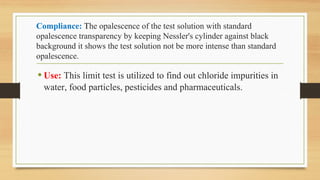
Compliance: The opalescenceof the test solution with standard
opalescence transparency by keeping Nessler's cylinder against black
background it shows the test solution not be more intense than standard
opalescence.
• Use: This limit test is utilized to find out chloride impurities in
water, food particles, pesticides and pharmaceuticals.
14.
Modified limit testfor chloride:
• Principle: limit test of chloride is based on the precipitation reaction, in
case of general chloride limit test there is occurrence of reaction between
chloride impurity or sodium chloride and silver nitrate in presence of dilute
nitric acid with the reference to the international pharmacopoeia 2016.
• The limit test of chloride has been modified in contest of standard solution
preparation. Early year the standard solution of chloride was prepared by
dissolving sodium chloride but now it has been modified by using
hydrochloric acid instead of sodium chloride.
15.
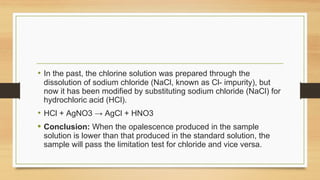
• In thepast, the chlorine solution was prepared through the
dissolution of sodium chloride (NaCl, known as Cl- impurity), but
now it has been modified by substituting sodium chloride (NaCl) for
hydrochloric acid (HCl).
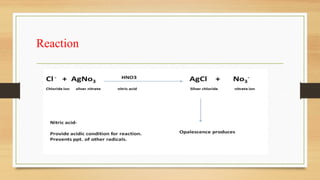
• HCl + AgNO3 → AgCl + HNO3
• Conclusion: When the opalescence produced in the sample
solution is lower than that produced in the standard solution, the
sample will pass the limitation test for chloride and vice versa.
16.
Limit test forsulphate
Principle:
• This test is designed to control sulphate impurity in inorganic substance.
• This test depends on simple reaction between barium chloride and soluble sulphate
in the presence of acetic acid to give insoluble barium sulphate.
• The opalescence produced in the test is compared with that of standard
opalescence obtained from standard sulphate solution containing known amount of
sulphate produced in the same manner. If the opalescence is less intense than that
of standard, the sample passes the limit test for sulphate and vice versa.
• The solubility of barium sulphate precipitate is affected by the concentration of the
acid. acidity of the solution is controlled by using acetic acid.
17.
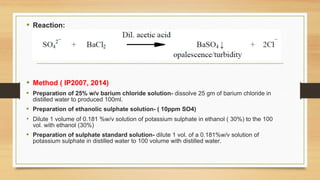
• Reaction:
• Method( IP2007, 2014)
• Preparation of 25% w/v barium chloride solution- dissolve 25 gm of barium chloride in
distilled water to produced 100ml.
• Preparation of ethanolic sulphate solution- ( 10ppm SO4)
• Dilute 1 volume of 0.181 %w/v solution of potassium sulphate in ethanol ( 30%) to the 100
vol. with ethanol (30%)
• Preparation of sulphate standard solution- dilute 1 vol. of a 0.181%w/v solution of
potassium sulphate in distilled water to 100 volume with distilled water.
18.
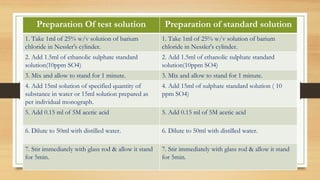
Preparation Of testsolution Preparation of standard solution
1. Take 1ml of 25% w/v solution of barium
chloride in Nessler's cylinder.
1. Take 1ml of 25% w/v solution of barium
chloride in Nessler's cylinder.
2. Add 1.5ml of ethanolic sulphate standard
solution(10ppm SO4)
2. Add 1.5ml of ethanolic sulphate standard
solution(10ppm SO4)
3. Mix and allow to stand for 1 minute. 3. Mix and allow to stand for 1 minute.
4. Add 15ml solution of specified quantity of
substance in water or 15ml solution prepared as
per individual monograph.
4. Add 15ml of sulphate standard solution ( 10
ppm SO4)
5. Add 0.15 ml of 5M acetic acid 5. Add 0.15 ml of 5M acetic acid
6. Dilute to 50ml with distilled water. 6. Dilute to 50ml with distilled water.
7. Stir immediately with glass rod & allow it stand
for 5min.
7. Stir immediately with glass rod & allow it stand
for 5min.
19.
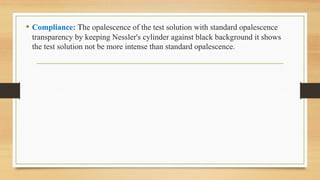
• Compliance: Theopalescence of the test solution with standard opalescence
transparency by keeping Nessler's cylinder against black background it shows
the test solution not be more intense than standard opalescence.
20.
Modified limit testfor sulphate
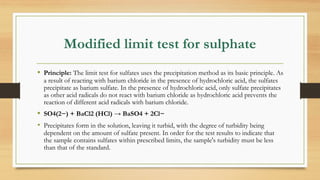
• Principle: The limit test for sulfates uses the precipitation method as its basic principle. As
a result of reacting with barium chloride in the presence of hydrochloric acid, the sulfates
precipitate as barium sulfate. In the presence of hydrochloric acid, only sulfate precipitates
as other acid radicals do not react with barium chloride as hydrochloric acid prevents the
reaction of different acid radicals with barium chloride.
• SO4(2−) + BaCl2 (HCl) → BaSO4 + 2Cl−
• Precipitates form in the solution, leaving it turbid, with the degree of turbidity being
dependent on the amount of sulfate present. In order for the test results to indicate that
the sample contains sulfates within prescribed limits, the sample's turbidity must be less
than that of the standard.
21.
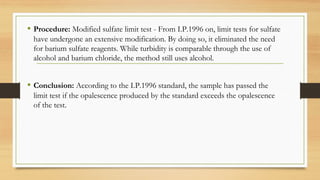
• Procedure: Modifiedsulfate limit test - From I.P.1996 on, limit tests for sulfate
have undergone an extensive modification. By doing so, it eliminated the need
for barium sulfate reagents. While turbidity is comparable through the use of
alcohol and barium chloride, the method still uses alcohol.
• Conclusion: According to the I.P.1996 standard, the sample has passed the
limit test if the opalescence produced by the standard exceeds the opalescence
of the test.
22.
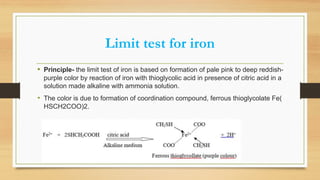
Limit test foriron
• Principle- the limit test of iron is based on formation of pale pink to deep reddish-
purple color by reaction of iron with thioglycolic acid in presence of citric acid in a
solution made alkaline with ammonia solution.
• The color is due to formation of coordination compound, ferrous thioglycolate Fe(
HSCH2COO)2.
23.
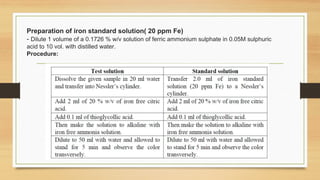
Preparation of ironstandard solution( 20 ppm Fe)
- Dilute 1 volume of a 0.1726 % w/v solution of ferric ammonium sulphate in 0.05M sulphuric
acid to 10 vol. with distilled water.
Procedure:
24.
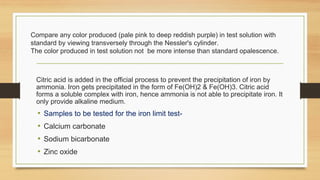
Compare any colorproduced (pale pink to deep reddish purple) in test solution with
standard by viewing transversely through the Nessler's cylinder.
The color produced in test solution not be more intense than standard opalescence.
Citric acid is added in the official process to prevent the precipitation of iron by
ammonia. Iron gets precipitated in the form of Fe(OH)2 & Fe(OH)3. Citric acid
forms a soluble complex with iron, hence ammonia is not able to precipitate iron. It
only provide alkaline medium.
• Samples to be tested for the iron limit test-
• Calcium carbonate
• Sodium bicarbonate
• Zinc oxide
25.
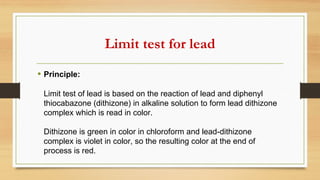
Limit test forlead
• Principle:
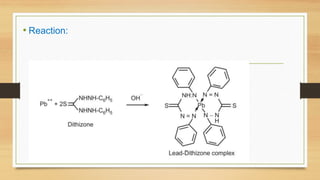
Limit test of lead is based on the reaction of lead and diphenyl
thiocabazone (dithizone) in alkaline solution to form lead dithizone
complex which is read in color.
Dithizone is green in color in chloroform and lead-dithizone
complex is violet in color, so the resulting color at the end of
process is red.
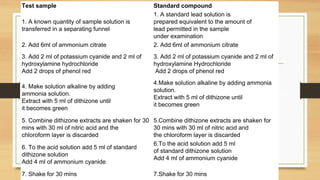
Test sample Standardcompound
1. A known quantity of sample solution is
transferred in a separating funnel
1. A standard lead solution is
prepared equivalent to the amount of
lead permitted in the sample
under examination
2. Add 6ml of ammonium citrate 2. Add 6ml of ammonium citrate
3. Add 2 ml of potassium cyanide and 2 ml of
hydroxylamine hydrochloride
Add 2 drops of phenol red
3. Add 2 ml of potassium cyanide and 2 ml of
hydroxylamine Hydrochloride
Add 2 drops of phenol red
4. Make solution alkaline by adding
ammonia solution.
Extract with 5 ml of dithizone until
it becomes green
4.Make solution alkaline by adding ammonia
solution.
Extract with 5 ml of dithizone until
it becomes green
5. Combine dithizone extracts are shaken for 30
mins with 30 ml of nitric acid and the
chloroform layer is discarded
5.Combine dithizone extracts are shaken for
30 mins with 30 ml of nitric acid and
the chloroform layer is discarded
6. To the acid solution add 5 ml of standard
dithizone solution
Add 4 ml of ammonium cyanide
6.To the acid solution add 5 ml
of standard dithizone solution
Add 4 ml of ammonium cyanide
7. Shake for 30 mins 7.Shake for 30 mins
28.
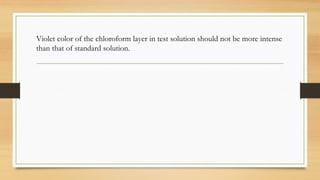
Violet color ofthe chloroform layer in test solution should not be more intense
than that of standard solution.
29.
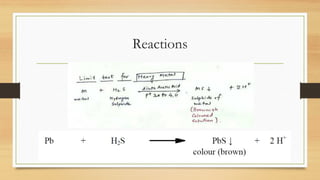
Limit test forheavy metals
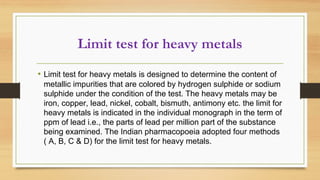
• Limit test for heavy metals is designed to determine the content of
metallic impurities that are colored by hydrogen sulphide or sodium
sulphide under the condition of the test. The heavy metals may be
iron, copper, lead, nickel, cobalt, bismuth, antimony etc. the limit for
heavy metals is indicated in the individual monograph in the term of
ppm of lead i.e., the parts of lead per million part of the substance
being examined. The Indian pharmacopoeia adopted four methods
( A, B, C & D) for the limit test for heavy metals.
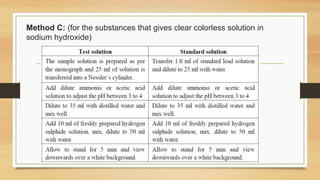
Method C: (forthe substances that gives clear colorless solution in
sodium hydroxide)
32.
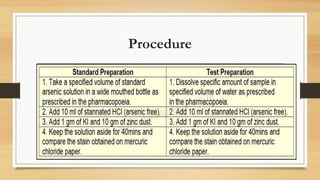
Limit test forArsenic
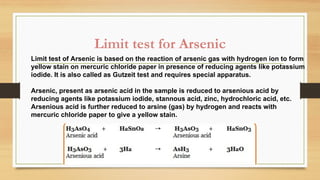
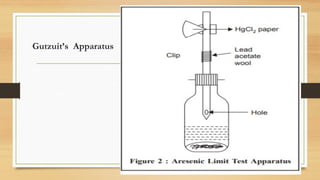
Limit test of Arsenic is based on the reaction of arsenic gas with hydrogen ion to form
yellow stain on mercuric chloride paper in presence of reducing agents like potassium
iodide. It is also called as Gutzeit test and requires special apparatus.
Arsenic, present as arsenic acid in the sample is reduced to arsenious acid by
reducing agents like potassium iodide, stannous acid, zinc, hydrochloric acid, etc.
Arsenious acid is further reduced to arsine (gas) by hydrogen and reacts with
mercuric chloride paper to give a yellow stain.