Comprehensive Guide to Journals and Ledgers in Accounting
Learn the formats, uses, and differences of general and special journals, general and subsidiary ledgers, and how to accurately record business transactions in accounting.
The learners areable
to differentiate a journal
from a ledger and identify
the types of journals and
ledger.
5.
Good day! Welcometo another interesting week
of learning.
By the end of our topic, you should be able to:
1. identify the uses of the two books of accounts
(journal and ledger) to record business transactions,
2. illustrate the format of journals and ledgers, and
3. manifest accuracy in recording business
transactions using the two books of accounts.
6.
Let us startyour Pre-test. Read and
understand the following questions. Type
the letter of the correct answer in the chat
box.
7.
1. Which ofthe following is one of
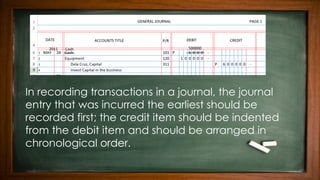
the special journals?
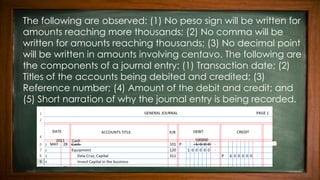
A. Sales journal
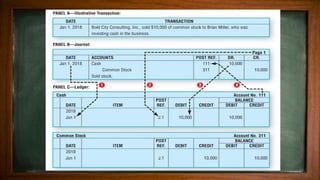
B. Purchases journal
C. Cash receipts journal
D. Options A, B, and C
8.
D. Options A,B, and C
Sales Journal, Purchases
Journal and Cash Receipts
Journal
9.
2. What transactionis recorded first in
the journal?
A. Most expensive entries
B. Latest entries
C. Earliest entries
D. Cheapest entries
3. Which ofthe following is one of the activities
recorded in the cash disbursements
journal?
A. Purchase of merchandise in cash
B. Remittance of SSS Premium and other
government dues
C. Payments of expenses
and obligations
D. Options A, B, and C
12.
D. Options A,B, and C
- Purchase of merchandise in cash
- Remittance of SSS Premium and other
government dues
- Payments of expenses and obligations
13.
4. Which accountlist contains the names and
numbers of all the bookkeeping accounts
necessary for classifying income and expenses?
A. General journal
B. General ledger
C. Subsidiary ledger
D. Special journal
5.Which refers tothe name for the list
of accounts used in the bookkeeping
system?
A. None of these are correct
B. Subsidiary ledgers
C. Chart of accounts
D. Double-entry bookkeeping
“Accounting is theprocess of identifying,
recording, and communicating economic
events of an organization to interested users.”
(Weygandt et.al).
From that definition, where do you think
we record the transactions that we have
identified? What are the tools that we use
to document these transactions? How
important are these records in
accounting?
18.
Companies initially recordtransactions and events in
chronological order (the order in which they occur).
Thus, the general journal is referred to as the book of
srcinal entry. General journal records all transactions
that do not belong in any special journals. Examples
are purchases of office supplies, property and
equipment on account, investment of a proprietor
not involving cash, and return of merchandise
bought on account.
Numerology
Analysis.
19.
While the followingare the special journals:
Sales journal records all merchandise sold on account.
An example is when goods are purchased by
customers on credit. Sales invoice or receipt is the
source document when recording transactions in
Revenue/Sales Journal.
20.
Cash receipts journalrecords all cash
collections. Examples are sales of merchandise
in cash and collections from customer’s
accounts.
21.
Purchases journal recordsall merchandise
bought on account. An example is
purchasing equipment on credit.
22.
Cash disbursements journalrecords all cash
payments. An example is the purchase of raw
materials in making furniture through cash, purchase
of merchandise in cash, payments of expenses and
obligations, and remittance of SSS Premium and other
government dues.
23.
In recording transactionsin a journal, the journal
entry that was incurred the earliest should be
recorded first; the credit item should be indented
from the debit item and should be arranged in
chronological order.
24.
The following areobserved: (1) No peso sign will be written for
amounts reaching more thousands; (2) No comma will be
written for amounts reaching thousands; (3) No decimal point
will be written in amounts involving centavo. The following are
the components of a journal entry: (1) Transaction date; (2)
Titles of the accounts being debited and credited; (3)
Reference number; (4) Amount of the debit and credit; and
(5) Short narration of why the journal entry is being recorded.
25.
General ledger andSubsidiary ledger Format
The general ledger includes the name of the account (e.g.,
cash and accounts receivable), account number, date of
transaction, explanation or details of the transaction, posting
reference or PR (e.g., reference to the general journal or
special journals), debit column, credit column, and a column
for balances for other types of general ledger forms.
26.
All journal entriesmust similarly post to accounts in general
ledger. All you need to do is to pick the entries from the
general journal and post them in the general ledger per
account. Debits and credits are numbers recorded as follows:
Debits are recorded on the left side of a T account in a
ledger. Debits increase balances in asset accounts and
expense accounts and decrease balances in liability
accounts, revenue accounts, and capital accounts. Credits
are recorded on the right side of a T account in a ledger.
28.
Credits increase balancesin liability accounts, revenue
accounts, and capital accounts, and decrease balances in
asset accounts and expense accounts. Debit accounts are
asset and expense accounts that usually have debit
balances, i.e., the total debits usually exceed the total
credits in each debit account. Credit accounts are revenue
(income, gains) accounts and liability accounts that usually
have credit balances.
29.
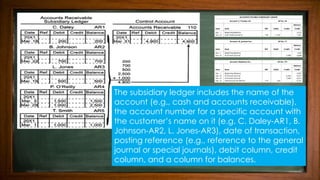
A subsidiary ledgeris a group of similar accounts
whose combined balances equal the balance in a
specific general ledger account. The general
ledger account that summarizes the account
balance of a subsidiary ledger is called a control
account or master account. For example, an
accounts receivable subsidiary ledger (customers'
subsidiary ledger) includes a separate account for
each customer who makes credit purchases. A
subsidiary ledger stores specific types of accounting
transactions. See the example:
30.
The subsidiary ledgerincludes the name of the
account (e.g., cash and accounts receivable),
the account number for a specific account with
the customer’s name on it (e.g. C. Daley-AR1, B.
Johnson-AR2, L. Jones-AR3), date of transaction,
posting reference (e.g., reference to the general
journal or special journals), debit column, credit
column, and a column for balances.
32.
general ledgers providea complete record of financial
transactions over the life of the company. It means that it
is a summary of all financial transactions of a company.
On the other hand, a subsidiary ledger is used as storage
of specific types of accounting transactions (especially for
large amounts of transactions).
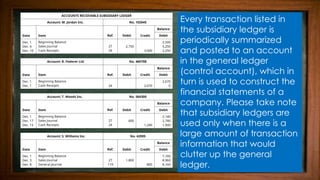
33.
Every transaction listedin
the subsidiary ledger is
periodically summarized
and posted to an account
in the general ledger
(control account), which in
turn is used to construct the
financial statements of a
company. Please take note
that subsidiary ledgers are
used only when there is a
large amount of transaction
information that would
clutter up the general
ledger.