Comprehensive Guide to Jasmine Cultivation Practices and Economic Potential
Explore jasmine cultivation techniques, suitable climates, propagation methods, pest management, and economic opportunities in Nepal's agro-climatic zones for essential oils and cultural uses.
Comprehensive Guide to Jasmine Cultivation Practices and Economic Potential
1.
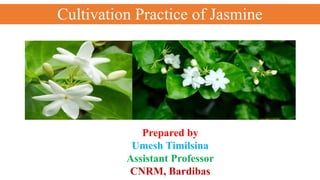
Cultivation Practice ofJasmine
Prepared by
Umesh Timilsina
Assistant Professor
CNRM, Bardibas
2.
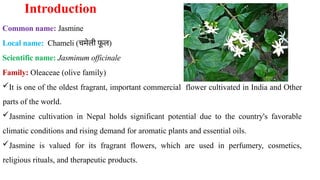
Introduction
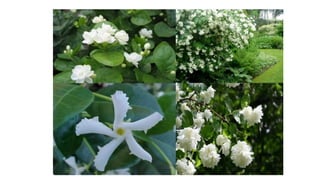
Common name: Jasmine
Localname: Chameli (चमेली फ
ू ल)
Scientific name: Jasminum officinale
Family: Oleaceae (olive family)
It is one of the oldest fragrant, important commercial flower cultivated in India and Other
parts of the world.
Jasmine cultivation in Nepal holds significant potential due to the country's favorable
climatic conditions and rising demand for aromatic plants and essential oils.
Jasmine is valued for its fragrant flowers, which are used in perfumery, cosmetics,
religious rituals, and therapeutic products.
3.
Uses and EconomicPotential
1.Essential Oils: Jasmine flowers are used to extract essential oils, which have
high export potential. Nepal can benefit by targeting international markets for
essential oils, especially in Europe and the Middle East.
2.Religious and Cultural Use: Jasmine flowers are widely used in Hindu and
Buddhist rituals, making them highly marketable in local markets.
3.Cosmetics and Perfumery: Jasmine oils are key ingredients in high-end
perfumes and beauty products.
4.Aromatherapy and Herbal Medicines: The calming properties of jasmine make
it valuable in natural healing and wellness.
8.
Important Species
1. Jasminumgrandiflorum: Spanish Jasmine
Widely used in the production of essential oils and perfumes.
2. Jasminum sambac (Mogra): Arabian / Tuscan jasmine
Known for its strong fragrance and use in garlands and religious
offerings.
3. Jasminum officinale (Common Jasmine):
Used for ornamental purposes and essential oils.
4. Jasminum pubescens/multiflorum
9.
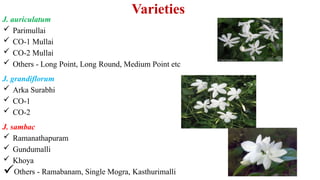
Varieties
J. auriculatum
Parimullai
CO-1 Mullai
CO-2 Mullai
Others - Long Point, Long Round, Medium Point etc
J. grandiflorum
Arka Surabhi
CO-1
CO-2
J. sambac
Ramanathapuram
Gundumalli
Khoya
Others - Ramabanam, Single Mogra, Kasthurimalli
13.
Climate
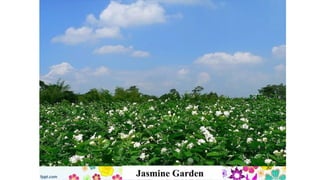
Jasmine preferstropical to sub tropical climate.
Nepal’s diverse agro-climatic zones, especially in the Terai, mid-hills, and lower
valleys, offer suitable environments.
The plant grows best at temperatures ranging from 20°C to 35°C
Altitude: Areas between 500–1,500 meters above sea level are ideal for
cultivation.
Soil
Jasmine can be planted on a wide range of soils.
Well-drained sandy loams and red loams with a pH of 6.5–7.5 under tropical
conditions are suitable for its cultivation.
In clayey soils, there is increased vegetative growth and reduced flowering.
14.
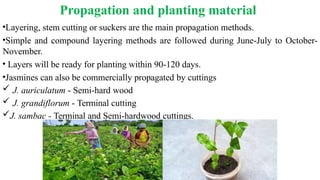
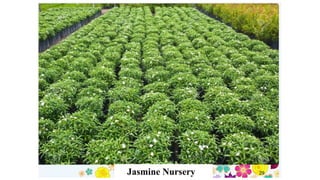
•Layering, stem cuttingor suckers are the main propagation methods.
•Simple and compound layering methods are followed during June-July to October-
November.
• Layers will be ready for planting within 90-120 days.
•Jasmines can also be commercially propagated by cuttings
J. auriculatum - Semi-hard wood
J. grandiflorum - Terminal cutting
J. sambac - Terminal and Semi-hardwood cuttings.
Propagation and planting material
15.
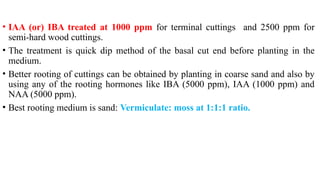
• IAA (or)IBA treated at 1000 ppm for terminal cuttings and 2500 ppm for
semi-hard wood cuttings.
• The treatment is quick dip method of the basal cut end before planting in the
medium.
• Better rooting of cuttings can be obtained by planting in coarse sand and also by
using any of the rooting hormones like IBA (5000 ppm), IAA (1000 ppm) and
NAA (5000 ppm).
• Best rooting medium is sand: Vermiculate: moss at 1:1:1 ratio.
18.
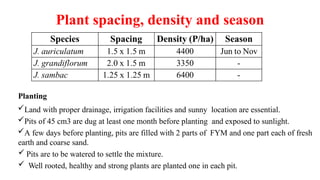
Plant spacing, densityand season
Planting
Land with proper drainage, irrigation facilities and sunny location are essential.
Pits of 45 cm3 are dug at least one month before planting and exposed to sunlight.
A few days before planting, pits are filled with 2 parts of FYM and one part each of fresh
earth and coarse sand.
Pits are to be watered to settle the mixture.
Well rooted, healthy and strong plants are planted one in each pit.
19.
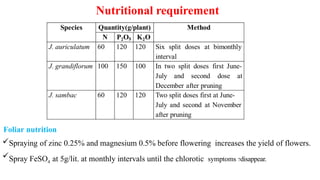
Nutritional requirement
Foliar nutrition
Sprayingof zinc 0.25% and magnesium 0.5% before flowering increases the yield of flowers.
Spray FeSO4 at 5g/lit. at monthly intervals until the chlorotic symptoms 7disappear.
20.
Irrigation
Sufficient amount ofmoisture in the soil is necessary for proper
growth and flowering.
Jasmines can be irrigated once in ten days depending on the soil
and climatic conditions.
Weeding
Commonly done manually but is expensive.
Chemical weed control is effective and economical.
Spraying with Oryzalin 1 or 2 application is effective.
Mulching also reduce weed population.
21.
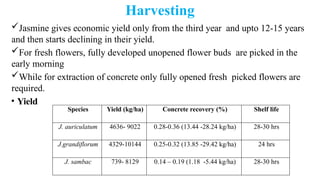
Harvesting
Jasmine gives economicyield only from the third year and upto 12-15 years
and then starts declining in their yield.
For fresh flowers, fully developed unopened flower buds are picked in the
early morning
While for extraction of concrete only fully opened fresh picked flowers are
required.
• Yield
Species Yield (kg/ha) Concrete recovery (%) Shelf life
J. auriculatum 4636- 9022 0.28-0.36 (13.44 -28.24 kg/ha) 28-30 hrs
J.grandiflorum 4329-10144 0.25-0.32 (13.85 -29.42 kg/ha) 24 hrs
J. sambac 739- 8129 0.14 – 0.19 (1.18 -5.44 kg/ha) 28-30 hrs
23.
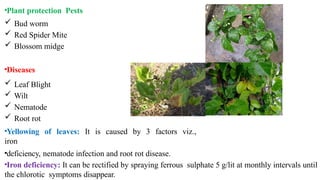
•Plant protection Pests
Bud worm
Red Spider Mite
Blossom midge
•Diseases
Leaf Blight
Wilt
Nematode
Root rot
•Yellowing of leaves: It is caused by 3 factors viz.,
iron
•deficiency, nematode infection and root rot disease.
•Iron deficiency: It can be rectified by spraying ferrous sulphate 5 g/lit at monthly intervals until
the chlorotic symptoms disappear.
24.
Challenges
1.Lack of Awareness:Many farmers in Nepal are not aware of the economic
potential of jasmine cultivation.
2.Limited Infrastructure: Absence of modern facilities for processing and
packaging essential oils hampers large-scale production.
3.Market Access: Small-scale farmers may struggle with access to both
domestic and international markets.
4.Pests and Diseases: Common pests include aphids and whiteflies, which
can reduce flower yield.
25.
Opportunities
1.Export Potential: Withgrowing global demand for essential oils, jasmine
cultivation offers an opportunity for export-oriented agriculture.
2.Agro-Tourism: Jasmine gardens can be a part of eco-tourism and agro-tourism
projects in Nepal.
3.Government Support: Encouraging policies from Nepal’s government for
promoting aromatic plants can further boost jasmine cultivation.
• Regions Suitable for Jasmine Cultivation in Nepal
• Terai Region: Due to its warmer climate and flat lands, areas like Chitwan,
Sunsari, and Rupandehi are ideal.
• Hill Regions: Warmer hill areas like Dhading and Kavre can also be suitable,
especially for high-value jasmine cultivation in small-scale farms.
 Most read



 Most read
 Most read