Comprehensive Guide to Implementing the Three-Term School Calendar in Basic Education
Overview of the three-term academic calendar, term activities, instructional guidelines, device policies, and student consequences for SY 2026-2027 in basic education.
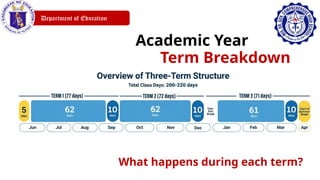
Academic Year
Term Breakdown
Theschool year shall consist of not more
than two hundred twenty (220) class days
and shall start not earlier than the first
Monday of June and not later than the last
day of August [RA 11480].
Term 1: June - August
Term 2: October - December
Term 3: January - March
Department of Education
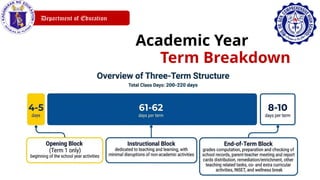
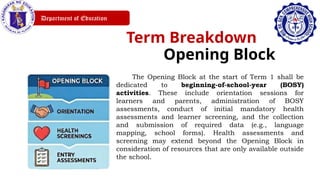
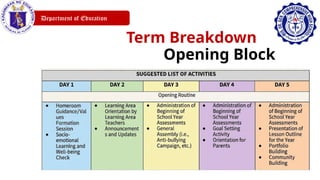
Opening Block
Term Breakdown
Departmentof Education
The Opening Block at the start of Term 1 shall be
dedicated to beginning-of-school-year (BOSY)
activities. These include orientation sessions for
learners and parents, administration of BOSY
assessments, conduct of initial mandatory health
assessments and learner screening, and the collection
and submission of required data (e.g., language
mapping, school forms). Health assessments and
screening may extend beyond the Opening Block in
consideration of resources that are only available outside
the school.
Instructional Block
Term Breakdown
Departmentof Education
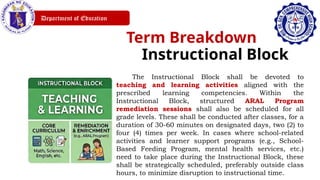
The Instructional Block shall be devoted to
teaching and learning activities aligned with the
prescribed learning competencies. Within the
Instructional Block, structured ARAL Program
remediation sessions shall also be scheduled for all
grade levels. These shall be conducted after classes, for a
duration of 30-60 minutes on designated days, two (2) to
four (4) times per week. In cases where school-related
activities and learner support programs (e.g., School-
Based Feeding Program, mental health services, etc.)
need to take place during the Instructional Block, these
shall be strategically scheduled, preferably outside class
hours, to minimize disruption to instructional time.
9.
End-of-Term Block
Term Breakdown
Departmentof Education
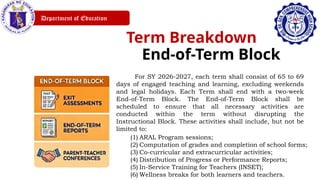
For SY 2026-2027, each term shall consist of 65 to 69
days of engaged teaching and learning, excluding weekends
and legal holidays. Each Term shall end with a two-week
End-of-Term Block. The End-of-Term Block shall be
scheduled to ensure that all necessary activities are
conducted within the term without disrupting the
Instructional Block. These activities shall include, but not be
limited to:
(1) ARAL Program sessions;
(2) Computation of grades and completion of school forms;
(3) Co-curricular and extracurricular activities;
(4) Distribution of Progress or Performance Reports;
(5) In-Service Training for Teachers (INSET);
(6) Wellness breaks for both learners and teachers.
10.
DepEd Order No.6, s. 2026
"GUIDELINES ON ENSURING A SAFE
AND MOTIVATING LEARNING
ENVIRONMENT"
11.
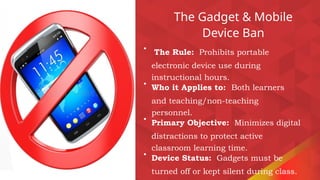
• The Rule:Prohibits portable
electronic device use during
instructional hours.
• Who it Applies to: Both learners
and teaching/non-teaching
personnel.
• Primary Objective: Minimizes digital
distractions to protect active
classroom learning time.
• Device Status: Gadgets must be
turned off or kept silent during class.
The Gadget & Mobile
Device Ban
12.
• Academic Exception:Authorized use for
digital resources or online lesson
activities.
• Teacher Supervision: Strictly limited to
managed instructional windows.
• Emergency Exception: Allowed during
medical crises, natural disasters, or
immediate safety threats.
• Prior Approval: Any non-emergency use
requires explicit permission from the
teacher.
Allowed Policy
Exceptions
13.
• 1st Offense:Device is temporarily
confiscated; returned at the end of the
subject period.
• 2nd Offense: Device is held until the end
of the school day; formal notice is sent to
parents.
• 3rd Offense: Device is deposited with the
School Head; returned only to parents.
• Mandatory Logs: Every single
confiscation requires a formal Confiscation
Student Consequences
(The "Three-Strike" Rule)