"Hand Hygiene Through a Microbiologist’s Lens" (Microbes + Mechanisms + Moments)
3.
The historical Turningpoint
Story of hand hygiene begins hundreds of year
ago…
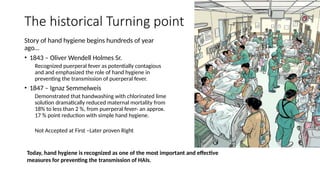
• 1843 – Oliver Wendell Holmes Sr.
Recognized puerperal fever as potentially contagious
and and emphasized the role of hand hygiene in
preventing the transmission of puerperal fever.
• 1847 – Ignaz Semmelweis
Demonstrated that handwashing with chlorinated lime
solution dramatically reduced maternal mortality from
18% to less than 2 %, from puerperal fever- an approx.
17 % point reduction with simple hand hygiene.
Not Accepted at First –Later proven Right
Today, hand hygiene is recognized as one of the most important and effective
measures for preventing the transmission of HAIs.
4.
We will discuss…
•The historical turning point
• Global burden of HAI
• 5-step Hand transmission sequence
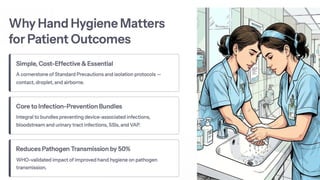
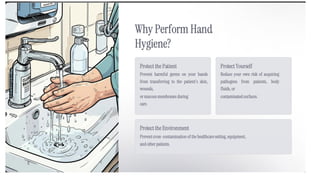
• Why hand hygiene matter and why we perform hand hygiene
• Microorganism survive on surface and transient /resident flora
• Definition and type of hand hygiene
• Mechanism of hand rub and hand wash
• Requirements and hand rub products detail
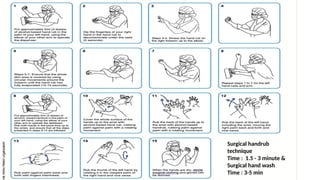
• Hand hygiene technique and missed area
• Zoning
• WHO 5 MOMENTS
• GLOVES &HAND HYGIENE
• COMMON BARRIER
• FINGER IMPRESSION
• REASON FOR FAILURES
6.
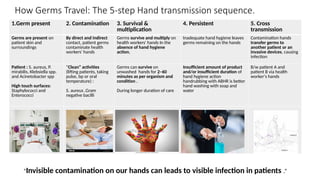
How Germs Travel:The 5-step Hand transmission sequence.
1.Germ present 2. Contamination 3. Survival &
multiplication
4. Persistent 5. Cross
transmission
Germs are present on
patient skin and
surroundings
By direct and indirect
contact, patient germs
contaminate health
workers' hands
Germs survive and multiply on
health workers' hands In the
absence of hand hygiene
action,
Inadequate hand hygiene leaves
germs remaining on the hands
Contamination hands
transfer germs to
another patient or an
invasive devices, causing
infection
Patient : S. aureus, P.
mirabilis, Klebsiella spp.
and Acinetobacter spp
High touch surfaces:
Staphylococci and
Enterococci
“Clean” activities
(lifting patients, taking
pulse, bp or oral
temperature) :
S. aureus ,Gram
negative bacilli
Germs can survive on
unwashed hands for 2–60
minutes as per organism and
condition .
During longer duration of care
Insufficient amount of product
and/or insufficient duration of
hand hygiene action
handrubbing with ABHR is better
hand washing with soap and
water
B/w patient A and
patient B via health
worker's hands
“Invisible contamination on our hands can leads to visible infection in patients .”
10.
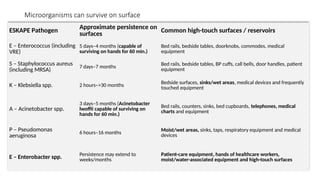
Microorganisms can surviveon surface
ESKAPE Pathogen
Approximate persistence on
surfaces Common high-touch surfaces / reservoirs
E – Enterococcus (including
VRE)
5 days–4 months (capable of
surviving on hands for 60 min.)
Bed rails, bedside tables, doorknobs, commodes, medical
equipment
S – Staphylococcus aureus
(including MRSA)
7 days–7 months
Bed rails, bedside tables, BP cuffs, call bells, door handles, patient
equipment
K – Klebsiella spp. 2 hours–>30 months
Bedside surfaces, sinks/wet areas, medical devices and frequently
touched equipment
A – Acinetobacter spp.
3 days–5 months (Acinetobacter
lwoffii capable of surviving on
hands for 60 min.)
Bed rails, counters, sinks, bed cupboards, telephones, medical
charts and equipment
P – Pseudomonas
aeruginosa
6 hours–16 months Moist/wet areas, sinks, taps, respiratory equipment and medical
devices
E – Enterobacter spp. Persistence may extend to
weeks/months
Patient-care equipment, hands of healthcare workers,
moist/water-associated equipment and high-touch surfaces
11.
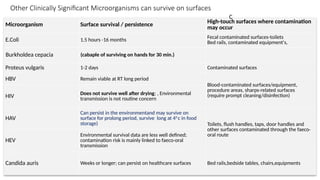
Other Clinically SignificantMicroorganisms can survive on surfaces
Microorganism Surface survival / persistence
High-touch surfaces where contamination
may occur
E.Coli 1.5 hours -16 months
Fecal contaminated surfaces-toilets
Bed rails, contaminated equipment's,
Burkholdea cepacia (cabaple of surviving on hands for 30 min.)
Proteus vulgaris 1-2 days Contaminated surfaces
HBV Remain viable at RT long period
Blood-contaminated surfaces/equipment,
procedure areas, sharps-related surfaces
(require prompt cleaning/disinfection)
HIV Does not survive well after drying; , Environmental
transmission is not routine concern
HAV
Can persist in the environmentand may survive on
surface for prolong period, survive long at 40
c in food
storage) Toilets, flush handles, taps, door handles and
other surfaces contaminated through the faeco-
oral route
HEV
Environmental survival data are less well defined;
contamination risk is mainly linked to faeco-oral
transmission
Candida auris Weeks or longer; can persist on healthcare surfaces Bed rails,bedside tables, chairs,equipments
C
12.
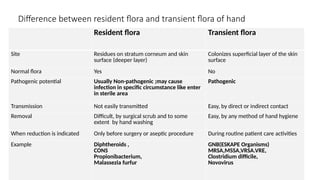
Difference between residentflora and transient flora of hand
Resident flora Transient flora
Site Residues on stratum corneum and skin
surface (deeper layer)
Colonizes superficial layer of the skin
surface
Normal flora Yes No
Pathogenic potential Usually Non-pathogenic ;may cause
infection in specific circumstance like enter
in sterile area
Pathogenic
Transmission Not easily transmitted Easy, by direct or indirect contact
Removal Difficult, by surgical scrub and to some
extent by hand washing
Easy, by any method of hand hygiene
When reduction is indicated Only before surgery or aseptic procedure During routine patient care activities
Example Diphtheroids ,
CONS
Propionibacterium,
Malassezia furfur
GNB(ESKAPE Organisms)
MRSA,MSSA,VRSA.VRE,
Clostridium difficile,
Novovirus
13.
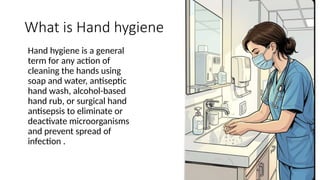
What is Handhygiene
Hand hygiene is a general
term for any action of
cleaning the hands using
soap and water, antiseptic
hand wash, alcohol-based
hand rub, or surgical hand
antisepsis to eliminate or
deactivate microorganisms
and prevent spread of
infection .
14.
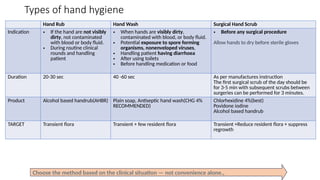
Types of handhygiene
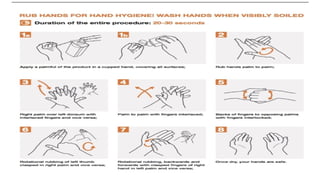
Hand Rub Hand Wash Surgical Hand Scrub
Indication • If the hand are not visibly
dirty, not contaminated
with blood or body fluid.
• During routine clinical
rounds and handling
patient
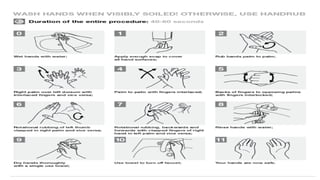
• When hands are visibly dirty,
contaminated with blood, or body fluid.
• Potential exposure to spore forming
organisms, nonenveloped viruses,
• Handling patient having diarrhoea
• After using toilets
• Before handling medication or food
• Before any surgical procedure
Allow hands to dry before sterile gloves
Duration 20-30 sec 40 -60 sec As per manufactures instruction
The first surgical scrub of the day should be
for 3-5 min with subsequent scrubs between
surgeries can be performed for 3 minutes.
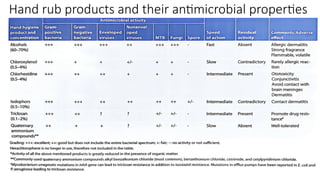
Product Alcohol based handrub(AHBR) Plain soap, Antiseptic hand wash(CHG 4%
RECOMMENDED)
Chlorhexidine 4%(best)
Povidone iodine
Alcohol based handrub
TARGET Transient flora Transient + few resident flora Transient +Reduce resident flora + suppress
regrowth
Choose the method based on the clinical situation — not convenience alone.,
15.
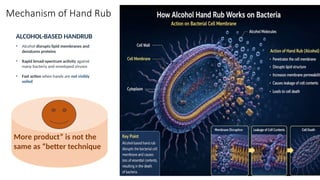
Mechanism of HandRub
ALCOHOL-BASED HANDRUB
• Alcohol disrupts lipid membranes and
denatures proteins
• Rapid broad-spectrum activity against
many bacteria and enveloped viruses
• Fast action when hands are not visibly
soiled
More product” is not the
same as “better technique
16.
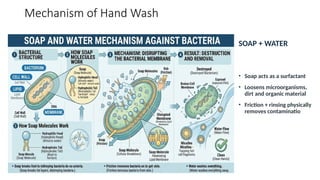
Mechanism of HandWash
SOAP + WATER
• Soap acts as a surfactant
• Loosens microorganisms,
dirt and organic material
• Friction + rinsing physically
removes contaminatio
17.
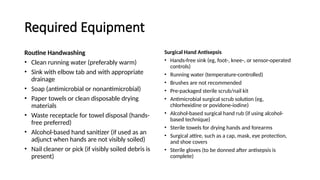
Required Equipment
Routine Handwashing
•Clean running water (preferably warm)
• Sink with elbow tab and with appropriate
drainage
• Soap (antimicrobial or nonantimicrobial)
• Paper towels or clean disposable drying
materials
• Waste receptacle for towel disposal (hands-
free preferred)
• Alcohol-based hand sanitizer (if used as an
adjunct when hands are not visibly soiled)
• Nail cleaner or pick (if visibly soiled debris is
present)
Surgical Hand Antisepsis
• Hands-free sink (eg, foot-, knee-, or sensor-operated
controls)
• Running water (temperature-controlled)
• Brushes are not recommended
• Pre-packaged sterile scrub/nail kit
• Antimicrobial surgical scrub solution (eg,
chlorhexidine or povidone-iodine)
• Alcohol-based surgical hand rub (if using alcohol-
based technique)
• Sterile towels for drying hands and forearms
• Surgical attire, such as a cap, mask, eye protection,
and shoe covers
• Sterile gloves (to be donned after antisepsis is
complete)
18.
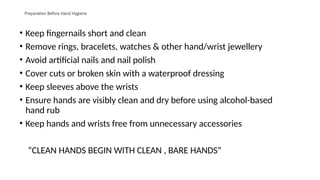
Preparation Before HandHygiene
• Keep fingernails short and clean
• Remove rings, bracelets, watches & other hand/wrist jewellery
• Avoid artificial nails and nail polish
• Cover cuts or broken skin with a waterproof dressing
• Keep sleeves above the wrists
• Ensure hands are visibly clean and dry before using alcohol-based
hand rub
• Keep hands and wrists free from unnecessary accessories
“CLEAN HANDS BEGIN WITH CLEAN , BARE HANDS”
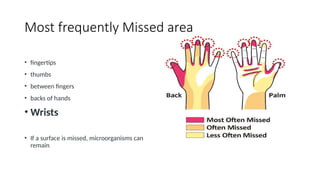
Most frequently Missedarea
• fingertips
• thumbs
• between fingers
• backs of hands
• Wrists
• If a surface is missed, microorganisms can
remain.
24.
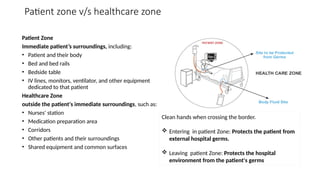
Patient zone v/shealthcare zone
Patient Zone
Immediate patient’s surroundings, including:
• Patient and their body
• Bed and bed rails
• Bedside table
• IV lines, monitors, ventilator, and other equipment
dedicated to that patient
Healthcare Zone
outside the patient's immediate surroundings, such as:
• Nurses' station
• Medication preparation area
• Corridors
• Other patients and their surroundings
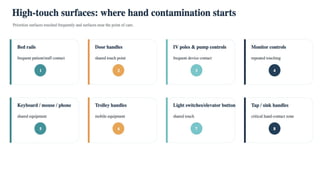
• Shared equipment and common surfaces
Clean hands when crossing the border.
Entering in patient Zone: Protects the patient from
external hospital germs.
Leaving patient Zone: Protects the hospital
environment from the patient's germs
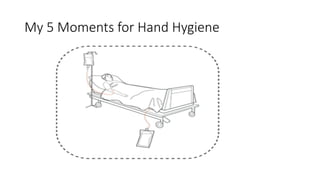
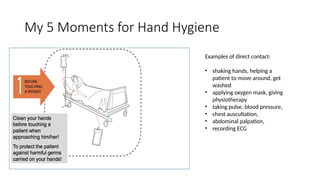
My 5 Momentsfor Hand Hygiene
Examples of direct contact:
• shaking hands, helping a
patient to move around, get
washed
• applying oxygen mask, giving
physiotherapy
• taking pulse, blood pressure,
• chest auscultation,
• abdominal palpation,
• recording ECG
27.
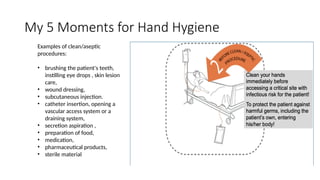
My 5 Momentsfor Hand Hygiene
Examples of clean/aseptic
procedures:
• brushing the patient's teeth,
instilling eye drops , skin lesion
care,
• wound dressing,
• subcutaneous injection.
• catheter insertion, opening a
vascular access system or a
draining system,
• secretion aspiration ,
• preparation of food,
• medication,
• pharmaceutical products,
• sterile material
28.
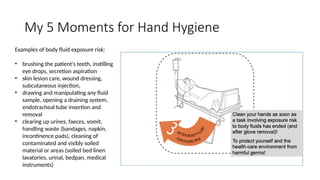
My 5 Momentsfor Hand Hygiene
Examples of body fluid exposure risk:
• brushing the patient's teeth, instilling
eye drops, secretion aspiration
• skin lesion care, wound dressing,
subcutaneous injection,
• drawing and manipulating any fluid
sample, opening a draining system,
endotracheal tube insertion and
removal
• clearing up urines, faeces, vomit,
handling waste (bandages, napkin,
incontinence pads), cleaning of
contaminated and visibly soiled
material or areas (soiled bed linen
lavatories, urinal, bedpan, medical
instruments)
29.
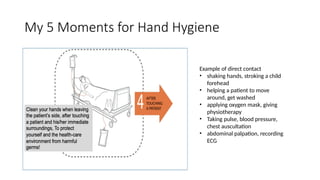
My 5 Momentsfor Hand Hygiene
Example of direct contact
• shaking hands, stroking a child
forehead
• helping a patient to move
around, get washed
• applying oxygen mask, giving
physiotherapy
• Taking pulse, blood pressure,
chest auscultation
• abdominal palpation, recording
ECG
30.
My 5 Momentsfor Hand Hygiene
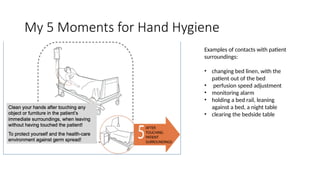
Examples of contacts with patient
surroundings:
• changing bed linen, with the
patient out of the bed
• perfusion speed adjustment
• monitoring alarm
• holding a bed rail, leaning
against a bed, a night table
• clearing the bedside table
31.
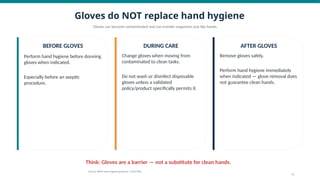
Gloves do NOTreplace hand hygiene
Gloves can become contaminated and can transfer organisms just like hands.
BEFORE GLOVES
Perform hand hygiene before donning
gloves when indicated.
Especially before an aseptic
procedure.
DURING CARE
Change gloves when moving from
contaminated to clean tasks.
Do not wash or disinfect disposable
gloves unless a validated
policy/product specifically permits it.
AFTER GLOVES
Remove gloves safely.
Perform hand hygiene immediately
when indicated — glove removal does
not guarantee clean hands.
Think: Gloves are a barrier — not a substitute for clean hands.
11
Source: WHO hand hygiene guidance / 2025 FAQ.
32.
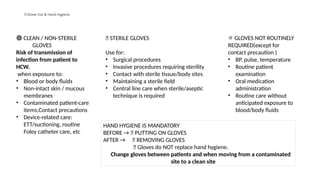
🧤 Glove Use& Hand Hygiene
🟢 CLEAN / NON-STERILE
GLOVES
Risk of transmission of
infection from patient to
HCW.
when exposure to:
• Blood or body fluids
• Non-intact skin / mucous
membranes
• Contaminated patient-care
items,Contact precautions
• Device-related care:
ETT/suctioning, routine
Foley catheter care, etc
🔵 STERILE GLOVES
Use for:
• Surgical procedures
• Invasive procedures requiring sterility
• Contact with sterile tissue/body sites
• Maintaining a sterile field
• Central line care when sterile/aseptic
technique is required
⚪ GLOVES NOT ROUTINELY
REQUIRED(except for
contact precaution )
• BP, pulse, temperature
• Routine patient
examination
• Oral medication
administration
• Routine care without
anticipated exposure to
blood/body fluids
HAND HYGIENE IS MANDATORY
BEFORE → 🧤 PUTTING ON GLOVES
AFTER → 🧤 REMOVING GLOVES
🧤 Gloves do NOT replace hand hygiene.
Change gloves between patients and when moving from a contaminated
site to a clean site
33.
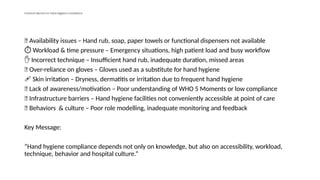
Common Barriers toHand Hygiene Compliance
🧴 Availability issues – Hand rub, soap, paper towels or functional dispensers not available
️
⏱️Workload & time pressure – Emergency situations, high patient load and busy workflow
✋ Incorrect technique – Insufficient hand rub, inadequate duration, missed areas
🧤 Over-reliance on gloves – Gloves used as a substitute for hand hygiene
🩹 Skin irritation – Dryness, dermatitis or irritation due to frequent hand hygiene
🧠 Lack of awareness/motivation – Poor understanding of WHO 5 Moments or low compliance
🏥 Infrastructure barriers – Hand hygiene facilities not conveniently accessible at point of care
👥 Behaviors & culture – Poor role modelling, inadequate monitoring and feedback
Key Message:
“Hand hygiene compliance depends not only on knowledge, but also on accessibility, workload,
technique, behavior and hospital culture.”
34.
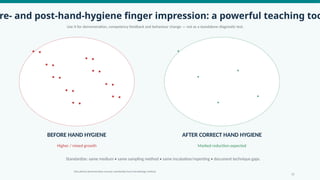
re- and post-hand-hygienefinger impression: a powerful teaching too
Use it for demonstration, competency feedback and behaviour change — not as a standalone diagnostic test.
BEFORE HAND HYGIENE
Higher / mixed growth
AFTER CORRECT HAND HYGIENE
Marked reduction expected
Standardize: same medium • same sampling method • same incubation/reporting • document technique gaps.
12
Educational demonstration concept; standardize local microbiology method.
35.
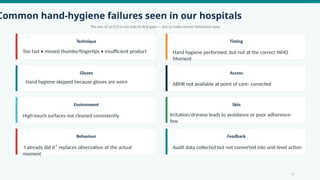
Common hand-hygiene failuresseen in our hospitals
The aim of an ICO is not only to find gaps — but to make correct behaviour easy.
Technique
Too fast • missed thumbs/fingertips • insufficient product
Timing
Hand hygiene performed, but not at the correct WHO
Moment
Gloves
Hand hygiene skipped because gloves are worn
Access
ABHR not available at point of care- corrected
Environment
High-touch surfaces not cleaned consistently
Skin
Irritation/dryness leads to avoidance or poor adherence-
few
Behaviour
“I already did it” replaces observation of the actual
moment
Feedback
Audit data collected but not converted into unit-level action
14
36.
Key take-home messages
Aclean hand at the right moment can break a chain of transmission.
• Hand hygiene is one of the simplest and most important IPC actions.
• Transient flora are acquired; resident flora persist on the skin.
• ABHR: routine preferred when hands are not visibly soiled — rub 20–30 sec and cover every
surface.
• Soap + water: use when hands are visibly soiled and when washing is indicated — 40–60 sec.
• Surgical hand preparation has a different objective: reduce resident flora and suppress
regrowth.
• WHO 5 Moments convert “wash your hands” into a specific, observable behavior.
• Finger-impression demonstrations can make invisible contamination visible and motivate
better technique.
• Gloves do not replace hand hygiene.
OUR SMALL EFFORT ON HAND HYGIENE CAN SAVE A PATIENT’S LIFE
16
37.
References & recommendedresources
• WHO. Guidelines on Hand Hygiene in Health Care.
• WHO. Five Moments for Hand Hygiene.
• WHO. How to Handrub? / How to Handwash?
• WHO. Surgical hand preparation guidance.
• CDC. Environmental Cleaning & Disinfection: pathogen survival on surfaces.
• WHO World Hand Hygiene Day 2026 resources.
17