Comprehensive Guide to Financial Planning & Analysis (FP&A) for Business Success
Explore FP&A fundamentals: budgeting, forecasting, variance analysis, KPIs, tools, and skills essential for strategic financial decision-making and business insight.
Comprehensive Guide to Financial Planning & Analysis (FP&A) for Business Success
1.
FP&A
Financial Planning &Analysis
Turning data into decisions: budgeting, forecasting & business insight
Prepared for Study & Professional Reference
2.
What is FP&A?
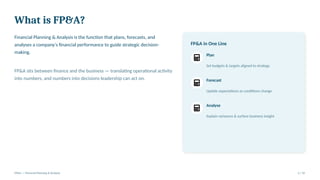
FinancialPlanning & Analysis is the function that plans, forecasts, and
analyses a company's financial performance to guide strategic decision-
making.
FP&A sits between finance and the business — translating operational activity
into numbers, and numbers into decisions leadership can act on.
FP&A in One Line
Plan
Set budgets & targets aligned to strategy
Forecast
Update expectations as conditions change
Analyse
Explain variances & surface business insight
FP&A — Financial Planning & Analysis 2 / 10
3.
The Role ofFP&A in a Business
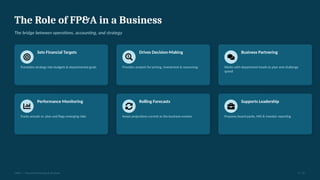
The bridge between operations, accounting, and strategy
Sets Financial Targets
Translates strategy into budgets & departmental goals
Drives Decision-Making
Provides analysis for pricing, investment & resourcing
Business Partnering
Works with department heads to plan and challenge
spend
Performance Monitoring
Tracks actuals vs. plan and flags emerging risks
Rolling Forecasts
Keeps projections current as the business evolves
Supports Leadership
Prepares board packs, MIS & investor reporting
FP&A — Financial Planning & Analysis 3 / 10
4.
Core FP&A Activities
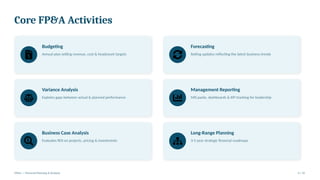
Budgeting
Annualplan setting revenue, cost & headcount targets
Forecasting
Rolling updates reflecting the latest business trends
Variance Analysis
Explains gaps between actual & planned performance
Management Reporting
MIS packs, dashboards & KPI tracking for leadership
Business Case Analysis
Evaluates ROI on projects, pricing & investments
Long-Range Planning
3-5 year strategic financial roadmaps
FP&A — Financial Planning & Analysis 4 / 10
5.
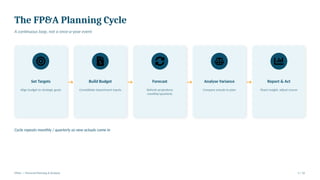
The FP&A PlanningCycle
A continuous loop, not a once-a-year event
Set Targets
Align budget to strategic goals
→ Build Budget
Consolidate department inputs
→ Forecast
Refresh projections
monthly/quarterly
→ Analyse Variance
Compare actuals to plan
→ Report & Act
Share insight; adjust course
Cycle repeats monthly / quarterly as new actuals come in
FP&A — Financial Planning & Analysis 5 / 10
6.
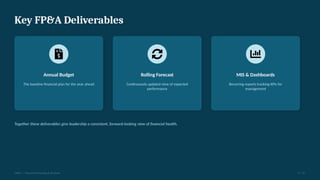
Key FP&A Deliverables
AnnualBudget
The baseline financial plan for the year ahead
Rolling Forecast
Continuously updated view of expected
performance
MIS & Dashboards
Recurring reports tracking KPIs for
management
Together these deliverables give leadership a consistent, forward-looking view of financial health.
FP&A — Financial Planning & Analysis 6 / 10
7.
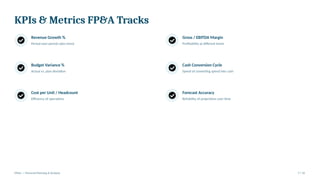
KPIs & MetricsFP&A Tracks
Revenue Growth %
Period-over-period sales trend
Gross / EBITDA Margin
Profitability at different levels
Budget Variance %
Actual vs. plan deviation
Cash Conversion Cycle
Speed of converting spend into cash
Cost per Unit / Headcount
Efficiency of operations
Forecast Accuracy
Reliability of projections over time
FP&A — Financial Planning & Analysis 7 / 10
8.
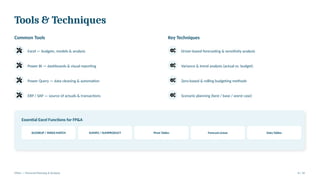
Tools & Techniques
CommonTools
Excel — budgets, models & analysis
Power BI — dashboards & visual reporting
Power Query — data cleaning & automation
ERP / SAP — source of actuals & transactions
Key Techniques
Driver-based forecasting & sensitivity analysis
Variance & trend analysis (actual vs. budget)
Zero-based & rolling budgeting methods
Scenario planning (best / base / worst case)
Essential Excel Functions for FP&A
XLOOKUP / INDEX-MATCH SUMIFS / SUMPRODUCT Pivot Tables Forecast.Linear Data Tables
FP&A — Financial Planning & Analysis 8 / 10
9.
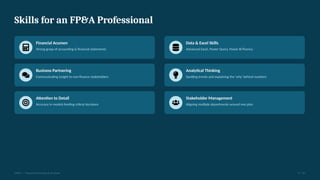
Skills for anFP&A Professional
Financial Acumen
Strong grasp of accounting & financial statements
Data & Excel Skills
Advanced Excel, Power Query, Power BI fluency
Business Partnering
Communicating insight to non-finance stakeholders
Analytical Thinking
Spotting trends and explaining the 'why' behind numbers
Attention to Detail
Accuracy in models feeding critical decisions
Stakeholder Management
Aligning multiple departments around one plan
FP&A — Financial Planning & Analysis 9 / 10
10.
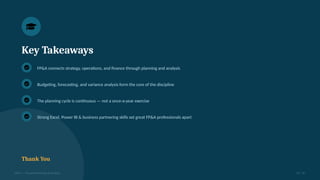
Key Takeaways
FP&A connectsstrategy, operations, and finance through planning and analysis
Budgeting, forecasting, and variance analysis form the core of the discipline
The planning cycle is continuous — not a once-a-year exercise
Strong Excel, Power BI & business partnering skills set great FP&A professionals apart
Thank You
FP&A — Financial Planning & Analysis 10 / 10