Comprehensive Guide to Effective Administration of Commercial Contracts
Explore key aspects of contract management including administration plans, risk mitigation, dispute resolution, performance monitoring, and contract closeout to ensure compliance and successful project outcomes.
3
Definitions:
• Contract Management:All activity that
occurs in the contracting process
• Contract Administration: The
management of all actions, after the
award of a contract, that must be taken to
assure compliance with contract
4.
4
Roles in the
ContractLife Cycle
• Effective contract management
ensures customer satisfaction and
contractor profit
5.
5
What Effective Contract
ManagementAccomplishes
• Serves customers by providing them with
a controlled effective job and good
communications
• Establishes clear expectations of both
parties
• Anticipates and handles disputes as they
arise
• Ensures compensation for the
deliverables achieved.
6.
6
Main Tasks ofContract
Management
• Read and analyze the contract
• Evaluate organization’s ability to comply
• Function as focal point for internal
support/team-members
• Protect the financial interests of the
organization
7.
7
Main Tasks ofContract
Management
• Obtains commitments from subcontractors
• Establishes a contract administration plan
• Plans and conducts a pre performance
conference
• Monitors, measure and reports progress
8.
8
Main Tasks ofContract
Management
•Manages contract changes
•Resolves disputes
•Ensures timely delivery
•Manages the invoice and payment process
•Documents decisions and events
•Closes out or terminates the contract
9.
9
Contract Manager’s Role
inTeam Effort
• The focal point for the team and all
communications on contractual issues
• Should know who does what, when,
where, and why, and how is documented
by team
• Should ensure that everything
contractually required is done by
appropriate members of the team
10.
10
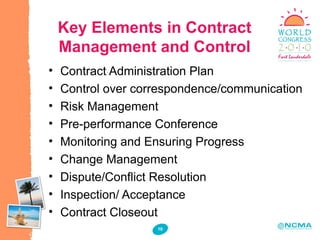
Key Elements inContract
Management and Control
• Contract Administration Plan
• Control over correspondence/communication
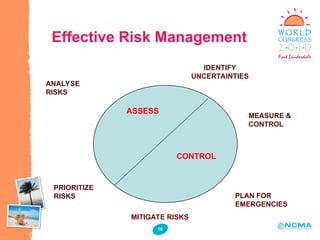
• Risk Management
• Pre-performance Conference
• Monitoring and Ensuring Progress
• Change Management
• Dispute/Conflict Resolution
• Inspection/ Acceptance
• Contract Closeout
11.
11
Creating the Contract
AdministrationPlan
• All project work should be based on the
Contract. Therefore, a key aspect of
project planning involves identifying the
specific actions required by the Contract.
• The Contract Manager and Project
Manager must completely read and
understand the contract documents
12.
12
Developing a Contract
AdministrationPlan
• Contract Managers should start by reviewing
the contract file for:
– Primary requirements
– Critical clauses
• The formality of the plan depends on the
contract complexity
– Simple as determining milestone dates
– Commercial-type contracts
13.
13
Developing a Contract
AdministrationPlan
• List terms & conditions
– identify supplier actions
– identify customer actions
• Identify contract milestones
• Identify reports & due dates
• Identify customer interfaces
• Coordinate with Program Manager(PM) for internal
effort:
– assign responsibilities
– develop a contract schedule
14.
14
Contract Files
Contract documentationincludes but is not
limited to:
• The contract itself, along with all supporting
schedules, requested and approved changes
• Supplier developed technical documentation
• Supplier progress reports, financial documents
such as invoices and payment records
• Results of any contract related inspections
15.
15
Management and Mitigation
•Realize the steps of the risk management
process
• Understand the elements that constitute risk
in projects
• Identify typical risk categories and types of
risk in each category
• Prioritize risk for probability and
consequences of risk
• Evaluate the use of risk mitigation strategies
17
Typical Risk Categories
Whatconstitutes risk in implementing
contracts?
• Financial Risks
• Scope and Schedule Risks
• Project Organization Risks
• Terms and Conditions Risks
• Human Behavior Risks
18.
18
Dispute and Conflict
Resolution
•Contract Dispute:
– A disagreement between the customer
and the supplier regarding the rights of
the parties under a contract
19.
19
Dispute and Conflict
Resolution
•Litigation- Judge and jury
• Arbitration- binding or non binding-
private judge
• Mediation- neutral party-mini trail
• Negotiation- dispute review board
• Internal step negotiations
20.
20
Monitoring, Tracking and
ImprovingContract Performance
• Understand what successful monitoring requires
• Know the different objectives of the customer vs.
the supplier in controlling quality and performance
• Understand the use of project management
measurement tools and third party performance
assessments
• Anticipate cost and schedule variances
• Determine appropriate actions to correct
performance variances and fulfill customer
expectations
21.
21
Key Element: MonitoringAnd
Ensuring Progress
• Successful Progress Monitoring Requires:
– Careful Planning
– Keen observation during performance
– Adequate Data Collection and reporting
systems
– Analysis of events and results as they
emerge
• Comparing them with planned status and
projecting revised expectations while
maintaining a record of baseline pla
22.
22
Warranty Management
• Tomanage the contract warranty effectively
requires close coordination with the
customer.
• Understanding and planning for the warranty
requirements is a critical step toward ensuring
the profitability of the project / program.
23.
23
Contract Close Out
ContractClose-out means that all contractual
obligations have been discharged by both the
Supplier and the Customer.
This includes all commercial, technical and
administrative obligations contained in the
contract and requires formal resolution of all
changes and claims.
24.
24
Document Lessons Learned
•Valuable in improving future contract
arrangements
– What worked, what did not work etc.
• Assist newly assigned contract managers
in understanding significant issues in past
contracts
• Proof for any future claims