Comprehensive Guide to DepEd's Three-Term School Calendar for SY 2026–2027
Overview of DepEd Order No. 009, s. 2026 detailing the shift to a three-term school calendar, instructional time protection, assessment cycles, professional development, and implementation guidelines for SY 2026–2027.
Comprehensive Guide to DepEd's Three-Term School Calendar for SY 2026–2027
1.
Three-Term School
Calendar
in BasicEducation
DepEd Order No. 009, s.
2026
Guidelines on the Implementation of the Three-Term
School Calendar in Basic Education
SY 2026–2027 201 class days 3 Terms
For school heads, district supervisors, program coordinators, and implementation teams
2.
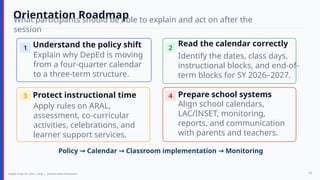
Orientation Roadmap
What participantsshould be able to explain and act on after the
session
1 Understand the policy shift
Explain why DepEd is moving
from a four-quarter calendar
to a three-term structure.
2
Read the calendar correctly
Identify the dates, class days,
instructional blocks, and end-of-
term blocks for SY 2026–2027.
3 Protect instructional time
Apply rules on ARAL,
assessment, co-curricular
activities, celebrations, and
learner support services.
4 Prepare school systems
Align school calendars,
LAC/INSET, monitoring,
reports, and communication
with parents and teachers.
Policy Calendar Classroom implementation Monitoring
→ → →
DepEd Order No. 009, s. 2026 | Division-wide Orientation 02
3.
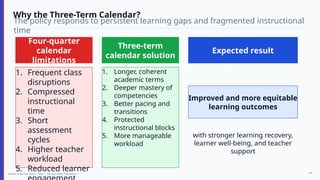
Why the Three-TermCalendar?
The policy responds to persistent learning gaps and fragmented instructional
time
Four-quarter
calendar
limitations
1. Frequent class
disruptions
2. Compressed
instructional
time
3. Short
assessment
cycles
4. Higher teacher
workload
5. Reduced learner
Three-term
calendar solution
1. Longer, coherent
academic terms
2. Deeper mastery of
competencies
3. Better pacing and
transitions
4. Protected
instructional blocks
5. More manageable
workload
Expected result
Improved and more equitable
learning outcomes
with stronger learning recovery,
learner well-being, and teacher
support
DepEd Order No. 009, s. 2026 | Division-wide Orientation 03
4.
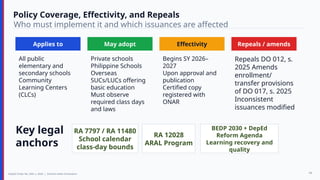
Policy Coverage, Effectivity,and Repeals
Who must implement it and which issuances are affected
Applies to
All public
elementary and
secondary schools
Community
Learning Centers
(CLCs)
May adopt
Private schools
Philippine Schools
Overseas
SUCs/LUCs offering
basic education
Must observe
required class days
and laws
Effectivity
Begins SY 2026–
2027
Upon approval and
publication
Certified copy
registered with
ONAR
Repeals / amends
Repeals DO 012, s.
2025 Amends
enrollment/
transfer provisions
of DO 017, s. 2025
Inconsistent
issuances modified
Key legal
anchors
RA 7797 / RA 11480
School calendar
class-day bounds
RA 12028
ARAL Program
BEDP 2030 + DepEd
Reform Agenda
Learning recovery and
quality
DepEd Order No. 009, s. 2026 | Division-wide Orientation 04
5.
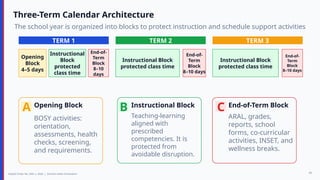
Three-Term Calendar Architecture
Theschool year is organized into blocks to protect instruction and schedule support activities
TERM 1 TERM 2 TERM 3
Opening
Block
4–5 days
Instructional
Block
protected
class time
End-of-
Term
Block
8–10
days
Instructional Block
protected class time
End-of-
Term
Block
8–10 days
Instructional Block
protected class time
End-of-
Term
Block
8–10 days
A Opening Block
BOSY activities:
orientation,
assessments, health
checks, screening,
and requirements.
B Instructional Block
Teaching-learning
aligned with
prescribed
competencies. It is
protected from
avoidable disruption.
C End-of-Term Block
ARAL, grades,
reports, school
forms, co-curricular
activities, INSET, and
wellness breaks.
DepEd Order No. 009, s. 2026 | Division-wide Orientation 05
6.
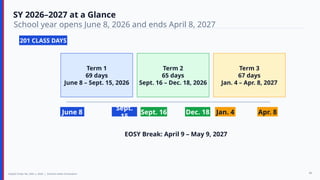
SY 2026–2027 ata Glance
School year opens June 8, 2026 and ends April 8, 2027
201 CLASS DAYS
Term 1
69 days
June 8 – Sept. 15, 2026
Term 2
65 days
Sept. 16 – Dec. 18, 2026
Term 3
67 days
Jan. 4 – Apr. 8, 2027
June 8
Sept.
15
Sept. 16 Dec. 18 Jan. 4 Apr. 8
EOSY Break: April 9 – May 9, 2027
DepEd Order No. 009, s. 2026 | Division-wide Orientation 06
7.
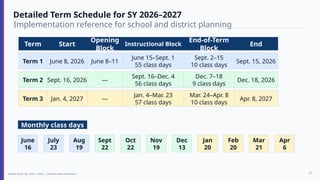
Detailed Term Schedulefor SY 2026–2027
Implementation reference for school and district planning
Term Start
Opening
Block
Instructional Block
End-of-Term
Block
End
Term 1 June 8, 2026 June 8–11
June 15–Sept. 1
55 class days
Sept. 2–15
10 class days
Sept. 15, 2026
Term 2 Sept. 16, 2026 —
Sept. 16–Dec. 4
56 class days
Dec. 7–18
9 class days
Dec. 18, 2026
Term 3 Jan. 4, 2027 —
Jan. 4–Mar. 23
57 class days
Mar. 24–Apr. 8
10 class days
Apr. 8, 2027
Monthly class days
June
16
July
23
Aug
19
Sept
22
Oct
22
Nov
19
Dec
13
Jan
20
Feb
20
Mar
21
Apr
6
DepEd Order No. 009, s. 2026 | Division-wide Orientation 07
8.
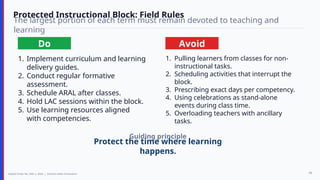
Protected Instructional Block:Field Rules
The largest portion of each term must remain devoted to teaching and
learning
Do
1. Implement curriculum and learning
delivery guides.
2. Conduct regular formative
assessment.
3. Schedule ARAL after classes.
4. Hold LAC sessions within the block.
5. Use learning resources aligned
with competencies.
Avoid
1. Pulling learners from classes for non-
instructional tasks.
2. Scheduling activities that interrupt the
block.
3. Prescribing exact days per competency.
4. Using celebrations as stand-alone
events during class time.
5. Overloading teachers with ancillary
tasks.
Guiding principle
Protect the time where learning
happens.
DepEd Order No. 009, s. 2026 | Division-wide Orientation 08
9.
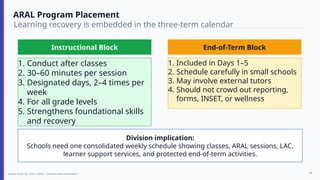
ARAL Program Placement
Learningrecovery is embedded in the three-term calendar
Instructional Block
1. Conduct after classes
2. 30–60 minutes per session
3. Designated days, 2–4 times per
week
4. For all grade levels
5. Strengthens foundational skills
and recovery
End-of-Term Block
1. Included in Days 1–5
2. Schedule carefully in small schools
3. May involve external tutors
4. Should not crowd out reporting,
forms, INSET, or wellness
Division implication:
Schools need one consolidated weekly schedule showing classes, ARAL sessions, LAC,
learner support services, and protected end-of-term activities.
DepEd Order No. 009, s. 2026 | Division-wide Orientation 09
10.
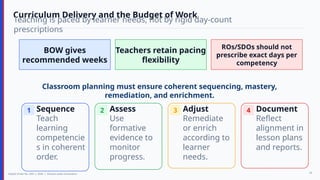
Curriculum Delivery andthe Budget of Work
Teaching is paced by learner needs, not by rigid day-count
prescriptions
BOW gives
recommended weeks
Teachers retain pacing
flexibility
ROs/SDOs should not
prescribe exact days per
competency
Classroom planning must ensure coherent sequencing, mastery,
remediation, and enrichment.
1 Sequence
Teach
learning
competencie
s in coherent
order.
2 Assess
Use
formative
evidence to
monitor
progress.
3 Adjust
Remediate
or enrich
according to
learner
needs.
4 Document
Reflect
alignment in
lesson plans
and reports.
DepEd Order No. 009, s. 2026 | Division-wide Orientation 10
11.
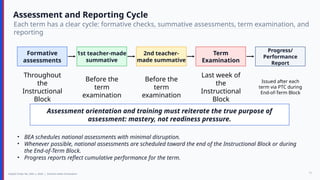
Assessment and ReportingCycle
Each term has a clear cycle: formative checks, summative assessments, term examination, and
reporting
Formative
assessments
Throughout
the
Instructional
Block
1st teacher-made
summative
Before the
term
examination
2nd teacher-
made summative
Before the
term
examination
Term
Examination
Last week of
the
Instructional
Block
Progress/
Performance
Report
Issued after each
term via PTC during
End-of-Term Block
Assessment orientation and training must reiterate the true purpose of
assessment: mastery, not readiness pressure.
• BEA schedules national assessments with minimal disruption.
• Whenever possible, national assessments are scheduled toward the end of the Instructional Block or during
the End-of-Term Block.
• Progress reports reflect cumulative performance for the term.
DepEd Order No. 009, s. 2026 | Division-wide Orientation 11
12.
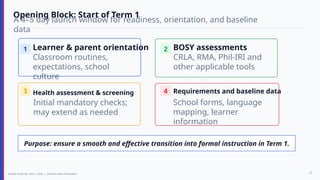
Opening Block: Startof Term 1
A 4–5 day launch window for readiness, orientation, and baseline
data
1 Learner & parent orientation
Classroom routines,
expectations, school
culture
2 BOSY assessments
CRLA, RMA, Phil-IRI and
other applicable tools
3 Health assessment & screening
Initial mandatory checks;
may extend as needed
4 Requirements and baseline data
School forms, language
mapping, learner
information
Purpose: ensure a smooth and effective transition into formal instruction in Term 1.
DepEd Order No. 009, s. 2026 | Division-wide Orientation 12
13.
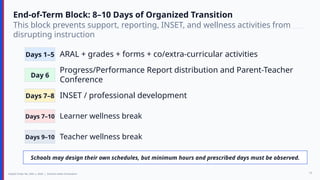
End-of-Term Block: 8–10Days of Organized Transition
This block prevents support, reporting, INSET, and wellness activities from
disrupting instruction
Days 1–5 ARAL + grades + forms + co/extra-curricular activities
Day 6
Progress/Performance Report distribution and Parent-Teacher
Conference
Days 7–8 INSET / professional development
Days 7–10 Learner wellness break
Days 9–10 Teacher wellness break
Schools may design their own schedules, but minimum hours and prescribed days must be observed.
DepEd Order No. 009, s. 2026 | Division-wide Orientation 13
14.
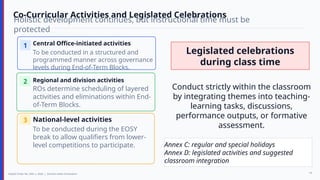
Co-Curricular Activities andLegislated Celebrations
Holistic development continues, but instructional time must be
protected
1 Central Office-initiated activities
To be conducted in a structured and
programmed manner across governance
levels during End-of-Term Blocks.
2 Regional and division activities
ROs determine scheduling of layered
activities and eliminations within End-
of-Term Blocks.
3 National-level activities
To be conducted during the EOSY
break to allow qualifiers from lower-
level competitions to participate.
Legislated celebrations
during class time
Conduct strictly within the classroom
by integrating themes into teaching-
learning tasks, discussions,
performance outputs, or formative
assessment.
Annex C: regular and special holidays
Annex D: legislated activities and suggested
classroom integration
DepEd Order No. 009, s. 2026 | Division-wide Orientation 14
15.
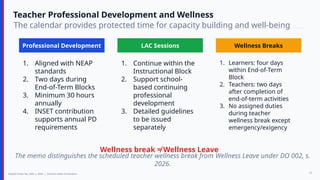
Teacher Professional Developmentand Wellness
The calendar provides protected time for capacity building and well-being
Professional Development
1. Aligned with NEAP
standards
2. Two days during
End-of-Term Blocks
3. Minimum 30 hours
annually
4. INSET contribution
supports annual PD
requirements
LAC Sessions
1. Continue within the
Instructional Block
2. Support school-
based continuing
professional
development
3. Detailed guidelines
to be issued
separately
Wellness Breaks
1. Learners: four days
within End-of-Term
Block
2. Teachers: two days
after completion of
end-of-term activities
3. No assigned duties
during teacher
wellness break except
emergency/exigency
Wellness break ≠ Wellness Leave
The memo distinguishes the scheduled teacher wellness break from Wellness Leave under DO 002, s.
2026.
DepEd Order No. 009, s. 2026 | Division-wide Orientation 15
16.
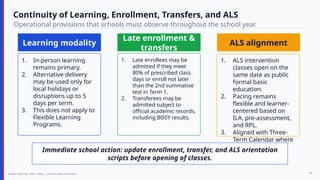
Continuity of Learning,Enrollment, Transfers, and ALS
Operational provisions that schools must observe throughout the school year
Learning modality
1. In-person learning
remains primary.
2. Alternative delivery
may be used only for
local holidays or
disruptions up to 5
days per term.
3. This does not apply to
Flexible Learning
Programs.
Late enrollment &
transfers
1. Late enrollees may be
admitted if they meet
80% of prescribed class
days or enroll not later
than the 2nd summative
test in Term 1.
2. Transferees may be
admitted subject to
official academic records,
including BOSY results.
ALS alignment
1. ALS intervention
classes open on the
same date as public
formal basic
education.
2. Pacing remains
flexible and learner-
centered based on
ILA, pre-assessment,
and RPL.
3. Aligned with Three-
Term Calendar where
applicable.
Immediate school action: update enrollment, transfer, and ALS orientation
scripts before opening of classes.
DepEd Order No. 009, s. 2026 | Division-wide Orientation 16
17.
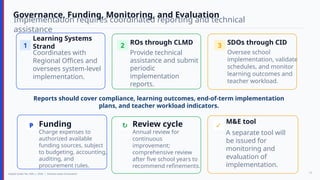
Governance, Funding, Monitoring,and Evaluation
Implementation requires coordinated reporting and technical
assistance
1
Learning Systems
Strand
Coordinates with
Regional Offices and
oversees system-level
implementation.
2 ROs through CLMD
Provide technical
assistance and submit
periodic
implementation
reports.
3 SDOs through CID
Oversee school
implementation, validate
schedules, and monitor
learning outcomes and
teacher workload.
Reports should cover compliance, learning outcomes, end-of-term implementation
plans, and teacher workload indicators.
₱ Funding
Charge expenses to
authorized available
funding sources, subject
to budgeting, accounting,
auditing, and
procurement rules.
↻ Review cycle
Annual review for
continuous
improvement;
comprehensive review
after five school years to
recommend refinements.
✓
M&E tool
A separate tool will
be issued for
monitoring and
evaluation of
implementation.
DepEd Order No. 009, s. 2026 | Division-wide Orientation 17
18.
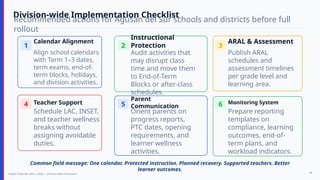
Division-wide Implementation Checklist
Recommendedactions for Agusan del Sur schools and districts before full
rollout
1
Calendar Alignment
Align school calendars
with Term 1–3 dates,
term exams, end-of-
term blocks, holidays,
and division activities.
2
Instructional
Protection
Audit activities that
may disrupt class
time and move them
to End-of-Term
Blocks or after-class
schedules.
3
ARAL & Assessment
Publish ARAL
schedules and
assessment timelines
per grade level and
learning area.
4 Teacher Support
Schedule LAC, INSET,
and teacher wellness
breaks without
assigning avoidable
duties.
5
Parent
Communication
Orient parents on
progress reports,
PTC dates, opening
requirements, and
learner wellness
activities.
6 Monitoring System
Prepare reporting
templates on
compliance, learning
outcomes, end-of-
term plans, and
workload indicators.
Common field message: One calendar. Protected instruction. Planned recovery. Supported teachers. Better
learner outcomes.
DepEd Order No. 009, s. 2026 | Division-wide Orientation 18
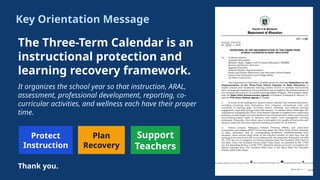
19.
Key Orientation Message
TheThree-Term Calendar is an
instructional protection and
learning recovery framework.
It organizes the school year so that instruction, ARAL,
assessment, professional development, reporting, co-
curricular activities, and wellness each have their proper
time.
Protect
Instruction
Plan
Recovery
Support
Teachers
Thank you.
Editor's Notes
#1 Open with the purpose of the orientation: common understanding of DepEd Order No. 009, s. 2026 and coordinated division-wide implementation.
#2 Use this as the session flow. Emphasize that this orientation is both policy clarification and implementation planning.
#3 The memo explains that quarter breaks and short cycles fragmented continuity and added non-teaching work. The three-term calendar is intended to provide longer instructional periods and planned end-of-term work windows.
#4 Clarify that this is mandatory for public schools and CLCs. Private and other schools may adopt, but class days and legal requirements cannot be reduced.
#5 Emphasize that the calendar is not simply a date shift; it is an operating framework that separates instruction, support activities, assessment reporting, professional development, and wellness.
#6 Mention that adjustments may be made by subsequent DepEd issuances due to unforeseen circumstances.
#7 Use this table as the master overview. Note that September has class days from Term 1 and Term 2.
#8 Point out the shift from activity-heavy calendars to protected teaching blocks. Emphasize that learner support services should be scheduled outside class hours when possible.
#9 ARAL is both during instruction weeks and in end-of-term blocks. The message for schools is to plan it explicitly rather than add it informally.
#10 The memo gives a BOW link and clarifies that the BOW uses recommended weeks. It is a guide for teacher lesson planning, not a rigid schedule to be imposed uniformly.
#11 Clarify the relationship among regular formative assessment, teacher-developed summative assessments, term examination, and reporting.
#12 Annex A provides sample lists of activities for the opening block by key stage. Schools may adapt based on context and resources.
#13 Explain that end-of-term work is not a break from school operations. It is a structured block for recovery, reporting, professional learning, and well-being.
#14 Emphasize that celebrations are not prohibited. They are integrated and scheduled in a way that protects instruction.
#15 Clarify that teacher wellness breaks are protected after timely completion of term-end activities. They should not be filled with regular administrative or extracurricular assignments.
#16 This slide is useful for school heads and registrars. It also helps clarify that in-person learning remains the rule, with limited exceptions.
#17 Stress the division role: technical assistance, calendar validation, school monitoring, and preparation of implementation reports.
#18 Use this as the action planning slide. Invite districts to translate the policy into concrete schedules and monitoring routines.
#19 Close by inviting clarifying questions on school calendar alignment, ARAL scheduling, assessment timelines, and teacher wellness/INSET schedules.

 Most read
 Most read
 Most read