Comprehensive Guide to Cyber Attacks on Networks and Prevention Techniques
Explore types of cyber attacks, real-world examples, causes, and both basic and advanced prevention methods to safeguard networks and data effectively.
INTRODUCTION:
Cyber attacks areattempts
by hackers to damage or steal information from
computers or networks.
Today, almost everything runs on networks — banks,
schools, and businesses — so keeping them safe is
very important.
Our topic explains how attacks happen and how we
can prevent them.
4.
What is aNetwork?
A network connects computers and devices so they
can share data.
Examples: Internet, Wi-Fi, LAN (Local Area Network).
Hackers target weak or unprotected networks to steal
data.
5.
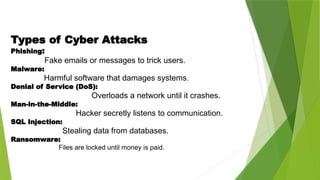
Types of CyberAttacks
Phishing:
Fake emails or messages to trick users.
Malware:
Harmful software that damages systems.
Denial of Service (DoS):
Overloads a network until it crashes.
Man-in-the-Middle:
Hacker secretly listens to communication.
SQL Injection:
Stealing data from databases.
Ransomware:
Files are locked until money is paid.
6.
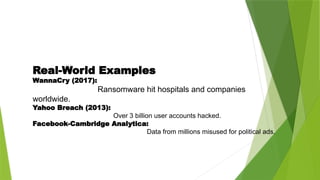
Real-World Examples
WannaCry (2017):
Ransomwarehit hospitals and companies
worldwide.
Yahoo Breach (2013):
Over 3 billion user accounts hacked.
Facebook-Cambridge Analytica:
Data from millions misused for political ads.
7.
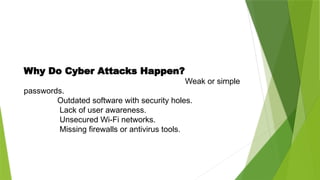
Why Do CyberAttacks Happen?
Weak or simple
passwords.
Outdated software with security holes.
Lack of user awareness.
Unsecured Wi-Fi networks.
Missing firewalls or antivirus tools.
8.
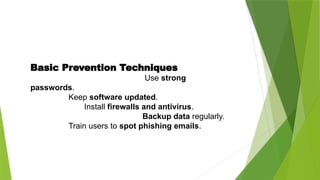
Basic Prevention Techniques
Usestrong
passwords.
Keep software updated.
Install firewalls and antivirus.
Backup data regularly.
Train users to spot phishing emails.
9.
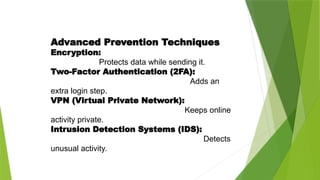
Advanced Prevention Techniques
Encryption:
Protectsdata while sending it.
Two-Factor Authentication (2FA):
Adds an
extra login step.
VPN (Virtual Private Network):
Keeps online
activity private.
Intrusion Detection Systems (IDS):
Detects
unusual activity.
10.
Benefits of CyberSecurity
Keeps personal and
company data safe.
Builds trust with users.
Saves time, money, and reputation.
11.
Conclusion
Cyber attacks areincreasing every
day.
Prevention is better than fixing the
damage.
Safe habits and modern tools can
protect our networks.