Comprehensive Guide to Curriculum Implementation and Evaluation in Education
Explore key aspects of curriculum implementation including teaching strategies, assessment, management, curriculum workers' roles, challenges, models for change, and evaluation types to enhance educational outcomes.
Curriculum Implementation
1.1Teaching Strategies and Resources
1.2 Assessment and Evaluation
1.3 Classroom Management and
Organization
3.
Curriculum Implementation
Curriculumimplementation, from the term itself, focuses on the actual
implementation of the curriculum from the national level to the local
school context, i.e., describes the dynamics of how various curriculum
workers strive to do their functions in order to attain educational
goals, programs, and policies set by the country, region, division, district,
and down to the local school level.
Each of these levels has special functions to do. Ideally, the
implementation of the curriculum is influenced by the educational goals
set by the government or schools. However, the process of curriculum
implementation is also guided by an educational or curriculum
philosophy.
In practice, curriculum implementation is highly influenced by different
curriculum workers, people influence the process. Consequently, not all
curricula are perfectly implemented as planned. In the process of
curriculum implementation there are always problems encountered.
4.
Levels of CurriculumImplementation
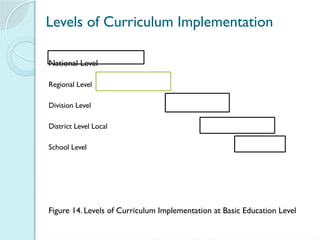
National Level
Regional Level
Division Level
District Level Local
School Level
Figure 14. Levels of Curriculum Implementation at Basic Education Level
5.
Curriculum Workers
Teachers- the most visible among the curriculum
workers.Their roles as implementers of the curriculum
are very crucial. It is through their expertise, creativity,
and commitment that any curriculum success is
attributed. Teachers develop lesson plans, unit plans,
yearly plans, and syllabi for each subject they teach.
They prepare instructional materials, select methods
and strategies, and assess students' progress. Every day,
teachers are given teaching loads to teach different
subjects. Their educational background, educational
philosophy, teaching styles, and personality affect the
implementation of the curriculum.
6.
Curriculum Workers
Principals- the chief academic and administrative officer
of the school. They provide curricular and instructional
leadership and supervision to the teachers and other
school personnel in the local school context. It is they
who lead teachers in planning different school activities
and make sure that all educational goals set by the
Department of Education are met. Principals check the
lesson plans developed by each teacher, prepare the
school calendar, supervise instruction, and prepare school
report. Principals also work with parents and community
leaders and win their support to any school activities and
projects.
7.
Curriculum Consultants- individuals with a
rich experience on doing curriculum projects
related to curriculum planning, curriculum
development, and curriculum evaluation.
District Supervisors -responsible for
supervising the implementation of the
curriculum in the district level.They help public
school principals in ensuring that the programs
of the Department of Education are
implemented in their respective schools.They
also implement policies and programs of the
Department of Education in private schools.
8.
Education Supervisors- assigned to specific
subject areas in basic education.They help the
district office of the Department of Education
in supervising the implementation of projects
and programs specific for each subject area.
Division Superintendents - the chief academic
officer of each division.They supervise the
implementation of the DepEd curriculum,
programs, and projects in the division level
for both public and private schools. Usually,
each province or a city is considered a
division for DepEd.
9.
Regional Directors- manage the programs
and projects of the Department of
Education in the regional level.
Education Program Specialists - work at the
national level or at the central offices of the
Commission on Higher Education and the
Department of Education.They assist the
two government agencies in the
development of curriculum policies that will
help teachers and other curriculum leaders
in the implementation of the curriculum.
10.
Technical Panelsand Technical Committees
- professors and individual experts from
different disciplines and fields that assist the
Commission on Higher Education in
developing curriculum, formulating
curriculum policies, and evaluating the
compliance of higher education institutions
to CHED program standards.
11.
Issues inCurriculum Implementation
Quality and quantity of teaching staff
Professional development of teachers
Lack of school facilities
Lack of learning resources
Time management
Limited funding
12.
Educational Strategyfor Implementing
Curriculum
The following are the most important aspects to
require of teams that are in charge of curriculum
implementation:
Clear Goals – Clearly define what is expected of
every team members.
Resource Management – Do the resources available
match the curriculum goals?
Professional Development – Does the plan leave and
address professional development of those involved
with the curriculum?
Community – Does the plan implement the
community, parents, and other stakeholders in the
educational process?
13.
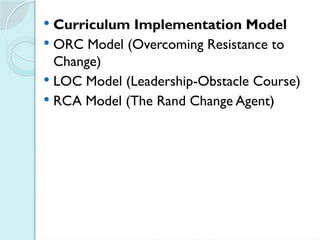
Curriculum ImplementationModel
ORC Model (Overcoming Resistance to
Change)
LOC Model (Leadership-Obstacle Course)
RCA Model (The Rand Change Agent)
14.
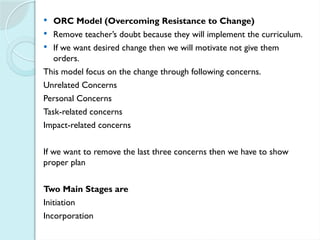
ORC Model(Overcoming Resistance to Change)
Remove teacher’s doubt because they will implement the curriculum.
If we want desired change then we will motivate not give them
orders.
This model focus on the change through following concerns.
Unrelated Concerns
Personal Concerns
Task-related concerns
Impact-related concerns
If we want to remove the last three concerns then we have to show
proper plan
Two Main Stages are
Initiation
Incorporation
15.
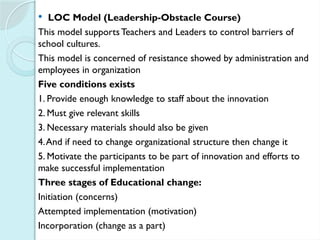
LOC Model(Leadership-Obstacle Course)
This model supportsTeachers and Leaders to control barriers of
school cultures.
This model is concerned of resistance showed by administration and
employees in organization
Five conditions exists
1. Provide enough knowledge to staff about the innovation
2. Must give relevant skills
3. Necessary materials should also be given
4.And if need to change organizational structure then change it
5. Motivate the participants to be part of innovation and efforts to
make successful implementation
Three stages of Educational change:
Initiation (concerns)
Attempted implementation (motivation)
Incorporation (change as a part)
16.
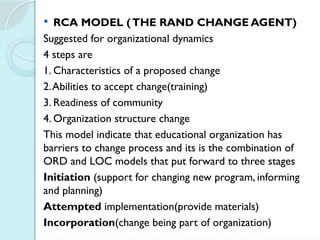
RCA MODEL(THE RAND CHANGE AGENT)
Suggested for organizational dynamics
4 steps are
1. Characteristics of a proposed change
2.Abilities to accept change(training)
3. Readiness of community
4. Organization structure change
This model indicate that educational organization has
barriers to change process and its is the combination of
ORD and LOC models that put forward to three stages
Initiation (support for changing new program, informing
and planning)
Attempted implementation(provide materials)
Incorporation(change being part of organization)
17.
CURRICULUM ASSESSMENT
Curriculumassessment is a process of collecting
information for use in evaluation.
- Highlights curriculum expectations
- Gather information about what students know and can
do
- Motivate students to learn better
- Motivate and encourage Teachers to meet the identified
needs of students
- Provide evidence to tell how well the students have
learned
- Obtain feedback that helps teachers, students, and
parents make good decisions to guide instruction
18.
CURRICULUM EVALUATION
It provides a means of obtaining information that can be
used to improve a course.
It provides a basis for descisions about curriculum
adoption and effective use.
To determine the value of the curriculum itself. Is the
curriculum appropriate for the particular group of
students with whom it is being used? Are the
instructional methods selected, the best choices in the
light of the objectives sought? Is the content the best
that could be selected? Are the materials recommended
for the instructional purpose appropriate and the best
available for the envisaged?
19.
TYPES OFCURRICULUM EVALUATION
According to Scriven, following are the three main types:
FORMATIVE EVALUATION – It occurs during the course
of curriculum development. Its purpose is to contribute to the
improvement of the educational programme.The merits of a
programme are evaluated during the process of its
development.The evaluation results provide information to the
programme developers and enable them to correct flaws
detected in the program.
SUMMATIVE EVALUATION – The final effects of a
curriculum are evaluated on the basis of its stated objectives. It
takes place after the curriculum has been fully developed and
put into operations.
DIAGNOSTIC EVALUATION – Is directed towards two
purposes either for placement of students properly at the
outset of an instructional level (such as secondary school) or to
discover the underlying cause of deviancies in student learning
in any field of study.