Introduction
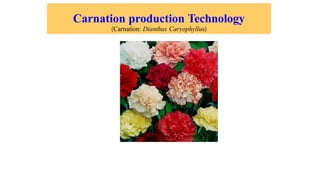
• Carnation (DianthusCaryophyllus) also known as Pink belongs to a large family called
Caryophyllaceae, is a native of Southern Europe is considered as the parent of all carnation.
• National flower of Spain.
• There are over 300 species of Carnations, and hundreds more of hybrid varieties. Though each
hybrid comes in a different color, white, pink and red are the most common ones.
• This flower is an excellent and one of the most important commercial cut flower. In
Nepal, it ranks the third most important cut flower.
• Carnation can be successfully grown in mild temperature (not more than 30oc). It has been
accepted as an important competitive product for export in the international market.
• Carnations come as annual, biennial and perennial varieties. Carnations are one of the flowers
with the longest vase life, lasting up to 2-3 weeks.
• Carnations are excellent for cut flowers, bedding, pots, borders, edging and rock gardens due to
its excellent keeping quality, wide range of forms, ability to withstand long distance
transportation and remarkably ability to rehydrate after continuous shipping.
• It ranks third most important cut flower after gladiolus and rose.
3.
Cultivars
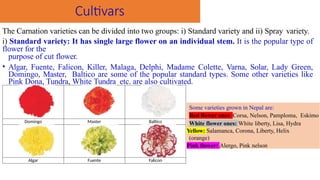
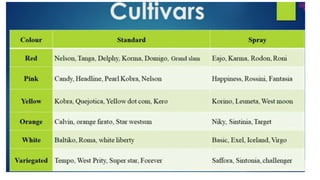
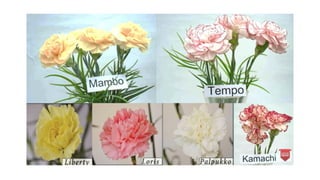
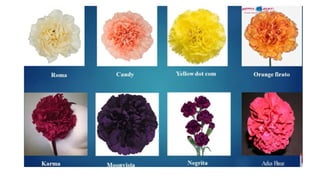
The Carnation varietiescan be divided into two groups: i) Standard variety and ii) Spray variety.
i) Standard variety: It has single large flower on an individual stem. It is the popular type of
flower for the
purpose of cut flower.
• Algar, Fuente, Falicon, Killer, Malaga, Delphi, Madame Colette, Varna, Solar, Lady Green,
Domingo, Master, Baltico are some of the popular standard types. Some other varieties like
Pink Dona, Tundra, White Tundra etc. are also cultivated.
Domingo Master Baltico
Algar Fuente Falicon
Some varieties grown in Nepal are:
Red flower ones: Corsa, Nelson, Pamploma, Eskimo
White flower ones: White liberty, Lisa, Hydra
Yellow: Salamanca, Corona, Liberty, Helix
(orange)
Pink flower: Alergo, Pink nelson
4.
Cultivars
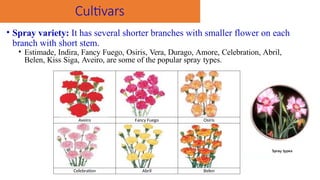
• Spray variety:It has several shorter branches with smaller flower on each
branch with short stem.
• Estimade, Indira, Fancy Fuego, Osiris, Vera, Durago, Amore, Celebration, Abril,
Belen, Kiss Siga, Aveiro, are some of the popular spray types.
Aveiro Fancy Fuego Osiris
Celebration Abril Belen
5.
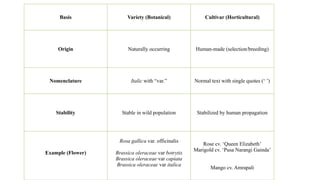
Basis Variety (Botanical)Cultivar (Horticultural)
Origin Naturally occurring Human-made (selection/breeding)
Nomenclature Italic with “var.” Normal text with single quotes (‘ ’)
Stability Stable in wild population Stabilized by human propagation
Example (Flower)
Rosa gallica var. officinalis
Brassica oleraceae var botrytis
Brassica oleraceae var capiata
Brassica oleraceae var italica
Rose cv. ‘Queen Elizabeth’
Marigold cv. ‘Pusa Narangi Gainda’
Mango cv. Amrapali
9.
• Carnation canbe successfully grown in any type of soil but the soil should be well drained
and be in good physical condition as it is highly susceptible to fusarium wilt.
• Soil must be worked up to 40 cm as carnation roots go as deep as 25 to 30 cm.
• So, well drained and red loamy soil with the pH of 5.5-6.5 is most suitable.
• Temperature should be within the range of 25°C- 27°C. The difference between day and night
temperature should be big enough and the night temperature low enough to grow carnations of
best quality.
• Higher day and night temperature specially during flowering results in abnormal flower
opening and calyx splitting, ideal day and night temperature is given below:
Growing condition:
• Day temperature 20-25°C, and
• Night temperature 10-15°C.
• Critical photoperiod 13 hours
• RH 50-60%.
• The carnation is a facultative long day plant, which means that they form the flowers faster
during long days than in short days. Carnation requires high levels of light to produce high
quality flowers.
Climate and Soil
10.
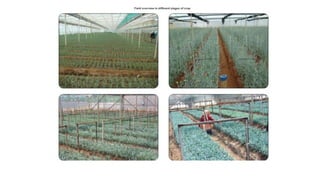
Growing structures
Most ofthe perpetual carnations are commercially grown
under protection.
• These require sufficient light and proper ventilation.
Therefore, the design and orientation of the greenhouse are
of great importance.
• The greenhouse should have the ridge, true north and south,
the plants being grown in beds running in the same direction
and ensure adequate air movement.
• Poly greenhouse fitted with fan and pad system can bring
down the temperature by 8-10 degree Centigrade.
• However, top ridge and side ventilation also give good fresh
air exchange and lower the temperature. Shed house height
5 to 6.5 meter.
• Polythene thickness: 200 microns
• Distance between two adjoining poly houses should be
minimum 4 meter.
• Sufficient ventilation space is required on top and sides
11.
Land preparation
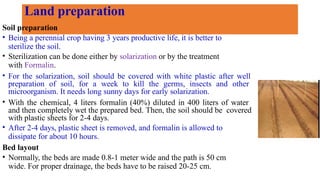
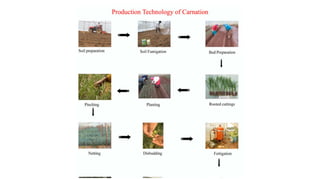
Soil preparation
•Being a perennial crop having 3 years productive life, it is better to
sterilize the soil.
• Sterilization can be done either by solarization or by the treatment
with Formalin.
• For the solarization, soil should be covered with white plastic after well
preparation of soil, for a week to kill the germs, insects and other
microorganism. It needs long sunny days for early solarization.
• With the chemical, 4 liters formalin (40%) diluted in 400 liters of water
and then completely wet the prepared bed. Then, the soil should be covered
with plastic sheets for 2-4 days.
• After 2-4 days, plastic sheet is removed, and formalin is allowed to
dissipate for about 10 hours.
Bed layout
• Normally, the beds are made 0.8-1 meter wide and the path is 50 cm
wide. For proper drainage, the beds have to be raised 20-25 cm.
12.
Propagation
Propagation by seeds:Annual carnation
• Seeds can be sown at a space of 30cm from one another.
Apply soil manure mix over the seed and apply mist spray
occasionally to keep it moist. The seeds will germinate in 2 to
3 weeks.
Seed Rate: 400 to 500 gm/ha.
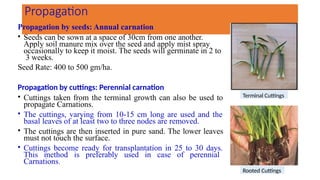
Propagation by cuttings: Perennial carnation
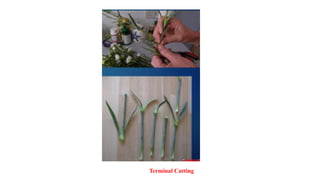
• Cuttings taken from the terminal growth can also be used to
propagate Carnations.
• The cuttings, varying from 10-15 cm long are used and the
basal leaves of at least two to three nodes are removed.
• The cuttings are then inserted in pure sand. The lower leaves
must not touch the surface.
• Cuttings become ready for transplantation in 25 to 30 days.
This method is preferably used in case of perennial
Carnations.
Terminal Cuttings
Rooted Cuttings
Planting
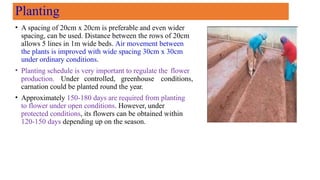
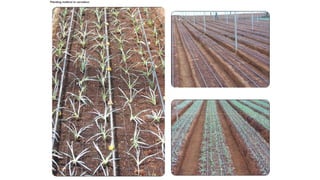
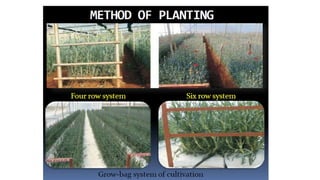
• A spacingof 20cm x 20cm is preferable and even wider
spacing, can be used. Distance between the rows of 20cm
allows 5 lines in 1m wide beds. Air movement between
the plants is improved with wide spacing 30cm x 30cm
under ordinary conditions.
• Planting schedule is very important to regulate the flower
production. Under controlled, greenhouse conditions,
carnation could be planted round the year.
• Approximately 150-180 days are required from planting
to flower under open conditions. However, under
protected conditions, its flowers can be obtained within
120-150 days depending up on the season.
17.
Irrigation
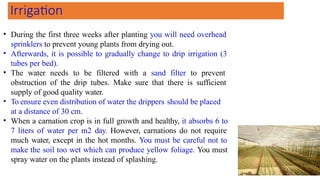
• During thefirst three weeks after planting you will need overhead
sprinklers to prevent young plants from drying out.
• Afterwards, it is possible to gradually change to drip irrigation (3
tubes per bed).
• The water needs to be filtered with a sand filter to prevent
obstruction of the drip tubes. Make sure that there is sufficient
supply of good quality water.
• To ensure even distribution of water the drippers should be placed
at a distance of 30 cm.
• When a carnation crop is in full growth and healthy, it absorbs 6 to
7 liters of water per m2 day. However, carnations do not require
much water, except in the hot months. You must be careful not to
make the soil too wet which can produce yellow foliage. You must
spray water on the plants instead of splashing.
18.
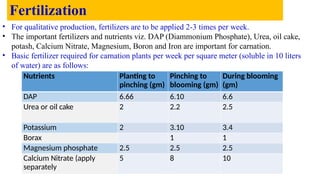
Fertilization
Nutrients Planting to
pinching(gm)
Pinching to
blooming (gm)
During blooming
(gm)
DAP 6.66 6.10 6.6
Urea or oil cake 2 2.2 2.5
Potassium 2 3.10 3.4
Borax 1 1
Magnesium phosphate 2.5 2.5 2.5
Calcium Nitrate (apply
separately
5 8 10
• For qualitative production, fertilizers are to be applied 2-3 times per week.
• The important fertilizers and nutrients viz. DAP (Diammonium Phosphate), Urea, oil cake,
potash, Calcium Nitrate, Magnesium, Boron and Iron are important for carnation.
• Basic fertilizer required for carnation plants per week per square meter (soluble in 10 liters
of water) are as follows:
19.
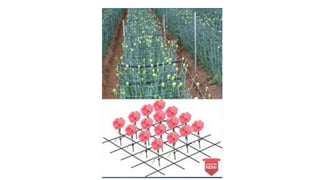
Netting and supportmaterial
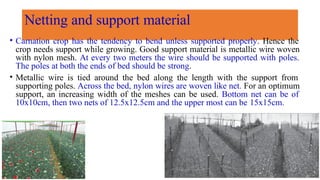
• Carnation crop has the tendency to bend unless supported properly. Hence the
crop needs support while growing. Good support material is metallic wire woven
with nylon mesh. At every two meters the wire should be supported with poles.
The poles at both the ends of bed should be strong.
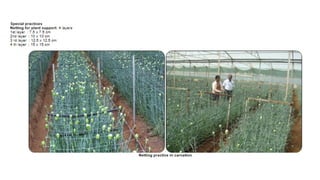
• Metallic wire is tied around the bed along the length with the support from
supporting poles. Across the bed, nylon wires are woven like net. For an optimum
support, an increasing width of the meshes can be used. Bottom net can be of
10x10cm, then two nets of 12.5x12.5cm and the upper most can be 15x15cm.
23.
Pinching
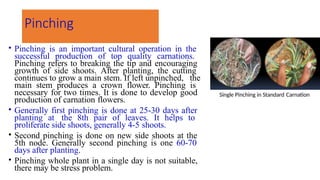
• Pinching isan important cultural operation in the
successful production of top quality carnations.
Pinching refers to breaking the tip and encouraging
growth of side shoots. After planting, the cutting
continues to grow a main stem. If left unpinched, the
main stem produces a crown flower. Pinching is
necessary for two times. It is done to develop good
production of carnation flowers.
• Generally first pinching is done at 25-30 days after
planting at the 8th pair of leaves. It helps to
proliferate side shoots, generally 4-5 shoots.
• Second pinching is done on new side shoots at the
5th node. Generally second pinching is one 60-70
days after planting.
• Pinching whole plant in a single day is not suitable,
there may be stress problem.
Single Pinching in Standard Carnation
24.
Disbudding
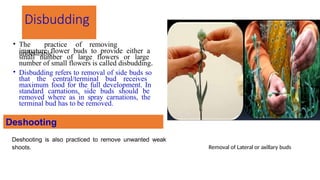
• The practiceof removing
undesirable
immature flower buds to provide either a
small number of large flowers or large
number of small flowers is called disbudding.
Removal of Lateral or axillary buds
• Disbudding refers to removal of side buds so
that the central/terminal bud receives
maximum food for the full development. In
standard carnations, side buds should be
removed where as in spray carnations, the
terminal bud has to be removed.
Deshooting
Deshooting is also practiced to remove unwanted weak
shoots.
25.
Supplementary lighting
• Itis very effective for increasing stem length, flower size and early
flower production
• should be given with l00 W incandescent bulbs hung at 1.5 m above
beds at 1m spacing during November-January from dusk to dawn
when light intensities are poor.
28.
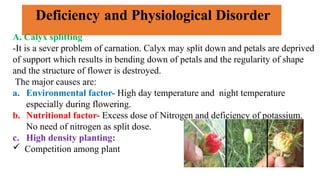
Deficiency and PhysiologicalDisorder
A. Calyx splitting
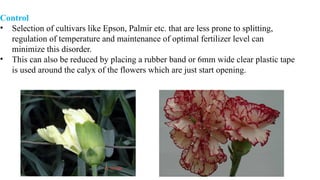
-It is a sever problem of carnation. Calyx may split down and petals are deprived
of support which results in bending down of petals and the regularity of shape
and the structure of flower is destroyed.
The major causes are:
a. Environmental factor- High day temperature and night temperature
especially during flowering.
b. Nutritional factor- Excess dose of Nitrogen and deficiency of potassium.
No need of nitrogen as split dose.
c. High density planting:
Competition among plant
29.
Control
• Selection ofcultivars like Epson, Palmir etc. that are less prone to splitting,
regulation of temperature and maintenance of optimal fertilizer level can
minimize this disorder.
• This can also be reduced by placing a rubber band or 6mm wide clear plastic tape
is used around the calyx of the flowers which are just start opening.
30.
B. Grassiness:
Absence offlower production
Genetically disorder in nature.
Nature vary from cultivar to cultivar.
Removal and destruction of all such plants is recommended.
C. Curly tip
This disorder affects the growing tips which curl and become distorted.
Tips of the young shoots fail to separate and continuation of growth results in a
characteristic curvature.
Poor light and other adverse conditions are thought to be the causes of the
disorder.
Water stress and potassium deficiency are suspected causes for a physiological
curly tip and die-back of carnation flowers
31.
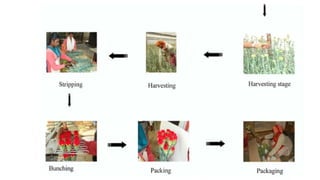
Harvesting
• Flower startsafter 4 months of planting
and continues up to one and half years.
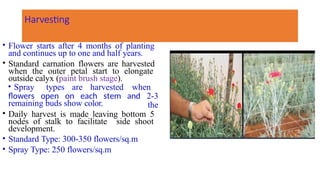
• Standard carnation flowers are harvested
when the outer petal start to elongate
outside calyx (paint brush stage).
flowers open on each stem and
• Spray types are harvested when
2-3
the
remaining buds show color.
• Daily harvest is made leaving bottom 5
nodes of stalk to facilitate side shoot
development.
• Standard Type: 300-350 flowers/sq.m
• Spray Type: 250 flowers/sq.m
33.
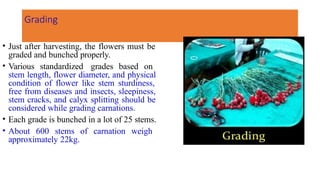
Grading
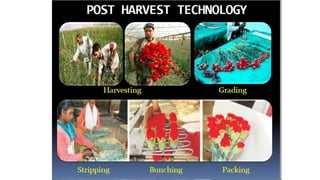
• Just afterharvesting, the flowers must be
graded and bunched properly.
• Various standardized grades based on
stem length, flower diameter, and physical
condition of flower like stem sturdiness,
free from diseases and insects, sleepiness,
stem cracks, and calyx splitting should be
considered while grading carnations.
• Each grade is bunched in a lot of 25 stems.
• About 600 stems of carnation weigh
approximately 22kg.
34.
Post harvest treatment
•Afterharvest, the flower stems have to be trimmed at the base and should
be immediately placed for 2-4 hours in a bucket of preservative solution of
warm and deionized water.
•A good preservative solution for carnations should be acidic (pH 4.5) with 2-
5% sucrose and a biocide not phytotoxic to carnations.
•The flowers can be stored for two to four weeks for marketing if packed
properly with good ventilation and conserving moisture.
35.
Packaging and transportation
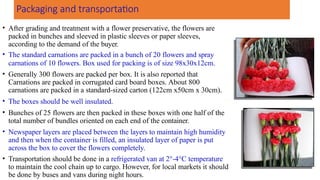
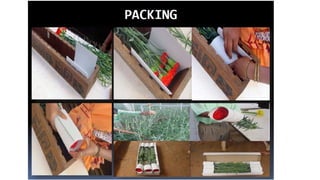
•After grading and treatment with a flower preservative, the flowers are
packed in bunches and sleeved in plastic sleeves or paper sleeves,
according to the demand of the buyer.
• The standard carnations are packed in a bunch of 20 flowers and spray
carnations of 10 flowers. Box used for packing is of size 98x30x12cm.
• Generally 300 flowers are packed per box. It is also reported that
Carnations are packed in corrugated card board boxes. About 800
carnations are packed in a standard-sized carton (122cm x50cm x 30cm).
• The boxes should be well insulated.
• Bunches of 25 flowers are then packed in these boxes with one half of the
total number of bundles oriented on each end of the container.
• Newspaper layers are placed between the layers to maintain high humidity
and then when the container is filled, an insulated layer of paper is put
across the box to cover the flowers completely.
• Transportation should be done in a refrigerated van at 2°-4°C temperature
to maintain the cool chain up to cargo. However, for local markets it should
be done by buses and vans during night hours.
37.
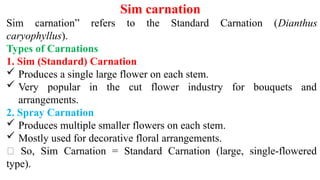
Sim carnation
Sim carnation”refers to the Standard Carnation (Dianthus
caryophyllus).
Types of Carnations
1. Sim (Standard) Carnation
Produces a single large flower on each stem.
Very popular in the cut flower industry for bouquets and
arrangements.
2. Spray Carnation
Produces multiple smaller flowers on each stem.
Mostly used for decorative floral arrangements.
✅ So, Sim Carnation = Standard Carnation (large, single-flowered
type).
38.
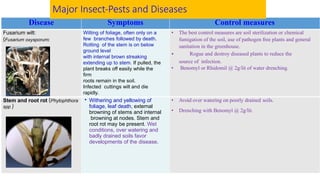
Disease Symptoms Controlmeasures
Fusarium wilt:
(Fusarium oxysporum)
Wilting of foliage, often only on a
few branches followed by death.
Rotting of the stem is on below
ground level
with internal brown streaking
extending up to stem. If pulled, the
plant breaks off easily while the
firm
roots remain in the soil.
Infected cuttings wilt and die
rapidly.
• The best control measures are soil sterilization or chemical
fumigation of the soil, use of pathogen free plants and general
sanitation in the greenhouse.
• Rogue and destroy diseased plants to reduce the
source of infection.
• Benomyl or Rhidomil @ 2g/lit of water drenching.
Stem and root rot (Phytophthora
spp )
• Withering and yellowing of
foliage, leaf death, external
browning of stems and internal
browning at nodes. Stem and
root rot may be present. Wet
conditions, over watering and
badly drained soils favor
developments of the disease.
• Avoid over watering on poorly drained soils.
• Drenching with Benomyl @ 2g/lit.
Major Insect-Pests and Diseases
39.
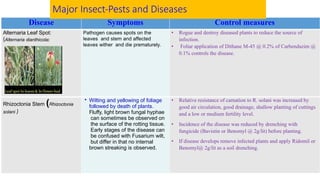
Disease Symptoms Controlmeasures
Alternaria Leaf Spot:
(Alternaria dianthicola)
Pathogen causes spots on the
leaves and stem and affected
leaves wither and die prematurely.
• Rogue and destroy diseased plants to reduce the source of
infection.
• Foliar application of Dithane M-45 @ 0.2% of Carbendazim @
0.1% controls the disease.
Rhizoctonia Stem (Rhizoctonia
solani )
• Wilting and yellowing of foliage
followed by death of plants.
Fluffy, light brown fungal hyphae
can sometimes be observed on
the surface of the rotting tissue.
Early stages of the disease can
be confused with Fusarium wilt,
but differ in that no internal
brown streaking is observed.
• Relative resistance of carnation to R. solani was increased by
good air circulation, good drainage, shallow planting of cuttings
and a low or medium fertility level.
• Incidence of the disease was reduced by drenching with
fungicide (Bavistin or Benomyl @ 2g/lit) before planting.
• If disease develops remove infected plants and apply Ridomil or
Benomyl@ 2g/lit as a soil drenching.
Major Insect-Pests and Diseases
40.
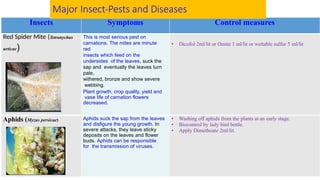
Insects Symptoms Controlmeasures
Red Spider Mite (Tetranychus
urticae)
This is most serious pest on
carnations. The mites are minute
red
insects which feed on the
undersides of the leaves, suck the
sap and eventually the leaves turn
pale,
withered, bronze and show severe
webbing.
Plant growth, crop quality, yield and
vase life of carnation flowers
decreased.
• Dicofol 2ml/lit or Omite 1 ml/lit or wettable sulfur 5 ml/lit
Aphids (Myzus persicae) Aphids suck the sap from the leaves
and disfigure the young growth. In
severe attacks, they leave sticky
deposits on the leaves and flower
buds. Aphids can be responsible
for the transmission of viruses.
• Washing off aphids from the plants at an early stage.
• Biocontrol by lady bird bettle.
• Apply Dimethoate 2ml/lit.
Major Insect-Pests and Diseases
41.
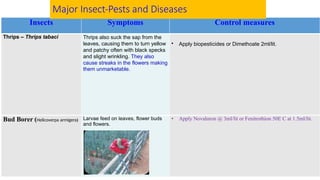
Insects Symptoms Controlmeasures
Thrips – Thrips tabaci Thrips also suck the sap from the
leaves, causing them to turn yellow
and patchy often with black specks
and slight wrinkling. They also
cause streaks in the flowers making
them unmarketable.
• Apply biopesticides or Dimethoate 2ml/lit.
Bud Borer (Helicoverpa armigera) Larvae feed on leaves, flower buds
and flowers.
• Apply Novaluron @ 3ml/lit or Fenitrothion 50E C at 1.5ml/lit.
Major Insect-Pests and Diseases
43.
References
FAN 2015. CarnationProduction Technology. Published by Floriculture
Association of Nepal, Battisputali-9, Kathmandu.
Bhandari, U. (2071). कार्नशर्ने खे ती प्रवि धी, पु ष् प
खे ती सम् ि न् धी प्रावि धधक
पु स्ततका । फलफू ल विकास नर्नर्देशर्नालयिाट
प्रकाशशत ।
https://www.theflowerexpert.com/content/growingflowers/growingflow
ers
/growing-carnations accessed on 23rd April 2018.
http://www.hillagric.ac.in/edu/coa/vegetables/lectures/VSF_233_HSc/VSF_
233_HSc_Lect_7.pdf
https://www.slideshare.net/Utpaldas2015/carnation-48741842