Unlocking of
terms
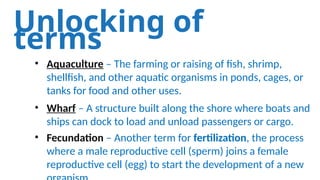
• Aquaculture– The farming or raising of fish, shrimp,
shellfish, and other aquatic organisms in ponds, cages, or
tanks for food and other uses.
• Wharf – A structure built along the shore where boats and
ships can dock to load and unload passengers or cargo.
• Fecundation – Another term for fertilization, the process
where a male reproductive cell (sperm) joins a female
reproductive cell (egg) to start the development of a new
8.
Unlocking of
terms
• Hatchery– A place where fish, shrimp, or eggs are kept
and cared for until they hatch and grow into young
animals.
• Brackish Water – Water that is a mix of fresh water and
salt water. It is usually found in estuaries, mangrove
areas, and places where rivers meet the sea.
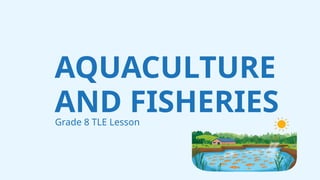
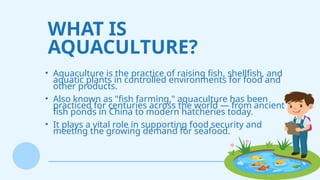
WHAT IS
AQUACULTURE?
• Aquacultureis the practice of raising fish, shellfish, and
aquatic plants in controlled environments for food and
other products.
• Also known as "fish farming," aquaculture has been
practiced for centuries across the world — from ancient
fish ponds in China to modern hatcheries today.
• It plays a vital role in supporting food security and
meeting the growing demand for seafood.
11.
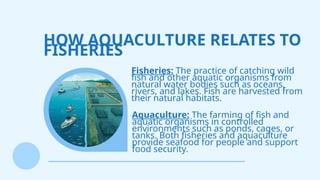
HOW AQUACULTURE RELATESTO
FISHERIES
Fisheries: The practice of catching wild
fish and other aquatic organisms from
natural water bodies such as oceans,
rivers, and lakes. Fish are harvested from
their natural habitats.
Aquaculture: The farming of fish and
aquatic organisms in controlled
environments such as ponds, cages, or
tanks. Both fisheries and aquaculture
provide seafood for people and support
food security.
12.
OVERVIEW OF AQUACULTURE
Aquacultureand Fisheries
• In the past, people didn’t give much thought to raising fish,
trusting that the oceans would always supply enough.
However, as human populations increased and illegal
fishing became more common, wild fish stocks began to
decline. This decline gave rise to fish farming, also known
as aquaculture.
13.
OVERVIEW OF AQUACULTURE
•Aquaculture has its roots in China, where historical records
show that fishing tools and techniques were already in use as
early as 2953 B.C. during the time of Fu Hi. In Ancient Rome,
fish were seen as a delicacy. While fish farming was practiced
there, it was primarily focused on providing food and did not
significantly advance aquaculture science.
14.
OVERVIEW OF AQUACULTURE
•One of the earliest adopters of artificial fish reproduction was
Jacob of Westphalia. In England, Leonard Mascall made a mark
by publishing the Book of Fishing in 1590, earning recognition
as a pioneer in fish culture. In the United States, interest in
fishponds is documented in Squire Caroll’s diary dated August
27, 1792, mentioning the cultivation of goldfish—the first
species raised in American ponds.
15.
OVERVIEW OF AQUACULTURE
•In Indonesia, the origins of fishponds are uncertain. Some
believe they were introduced from China, while others
suggest they developed through Malay influence.
Government documentation of fishponds dates back to 1821.
Meanwhile, Japan’s early aquaculture efforts focused on
seaweed and pearl oysters. Mikimoto, renowned for his
groundbreaking work with pearl oysters, earned the title
“king of pearl oyster culture.”
16.
FISH CULTURE INTHE PH
• There are no official records of when Filipinos first started
raising fish in ponds. It's believed that Malay settlers
introduced this practice before the Chinese traders arrived.
Navotas and Malabon are considered among the first towns
to develop fishponds.
• In the Visayas, Dr. Pio Valencia is acknowledged as the pioneer
in fish farming, while Talaba led the way in oyster culture.
17.
FISH CULTURE INTHE PH
• Scientific fish farming in the Philippines began with milkfish
research in 1940. By the 1960s, improved methods for milkfish
culture were used. To support the growth of the industry, the
government and international organizations created research
centers in the 1970s, such as:
• SEAFDEC Aquaculture Department – Tigbauan, Iloilo
• International Center for Living Aquatic Resources Management – Makati
• Freshwater Aquaculture Center – Central Luzon State University, Nueva Ecija
• Brackish water Aquaculture Center – University of the Philippines
18.
FISH CULTURE INTHE PH
• Common freshwater species grown include tilapia, carp,
catfish, mudfish, and gourami. In brackish water ponds,
milkfish and prawns are the main species. Marine species
farming is still being tested, and only a few types have been
successfully grown in enclosed areas so far.
19.
WHY IS AQUACULTURE
IMPORTANT?
Aquaculturehelps meet the growing global
demand for seafood and supports food
security for millions of people. It also provides
livelihoods for many farming communities.
Key fact: Aquaculture provides over 50% of the
world's seafood supply.
Aquaculture reduces pressure on wild fish
populations by providing an alternative source
of seafood. This helps protect natural fisheries
and promotes a more sustainable and
balanced marine ecosystem for future
generations.
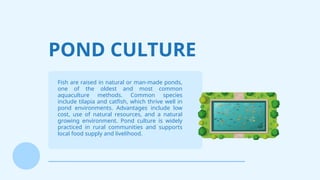
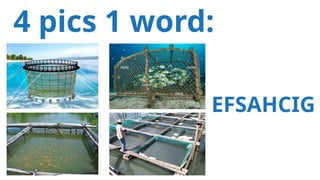
POND CULTURE
Fish areraised in natural or man-made ponds,
one of the oldest and most common
aquaculture methods. Common species
include tilapia and catfish, which thrive well in
pond environments. Advantages include low
cost, use of natural resources, and a natural
growing environment. Pond culture is widely
practiced in rural communities and supports
local food supply and livelihood.
22.
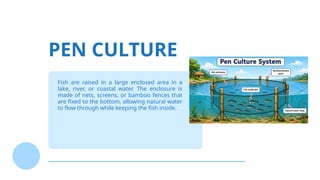
PEN CULTURE
Fish areraised in a large enclosed area in a
lake, river, or coastal water. The enclosure is
made of nets, screens, or bamboo fences that
are fixed to the bottom, allowing natural water
to flow through while keeping the fish inside.
23.
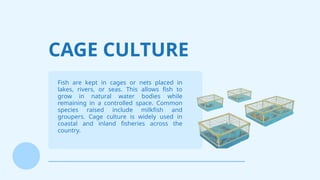
CAGE CULTURE
Fish arekept in cages or nets placed in
lakes, rivers, or seas. This allows fish to
grow in natural water bodies while
remaining in a controlled space. Common
species raised include milkfish and
groupers. Cage culture is widely used in
coastal and inland fisheries across the
country.
24.
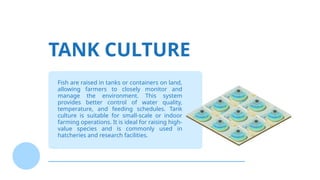
TANK CULTURE
Fish areraised in tanks or containers on land,
allowing farmers to closely monitor and
manage the environment. This system
provides better control of water quality,
temperature, and feeding schedules. Tank
culture is suitable for small-scale or indoor
farming operations. It is ideal for raising high-
value species and is commonly used in
hatcheries and research facilities.
25.
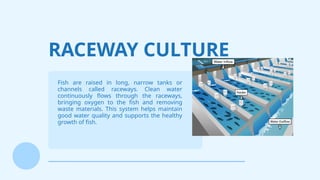
RACEWAY CULTURE
Fish areraised in long, narrow tanks or
channels called raceways. Clean water
continuously flows through the raceways,
bringing oxygen to the fish and removing
waste materials. This system helps maintain
good water quality and supports the healthy
growth of fish.
26.
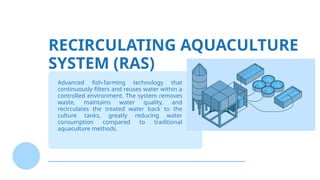
RECIRCULATING AQUACULTURE
SYSTEM (RAS)
Advancedfish-farming technology that
continuously filters and reuses water within a
controlled environment. The system removes
waste, maintains water quality, and
recirculates the treated water back to the
culture tanks, greatly reducing water
consumption compared to traditional
aquaculture methods.
27.
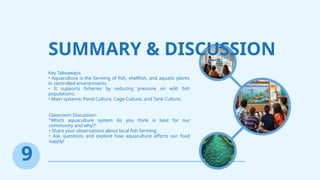
SUMMARY & DISCUSSION
KeyTakeaways:
• Aquaculture is the farming of fish, shellfish, and aquatic plants
in controlled environments.
• It supports fisheries by reducing pressure on wild fish
populations.
• Main systems: Pond Culture, Cage Culture, and Tank Culture.
9
Classroom Discussion:
"Which aquaculture system do you think is best for our
community and why?"
• Share your observations about local fish farming.
• Ask questions and explore how aquaculture affects our food
supply!
hivessel _hivessel info.hivessel@gmail.comHivessel.com
1. What is the practice of cultivating fish, shellfish,
and aquatic plants in controlled environments?
a. Fisheries
b. Aquaculture
c. Hatchery
d. Agriculture
33.
hivessel _hivessel info.hivessel@gmail.comHivessel.com
2. A wharf is best described as:
a. A breeding facility for fish eggs
b. A mix of salt and fresh water
c. A dock used for loading and unloading
d. A machine for fishing
34.
hivessel _hivessel info.hivessel@gmail.comHivessel.com
3. The process of fertilization in fish culture is
called:
a. Incubation
b. Hatching
c. Fecundation
d. Recirculation
35.
hivessel _hivessel info.hivessel@gmail.comHivessel.com
4. What is the main purpose of a hatchery?
a. To clean water
b. To feed adult fish
c. To catch fish from the sea
d. To hatch and raise young fish
36.
hivessel _hivessel info.hivessel@gmail.comHivessel.com
5. Who is known as the “king of pearl oyster culture”
in Japan?
a. Mikimoto
b. Jacob of Westphalia
c. Leonard Mascall
d. Squire Caroll
37.
hivessel _hivessel info.hivessel@gmail.comHivessel.com
6. What Philippine city is home to the SEAFDEC
Aquaculture Department?
a. Makati
b. Tigbauan, Iloilo
c. Nueva Ecija
d. Malabon
38.
hivessel _hivessel info.hivessel@gmail.comHivessel.com
7. Brackish water is:
a. Pure saltwater
b. Clean freshwater
c. Water with chemicals
d. A mix of freshwater and seawater
hivessel _hivessel info.hivessel@gmail.comHivessel.com
9. Which aquaculture system uses flowing water
channels to raise fish?
a. Cage culture
b. Pond culture
c. Raceway culture
d. Pen culture
41.
hivessel _hivessel info.hivessel@gmail.comHivessel.com
10. Which of the following is raised in brackish
water ponds in the Philippines?
a. Tilapia
b. Catfish
c. Gourami
d. Milkfish
42.
hivessel _hivessel info.hivessel@gmail.comHivessel.com
1. What is the practice of cultivating fish, shellfish,
and aquatic plants in controlled environments?
a. Fisheries
b. Aquaculture ✅
c. Hatchery
d. Agriculture
43.
hivessel _hivessel info.hivessel@gmail.comHivessel.com
2. A wharf is best described as:
a. A breeding facility for fish eggs
b. A mix of salt and fresh water
c. A dock used for loading and unloading ✅
d. A machine for fishing
44.
hivessel _hivessel info.hivessel@gmail.comHivessel.com
3. The process of fertilization in fish culture is
called:
a. Incubation
b. Hatching
c. Fecundation ✅
d. Recirculation
45.
hivessel _hivessel info.hivessel@gmail.comHivessel.com
4. What is the main purpose of a hatchery?
a. To clean water
b. To feed adult fish
c. To catch fish from the sea
d. To hatch and raise young fish ✅
46.
hivessel _hivessel info.hivessel@gmail.comHivessel.com
5. Who is known as the “king of pearl oyster
culture” in Japan?
a. Mikimoto ✅
b. Jacob of Westphalia
c. Leonard Mascall
d. Squire Caroll
47.
hivessel _hivessel info.hivessel@gmail.comHivessel.com
6. What Philippine city is home to the SEAFDEC
Aquaculture Department?
a. Makati
b. Tigbauan, Iloilo ✅
c. Nueva Ecija
d. Malabon
48.
hivessel _hivessel info.hivessel@gmail.comHivessel.com
7. Brackish water is:
a. Pure saltwater
b. Clean freshwater
c. Water with chemicals
d. A mix of freshwater and seawater ✅
hivessel _hivessel info.hivessel@gmail.comHivessel.com
9. Which aquaculture system uses flowing water
channels to raise fish?
a. Cage culture
b. Pond culture
c. Raceway culture ✅
d. Pen culture
51.
hivessel _hivessel info.hivessel@gmail.comHivessel.com
10. Which of the following is raised in brackish
water ponds in the Philippines?
a. Tilapia
b. Catfish
c. Gourami
d. Milkfish ✅
 Most read
 Most read