Comprehensive Grade 10 Science Lesson on Evolution and Natural Selection
Detailed lesson exemplar for Grade 10 Science covering evolutionary change, natural selection, and key concepts like variation, heredity, and adaptation.
Lesson Exemplar forScience Grade 10
Quarter 4: Week 3 (Lesson 3)
SY 2026-2027
This material is intended exclusively for the use of teachers participating in the pilot implementation of the MATATAG K to 10 Curriculum during the
School Year 2025-2026. It aims to assist in delivering the curriculum content, standards, and lesson competencies. Any unauthorized reproduction, distribution,
modification, or utilization of this material beyond the designated scope is strictly prohibited and may result in appropriate legal actions and disciplinary measures.
Borrowed content included in this material are owned by their respective copyright holders. Every effort has been made to locate and obtain permission
to use these materials from their respective copyright owners. The publisher and development team do not represent nor claim ownership over them.
Every care has been taken to ensure the accuracy of the information provided in this material. For inquiries or feedback, please write or call the Office
of the Director of the Bureau of Learning Resources via telephone numbers (02) 8634-1072 and 8631-6922 or by email at blr.od@deped.gov.ph.
Development Team
Writer:
• Kristine N. Busmion (Silliman University)
Validator:
• PNU RITQ Development Team
Management Team
Philippine Normal University
Research Institute for Teacher Quality
SiMERR National Research Centre
3.
1
SCIENCE/QUARTER 4/GRADE 10(Week 3)
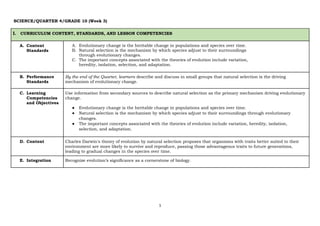
I. CURRICULUM CONTENT, STANDARDS, AND LESSON COMPETENCIES
A. Content
Standards
A. Evolutionary change is the heritable change in populations and species over time.
B. Natural selection is the mechanism by which species adjust to their surroundings
through evolutionary changes.
C. The important concepts associated with the theories of evolution include variation,
heredity, isolation, selection, and adaptation.
B. Performance
Standards
By the end of the Quarter, learners describe and discuss in small groups that natural selection is the driving
mechanism of evolutionary change.
C. Learning
Competencies
and Objectives
Use information from secondary sources to describe natural selection as the primary mechanism driving evolutionary
change.
● Evolutionary change is the heritable change in populations and species over time.
● Natural selection is the mechanism by which species adjust to their surroundings through evolutionary
changes.
● The important concepts associated with the theories of evolution include variation, heredity, isolation,
selection, and adaptation.
D. Content Charles Darwin's theory of evolution by natural selection proposes that organisms with traits better suited to their
environment are more likely to survive and reproduce, passing those advantageous traits to future generations,
leading to gradual changes in the species over time.
E. Integration Recognize evolution’s significance as a cornerstone of biology.
4.
2
II. LEARNING RESOURCES
Adaptation- Google Search. (n.d.). Google. Retrieved June 26, 2024, from https://www.google.com/search?q=adaptation
Centre, U. W. H. (n.d.). Galápagos Islands. UNESCO World Heritage Centre. http://whc.unesco.org/en/list/1/
Doña, R. N. A., et al. (2019). Science in everyday living. Brilliant Creations Publishing, Inc.
Julian-Tañada, et al. (2024). Science Links 10 (1st ed.). Rex Book Store, Inc.
National Geographic Society. (2022, August 1). Natural selection. National Geographic.
https://education.nationalgeographic.org/resource/natural-selection/
New England Complex Systems Institute. (2020, January 6). New England Complex Systems Institute. https://necsi.edu/
Practical Science 10. (2018). Practical science 10. Diwa Learning Systems, Inc.
Selection. (2019, October 7). Biology Online. https://www.biologyonline.com/dictionary/selection
III. TEACHING AND LEARNING PROCEDURE NOTES TO TEACHERS
A. Activating Prior
Knowledge
Short Review
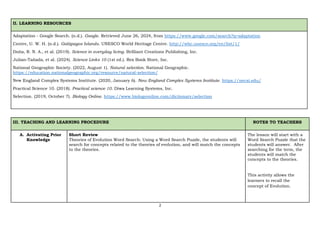
Theories of Evolution Word Search: Using a Word Search Puzzle, the students will
search for concepts related to the theories of evolution, and will match the concepts
to the theories.
The lesson will start with a
Word Search Puzzle that the
students will answer. After
searching for the term, the
students will match the
concepts to the theories.
This activity allows the
learners to recall the
concept of Evolution.
5.
3
Question:
What is thereason why living things survive in their natural habitats?
_______________________________________________________________________
_______________________________________________________________________
_______________________________________________________________________
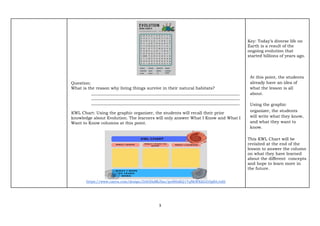
KWL Chart: Using the graphic organizer, the students will recall their prior
knowledge about Evolution. The learners will only answer What I Know and What I
Want to Know columns at this point.
https://www.canva.com/design/DAGHzMlJIas/jpyB0xKQ17qNkWKKGD3g8A/edit
Key: Today’s diverse life on
Earth is a result of the
ongoing evolution that
started billions of years ago.
At this point, the students
already have an idea of
what the lesson is all
about.
Using the graphic
organizer, the students
will write what they know,
and what they want to
know.
This KWL Chart will be
revisited at the end of the
lesson to answer the column
on what they have learned
about the different concepts
and hope to learn more in
the future.
6.
4
B. Establishing
Lesson Purpose
1.Lesson Purpose
The students will read the article on Natural Selection.
In groups, students will describe the following terms used in natural selection,
based on prior knowledge.
Source: Canva
Picture Analysis
The lesson proper will start
with the understanding of
Natural Selection based on
the material:
https://education.national
geographic.org/resource/n
atural-selection/
This activity will be done
collaboratively
emphasizing on the theory
of natural selection.
Key:
Evolution is a
developmental process by
which all organisms
progress from earlier forms
of living things. So, animal
evolution is greatly
influenced by plant
evolution.
All placental mammals (one
of the 3 groups) alive today
share a common ancestor
that lived somewhere
between 100 million years
ago and 65 million years
ago.
Direct and indirect
evidence show that living
Source:
https://www.tourhq.com/tours/86467/8-
day-wildlife-and-safari-expedition-
through-tanzania-s-national-parks
Source: https://iucnsos.org/projects/the-impact-
of-the-mauritius-fruit-bat-pteropus-niger-on-
commercial-fruit-farms-and-possible-mitigation-
methods/
7.
5
Questions:
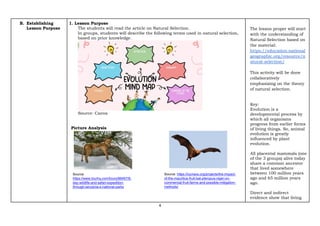
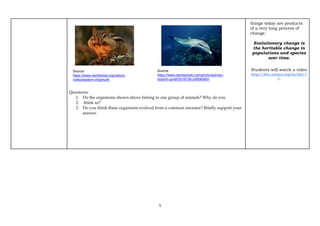
1. Do theorganisms shown above belong to one group of animals? Why do you
2. think so?
3. Do you think these organisms evolved from a common ancestor? Briefly support your
answer.
things today are products
of a very long process of
change.
Evolutionary change is
the heritable change in
populations and species
over time.
Students will watch a video
http://whc.unesco.org/en/list/1
/.
Source:
https://www.nemtforest.org/nature-
notes/eastern-chipmunk
Source:
https://www.istockphoto.com/photo/spinner-
dolphin-gm903018736-249065691
8.
6
C. Developing and
Deepening
Understanding
1.Explicitation
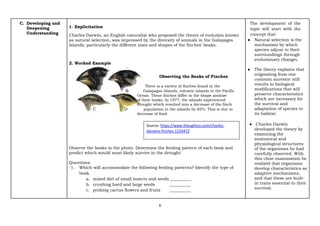
Charles Darwin, an English naturalist who proposed the theory of evolution known
as natural selection, was impressed by the diversity of animals in the Galapagos
Islands, particularly the different sizes and shapes of the finches’ beaks.
2. Worked Example
Observing the Beaks of Finches
There is a variety of finches found in the
A B Galapagos Islands, volcanic islands in the Pacific
Ocean. These finches differ in the shape andsize
of their beaks. In 1977, the islands experienced
drought which resulted into a decrease of the finch
C D population in the islands by 85%. This is due to
decrease of food.
Observe the beaks in the photo. Determine the feeding pattern of each beak and
predict which would most likely survive in the drought.
Questions:
1. Which will accommodate the following feeding patterns? Identify the type of
beak.
a. mixed diet of small insects and seeds __________
b. crushing hard and large seeds __________
c. probing cactus flowers and fruits __________
The development of the
topic will start with the
concept that
● Natural selection is the
mechanism by which
species adjust to their
surroundings through
evolutionary changes.
● The theory explains that
originating from one
common ancestor still
results in biological
modifications that will
preserve characteristics
which are necessary for
the survival and
adaptation of species to
its habitat.
● Charles Darwin
developed the theory by
examining the
anatomical and
physiological structures
of the organisms he had
carefully observed. With
this close examination he
realized that organisms
develop characteristics as
adaptive mechanisms,
and that these are built-
in traits essential to their
survival.
Source: https://www.thoughtco.com/charles-
darwins-finches-1224472
9.
7
2. Which typeof beak would have been best to allow the bird to survive the drought?
3. Where did you base your observations?
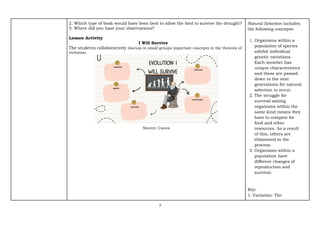
Lesson Activity
I Will Survive
The students collaboratively discuss in small groups important concepts in the theories of
evolution.
Source: Canva
Natural Selection includes
the following concepts:
1. Organisms within a
population of species
exhibit individual
genetic variations.
Each member has
unique characteristics
and these are passed
down to the next
generations for natural
selection to occur.
2. The struggle for
survival among
organisms within the
same kind means they
have to compete for
food and other
resources. As a result
of this, others are
eliminated in the
process.
3. Organisms within a
population have
different changes of
reproduction and
survival.
Key:
1. Variation: The
10.
8
differences between the
charactersor traits
among the individuals
of the same species are
called variations.
2. Heredity: The transfer of
characters or traits from
the parents to their
offsprings is called
heredity.
3. Isolation means that
organisms of the same
species are separated,
and happens when
there is something
between the organisms
that they can't cross.
Organisms become
isolated as a result of
environmental change.
The cause of isolation
can be gradual, like
when mountains or
deserts form, or
continents split apart. It
can also be quick, such
as organisms being
blown to different places
by a storm or tsunami.
4. Selection- means
placing organisms
under conditions where
11.
9
the growth ofthose with
a particular genotype
will be favored.
5. Adaptation: The
biological mechanism by
which organisms adjust
to new environments or
to changes in their
current environment.
D. Making
Generalizations
1. Learners’ Takeaways
KWL Chart: Using the graphic organizer, the students will answer the What I
Learned and What I hope to learn more columns.
https://www.canva.com/design/DAGHzMlJIas/jpyB0xKQ17qNkWKKGD3g8A/edit
2. Reflection on Learning
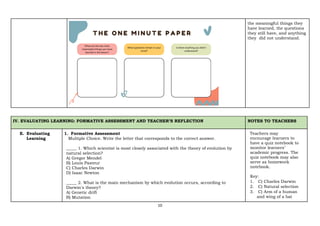
One Minute Paper: Using the graphic organizer, reflect on your learning by
creating a one-minute paper by answering the questions.
Towards the end of the
lesson, the students will
revisit the KWL Chart to
map the conceptual
change. It allows the
learners to identify their
takeaways of the lesson.
The students, at this
point, will reflect on their
learning by answering the
one-minute paper. This will
allow them to map what are
12.
10
the meaningful thingsthey
have learned, the questions
they still have, and anything
they did not understand.
IV. EVALUATING LEARNING: FORMATIVE ASSESSMENT AND TEACHER’S REFLECTION NOTES TO TEACHERS
E. Evaluating
Learning
1. Formative Assessment
Multiple Choice. Write the letter that corresponds to the correct answer.
_____ 1. Which scientist is most closely associated with the theory of evolution by
natural selection?
A) Gregor Mendel
B) Louis Pasteur
C) Charles Darwin
D) Isaac Newton
_____ 2. What is the main mechanism by which evolution occurs, according to
Darwin's theory?
A) Genetic drift
B) Mutation
Teachers may
encourage learners to
have a quiz notebook to
monitor learners’
academic progress. The
quiz notebook may also
serve as homework
notebook.
Key:
1. C) Charles Darwin
2. C) Natural selection
3. C) Arm of a human
and wing of a bat
13.
11
C) Natural selection
D)Gene flow
_____ 3. Which of the following is an example of a homologous structure?
A) Wings of a butterfly and wings of a bird
B) Fins of a shark and fins of a dolphin
C) Arm of a human and wing of a bat
D) Eye of a squid and eye of a human
_____ 4. What does the term "survival of the fittest" refer to in the context of
evolution?
A) The largest and strongest individuals always survive
B) The individuals best adapted to their environment are more likely to survive and
reproduce
C) Only the individuals with the most offspring survive
D) The individuals that live the longest are the most fit
_____ 5. What is the significance of the fossil record in understanding evolution?
A) It provides evidence of the chronological order of species development
B) It disproves the theory of natural selection
C) It shows that all species were created simultaneously
D) It is unrelated to the study of evolution
4. B) The individuals best
adapted to their
environment are more
likely to survive and
reproduce
5. A) It provides evidence
of the chronological
order of species
development
F. Teacher’s
Remarks
Note observations on
any of the following
areas:
Effective Practices Problems Encountered
The teacher may take note
of some observations
related to the effective
practices and problems
encountered after utilizing
the different strategies,
materials used, the earner
strategies explored
14.
12
materials used engagementand other
related stuff. Teachers may
also suggest ways to
improve the different
activities explored.
learner engagement/
interaction
Others
G. Teacher’s
Reflection
Reflection guide or prompt can be on:
▪ principles behind the teaching
What principles and beliefs informed my lesson?
Why did I teach the lesson the way I did?
▪ students
What roles did my students play in my lesson?
What did my students learn? How did they learn?
▪ ways forward
What could I have done differently?
What can I explore in the next lesson?
Teacher’s reflection in every
Lesson
conducted/facilitated is
essential and necessary to
improve practice. You may
also consider this as an
input for the LAC/Collab
sessions.
 Most read
 Most read
 Most read