Comprehensive Geriatric Care: Health, Safety, and Rights of the Elderly
Explore geriatric care principles, elderly health maintenance, abuse prevention, legal protections, and safety measures to support the well-being and independence of older adults.
OBJECTIVES:
To Define whatis Geriatrics
To Identify Needs among elderly people .
To demonstrate care and safety among elderly people.
To Know the maintenance of Elderly Health function .
To Enumerate factors affecting health among elderly
people.
3.
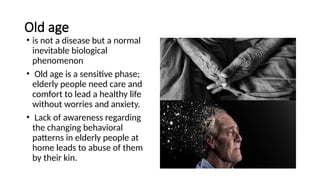
Old age
• isnot a disease but a normal
inevitable biological
phenomenon
• Old age is a sensitive phase;
elderly people need care and
comfort to lead a healthy life
without worries and anxiety.
• Lack of awareness regarding
the changing behavioral
patterns in elderly people at
home leads to abuse of them
by their kin.
4.
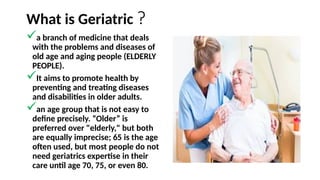
What is Geriatric?
a branch of medicine that deals
with the problems and diseases of
old age and aging people (ELDERLY
PEOPLE).
It aims to promote health by
preventing and treating diseases
and disabilities in older adults.
an age group that is not easy to
define precisely. “Older” is
preferred over "elderly," but both
are equally imprecise; 65 is the age
often used, but most people do not
need geriatrics expertise in their
care until age 70, 75, or even 80.
5.
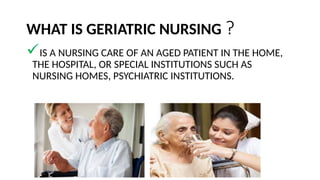
WHAT IS GERIATRICNURSING ?
IS A NURSING CARE OF AN AGED PATIENT IN THE HOME,
THE HOSPITAL, OR SPECIAL INSTITUTIONS SUCH AS
NURSING HOMES, PSYCHIATRIC INSTITUTIONS.
6.
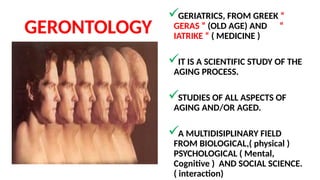
GERONTOLOGY
GERIATRICS, FROM GREEK“
GERAS ” (OLD AGE) AND “
IATRIKE “ ( MEDICINE )
IT IS A SCIENTIFIC STUDY OF THE
AGING PROCESS.
STUDIES OF ALL ASPECTS OF
AGING AND/OR AGED.
A MULTIDISIPLINARY FIELD
FROM BIOLOGICAL,( physical )
PSYCHOLOGICAL ( Mental,
Cognitive ) AND SOCIAL SCIENCE.
( interaction)
7.
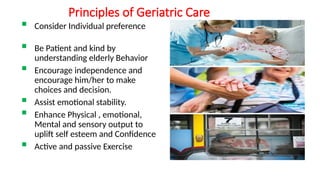
Principles of GeriatricCare
Consider Individual preference
Be Patient and kind by
understanding elderly Behavior
Encourage independence and
encourage him/her to make
choices and decision.
Assist emotional stability.
Enhance Physical , emotional,
Mental and sensory output to
uplift self esteem and Confidence
Active and passive Exercise
8.
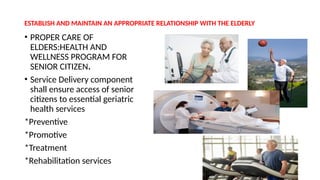
ESTABLISH AND MAINTAINAN APPROPRIATE RELATIONSHIP WITH THE ELDERLY
• PROPER CARE OF
ELDERS:HEALTH AND
WELLNESS PROGRAM FOR
SENIOR CITIZEN.
• Service Delivery component
shall ensure access of senior
citizens to essential geriatric
health services
*Preventive
*Promotive
*Treatment
*Rehabilitation services
9.
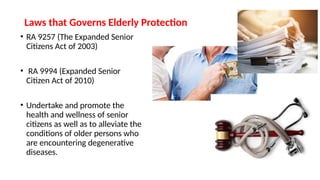
Laws that GovernsElderly Protection
• RA 9257 (The Expanded Senior
Citizens Act of 2003)
• RA 9994 (Expanded Senior
Citizen Act of 2010)
• Undertake and promote the
health and wellness of senior
citizens as well as to alleviate the
conditions of older persons who
are encountering degenerative
diseases.
10.
Laws that GovernsElderly Protection
• Republic Act No. 10642
=An act granting mandatory national health insurance
program of Phil Health for all senior citizens
Objective:
• 1. Ensure better health for senior citizens through the
provision of focused service delivery packages and
integrated continuum of quality care in various settings.
• 2. Develop patient-centered and environment standards
to ensure safety and accessibility of all health
facilities for the senior citizens.
• 3. Achieve equitable health financing to develop,
implement, sustain, monitor and continuously improve
quality health programs accessible to senior citizens.
• 4. Enhance the capacity of health providers and other
stakeholders including senior citizens group in the
implementation of health programs for senior citizens.
11.
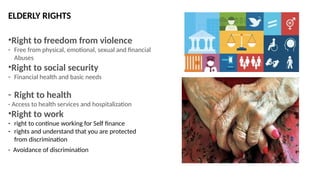
ELDERLY RIGHTS
•Right tofreedom from violence
- Free from physical, emotional, sexual and financial
Abuses
•Right to social security
- Financial health and basic needs
- Right to health
- Access to health services and hospitalization
•Right to work
- right to continue working for Self finance
- rights and understand that you are protected
from discrimination
- Avoidance of discrimination
12.
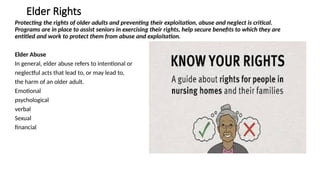
Elder Rights
Protecting therights of older adults and preventing their exploitation, abuse and neglect is critical.
Programs are in place to assist seniors in exercising their rights, help secure benefits to which they are
entitled and work to protect them from abuse and exploitation.
Elder Abuse
In general, elder abuse refers to intentional or
neglectful acts that lead to, or may lead to,
the harm of an older adult.
Emotional
psychological
verbal
Sexual
financial
13.
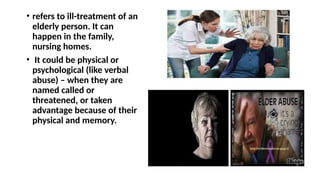
• refers toill-treatment of an
elderly person. It can
happen in the family,
nursing homes.
• It could be physical or
psychological (like verbal
abuse) – when they are
named called or
threatened, or taken
advantage because of their
physical and memory.
14.
CATEGORIES OF ABUSE
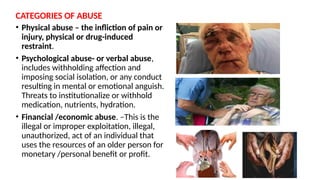
•Physical abuse – the infliction of pain or
injury, physical or drug-induced
restraint.
• Psychological abuse- or verbal abuse,
includes withholding affection and
imposing social isolation, or any conduct
resulting in mental or emotional anguish.
Threats to institutionalize or withhold
medication, nutrients, hydration.
• Financial /economic abuse. –This is the
illegal or improper exploitation, illegal,
unauthorized, act of an individual that
uses the resources of an older person for
monetary /personal benefit or profit.
15.
Legal Assistance
The legalissue may include:
* income security
*housing, utilities,
*protective services,
*Abuse, neglect and
*Age discrimination.
16.
CATEGORIES OF ABUSE
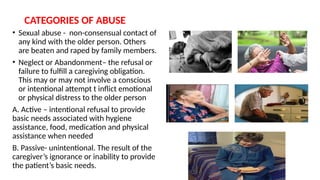
•Sexual abuse - non-consensual contact of
any kind with the older person. Others
are beaten and raped by family members.
• Neglect or Abandonment– the refusal or
failure to fulfill a caregiving obligation.
This may or may not involve a conscious
or intentional attempt t inflict emotional
or physical distress to the older person
A. Active – intentional refusal to provide
basic needs associated with hygiene
assistance, food, medication and physical
assistance when needed
B. Passive- unintentional. The result of the
caregiver’s ignorance or inability to provide
the patient’s basic needs.
17.
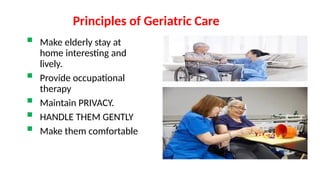
Principles of GeriatricCare
Make elderly stay at
home interesting and
lively.
Provide occupational
therapy
Maintain PRIVACY.
HANDLE THEM GENTLY
Make them comfortable
18.
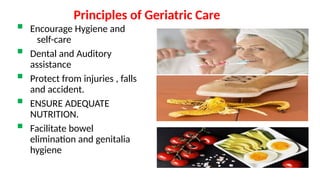
Principles of GeriatricCare
Encourage Hygiene and
self-care
Dental and Auditory
assistance
Protect from injuries , falls
and accident.
ENSURE ADEQUATE
NUTRITION.
Facilitate bowel
elimination and genitalia
hygiene
19.
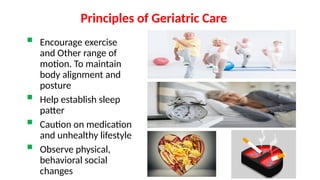
Principles of GeriatricCare
Encourage exercise
and Other range of
motion. To maintain
body alignment and
posture
Help establish sleep
patter
Caution on medication
and unhealthy lifestyle
Observe physical,
behavioral social
changes
20.
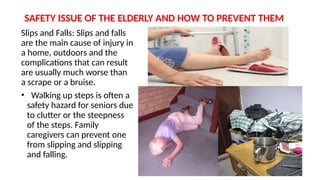
SAFETY ISSUE OFTHE ELDERLY AND HOW TO PREVENT THEM
Slips and Falls: Slips and falls
are the main cause of injury in
a home, outdoors and the
complications that can result
are usually much worse than
a scrape or a bruise.
• Walking up steps is often a
safety hazard for seniors due
to clutter or the steepness
of the steps. Family
caregivers can prevent one
from slipping and slipping
and falling.
21.
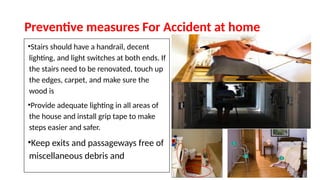
Preventive measures ForAccident at home
•Stairs should have a handrail, decent
lighting, and light switches at both ends. If
the stairs need to be renovated, touch up
the edges, carpet, and make sure the
wood is
•Provide adequate lighting in all areas of
the house and install grip tape to make
steps easier and safer.
•Keep exits and passageways free of
miscellaneous debris and
22.
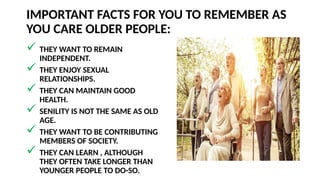
IMPORTANT FACTS FORYOU TO REMEMBER AS
YOU CARE OLDER PEOPLE:
THEY WANT TO REMAIN
INDEPENDENT.
THEY ENJOY SEXUAL
RELATIONSHIPS.
THEY CAN MAINTAIN GOOD
HEALTH.
SENILITY IS NOT THE SAME AS OLD
AGE.
THEY WANT TO BE CONTRIBUTING
MEMBERS OF SOCIETY.
THEY CAN LEARN , ALTHOUGH
THEY OFTEN TAKE LONGER THAN
YOUNGER PEOPLE TO DO-SO.
23.
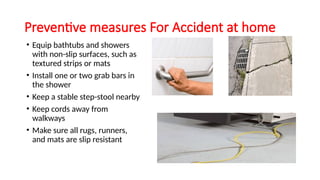
Preventive measures ForAccident at home
• Equip bathtubs and showers
with non-slip surfaces, such as
textured strips or mats
• Install one or two grab bars in
the shower
• Keep a stable step-stool nearby
• Keep cords away from
walkways
• Make sure all rugs, runners,
and mats are slip resistant
24.
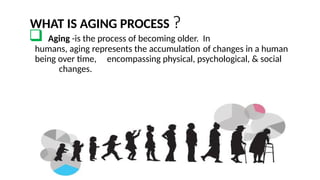
WHAT IS AGINGPROCESS ?
Aging -is the process of becoming older. In
humans, aging represents the accumulation of changes in a human
being over time, encompassing physical, psychological, & social
changes.
25.
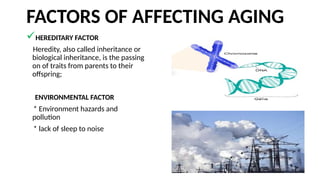
FACTORS OF AFFECTINGAGING
HEREDITARY FACTOR
Heredity, also called inheritance or
biological inheritance, is the passing
on of traits from parents to their
offspring;
ENVIRONMENTAL FACTOR
* Environment hazards and
pollution
* lack of sleep to noise
26.
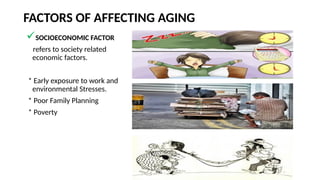
FACTORS OF AFFECTINGAGING
SOCIOECONOMIC FACTOR
refers to society related
economic factors.
* Early exposure to work and
environmental Stresses.
* Poor Family Planning
* Poverty
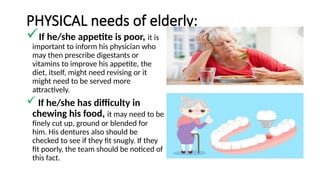
PHYSICAL needs ofelderly:
If he/she appetite is poor, it is
important to inform his physician who
may then prescribe digestants or
vitamins to improve his appetite, the
diet, itself, might need revising or it
might need to be served more
attractively.
If he/she has difficulty in
chewing his food, it may need to be
finely cut up, ground or blended for
him. His dentures also should be
checked to see if they fit snugly. If they
fit poorly, the team should be noticed of
this fact.
29.
PHYSICAL needs ofelderly
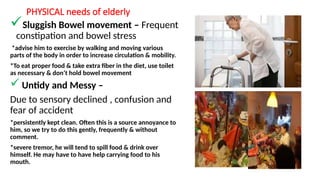
Sluggish Bowel movement – Frequent
constipation and bowel stress
*advise him to exercise by walking and moving various
parts of the body in order to increase circulation & mobility.
*To eat proper food & take extra fiber in the diet, use toilet
as necessary & don’t hold bowel movement
Untidy and Messy –
Due to sensory declined , confusion and
fear of accident
*persistently kept clean. Often this is a source annoyance to
him, so we try to do this gently, frequently & without
comment.
*severe tremor, he will tend to spill food & drink over
himself. He may have to have help carrying food to his
mouth.
30.
PHYSICAL needs ofelderly:
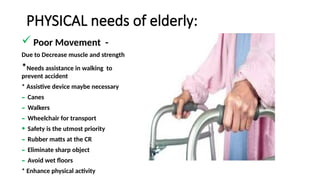
Poor Movement -
Due to Decrease muscle and strength
*Needs assistance in walking to
prevent accident
* Assistive device maybe necessary
- Canes
- Walkers
- Wheelchair for transport
• Safety is the utmost priority
- Rubber matts at the CR
- Eliminate sharp object
- Avoid wet floors
* Enhance physical activity
31.
PHYSICAL CHANGES
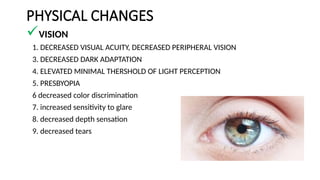
VISION
1. DECREASEDVISUAL ACUITY, DECREASED PERIPHERAL VISION
3. DECREASED DARK ADAPTATION
4. ELEVATED MINIMAL THERSHOLD OF LIGHT PERCEPTION
5. PRESBYOPIA
6 decreased color discrimination
7. increased sensitivity to glare
8. decreased depth sensation
9. decreased tears
32.
PHYSICAL CHANGES
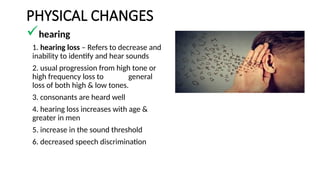
hearing
1. hearingloss – Refers to decrease and
inability to identify and hear sounds
2. usual progression from high tone or
high frequency loss to general
loss of both high & low tones.
3. consonants are heard well
4. hearing loss increases with age &
greater in men
5. increase in the sound threshold
6. decreased speech discrimination
33.
PHYSICAL CHANGES
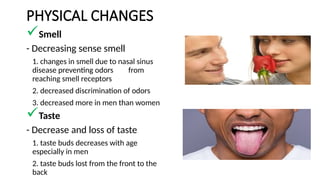
Smell
- Decreasingsense smell
1. changes in smell due to nasal sinus
disease preventing odors from
reaching smell receptors
2. decreased discrimination of odors
3. decreased more in men than women
Taste
- Decrease and loss of taste
1. taste buds decreases with age
especially in men
2. taste buds lost from the front to the
back
34.
PHYSICAL CHANGES
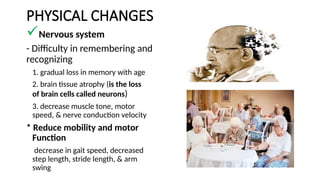
Nervous system
-Difficulty in remembering and
recognizing
1. gradual loss in memory with age
2. brain tissue atrophy (is the loss
of brain cells called neurons)
3. decrease muscle tone, motor
speed, & nerve conduction velocity
* Reduce mobility and motor
Function
decrease in gait speed, decreased
step length, stride length, & arm
swing
35.
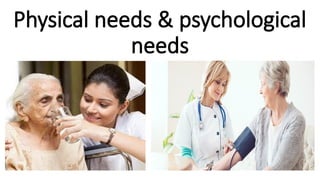
Psychological needs ofelderly:
basic psychological needs of all
people include respect, security,
self-esteem, & the need feel
appreciated & valued by others.
The maintenance of self ( self-
continuity, integrity, & identity ) is
important to the psychological
survival of the elderly.
He needs to feel that he is a
worthwhile person. Aging person
needs warm affectionate
relationship with his loved ones.
36.
Psychological needs ofelderly:
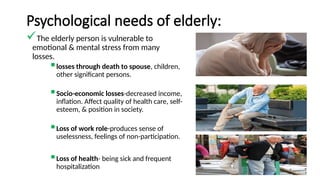
The elderly person is vulnerable to
emotional & mental stress from many
losses.
losses through death to spouse, children,
other significant persons.
Socio-economic losses-decreased income,
inflation. Affect quality of health care, self-
esteem, & position in society.
Loss of work role-produces sense of
uselessness, feelings of non-participation.
Loss of health- being sick and frequent
hospitalization
37.
Other needs forElderly People
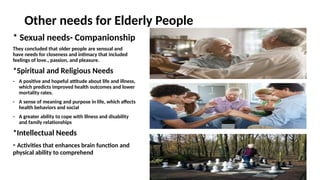
* Sexual needs- Companionship
They concluded that older people are sensual and
have needs for closeness and intimacy that included
feelings of love., passion, and pleasure.
*Spiritual and Religious Needs
- A positive and hopeful attitude about life and illness,
which predicts improved health outcomes and lower
mortality rates.
- A sense of meaning and purpose in life, which affects
health behaviors and social
- A greater ability to cope with illness and disability
and family relationships
*Intellectual Needs
- Activities that enhances brain function and
physical ability to comprehend
38.
Other needs forElderly People
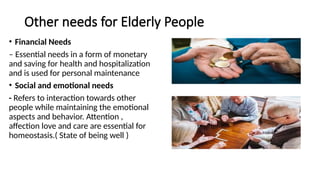
• Financial Needs
– Essential needs in a form of monetary
and saving for health and hospitalization
and is used for personal maintenance
• Social and emotional needs
- Refers to interaction towards other
people while maintaining the emotional
aspects and behavior. Attention ,
affection love and care are essential for
homeostasis.( State of being well )
39.
Other needs forElderly People
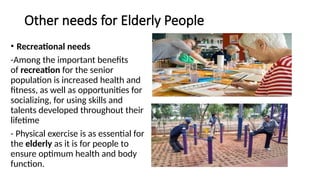
• Recreational needs
-Among the important benefits
of recreation for the senior
population is increased health and
fitness, as well as opportunities for
socializing, for using skills and
talents developed throughout their
lifetime
- Physical exercise is as essential for
the elderly as it is for people to
ensure optimum health and body
function.
40.
Elderly Behavioral Problemsand How to
Handle Them
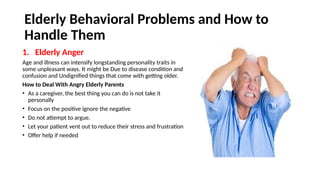
1. Elderly Anger
Age and illness can intensify longstanding personality traits in
some unpleasant ways. It might be Due to disease condition and
confusion and Undignified things that come with getting older.
How to Deal With Angry Elderly Parents
• As a caregiver, the best thing you can do is not take it
personally
• Focus on the positive ignore the negative
• Do not attempt to argue.
• Let your patient vent out to reduce their stress and frustration
• Offer help if needed
41.
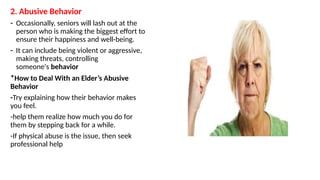
2. Abusive Behavior
-Occasionally, seniors will lash out at the
person who is making the biggest effort to
ensure their happiness and well-being.
- It can include being violent or aggressive,
making threats, controlling
someone's behavior
*How to Deal With an Elder’s Abusive
Behavior
-Try explaining how their behavior makes
you feel.
-help them realize how much you do for
them by stepping back for a while.
-If physical abuse is the issue, then seek
professional help
42.
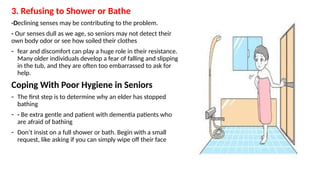
3. Refusing toShower or Bathe
-Declining senses may be contributing to the problem.
- Our senses dull as we age, so seniors may not detect their
own body odor or see how soiled their clothes
- fear and discomfort can play a huge role in their resistance.
Many older individuals develop a fear of falling and slipping
in the tub, and they are often too embarrassed to ask for
help.
Coping With Poor Hygiene in Seniors
- The first step is to determine why an elder has stopped
bathing
- - Be extra gentle and patient with dementia patients who
are afraid of bathing
- Don’t insist on a full shower or bath. Begin with a small
request, like asking if you can simply wipe off their face
43.
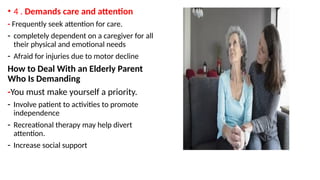
• 4 .Demands care and attention
- Frequently seek attention for care.
- completely dependent on a caregiver for all
their physical and emotional needs
- Afraid for injuries due to motor decline
How to Deal With an Elderly Parent
Who Is Demanding
-You must make yourself a priority.
- Involve patient to activities to promote
independence
- Recreational therapy may help divert
attention.
- Increase social support
Indicators of illnessfor elderly:
the following indicators of illness demands
immediate attention from the caregiver to
avoid later complications.
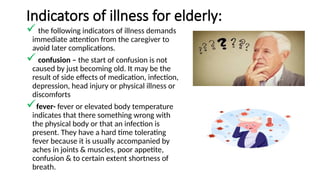
confusion – the start of confusion is not
caused by just becoming old. It may be the
result of side effects of medication, infection,
depression, head injury or physical illness or
discomforts
fever- fever or elevated body temperature
indicates that there something wrong with
the physical body or that an infection is
present. They have a hard time tolerating
fever because it is usually accompanied by
aches in joints & muscles, poor appetite,
confusion & to certain extent shortness of
breath.
46.
Indicators of illnessfor elderly:
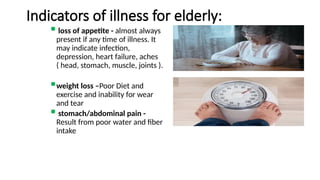
loss of appetite - almost always
present if any time of illness. It
may indicate infection,
depression, heart failure, aches
( head, stomach, muscle, joints ).
weight loss –Poor Diet and
exercise and inability for wear
and tear
stomach/abdominal pain -
Result from poor water and fiber
intake
47.
Indicators of illnessfor elderly:
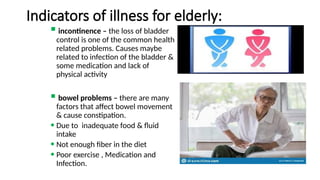
incontinence – the loss of bladder
control is one of the common health
related problems. Causes maybe
related to infection of the bladder &
some medication and lack of
physical activity
bowel problems – there are many
factors that affect bowel movement
& cause constipation.
•Due to inadequate food & fluid
intake
•Not enough fiber in the diet
•Poor exercise , Medication and
Infection.