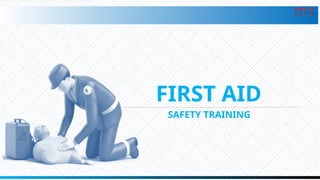
Comprehensive First Aid Safety Training: Emergency Response Skills and Procedures
Learn essential first aid skills including emergency action, wound types, CPR, recovery position, and treatment for common emergencies like heart attack, asthma, choking, heatstroke, and bleeding.
TABLE OF CONTENT
1Aim and Objective
2 What is First Aid? & First Aid Kit
3 Action in an Emergency & Primary Survey
4 Recovery Position
5 Types of Wound
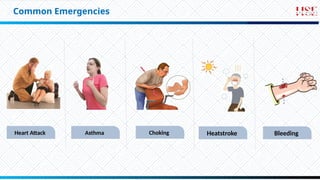
6 Common Emergencies
7 Regulations & Risk Assessment
3.
Aim / Objectives
Theaim of First Aid Training is to equip individuals with the essential skills to
respond promptly and effectively in the event of an accident or medical emergency.
The objectives are to preserve life, prevent the condition from deteriorating, and
promote recovery. This training empowers participants to provide immediate
assistance until professional medical help becomes available.
4.
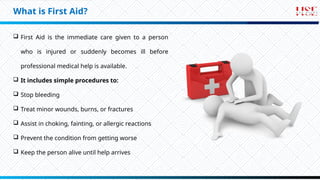
What is FirstAid?
First Aid is the immediate care given to a person
who is injured or suddenly becomes ill before
professional medical help is available.
It includes simple procedures to:
Stop bleeding
Treat minor wounds, burns, or fractures
Assist in choking, fainting, or allergic reactions
Prevent the condition from getting worse
Keep the person alive until help arrives
5.
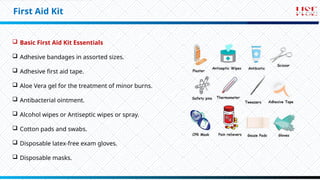
First Aid Kit
Basic First Aid Kit Essentials
Adhesive bandages in assorted sizes.
Adhesive first aid tape.
Aloe Vera gel for the treatment of minor burns.
Antibacterial ointment.
Alcohol wipes or Antiseptic wipes or spray.
Cotton pads and swabs.
Disposable latex-free exam gloves.
Disposable masks.
6.
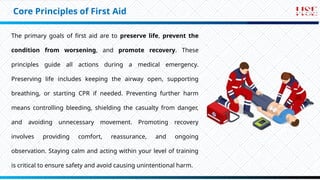
Core Principles ofFirst Aid
The primary goals of first aid are to preserve life, prevent the
condition from worsening, and promote recovery. These
principles guide all actions during a medical emergency.
Preserving life includes keeping the airway open, supporting
breathing, or starting CPR if needed. Preventing further harm
means controlling bleeding, shielding the casualty from danger,
and avoiding unnecessary movement. Promoting recovery
involves providing comfort, reassurance, and ongoing
observation. Staying calm and acting within your level of training
is critical to ensure safety and avoid causing unintentional harm.
7.
Responsibilities of theEmergency First Aider
Assess the situation:
Quickly and calmly assess the scene and the
injured person to understand the nature and
severity of the situation.
Protect yourself and others:
Ensure the safety of yourself and the casualty
by identifying and mitigating any hazards.
Provide initial care:
Administer appropriate first aid techniques to
stabilize the person's condition and prevent
further harm, such as CPR, controlling
bleeding, or dealing with choking.
Call for professional help:
Contact emergency services or other appropriate
support when necessary.
Reassure the casualty:
Provide comfort and reassurance to the injured person
to reduce anxiety and pain.
Prevent infection:
Take precautions to prevent the spread of infection,
such as wearing gloves and washing hands.
8.
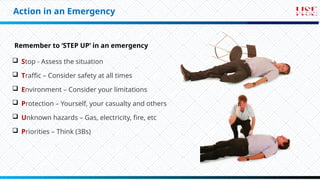
Action in anEmergency
Remember to ‘STEP UP’ in an emergency
Stop - Assess the situation
Traffic – Consider safety at all times
Environment – Consider your limitations
Protection – Yourself, your casualty and others
Unknown hazards – Gas, electricity, fire, etc
Priorities – Think (3Bs)
9.
Primary Survey
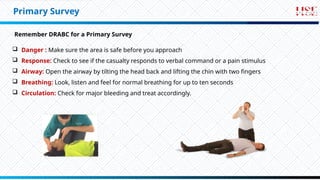
Remember DRABCfor a Primary Survey
Danger : Make sure the area is safe before you approach
Response: Check to see if the casualty responds to verbal command or a pain stimulus
Airway: Open the airway by tilting the head back and lifting the chin with two fingers
Breathing: Look, listen and feel for normal breathing for up to ten seconds
Circulation: Check for major bleeding and treat accordingly.
10.
Top-to-Toe Survey
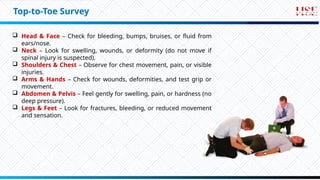
Head& Face – Check for bleeding, bumps, bruises, or fluid from
ears/nose.
Neck – Look for swelling, wounds, or deformity (do not move if
spinal injury is suspected).
Shoulders & Chest – Observe for chest movement, pain, or visible
injuries.
Arms & Hands – Check for wounds, deformities, and test grip or
movement.
Abdomen & Pelvis – Feel gently for swelling, pain, or hardness (no
deep pressure).
Legs & Feet – Look for fractures, bleeding, or reduced movement
and sensation.
11.
Principles of Resuscitation
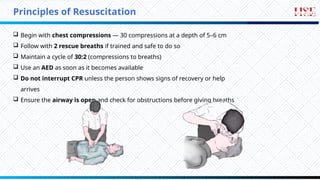
Begin with chest compressions — 30 compressions at a depth of 5–6 cm
Follow with 2 rescue breaths if trained and safe to do so
Maintain a cycle of 30:2 (compressions to breaths)
Use an AED as soon as it becomes available
Do not interrupt CPR unless the person shows signs of recovery or help
arrives
Ensure the airway is open and check for obstructions before giving breaths
12.
Recovery Position
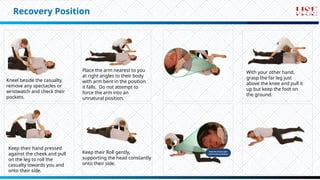
Keep theirRoll gently,
supporting the head constantly
onto their side.
Keep their hand pressed
against the cheek and pull
on the leg to roll the
casualty towards you and
onto their side.
With your other hand,
grasp the far leg just
above the knee and pull it
up but keep the foot on
the ground.
Place the arm nearest to you
at right angles to their body
with arm bent in the position
it falls. Do not attempt to
force the arm into an
unnatural position.
Kneel beside the casualty,
remove any spectacles or
wristwatch and check their
pockets.
13.
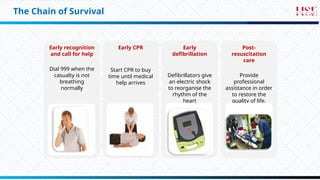
The Chain ofSurvival
Early recognition
and call for help
Dial 999 when the
casualty is not
breathing
normally
Early CPR
Start CPR to buy
time until medical
help arrives
Early
defibrillation
Defibrillators give
an electric shock
to reorganise the
rhythm of the
heart
Post-
resuscitation
care
Provide
professional
assistance in order
to restore the
quality of life.
14.
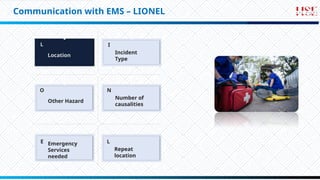
Communication with EMS– LIONEL
Location
L
Incident
Type
I
Number of
causalities
N
Other Hazard
O
Emergency
Services
needed
E
Repeat
location
L
15.
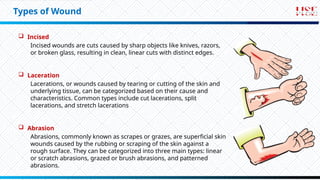
Types of Wound
Incised
Incised wounds are cuts caused by sharp objects like knives, razors,
or broken glass, resulting in clean, linear cuts with distinct edges.
Laceration
Lacerations, or wounds caused by tearing or cutting of the skin and
underlying tissue, can be categorized based on their cause and
characteristics. Common types include cut lacerations, split
lacerations, and stretch lacerations
Abrasion
Abrasions, commonly known as scrapes or grazes, are superficial skin
wounds caused by the rubbing or scraping of the skin against a
rough surface. They can be categorized into three main types: linear
or scratch abrasions, grazed or brush abrasions, and patterned
abrasions.
16.
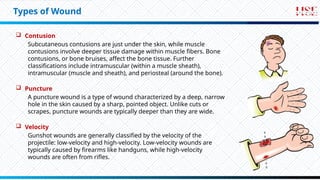
Types of Wound
Contusion
Subcutaneous contusions are just under the skin, while muscle
contusions involve deeper tissue damage within muscle fibers. Bone
contusions, or bone bruises, affect the bone tissue. Further
classifications include intramuscular (within a muscle sheath),
intramuscular (muscle and sheath), and periosteal (around the bone).
Puncture
A puncture wound is a type of wound characterized by a deep, narrow
hole in the skin caused by a sharp, pointed object. Unlike cuts or
scrapes, puncture wounds are typically deeper than they are wide.
Velocity
Gunshot wounds are generally classified by the velocity of the
projectile: low-velocity and high-velocity. Low-velocity wounds are
typically caused by firearms like handguns, while high-velocity
wounds are often from rifles.
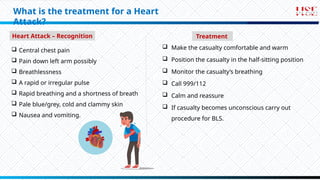
What is thetreatment for a Heart
Attack?
Central chest pain
Pain down left arm possibly
Breathlessness
A rapid or irregular pulse
Rapid breathing and a shortness of breath
Pale blue/grey, cold and clammy skin
Nausea and vomiting.
Heart Attack – Recognition
Make the casualty comfortable and warm
Position the casualty in the half-sitting position
Monitor the casualty’s breathing
Call 999/112
Calm and reassure
If casualty becomes unconscious carry out
procedure for BLS.
Treatment
19.
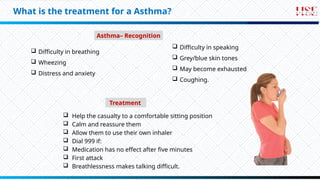
What is thetreatment for a Asthma?
Difficulty in breathing
Wheezing
Distress and anxiety
Asthma– Recognition
Help the casualty to a comfortable sitting position
Calm and reassure them
Allow them to use their own inhaler
Dial 999 if:
Medication has no effect after five minutes
First attack
Breathlessness makes talking difficult.
Treatment
Difficulty in speaking
Grey/blue skin tones
May become exhausted
Coughing.
20.
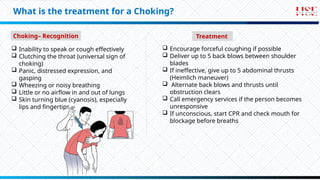
What is thetreatment for a Choking?
Inability to speak or cough effectively
Clutching the throat (universal sign of
choking)
Panic, distressed expression, and
gasping
Wheezing or noisy breathing
Little or no airflow in and out of lungs
Skin turning blue (cyanosis), especially
lips and fingertips
Choking– Recognition
Encourage forceful coughing if possible
Deliver up to 5 back blows between shoulder
blades
If ineffective, give up to 5 abdominal thrusts
(Heimlich maneuver)
Alternate back blows and thrusts until
obstruction clears
Call emergency services if the person becomes
unresponsive
If unconscious, start CPR and check mouth for
blockage before breaths
Treatment
21.
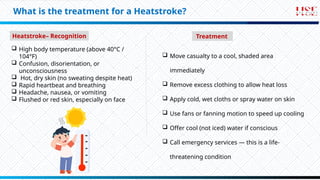
What is thetreatment for a Heatstroke?
High body temperature (above 40°C /
104°F)
Confusion, disorientation, or
unconsciousness
Hot, dry skin (no sweating despite heat)
Rapid heartbeat and breathing
Headache, nausea, or vomiting
Flushed or red skin, especially on face
Heatstroke– Recognition
Move casualty to a cool, shaded area
immediately
Remove excess clothing to allow heat loss
Apply cold, wet cloths or spray water on skin
Use fans or fanning motion to speed up cooling
Offer cool (not iced) water if conscious
Call emergency services — this is a life-
threatening condition
Treatment
22.
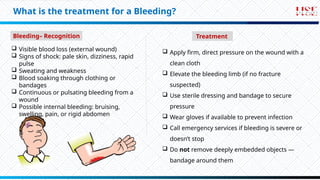
What is thetreatment for a Bleeding?
Visible blood loss (external wound)
Signs of shock: pale skin, dizziness, rapid
pulse
Sweating and weakness
Blood soaking through clothing or
bandages
Continuous or pulsating bleeding from a
wound
Possible internal bleeding: bruising,
swelling, pain, or rigid abdomen
Bleeding– Recognition
Apply firm, direct pressure on the wound with a
clean cloth
Elevate the bleeding limb (if no fracture
suspected)
Use sterile dressing and bandage to secure
pressure
Wear gloves if available to prevent infection
Call emergency services if bleeding is severe or
doesn’t stop
Do not remove deeply embedded objects —
bandage around them
Treatment
23.
Hypothermia vs. HeatExhaustion
Caused by prolonged exposure to cold
temperatures
Core body temperature drops below 35°C
Symptoms include intense shivering, cold/pale
skin, slow breathing, and slurred speech
Mental confusion, fatigue, and possible
unconsciousness
Skin may appear blue or grey in advanced
cases
First Aid: Move to a warm, dry place; remove
wet clothing; wrap in blankets; give warm
drinks if alert; call emergency services
Caused by prolonged exposure to high
temperatures and loss of fluids/salts through
sweating
Symptoms include heavy sweating, dizziness,
weakness, nausea, and muscle cramps
Pale, clammy skin; rapid but weak pulse
Possible fainting or vomiting, but usually
responsive
If untreated, may progress to heatstroke
First Aid: Move to a cool, shaded area; loosen
clothing; offer cool fluids (preferably with
electrolytes); apply cool compresses; seek
Heat Exhaustion
Hypothermia
24.
AED (Defibrillator) Use
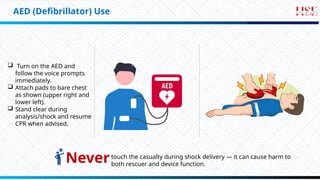
Turn on the AED and
follow the voice prompts
immediately.
Attach pads to bare chest
as shown (upper right and
lower left).
Stand clear during
analysis/shock and resume
CPR when advised.
touch the casualty during shock delivery — it can cause harm to
both rescuer and device function.
Never
25.
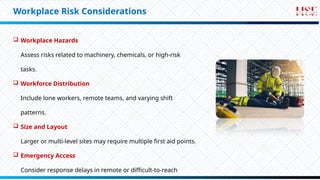
Workplace Risk Considerations
Workplace Hazards
Assess risks related to machinery, chemicals, or high-risk
tasks.
Workforce Distribution
Include lone workers, remote teams, and varying shift
patterns.
Size and Layout
Larger or multi-level sites may require multiple first aid points.
Emergency Access
Consider response delays in remote or difficult-to-reach
26.
Regulations & RiskAssessment
Legal
Requirements
Risk
Assessment
• Workplace hazards and risks
• The size of the organization
• The organization's history of accidents
• The nature and distribution of the
workforce
• The remoteness of the site from
emergency services
• Remote and lone workers
• Employees working on shared or multi-
occupied sites
• Annual leave and other absences of First
Aiders.
• Factories Act, 1948
Requires first aid kits, trained first aiders, and a
medical room in factories with over 150
workers.
• BOCW Act, 1996
Mandates on-site first aid arrangements and
trained personnel at construction sites.
• OSH Code, 2020
Enforces certified first aid and CPR training
across all sectors including factories, ports, and
mines.
• Indian Red Cross / St. John Ambulance
Authorized bodies for certified first aid and
CPR training recognized by employers and
authorities.
• ILO Convention No. 155
Requires risk-based first aid planning and
CPR/AED readiness in hazardous or large
workplaces.
27.
Training Requirements
AppointTrained First Aiders
Every workplace must have a sufficient number of trained personnel based on risk level.
Regular Refresher Courses
Recommended every 1–3 years to maintain skills and confidence.
Certification Standards
Training should be accredited (e.g., EFAW/FAW) and meet national workplace safety regulations.
Tailored to Job Hazards
Specific training for high-risk environments like construction, chemicals, or remote work.
Documentation and Records
Keep records of trained staff, expiration dates, and requalification needs.
Awareness for All Employees
Even non-certified staff should receive basic awareness to support safer responses.
28.
Summary
First aid isa critical skill that empowers individuals to take immediate, lifesaving actions
during emergencies. From assessing danger and performing CPR to managing bleeding,
choking, and heat or cold-related conditions, every step matters. Understanding the
principles of DRABC, using tools like AEDs properly, and staying calm under pressure can
save lives. Regular training, awareness of workplace risks, and confidence in acting swiftly
ensure preparedness in both personal and professional environments.