Comprehensive Exploration of Translational and Rotational Motion in Physics
This Grade 11 science lesson covers angular displacement, velocity, acceleration, radians, and practical applications like clock hands and fidget spinners.
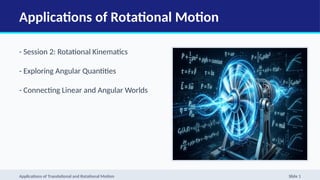
Applications of RotationalMotion
- Session 2: Rotational Kinematics
- Exploring Angular Quantities
- Connecting Linear and Angular Worlds
Applications of Translational and Rotational Motion Slide 1
3.
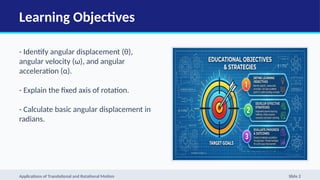
Learning Objectives
- Identifyangular displacement (θ),
angular velocity (ω), and angular
acceleration (α).
- Explain the fixed axis of rotation.
- Calculate basic angular displacement in
radians.
Applications of Translational and Rotational Motion Slide 2
4.
The Clock HandChallenge
- Look at a moving clock hand.
- Does the tip move differently than the
middle?
- Distance vs. Angle covered.
Applications of Translational and Rotational Motion Slide 3
5.
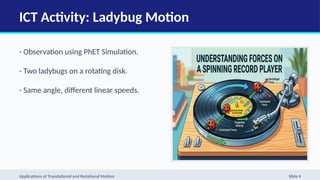
ICT Activity: LadybugMotion
- Observation using PhET Simulation.
- Two ladybugs on a rotating disk.
- Same angle, different linear speeds.
Applications of Translational and Rotational Motion Slide 4
6.
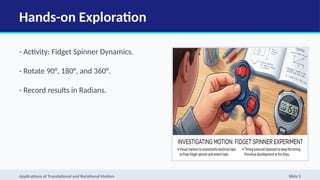
Hands-on Exploration
- Activity:Fidget Spinner Dynamics.
- Rotate 90°, 180°, and 360°.
- Record results in Radians.
Applications of Translational and Rotational Motion Slide 5
7.
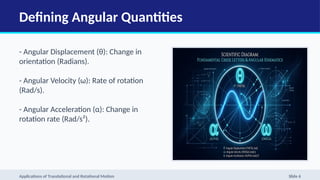
Defining Angular Quantities
-Angular Displacement (θ): Change in
orientation (Radians).
- Angular Velocity (ω): Rate of rotation
(Rad/s).
- Angular Acceleration (α): Change in
rotation rate (Rad/s²).
Applications of Translational and Rotational Motion Slide 6
8.
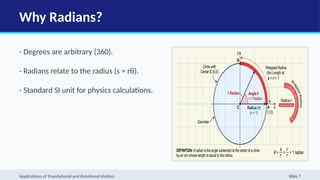
Why Radians?
- Degreesare arbitrary (360).
- Radians relate to the radius (s = rθ).
- Standard SI unit for physics calculations.
Applications of Translational and Rotational Motion Slide 7
9.
Assessment Checkpoint 1
-1. What is the rotational equivalent of
linear displacement, measured in radians?
- 2. What symbol is used to represent
angular velocity?
Applications of Translational and Rotational Motion Slide 8
10.
Assessment Checkpoint 2
-3. What is the fixed line around which a
body rotates?
- 4. What is the rate of change of angular
velocity?
- 5. How many radians are in one full 360-
degree rotation?
Applications of Translational and Rotational Motion Slide 9
11.
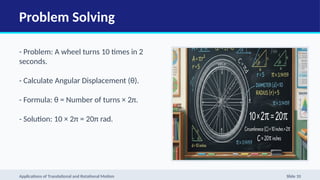
Problem Solving
- Problem:A wheel turns 10 times in 2
seconds.
- Calculate Angular Displacement (θ).
- Formula: θ = Number of turns × 2π.
- Solution: 10 × 2π = 20π rad.
Applications of Translational and Rotational Motion Slide 10
12.
Extend Your Knowledge
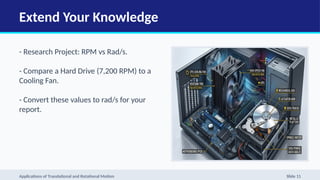
-Research Project: RPM vs Rad/s.
- Compare a Hard Drive (7,200 RPM) to a
Cooling Fan.
- Convert these values to rad/s for your
report.
Applications of Translational and Rotational Motion Slide 11
Editor's Notes
#1 Welcome the class. Today's topic is Applications of Translational and Rotational Motion .
#2 Welcome back to Session 2 of our series on motion. Today we move from moving in straight lines to moving in circles. We will explore how objects rotate around a fixed axis and the specific language scientists use to describe that spinning movement.
#3 By the end of today's lesson, you'll be able to name the three main quantities of rotation, understand the concept of a fixed axis, and perform calculations to determine how far an object has rotated using radians.
#4 Think about a clock hand. When the second hand moves from 12 to 3, does the tip travel the same distance as a point halfway down the hand? Physically, the tip travels a longer arc, but both points sweep through the exact same angle. This is the core of rotational motion.
#5 We are going to use the PhET Ladybug Motion 2D simulation. Notice how the ladybug on the outer edge moves faster in terms of meters per second, but both ladybugs complete a full circle in the exact same time. This constant is what we call angular velocity.
#6 Now, take your circular cardboard or fidget spinner. Place a piece of tape on one edge. Rotate it exactly one quarter turn, half turn, and full turn. We are going to record these as angular displacements. Instead of degrees, we will use radians.
#7 Let's define our terms. Theta is the angle turned. Omega, which looks like a curvy 'w', is how fast it's spinning. Alpha is the rate at which that spin speeds up or slows down. These are the rotational equivalents of displacement, velocity, and acceleration.
#8 Why don't we just use degrees? Radians are more natural for physics because they link the linear world to the angular world directly. One radian is the angle where the arc length equals the radius. It makes the math much cleaner when we bridge these two types of motion.
#9 Let's check our understanding. Question 1: What do we call the equivalent of linear displacement? (Wait for student answer: Angular Displacement). Question 2: What symbol represents angular velocity? (Wait for student answer: Omega / ω).
#10 Continuing our check. Question 3: What is the fixed line? (Answer: Axis of Rotation). Question 4: Rate of change of angular velocity? (Answer: Angular Acceleration). Question 5: How many radians in a full circle? (Answer: 2π).
#11 Let's practice. If a wheel spins 10 full times, and each time is 2π radians, then the total displacement is 20π radians. The time given (2 seconds) would be used if we wanted to find the velocity, but for displacement, we just need the turns.
#12 Your homework is to look at real-world devices. Check the RPM of a computer hard drive or a fan. Convert that 'Revolutions Per Minute' into 'Radians Per Second' to see just how fast these objects are actually rotating in scientific terms.