Comprehensive Exploration of the Indian Knowledge System and Ancient Scientific Contributions
An in-depth overview of the Indian Knowledge System covering philosophy, archaeology, Vedic civilization, and ancient advancements in astronomy, mathematics, and life sciences.
2
Contents
Antiquary of Indianknowledge system
● Basic knowledge and scope of IKS
● Archaeological Sources of IKS- Pre historic period’s evidences
● Indus Valley Civilization-
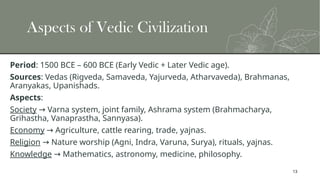
● Various aspects of Vedic civilization
● Dharma and darshan- Vedic Dharm and Shad Darshan (6+3)
Development of scientific thoughts in ancient India
● Development of Science and Technology in ancient India
● Astronomy - Aryabhata and Varahmihir
● Mathematics- Shulvasutra and Baksali manuscript,
Formulation of Arithmetic, Algebra and trigonometry
● Life Sciences – Life science in Plants, Anatomy,
Physiology, Ayurveda, Medicine, Microbiology, Surgery,
Yoga and Meditation etc.
Basic knowledge ofIKS
o The Indian Knowledge System (IKS) encompasses the intellectual
and philosophical traditions of India, rooted in ancient practices like
the guru-shishya parampara and includes diverse areas such as
philosophy, Ayurveda, yoga, arts, and literature.
o Key aspects include six systems of Indian philosophy, holistic health
through Ayurveda, various forms of yoga, and the significance of
dharma and karma in moral living.
o IKS also highlights the modern relevance of these traditions in
addressing contemporary challenges across multiple fields.
5.
5
Scope of IKS
IKScovers almost every aspect of human knowledge and life:
•Philosophy & Spirituality – Vedas, Upanishads, Yoga, Vedanta.
•Sciences & Technology – Ayurveda (medicine), Mathematics (zero, decimal,
astronomy), Metallurgy (iron, zinc), Architecture (Vastu Shastra).
•Arts & Literature – Sanskrit literature, epics (Ramayana, Mahabharata),
performing arts (Natya Shastra, music, dance).
•Social & Political Thought – Arthashastra (economics, governance),
Dharmashastra (law & ethics).
•Environment & Agriculture – Ancient irrigation, organic farming,
sustainable practices.
•Education System – Gurukul system, Nalanda, Takshashila universities.
6.
6
Archaeological Sources ofIKS
Archaeology provides material evidence that supports written
and oral traditions.
• Stone tools, pottery, figurines, cave art, inscriptions show
→
the technological and cultural achievements.
• Burial sites religious beliefs and rituals.
→
• Settlements & architecture social organization, economy,
→
urban planning.
7.
7
Prehistoric Period Evidence
Prehistory= before writing systems, evidence mainly from
archaeology.
• Palaeolithic Age (2 million–10,000 BCE).
• Mesolithic Age (10,000–8000 BCE).
• Neolithic Age (8000–3000 BCE).
• Chalcolithic Age (3000–1500 BCE).
• Indus Valley Civilization (2600–1900 BCE).
8.
8
Paleolithic Age (OldStone Age)
• Tools: Hand axes, cleavers, scrapers, choppers (stone-based
technology).
• Lifestyle: Hunting-gathering, nomadic.
• Discoveries:
Use of fire (proof from Kurnool caves, Andhra Pradesh).
Cave paintings: Bhimbetka (Madhya Pradesh) depictions of
→
animals, hunting scenes, dances.
• Significance: Early human creativity, survival strategies,
symbolic communication.
9.
9
Mesolithic Age (MiddleStone Age)
• Tools: Microliths (small, sharp stone blades) fixed on wood
or bone.
• Lifestyle: Semi-nomadic, fishing, hunting, beginning of
food production.
• Rock art: More detailed paintings humans, animals,
→
rituals.
• Sites: Bagor (Rajasthan), Adamgarh (Madhya Pradesh).
• Significance: Transition from nomadic to semi-settled life.
10.
10
Neolithic Age (NewStone Age)
Agriculture begins domestication of plants (wheat, barley,
→
rice) and animals (cattle, sheep, goats).
• Settlements: Mud huts, storage pits, stone tools polished
and refined.
• Pottery: Handmade, later wheel-made.
• Sites: Burzahom (Kashmir), Chirand (Bihar), Mehrgarh
(Baluchistan – early farming).
• Knowledge contribution: Start of agricultural science,
animal husbandry, pottery technology.
11.
11
Chalcolithic Age (Stone–CopperAge)
Use of copper and stone together.
• Advances: Painted pottery, beads, terracotta figurines.
• Economy: Agriculture, trade, copper tools.
• Sites: Malwa, Jorwe (Maharashtra), Ahar (Rajasthan).
• Significance: First rural communities, surplus food
production.
12.
12
Indus Valley Civilization(Harappan
Civilization)
• Urban planning: Cities (Harappa, Mohenjo-Daro, Lothal, Dholavira).
• Drainage system: Covered drains, soak pits sanitation science.
→
• Architecture: Granaries, Great Bath (Mohenjo-Daro), dockyard
(Lothal).
• Economy: Standardized weights & measures, bead-making, trade
with Mesopotamia.
• Crafts & Technology: Bronze metallurgy, seals, pottery.
• Cultural aspects: Terracotta figurines (Mother Goddess), possible
proto-Shiva seal.
• Significance: Advanced urban civilization with science, trade, and
14
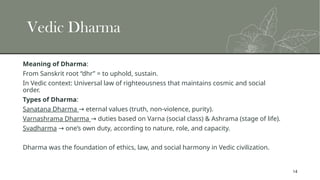
Vedic Dharma
Meaning ofDharma:
From Sanskrit root “dhr” = to uphold, sustain.
In Vedic context: Universal law of righteousness that maintains cosmic and social
order.
Types of Dharma:
Sanatana Dharma eternal values (truth, non-violence, purity).
→
Varnashrama Dharma duties based on Varna (social class) & Ashrama (stage of life).
→
Svadharma one’s own duty, according to nature, role, and capacity.
→
Dharma was the foundation of ethics, law, and social harmony in Vedic civilization.
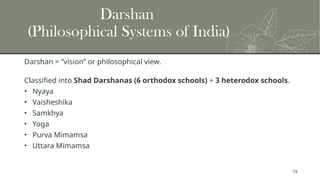
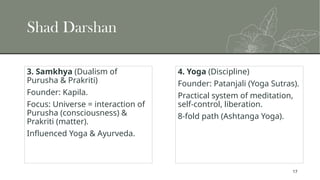
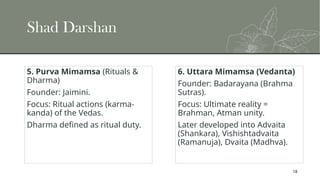
Shad Darshan
5. PurvaMimamsa (Rituals &
Dharma)
Founder: Jaimini.
Focus: Ritual actions (karma-
kanda) of the Vedas.
Dharma defined as ritual duty.
6. Uttara Mimamsa (Vedanta)
Founder: Badarayana (Brahma
Sutras).
Focus: Ultimate reality =
Brahman, Atman unity.
Later developed into Advaita
(Shankara), Vishishtadvaita
(Ramanuja), Dvaita (Madhva).
18
19.
19
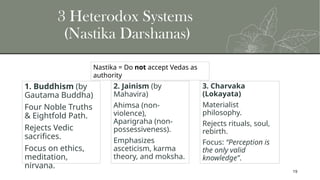
3 Heterodox Systems
(NastikaDarshanas)
1. Buddhism (by
Gautama Buddha)
Four Noble Truths
& Eightfold Path.
Rejects Vedic
sacrifices.
Focus on ethics,
meditation,
nirvana.
2. Jainism (by
Mahavira)
Ahimsa (non-
violence),
Aparigraha (non-
possessiveness).
Emphasizes
asceticism, karma
theory, and moksha.
3. Charvaka
(Lokayata)
Materialist
philosophy.
Rejects rituals, soul,
rebirth.
Focus: “Perception is
the only valid
knowledge”.
Nastika = Do not accept Vedas as
authority
20.
20
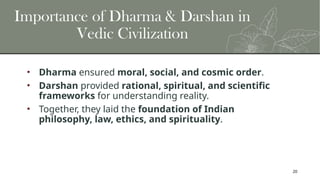
Importance of Dharma& Darshan in
Vedic Civilization
• Dharma ensured moral, social, and cosmic order.
• Darshan provided rational, spiritual, and scientific
frameworks for understanding reality.
• Together, they laid the foundation of Indian
philosophy, law, ethics, and spirituality.
Presentation title 22
Developmentof Science and
Technology in ancient India
o Ancient India made remarkable contributions to science
and technology that laid the foundation for many modern
disciplines.
o Indian scholars excelled in astronomy, mathematics,
medicine, metallurgy, life sciences, and yoga.
o Their discoveries were based on observation,
experimentation, and a deep understanding of nature.
23.
Presentation title 23
Astronomy- Aryabhata and Varahmihir
Aryabhata (476–550 CE)
o Authored the Aryabhatiya, a major text in
astronomy and mathematics.
o Proposed that the Earth rotates on its own
axis, explaining the apparent movement of
stars.
o Correctly explained solar and lunar eclipses as
shadows of Earth and Moon.
o Estimated the length of a year as 365.358
days and provided a near-accurate value of π
(pi = 3.1416).
o Introduced the concept of sine for calculating
planetary positions.
Varahmihir (505–587 CE)
o Wrote the Brihat Samhita and
Panchasiddhantika.
o Studied planetary movements, eclipses,
and weather patterns.
o Predicted rainfall and earthquakes using
astronomical observations.
o Recognized the existence of gravitational
attraction centuries before Newton.
24.
Presentation title 24
Mathematics
Shulvasutras(c. 800–500 BCE)
Part of the Vedic texts used to construct fire altars.
Contained advanced geometrical knowledge:
• Pythagorean theorem stated in geometric form.
• Rules for constructing squares, rectangles, and circles.
• Approximated 2 as 1.4142.
√
Showed early use of mathematics in practical and architectural design.
25.
Mathematics
Arithmetic, Algebra, andTrigonometry
Arithmetic (Ganita): Concepts of addition, subtraction, multiplication, and division
were systematized.
Algebra (Beejganita):
• Introduced by Brahmagupta and later developed by Bhaskara II.
• Included rules for solving quadratic equations and using negative numbers.
Trigonometry (Trikonamiti):
• Introduced by Aryabhata and refined by Bhaskara II.
• Defined sine (jya), cosine (kojya), and tangent (otkram jya) functions.
• Used for calculating planetary positions and eclipses.
Presentation title 25
26.
Presentation title 26
Mathematics
BakhshaliManuscript (3rd–7th century CE)
An ancient mathematical text written on birch bark.
Included rules for arithmetic, algebra, and geometry.
Used a dot symbol for zero (•) — one of the earliest recorded uses
in the world.
Discussed fractions, square roots, and equations, showing an
advanced understanding of number systems.
Presentation title 26
27.
Presentation title 27
LifeSciences in Ancient India
o Life sciences in ancient India developed through careful
observation of living beings, nature, and the environment.
o Indian scholars studied the human body, plants, animals,
health, and diseases, combining spiritual understanding
with scientific reasoning.
o Their ideas laid the foundation for modern biology,
medicine, and psychology.
28.
Presentation title 28
1.Botany (Sciences of Plants)
•The Vedas and later texts like Vrikshayurveda (Science of Plants) by Parashara and
Surapala describe plant classification, growth, and medicinal properties.
•Ancient Indians recognized plants as living organisms capable of growth, response, and
reproduction.
Knowledge included:
•Seed germination and soil types
•Grafting, irrigation, and seasonal cultivation
•Medicinal and aromatic plants for healing
Plants were classified based on:
•Structure (herbs, shrubs, trees, climbers)
•Utility (food, medicine, timber, dye, etc.)
•The Rigveda and Atharvaveda mention over 200 medicinal plants.
29.
Presentation title 29
2.Anatomy & Physiology
Anatomy (Sharir Rachana)
Ancient scholars studied the structure of the
human body through dissection and
observation.
Sushruta Samhita describes the body as
composed of:
• Seven Dhatus (tissues): rasa (plasma),
rakta (blood), mamsa (muscle), meda (fat),
asthi (bone), majja (marrow), and shukra
(reproductive tissue).
Detailed descriptions of bones, muscles,
nerves, and organs appear centuries before
Western anatomy.
Physiology (Sharir Kriya)
Explained the functioning of the body
through the Tridosha theory:
• Vata (air & motion)
• Pitta (fire & metabolism)
• Kapha (water & structure)
Health means balance among these
three doshas; disease means imbalance.
Described systems like circulation,
digestion, excretion, and respiration
in scientific terms.
30.
Presentation title 30
3.Ayurveda (Science of Life)
Meaning and Origin
“Ayurveda” means “knowledge (veda) of life
(ayur)”.
Rooted in the Atharvaveda, it developed as
a comprehensive medical system.
Major texts:
• Charaka Samhita – by Charaka, focuses on
internal medicine.
• Sushruta Samhita – by Sushruta, focuses
on surgery.
• Ashtanga Hridaya – by Vagbhata, a
summary of both.
Principles of Ayurveda
Emphasizes the balance of body, mind,
and spirit.
Health = harmony of doshas (bio-
energies), dhatus (tissues), and malas
(wastes).
Preventive approach: Dinacharya (daily
routine) and Ritucharya (seasonal
routine).
Uses herbs, diet, exercise, and yoga for
prevention and cure.
31.
Presentation title 31
4.Medicine & Pharmacology
•Medicines were prepared from herbs, minerals, and animal products.
•Rasashastra (alchemy) developed the use of metals and minerals like
mercury, gold, and copper in treatment.
Ancient texts describe:
•Preparation of decoctions, powders, oils, and pastes
•Purification and preservation methods
Immunity (Ojas) was considered vital for disease prevention.
Special emphasis was placed on diet (Ahara) and lifestyle (Vihara) as
therapeutic tools.
32.
32
5. Surgery (ShalyaTantra)
Sushruta – The Father of Surgery (Lived around 6th century BCE.)
Sushruta Samhita describes:
• 300+ surgical procedures
• 120 surgical instruments (made of metal, wood, and stone)
Surgical advancements included:
• Plastic surgery (rhinoplasty) – nose reconstruction
• Cataract removal using specialized instruments
• Lithotomy (removal of stones from bladder)
• Amputations, suturing, cauterization, and bone setting
Advocated training students on vegetables, animal hides, and human cadavers.
Emphasized sterilization, anesthesia using herbal extracts, and post-operative care.
33.
33
6. Yoga &Meditation
Origins Rooted in Upanishads and Patanjali’s Yoga Sutras (2nd century BCE).
Aimed at achieving harmony between body and mind.
Eight Limbs of Yoga (Ashtanga Yoga)
Yama – Moral discipline
Niyama – Personal discipline
Asana – Physical postures
Pranayama – Breath control
Pratyahara – Withdrawal of senses
Dharana – Concentration
Dhyana – Meditation
Samadhi – Spiritual realization
34.
Presentation title 34
Conclusion
oThe development of Life Sciences in Ancient India shows a
deep understanding of both the physical and psychological
aspects of health.
o Systems like Ayurveda and Yoga reflect India’s scientific
and philosophical wisdom.
o Even today, these ancient principles continue to guide
modern medicine, environmental science, and holistic
healthcare practices worldwide.