Comprehensive Exploration of Aquaculture and Fisheries: History, Systems, and Careers
An educational presentation covering aquaculture history, fish culture systems, Philippine aquaculture development, career paths, and business opportunities in fisheries.
Comprehensive Exploration of Aquaculture and Fisheries: History, Systems, and Careers
1.
AQUACULTURE
AND FISHERIES
E xp l o r i n g F i s h C u l t u r e a n d O p p o r t u n i t i e s | P r e s e n t e d b y Te d d y
Y u
2.
FOUR PICS ONEWORD
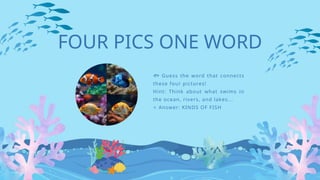
🐟 Guess the word that connects
these four pictures!
Hint: Think about what swims in
the ocean, rivers, and lakes...
⭐ Answer: KINDS OF FISH
3.
FOUR PICS ONEWORD
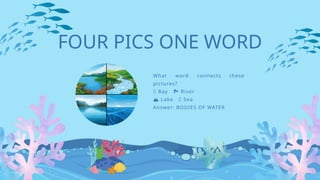
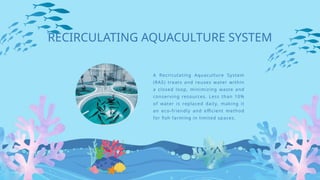
What word connects these
pictures?
🌊 Bay River
️ 🏞️
️
🏔️Lake 🌊 Sea
Answer: BODIES OF WATER
4.
FISHERMEN
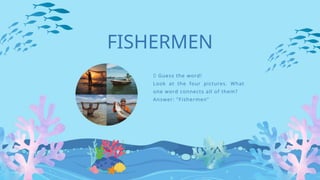
🎣 Guess theword!
Look at the four pictures. What
one word connects all of them?
Answer: "Fishermen"
5.
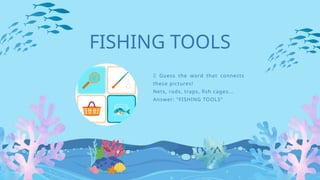
FISHING TOOLS
🎣 Guessthe word that connects
these pictures!
Nets, rods, traps, fish cages...
Answer: "FISHING TOOLS"
6.
FOUR PICS ONEWORD
Four pictures show fish cages in
ponds and seas.
🐠 Guess the word that connects
all four pictures!
Answer: FISH CAGE
7.
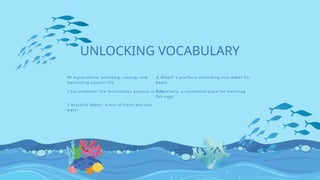
UNLOCKING VOCABULARY
🐟 Aquaculture:breeding, raising, and
harvesting aquatic life
⚓ Wharf: a platform extending into water for
boats
🌊 Fecundation: the fertilization process in fish
🥚 Hatchery: a controlled place for hatching
fish eggs
💧 Brackish Water: a mix of fresh and salt
water
8.
BRIEF BACKGROUND OF
AQUACULTURE
Fora long time, people believed that the ocean's fish supply was unlimited and would
never run out. However, as the world's population grew rapidly, the demand for fish
increased dramatically.
Illegal and overfishing practices further reduced fish stocks in rivers, lakes, and seas.
Fish populations began to decline at an alarming rate, threatening food security for
many communities.
This pressing problem prompted scientists and farmers around the world to develop fish
culture — the controlled breeding and raising of fish. Aquaculture emerged as a solution
to meet growing food demands while helping protect wild fish populations.
9.
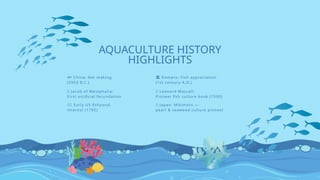
AQUACULTURE HISTORY
HIGHLIGHTS
🐟 China:Net making
(2953 B.C.)
️
🏛️Romans: Fish appreciation
(1st century A.D.)
🔬 Jacob of Westphalia:
First artificial fecundation
📖 Leonard Mascall:
Pioneer fish culture book (1590)
🇺🇸 Early US fishpond
interest (1792)
🦪 Japan: Mikimoto —
pearl & seaweed culture pioneer
10.
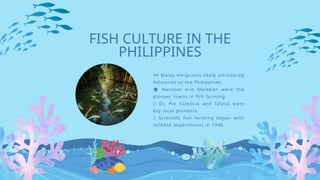
FISH CULTURE INTHE
PHILIPPINES
🐟 Malay emigrants likely introduced
fishponds to the Philippines.
️
🏘️ Navotas and Malabon were the
pioneer towns in fish farming.
🌟 Dr. Pio Valencia and Talava were
key local pioneers.
🔬 Scientific fish farming began with
milkfish experiments in 1940.
11.
PHILIPPINE AQUACULTURE
RESEARCH CENTERS
SoutheastAsian Fisheries Development
Center, Tigbuan, Iloilo
International Center for Living Aquatic
Resources Management, Makati
Central Luzon State University Freshwater
Aquaculture Center, Nueva Ecija
Brackishwater Aquaculture Center, University
of the Philippines
SEAFDEC: Research on marine and freshwater
fisheries development
CLSU: Specializes in freshwater fish culture
and aquaculture training
12.
TYPES OF AQUACULTURESYSTEMS
Fish can be cultured using a variety of methods, each adapted to different environments,
resources, and needs. The main aquaculture systems include:
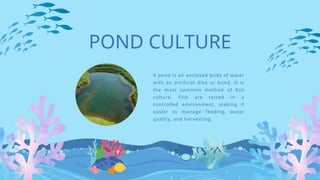
🐟 Pond Culture – Fish raised in enclosed water areas with artificial dikes or bunds.
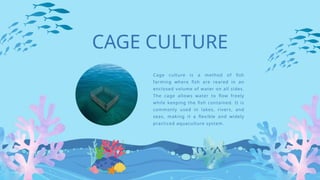
🐠 Cage Culture – Fish reared in enclosed volumes of water on all sides.
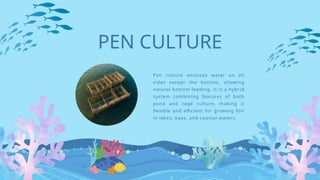
🐡 Pen Culture – Enclosed on all sides except the bottom, blending pond and cage methods.
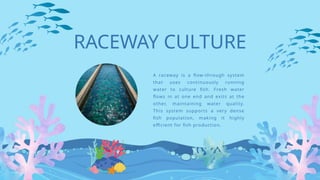
💧 Raceway Culture – A flow-through system using running water for dense fish populations.
♻️Recirculating System – Water is treated and reused, with less than 10% replaced daily.
Each system offers unique advantages depending on location, species, and scale of
production.
13.
POND CULTURE
A pondis an enclosed body of water
with an artificial dike or bund. It is
the most common method of fish
culture. Fish are raised in a
controlled environment, making it
easier to manage feeding, water
quality, and harvesting.
14.
CAGE CULTURE
Cage cultureis a method of fish
farming where fish are reared in an
enclosed volume of water on all sides.
The cage allows water to flow freely
while keeping the fish contained. It is
commonly used in lakes, rivers, and
seas, making it a flexible and widely
practiced aquaculture system.
15.
PEN CULTURE
Pen cultureencloses water on all
sides except the bottom, allowing
natural bottom feeding. It is a hybrid
system combining features of both
pond and cage culture, making it
flexible and efficient for growing fish
in lakes, bays, and coastal waters.
16.
RACEWAY CULTURE
A racewayis a flow-through system
that uses continuously running
water to culture fish. Fresh water
flows in at one end and exits at the
other, maintaining water quality.
This system supports a very dense
fish population, making it highly
efficient for fish production.
17.
RECIRCULATING AQUACULTURE SYSTEM
ARecirculating Aquaculture System
(RAS) treats and reuses water within
a closed loop, minimizing waste and
conserving resources. Less than 10%
of water is replaced daily, making it
an eco-friendly and efficient method
for fish farming in limited spaces.
18.
CAREER OPPORTUNITIES IN
AQUACULTURE
AquaCulturist
Breeding & rearing aquatic organisms
Fishery Technician
Fisheries management & monitoring
Fish Farm Caretaker
Daily care of fish stocks
Research Officer
Advancing industry knowledge
Fish Wharf Operator
Managing fish unloading & processing
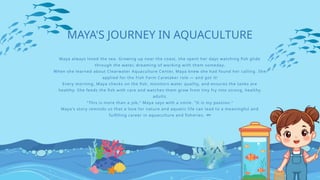
MAYA'S JOURNEY INAQUACULTURE
Maya always loved the sea. Growing up near the coast, she spent her days watching fish glide
through the water, dreaming of working with them someday.
When she learned about Clearwater Aquaculture Center, Maya knew she had found her calling. She
applied for the Fish Farm Caretaker role — and got it!
Every morning, Maya checks on the fish, monitors water quality, and ensures the tanks are
healthy. She feeds the fish with care and watches them grow from tiny fry into strong, healthy
adults.
"This is more than a job," Maya says with a smile. "It is my passion."
Maya's story reminds us that a love for nature and aquatic life can lead to a meaningful and
fulfilling career in aquaculture and fisheries. 🐟
21.
CAREER OR JOB
IDENTIFICATIONCHALLENGE
Fish Supplier Aqua Culturist
Research Officer Fish Caretaker
Fish Wharf Operator
Fish Trader
22.
LESSON TAKEAWAYS
Can younarrate the brief background of aquaculture in the Philippines? Share
what you know about how fish culture began and developed in our country.
What are the different career and job opportunities in aquaculture and
fisheries? Can you give examples and explain each one?
23.
REFLECTION ON LEARNING
Completethe sentences below and share your thoughts with the class:
🐟 I understand that _______________________________________________.
🌊 I realize that _______________________________________________.
🐠 I need to learn more about _______________________________________________.
Thank you for being amazing learners today! Keep exploring the wonderful
world of Aquaculture and Fisheries! 🌟