Comprehensive E-commerce Marketing and Advertising Strategies for 2026
Explore digital commerce marketing tools, online advertising, social, mobile, and local marketing, plus customer retention strategies to build brand and increase sales in e-commerce.
E-commerce Marketing andAdvertising Concepts
Chapter Objectives
1. Identify and describe the basic digital commerce marketing and advertising strategies and
tools.
5.
E-commerce Marketing andAdvertising Concepts
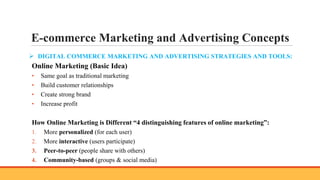
➢ DIGITAL COMMERCE MARKETING AND ADVERTISING STRATEGIES AND TOOLS:
Online Marketing (Basic Idea)
• Same goal as traditional marketing
• Build customer relationships
• Create strong brand
• Increase profit
How Online Marketing is Different “4 distinguishing features of online marketing”:
1. More personalized (for each user)
2. More interactive (users participate)
3. Peer-to-peer (people share with others)
4. Community-based (groups & social media)
6.
E-commerce Marketing andAdvertising Concepts
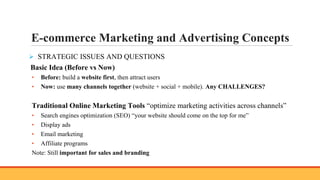
➢ STRATEGIC ISSUES AND QUESTIONS
Basic Idea (Before vs Now)
• Before: build a website first, then attract users
• Now: use many channels together (website + social + mobile). Any CHALLENGES?
Traditional Online Marketing Tools “optimize marketing activities across channels”
• Search engines optimization (SEO) “your website should come on the top for me”
• Display ads
• Email marketing
• Affiliate programs
Note: Still important for sales and branding
7.
E-commerce Marketing andAdvertising Concepts
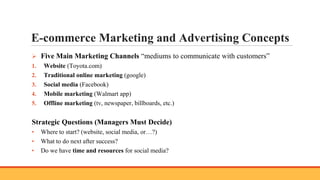
➢ Five Main Marketing Channels “mediums to communicate with customers”
1. Website (Toyota.com)
2. Traditional online marketing (google)
3. Social media (Facebook)
4. Mobile marketing (Walmart app)
5. Offline marketing (tv, newspaper, billboards, etc.)
Strategic Questions (Managers Must Decide)
• Where to start? (website, social media, or…?)
• What to do next after success?
• Do we have time and resources for social media?
8.
E-commerce Marketing andAdvertising Concepts
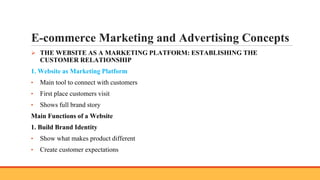
➢ THE WEBSITE AS A MARKETING PLATFORM: ESTABLISHING THE
CUSTOMER RELATIONSHIP
1. Website as Marketing Platform
• Main tool to connect with customers
• First place customers visit
• Shows full brand story
Main Functions of a Website
1. Build Brand Identity
• Show what makes product different
• Create customer expectations
9.
E-commerce Marketing andAdvertising Concepts
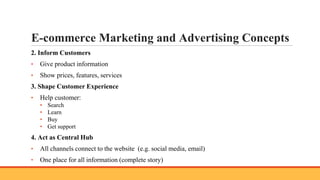
2. Inform Customers
• Give product information
• Show prices, features, services
3. Shape Customer Experience
• Help customer:
• Search
• Learn
• Buy
• Get support
4. Act as Central Hub
• All channels connect to the website (e.g. social media, email)
• One place for all information (complete story)
10.
E-commerce Marketing andAdvertising Concepts
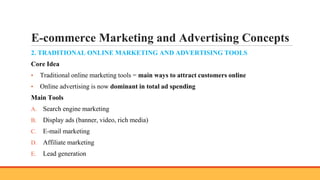
2. TRADITIONAL ONLINE MARKETING AND ADVERTISING TOOLS
Core Idea
• Traditional online marketing tools = main ways to attract customers online
• Online advertising is now dominant in total ad spending
Main Tools
A. Search engine marketing
B. Display ads (banner, video, rich media)
C. E-mail marketing
D. Affiliate marketing
E. Lead generation
11.
E-commerce Marketing andAdvertising Concepts
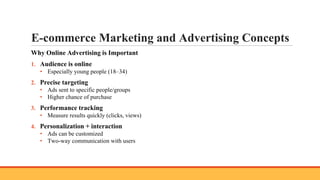
Why Online Advertising is Important
1. Audience is online
• Especially young people (18–34)
2. Precise targeting
• Ads sent to specific people/groups
• Higher chance of purchase
3. Performance tracking
• Measure results quickly (clicks, views)
4. Personalization + interaction
• Ads can be customized
• Two-way communication with users
12.
E-commerce Marketing andAdvertising Concepts
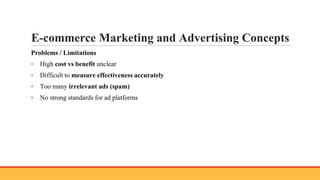
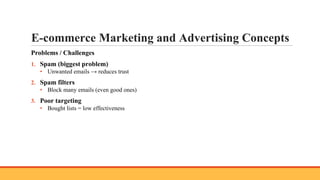
Problems / Limitations
• High cost vs benefit unclear
• Difficult to measure effectiveness accurately
• Too many irrelevant ads (spam)
• No strong standards for ad platforms
13.
E-commerce Marketing andAdvertising Concepts
A. Search Engine Marketing and Advertising
Core Idea
• Search Engine Marketing (SEM) = use search engines to build brand + get sales
• One of the most important online marketing tools
Why It Is Powerful
1. Users are already searching
• People search when they need something
• Ads match user intention
2. High visibility
• Ads appear at the top of search results
3. Targeted advertising
• Based on keywords
• Right ad to right person
14.
E-commerce Marketing andAdvertising Concepts
How It Works
1. Keyword advertising (PPC)
• Companies pay for keywords
• Pay only when users click (Pay-Per-Click)
2. Ad ranking
• Based on:
• Money paid
• Number of clicks
3. Ad networks (AdSense)
• Ads appear on other websites
• Revenue shared with site owners
15.
E-commerce Marketing andAdvertising Concepts
SEO (Search Engine Optimization)
Improve website ranking without paying (Higher rank = more visitors)
• Use:
• Good keywords
• Updated content
• Good website design
Problems / Risks
• Dependence on search engines (especially Google)
• Ranking system is not clear
• Click fraud (fake clicks → waste money)
• Content (low-quality content)
• Link (fake links to cheat ranking)
16.
E-commerce Marketing andAdvertising Concepts
B. Display Ad Marketing
Core Idea
• Display advertising = visual ads shown online (websites, apps, social media)
• It is the largest part of digital advertising
Main Types (5 types)
1. Banner ads
• Simple image ads
• Cheap but low effectiveness
2. Rich media ads
• Interactive (animation, expanding ads)
• More engagement
17.
E-commerce Marketing andAdvertising Concepts
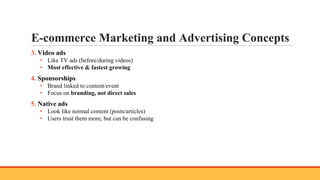
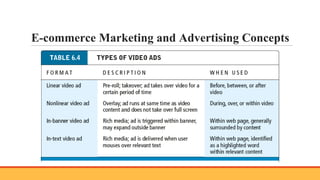
3. Video ads
• Like TV ads (before/during videos)
• Most effective & fastest growing
4. Sponsorships
• Brand linked to content/event
• Focus on branding, not direct sales
5. Native ads
• Look like normal content (posts/articles)
• Users trust them more, but can be confusing
E-commerce Marketing andAdvertising Concepts
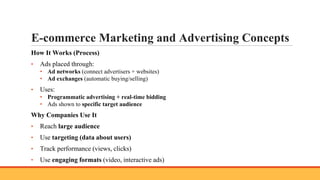
How It Works (Process)
• Ads placed through:
• Ad networks (connect advertisers + websites)
• Ad exchanges (automatic buying/selling)
• Uses:
• Programmatic advertising + real-time bidding
• Ads shown to specific target audience
Why Companies Use It
• Reach large audience
• Use targeting (data about users)
• Track performance (views, clicks)
• Use engaging formats (video, interactive ads)
20.
E-commerce Marketing andAdvertising Concepts
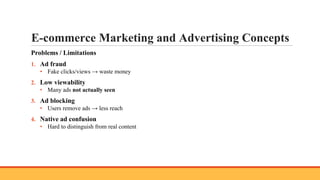
Problems / Limitations
1. Ad fraud
• Fake clicks/views → waste money
2. Low viewability
• Many ads not actually seen
3. Ad blocking
• Users remove ads → less reach
4. Native ad confusion
• Hard to distinguish from real content
21.
E-commerce Marketing andAdvertising Concepts
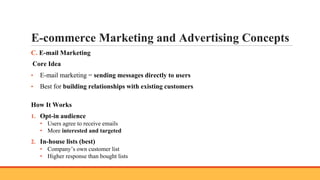
C. E-mail Marketing
Core Idea
• E-mail marketing = sending messages directly to users
• Best for building relationships with existing customers
How It Works
1. Opt-in audience
• Users agree to receive emails
• More interested and targeted
2. In-house lists (best)
• Company’s own customer list
• Higher response than bought lists
22.
E-commerce Marketing andAdvertising Concepts
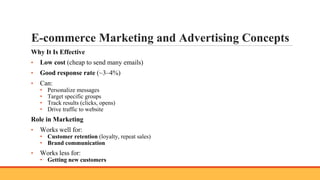
Why It Is Effective
• Low cost (cheap to send many emails)
• Good response rate (~3–4%)
• Can:
• Personalize messages
• Target specific groups
• Track results (clicks, opens)
• Drive traffic to website
Role in Marketing
• Works well for:
• Customer retention (loyalty, repeat sales)
• Brand communication
• Works less for:
• Getting new customers
E-commerce Marketing andAdvertising Concepts
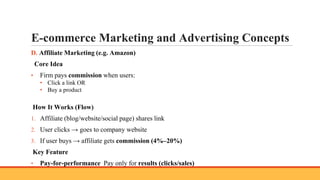
D. Affiliate Marketing (e.g. Amazon)
Core Idea
• Firm pays commission when users:
• Click a link OR
• Buy a product
How It Works (Flow)
1. Affiliate (blog/website/social page) shares link
2. User clicks → goes to company website
3. If user buys → affiliate gets commission (4%–20%)
Key Feature
• Pay-for-performance Pay only for results (clicks/sales)
25.
E-commerce Marketing andAdvertising Concepts
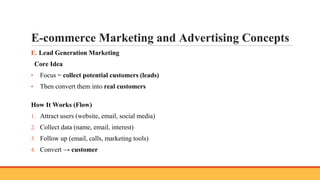
E. Lead Generation Marketing
Core Idea
• Focus = collect potential customers (leads)
• Then convert them into real customers
How It Works (Flow)
1. Attract users (website, email, social media)
2. Collect data (name, email, interest)
3. Follow up (email, calls, marketing tools)
4. Convert → customer
26.
E-commerce Marketing andAdvertising Concepts
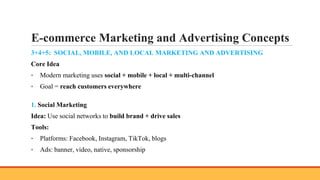
3+4+5: SOCIAL, MOBILE, AND LOCAL MARKETING AND ADVERTISING
Core Idea
• Modern marketing uses social + mobile + local + multi-channel
• Goal = reach customers everywhere
1. Social Marketing
Idea: Use social networks to build brand + drive sales
Tools:
• Platforms: Facebook, Instagram, TikTok, blogs
• Ads: banner, video, native, sponsorship
27.
E-commerce Marketing andAdvertising Concepts
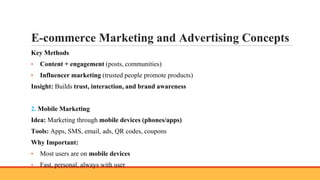
Key Methods
• Content + engagement (posts, communities)
• Influencer marketing (trusted people promote products)
Insight: Builds trust, interaction, and brand awareness
2. Mobile Marketing
Idea: Marketing through mobile devices (phones/apps)
Tools: Apps, SMS, email, ads, QR codes, coupons
Why Important:
• Most users are on mobile devices
• Fast, personal, always with user
28.
E-commerce Marketing andAdvertising Concepts
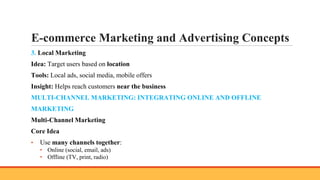
3. Local Marketing
Idea: Target users based on location
Tools: Local ads, social media, mobile offers
Insight: Helps reach customers near the business
MULTI-CHANNEL MARKETING: INTEGRATING ONLINE AND OFFLINE
MARKETING
Multi-Channel Marketing
Core Idea
• Use many channels together:
• Online (social, email, ads)
• Offline (TV, print, radio)
29.
E-commerce Marketing andAdvertising Concepts
How It Works (Flow)
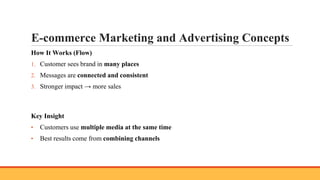
1. Customer sees brand in many places
2. Messages are connected and consistent
3. Stronger impact → more sales
Key Insight
• Customers use multiple media at the same time
• Best results come from combining channels
30.
E-commerce Marketing andAdvertising Concepts
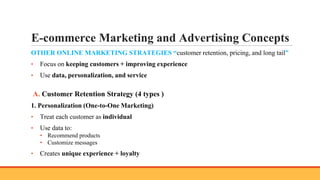
OTHER ONLINE MARKETING STRATEGIES “customer retention, pricing, and long tail”
• Focus on keeping customers + improving experience
• Use data, personalization, and service
A. Customer Retention Strategy (4 types )
1. Personalization (One-to-One Marketing)
• Treat each customer as individual
• Use data to:
• Recommend products
• Customize messages
• Creates unique experience + loyalty
31.
E-commerce Marketing andAdvertising Concepts
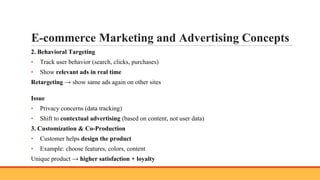
2. Behavioral Targeting
• Track user behavior (search, clicks, purchases)
• Show relevant ads in real time
Retargeting → show same ads again on other sites
Issue
• Privacy concerns (data tracking)
• Shift to contextual advertising (based on content, not user data)
3. Customization & Co-Production
• Customer helps design the product
• Example: choose features, colors, content
Unique product → higher satisfaction + loyalty
32.
E-commerce Marketing andAdvertising Concepts
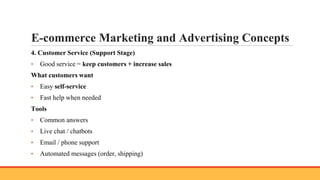
4. Customer Service (Support Stage)
• Good service = keep customers + increase sales
What customers want
• Easy self-service
• Fast help when needed
Tools
• Common answers
• Live chat / chatbots
• Email / phone support
• Automated messages (order, shipping)
33.
E-commerce Marketing andAdvertising Concepts
B. Pricing Strategies
• Pricing = key part of marketing
• Goal = maximize profit + attract customers
Reality vs Expectation
• Expected: Internet → one price (cheap for all)
• Reality: Firms still use different pricing strategies
Basic Pricing Logic
• Price depends on:
• Cost
• Demand
• Goal:
• Profit when revenue = cost
34.
E-commerce Marketing andAdvertising Concepts
Key Pricing Strategies
1. Price Discrimination
• Different customers → different prices
• Based on willingness to pay
2. Free & Freemium
• Free → attract users
• Freemium → basic free + paid premium
Problem: many users never pay
35.
E-commerce Marketing andAdvertising Concepts
3. Versioning
• Same product → different versions
• Free (limited)
• Paid (full features)
4. Bundling
• Sell products together at lower price
• Increases sales + value perception
36.
E-commerce Marketing andAdvertising Concepts
5. Dynamic Pricing
• Price changes based on:
• Demand
• Time
• customer behavior
Types:
• Auctions → users decide price
• Yield management → adjust price to sell extra stock
• Surge pricing → higher price when demand high
• Flash sales → big discounts for short time
37.
E-commerce Marketing andAdvertising Concepts
C. Long Tail Marketing
• Long Tail Marketing = selling many low-demand (niche) products
• Internet makes these products visible and profitable
Basic Concept
• Traditional market:
• Focus on popular products (hits)
• Niche products are ignored
• Online market:
• Can sell both popular + niche products
38.
E-commerce Marketing andAdvertising Concepts
How It Works
1. Internet increases product visibility
• Search engines
• Recommendations
• Social media
2. Low costs (storage, distribution)
• Especially for digital products
3. Many small sales together
• Generate high total revenue
Key Insight
• Few products = high sales (hits)
• Many products = low individual sales (long tail)
• Combined niche sales can be very large