Comprehensive Concepts and Career Opportunities in Fisheries and Aquaculture
Explore the history, types, and systems of aquaculture alongside career paths and business opportunities in fisheries, including fish farming, distribution, and research roles.
Aquaculture and Fisheries
•It is said that in the early days, nobody
bothered about the culturing of fish for the
people believed that the sea can forever
yield them adequate supply of fish. The
increase of population and the use of illegal
fishing, however, did have adverse effect in
the natural productivity of the seas and
other bodies of water making the fish
scarce. This prompted the people to culture
fish.
9.
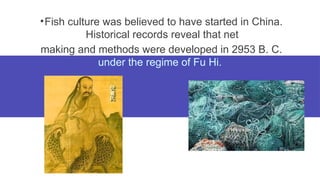
•Fish culture wasbelieved to have started in China.
Historical records reveal that net
making and methods were developed in 2953 B. C.
under the regime of Fu Hi.
10.
Fish farming was
wellattended during
this period but it did
not contribute
much to the scientific
progress of
aquaculture because
the people were
more interested
in food rather than in
the progress of the
industry.
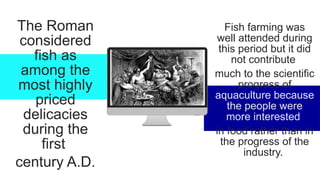
The Roman
considered
fish as
among the
most highly
priced
delicacies
during the
first
century A.D.
11.
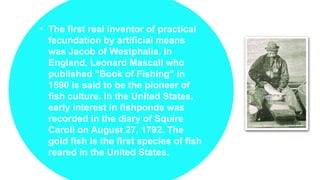
• The firstreal inventor of practical
fecundation by artificial means
was Jacob of Westphalia. In
England, Leonard Mascall who
published "Book of Fishing" in
1590 is said to be the pioneer of
fish culture. In the United States,
early interest in fishponds was
recorded in the diary of Squire
Caroll on August 27, 1792. The
gold fish is the first species of fish
reared in the United States.
12.
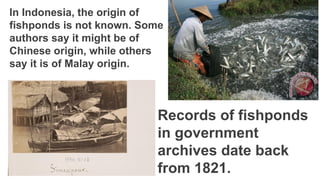
In Indonesia, theorigin of
fishponds is not known. Some
authors say it might be of
Chinese origin, while others
say it is of Malay origin.
Records of fishponds
in government
archives date back
from 1821.
13.
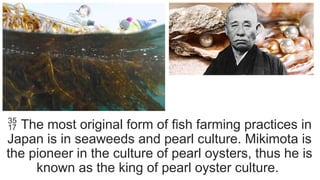
The mostoriginal form of fish farming practices in
Japan is in seaweeds and pearl culture. Mikimota is
the pioneer in the culture of pearl oysters, thus he is
known as the king of pearl oyster culture.
14.
• In thePhilippines, there is no
record as to when the
cultivation of fish in pond
started. The first fishponds
must have been introduced by
the Malay emigrants long
before the Chinese traders
came to the Philippines.
Navotas and Malabon are the
two principal towns which may
be considered as pioneers in
the fishpond industry in the
Philippines.
Fish Culture in the Philippines
15.
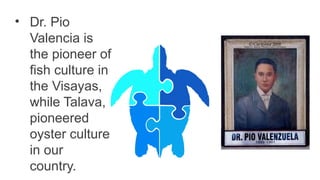
• Dr. Pio
Valenciais
the pioneer of
fish culture in
the Visayas,
while Talava,
pioneered
oyster culture
in our
country.
16.
Scientific fishfarming in our country may be said to
have started with the experiments on milkfish culture in
1940. In the sixties, improved milkfish culture was applied.
To further support the industry, national and international
research institutions were established in the early
seventies. Among the leading aquaculture research
centers today are the Southeast Asian Fisheries
Development Center's Aquaculture Department in Tigbuan,
Iloilo; the International Center for Living Aquatic
Resources Management in Makati; the Central Luzon State
University's Freshwater Aquaculture Center in Nueva Ecija;
and the Brackishwater Aquaculture Center of the
University of the Philippines.
17.
01
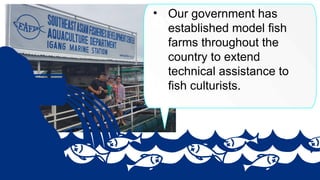
• Our governmenthas
established model fish
farms throughout the
country to extend
technical assistance to
fish culturists.
18.
Some operateas fish hatcheries
and nurseries and distribute
fingerlings to fish farmers.
19.
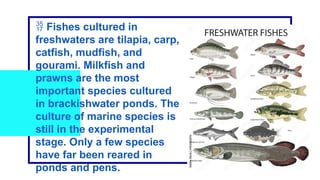
Fishes culturedin
freshwaters are tilapia, carp,
catfish, mudfish, and
gourami. Milkfish and
prawns are the most
important species cultured
in brackishwater ponds. The
culture of marine species is
still in the experimental
stage. Only a few species
have far been reared in
ponds and pens.
20.
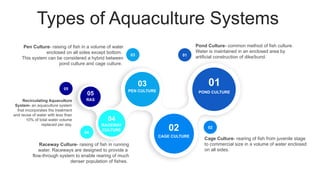
Types of AquacultureSystems
01
POND CULTURE
02
CAGE CULTURE
03
PEN CULTURE
04
RACEWAY
CULTURE
05
RAS
Cage Culture- rearing of fish from juvenile stage
to commercial size in a volume of water enclosed
on all sides.
02
Raceway Culture- raising of fish in running
water. Raceways are designed to provide a
flow-through system to enable rearing of much
denser population of fishes.
04
Pen Culture- raising of fish in a volume of water
enclosed on all sides except bottom.
This system can be considered a hybrid between
pond culture and cage culture.
03
Pond Culture- common method of fish culture.
Water is maintained in an enclosed area by
artificial construction of dike/bund.
01
Recirculating Aquaculture
System- an aquaculture system
that incorporates the treatment
and reuse of water with less than
10% of total water volume
replaced per day.
05
21.
SUB-TOPIC 2: Careerand Business
Opportunities
Text
Here
Text
Here
Text
Here
Text
Here
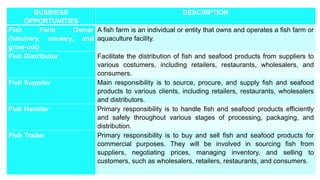
BUSINESS
OPPORTUNITIES
DESCRIPTION
Fish Farm Owner
(hatchery,nursery, and
grow-out)
A fish farm is an individual or entity that owns and operates a fish farm or
aquaculture facility.
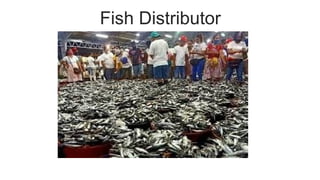
Fish Distributor Facilitate the distribution of fish and seafood products from suppliers to
various costumers, including retailers, restaurants, wholesalers, and
consumers.
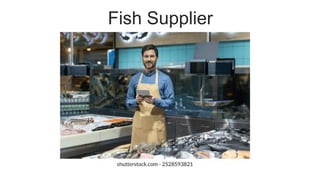
Fish Supplier Main responsibility is to source, procure, and supply fish and seafood
products to various clients, including retailers, restaurants, wholesalers
and distributors.
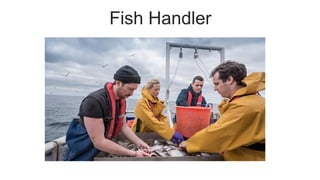
Fish Handler Primary responsibility is to handle fish and seafood products efficiently
and safely throughout various stages of processing, packaging, and
distribution.
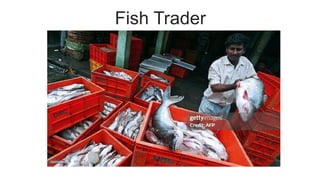
Fish Trader Primary responsibility is to buy and sell fish and seafood products for
commercial purposes. They will be involved in sourcing fish from
suppliers, negotiating prices, managing inventory, and selling to
customers, such as wholesalers, retailers, restaurants, and consumers.
#20 2. Pond Culture- common method of fish culture. Water is maintained in an enclosed area by artificial construction of dike/bund.
3. Cage Culture- rearing of fish from juvenile stage to commercial size in a volume of water enclosed on all sides.
4. Pen Culture- raising of fish in a volume of water enclosed on all sides except bottom. This system can be considered a hybrid between pond culture and cage culture.
5. Raceway Culture- raising of fish in running water. Raceways are designed to provide a flow-through system to enable rearing of much denser population of fishes.
6. Recirculating Aquaculture System- an aquaculture system that incorporates the treatment and reuse of water with less than 10% of total water volume replaced per day.
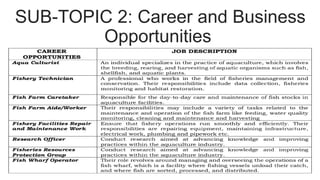
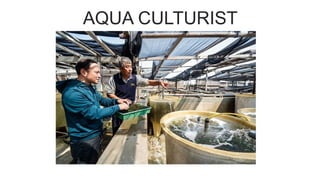
#22 An aquaculturist is someone who raises and manages aquatic animals and plants, like fish, shellfish, and seaweed, in controlled environments for various purposes including food production, restoration, and commercial products. They are essentially farmers of aquatic life.
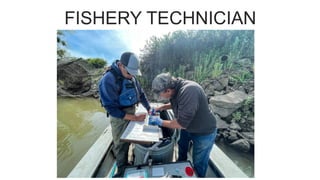
#23 A fisheries technician is a biologist who works within the fishing, aquaculture, and fish hatchery industries.
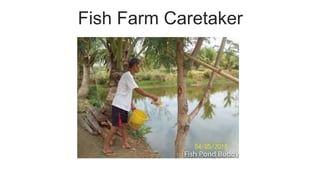
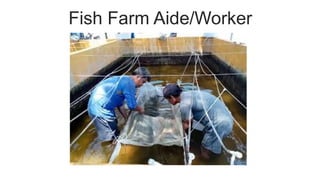
#24 Responsible for the day-to-day care and maintenance of fish stocks in aquaculture facilities.
#25 Their responsibilities may include a variety of tasks related to the maintenance and operation of the fish farm like feeding, water quality monitoring, cleaning and maintenance and harvesting
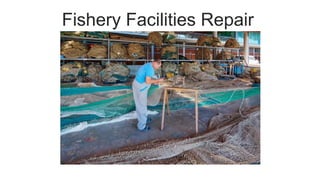
#26 Ensure that fishery operations run smoothly and efficiently. Their responsibilities are repairing equipment, maintaining infrastructure, electrical work, plumbing and pipework etc.
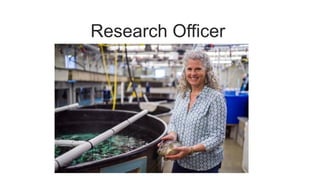
#27 Conduct research aimed at advancing knowledge and improving practices within the aquaculture industry.
#28 Conduct research aimed at advancing knowledge and improving practices within the aquaculture industry.
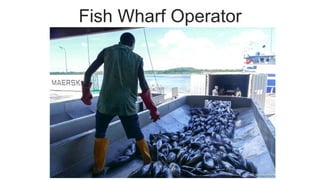
#29 Their role revolves around managing and overseeing the operations of a fish wharf, which is a facility where fishing vessels unload their catch, and where fish are sorted, processed, and distributed.
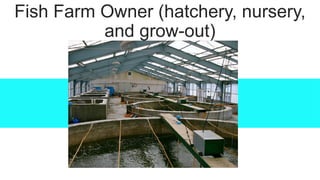
#31 A fish farm is an individual or entity that owns and operates a fish farm or aquaculture facility.
#32 Facilitate the distribution of fish and seafood products from suppliers to various costumers, including retailers, restaurants, wholesalers, and consumers.
#33 Main responsibility is to source, procure, and supply fish and seafood products to various clients, including retailers, restaurants, wholesalers and distributors.
#34 Primary responsibility is to handle fish and seafood products efficiently and safely throughout various stages of processing, packaging, and distribution.
#35 Primary responsibility is to buy and sell fish and seafood products for commercial purposes. They will be involved in sourcing fish from suppliers, negotiating prices, managing inventory, and selling to customers, such as wholesalers, retailers, restaurants, and consumers.
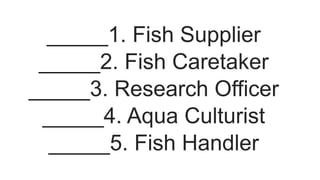
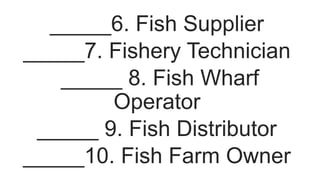
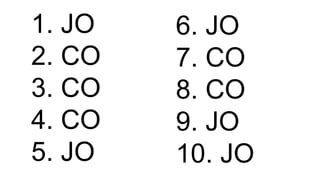
#39 JO 6. JO
2. CO 7. CO
3. CO 8. CO
4. CO 9. JO
5. JO 10. JO