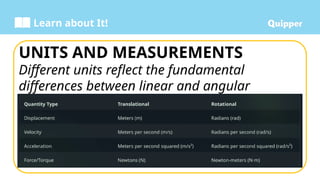
Comprehensive Comparison of Translational and Rotational Motion in Physics
Explore the differences between translational and rotational motion, including definitions, formulas, units, and sample problems on displacement, velocity, and acceleration in linear and angular contexts.
Learn about It!
OBJECTIVES:
Bythe end of the discussion,
learners are expected to:
1. Compare and contrast
translational and rotational
motion in terms of linear and
Learn about It!
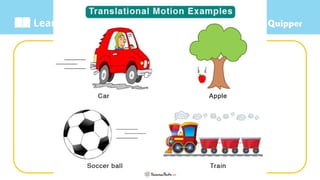
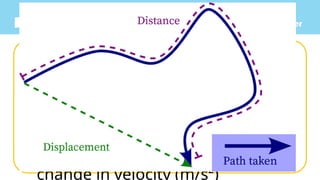
TRANSLATIONALMOTION
Translational motion occurs when an object
moves from one location to another along a
straight path.
Occurs when an object moves from one
point to another—either in a straight line
(rectilinear motion) or along a curved path
(curvilinear motion).
Learn about It!
Describedusing linear quantities:
Linear Displacement – Change in
position measured in meters (m)
Linear Velocity – Rate of change
in position (m/s)
Linear Acceleration – Rate of
change in velocity (m/s²)
Learn about It!
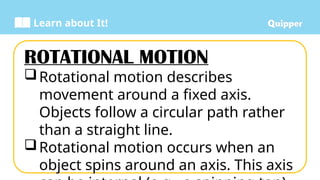
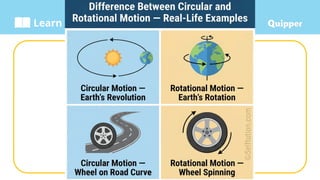
ROTATIONALMOTION
Rotational motion describes
movement around a fixed axis.
Objects follow a circular path rather
than a straight line.
Rotational motion occurs when an
object spins around an axis. This axis
Learn about It!
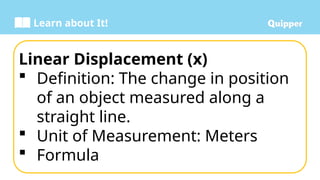
LinearDisplacement (x)
Definition: The change in position
of an object measured along a
straight line.
Unit of Measurement: Meters
Formula
15.
Learn about It!
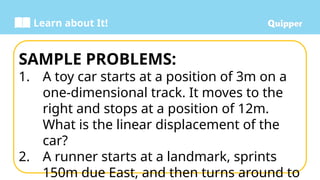
SAMPLEPROBLEMS:
1. A toy car starts at a position of 3m on a
one-dimensional track. It moves to the
right and stops at a position of 12m.
What is the linear displacement of the
car?
2. A runner starts at a landmark, sprints
150m due East, and then turns around to
Learn about It!
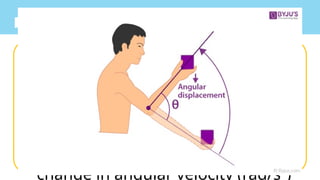
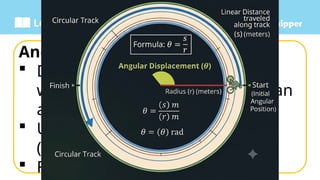
AngularDisplacement ()
Definition: The angle through
which an object rotates around an
axis.
Unit of Measurement: Radians
(rad)
Formula:
18.
Learn about It!
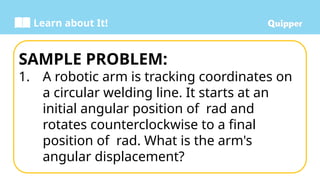
SAMPLEPROBLEM:
1. A robotic arm is tracking coordinates on
a circular welding line. It starts at an
initial angular position of rad and
rotates counterclockwise to a final
position of rad. What is the arm's
angular displacement?
19.
Learn about It!
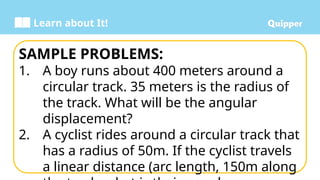
SAMPLEPROBLEMS:
1. A boy runs about 400 meters around a
circular track. 35 meters is the radius of
the track. What will be the angular
displacement?
2. A cyclist rides around a circular track that
has a radius of 50m. If the cyclist travels
a linear distance (arc length, 150m along
Learn about It!
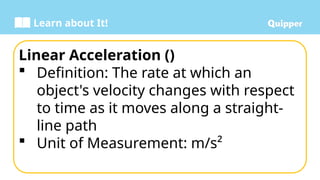
LinearAcceleration ()
Definition: The rate at which an
object's velocity changes with respect
to time as it moves along a straight-
line path
Unit of Measurement: m/s²
22.
Learn about It!
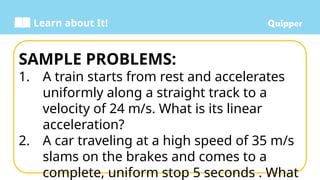
SAMPLEPROBLEMS:
1. A train starts from rest and accelerates
uniformly along a straight track to a
velocity of 24 m/s. What is its linear
acceleration?
2. A car traveling at a high speed of 35 m/s
slams on the brakes and comes to a
complete, uniform stop 5 seconds . What
23.
Learn about It!
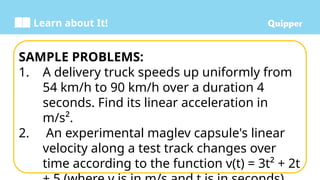
SAMPLEPROBLEMS:
1. A delivery truck speeds up uniformly from
54 km/h to 90 km/h over a duration 4
seconds. Find its linear acceleration in
m/s².
2. An experimental maglev capsule's linear
velocity along a test track changes over
time according to the function v(t) = 3t² + 2t
24.
Learn about It!
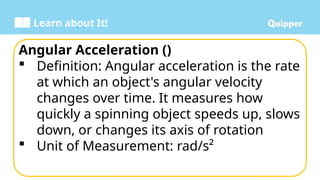
AngularAcceleration ()
Definition: Angular acceleration is the rate
at which an object's angular velocity
changes over time. It measures how
quickly a spinning object speeds up, slows
down, or changes its axis of rotation
Unit of Measurement: rad/s²
25.
Learn about It!
SAMPLEPROBLEMS:
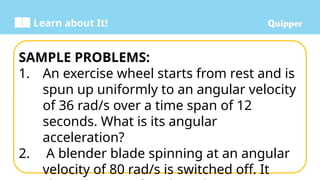
1. An exercise wheel starts from rest and is
spun up uniformly to an angular velocity
of 36 rad/s over a time span of 12
seconds. What is its angular
acceleration?
2. A blender blade spinning at an angular
velocity of 80 rad/s is switched off. It
26.
Learn about It!
SAMPLEPROBLEMS:
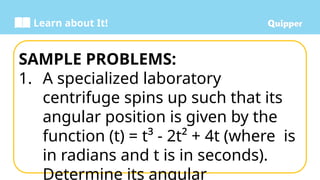
1. A specialized laboratory
centrifuge spins up such that its
angular position is given by the
function (t) = t³ - 2t² + 4t (where is
in radians and t is in seconds).
Determine its angular