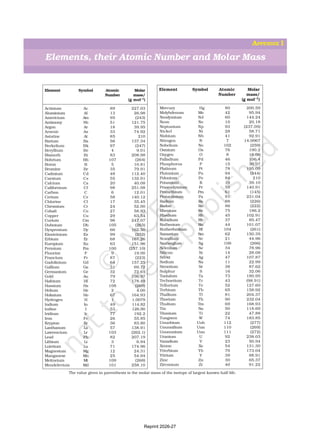
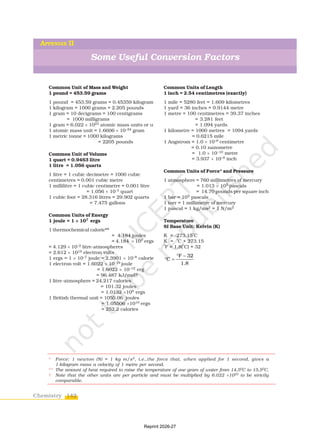
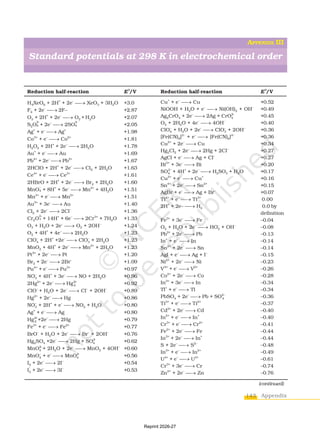
Comprehensive Chemistry Reference: Elements, Units, and Logarithms Explained
Detailed chemistry appendix covering elements' atomic data, common units of measurement, standard reduction potentials, and logarithm laws for chemical calculations.
144
Chemistry
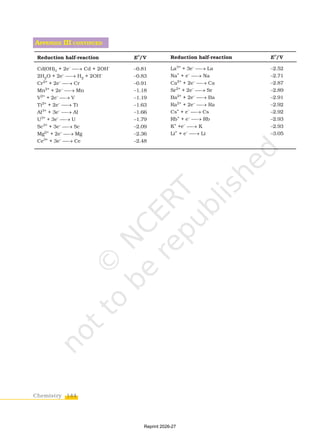
Reduction half-reaction Eo
/V
Cd(OH)2+ 2e–
¾® Cd + 2OH–
–0.81
2H2O + 2e–
¾® H2 + 2OH–
–0.83
Cr2+
+ 2e–
¾® Cr –0.91
Mn2+
+ 2e–
¾® Mn –1.18
V2+
+ 2e–
¾® V –1.19
Ti2+
+ 2e–
¾® Ti –1.63
Al3+
+ 3e–
¾® Al –1.66
U3+
+ 3e–
¾® U –1.79
Sc3+
+ 3e–
¾® Sc –2.09
Mg2+
+ 2e–
¾® Mg –2.36
Ce3+
+ 3e–
¾® Ce –2.48
Reduction half-reaction Eo
/V
La3+
+ 3e–
¾® La –2.52
Na+
+ e–
¾® Na –2.71
Ca2+
+ 2e–
¾® Ca –2.87
Sr2+
+ 2e–
¾® Sr –2.89
Ba2+
+ 2e–
¾® Ba –2.91
Ra2+
+ 2e–
¾® Ra –2.92
Cs+
+ e–
¾® Cs –2.92
Rb+
+ e–
¾® Rb –2.93
K+
+e–
¾® K –2.93
Li+
+ e–
¾® Li –3.05
APPENDIX III CONTINUED
Reprint 2026-27
5.
145 Appendix
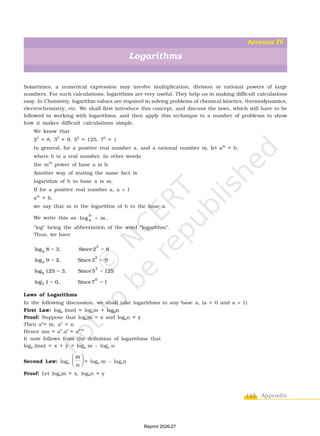
Sometimes, anumerical expression may involve multiplication, division or rational powers of large
numbers. For such calculations, logarithms are very useful. They help us in making difficult calculations
easy. In Chemistry, logarithm values are required in solving problems of chemical kinetics, thermodynamics,
electrochemistry, etc. We shall first introduce this concept, and discuss the laws, which will have to be
followed in working with logarithms, and then apply this technique to a number of problems to show
how it makes difficult calculations simple.
We know that
23
= 8, 32
= 9, 53
= 125, 70
= 1
In general, for a positive real number a, and a rational number m, let am
= b,
where b is a real number. In other words
the mth
power of base a is b.
Another way of stating the same fact is
logarithm of b to base a is m.
If for a positive real number a, a ¹ 1
am
= b,
we say that m is the logarithm of b to the base a.
We write this as
b
a
log m ,
“log” being the abbreviation of the word “logarithm”.
Thus, we have
= =
= =
= =
= =
3
2
2
3
3
5
0
7
log 8 3, Since2 8
log 9 2, Since3 9
log 125 3, Since5 125
log 1 0, Since7 1
Laws of Logarithms
In the following discussion, we shall take logarithms to any base a, (a > 0 and a ¹ 1)
First Law: loga (mn) = logam + logan
Proof: Suppose that logam = x and logan = y
Then ax
= m, ay
= n
Hence mn = ax
.ay
= ax+y
It now follows from the definition of logarithms that
loga (mn) = x + y = loga m – loga n
Second Law: loga
m
n
= loga m – logan
Proof: Let logam = x, logan = y
Logarithms
APPENDIX IV
Reprint 2026-27
6.
146
Chemistry
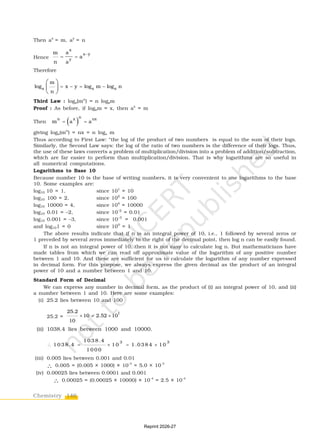
Then ax
= m,ay
= n
Hence
x
x y
y
a
m
a
n a
Therefore
a a a
m
log x y log m log n
n
Third Law : loga(mn
) = n logam
Proof : As before, if logam = x, then ax
= m
Then
n
n x nx
m a a
giving loga(mn
) = nx = n loga m
Thus according to First Law: “the log of the product of two numbers is equal to the sum of their logs.
Similarly, the Second Law says: the log of the ratio of two numbers is the difference of their logs. Thus,
the use of these laws converts a problem of multiplication/division into a problem of addition/subtraction,
which are far easier to perform than multiplication/division. That is why logarithms are so useful in
all numerical computations.
Logarithms to Base 10
Because number 10 is the base of writing numbers, it is very convenient to use logarithms to the base
10. Some examples are:
log10 10 = 1, since 101
= 10
log10 100 = 2, since 102
= 100
log10 10000 = 4, since 104
= 10000
log10 0.01 = –2, since 10–2
= 0.01
log10 0.001 = –3, since 10–3
= 0.001
and log101 = 0 since 100
= 1
The above results indicate that if n is an integral power of 10, i.e., 1 followed by several zeros or
1 preceded by several zeros immediately to the right of the decimal point, then log n can be easily found.
If n is not an integral power of 10, then it is not easy to calculate log n. But mathematicians have
made tables from which we can read off approximate value of the logarithm of any positive number
between 1 and 10. And these are sufficient for us to calculate the logarithm of any number expressed
in decimal form. For this purpose, we always express the given decimal as the product of an integral
power of 10 and a number between 1 and 10.
Standard Form of Decimal
We can express any number in decimal form, as the product of (i) an integral power of 10, and (ii)
a number between 1 and 10. Here are some examples:
(i) 25.2 lies between 10 and 100
25.2 =
1
25.2
10 2.52 10
10
(ii) 1038.4 lies between 1000 and 10000.
3 3
1 0 3 8 .4
1 0 3 8 .4 1 0 1 .0 3 8 4 1 0
1 0 0 0
(iii) 0.005 lies between 0.001 and 0.01
∴ 0.005 = (0.005 × 1000) × 10–3
= 5.0 × 10⁻³
(iv) 0.00025 lies between 0.0001 and 0.001
∴ 0.00025 = (0.00025 × 10000) × 10–4
= 2.5 × 10⁻⁴
Reprint 2026-27
7.
147 Appendix
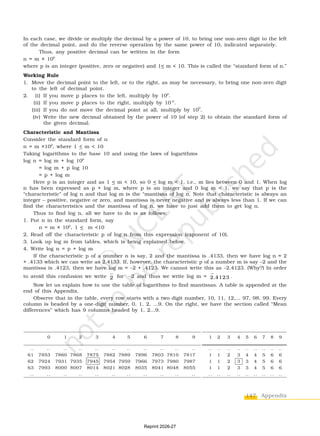
In eachcase, we divide or multiply the decimal by a power of 10, to bring one non-zero digit to the left
of the decimal point, and do the reverse operation by the same power of 10, indicated separately.
Thus, any positive decimal can be written in the form
n = m × 10
p
where p is an integer (positive, zero or negative) and 1< m < 10. This is called the “standard form of n.”
Working Rule
1. Move the decimal point to the left, or to the right, as may be necessary, to bring one non-zero digit
to the left of decimal point.
2. (i) If you move p places to the left, multiply by 10
p
.
(ii) If you move p places to the right, multiply by 10–p
.
(iii) If you do not move the decimal point at all, multiply by 100
.
(iv) Write the new decimal obtained by the power of 10 (of step 2) to obtain the standard form of
the given decimal.
Characteristic and Mantissa
Consider the standard form of n
n = m ×10p
, where 1 < m < 10
Taking logarithms to the base 10 and using the laws of logarithms
log n = log m + log 10p
= log m + p log 10
= p + log m
Here p is an integer and as 1 < m < 10, so 0 < log m < 1, i.e., m lies between 0 and 1. When log
n has been expressed as p + log m, where p is an integer and 0 log m < 1, we say that p is the
“characteristic” of log n and that log m is the “mantissa of log n. Note that characteristic is always an
integer – positive, negative or zero, and mantissa is never negative and is always less than 1. If we can
find the characteristics and the mantissa of log n, we have to just add them to get log n.
Thus to find log n, all we have to do is as follows:
1. Put n in the standard form, say
n = m × 10p
, 1 < m <10
2. Read off the characteristic p of log n from this expression (exponent of 10).
3. Look up log m from tables, which is being explained below.
4. Write log n = p + log m
If the characteristic p of a number n is say, 2 and the mantissa is .4133, then we have log n = 2
+ .4133 which we can write as 2.4133. If, however, the characteristic p of a number m is say –2 and the
mantissa is .4123, then we have log m = –2 + .4123. We cannot write this as –2.4123. (Why?) In order
to avoid this confusion we write 2 for –2 and thus we write log m = 2.4123 .
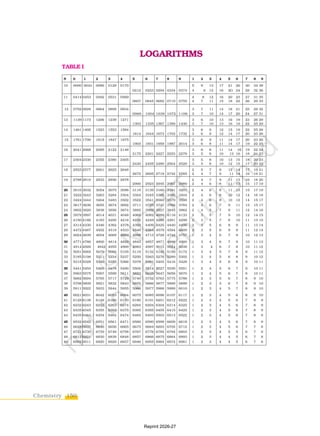
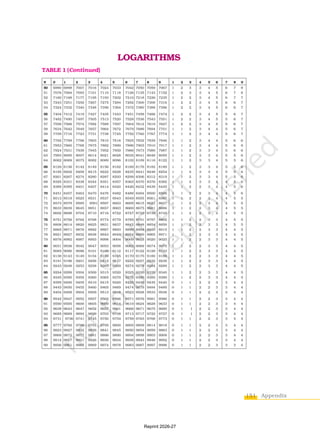
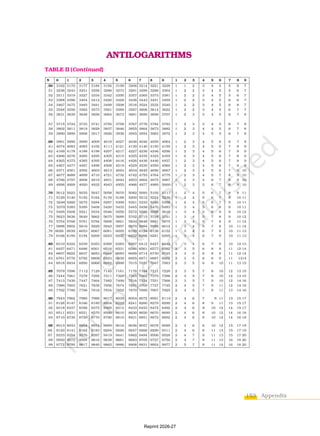
Now let us explain how to use the table of logarithms to find mantissas. A table is appended at the
end of this Appendix.
Observe that in the table, every row starts with a two digit number, 10, 11, 12,... 97, 98, 99. Every
column is headed by a one-digit number, 0, 1, 2, ...9. On the right, we have the section called “Mean
differences” which has 9 columns headed by 1, 2...9.
1 2 3 4 5 6 7 8 9
.. .. .. .. .. .. .. .. ..
1 1 2 3 4 4 5 6 6
1 1 2 3 3 4 5 6 6
1 1 2 3 3 4 5 6 6
.. .. .. .. .. .. .. .. ..
0 1 2 3 4 5 6 7 8 9
.. .. .. .. .. .. .. .. .. .. ..
61 7853 7860 7868 7875 7882 7889 7896 7803 7810 7817
62 7924 7931 7935 7945 7954 7959 7966 7973 7980 7987
63 7993 8000 8007 8014 8021 8028 8035 8041 8048 8055
.. .. .. .. .. .. .. .. .. .. ..
Reprint 2026-27
8.
148
Chemistry
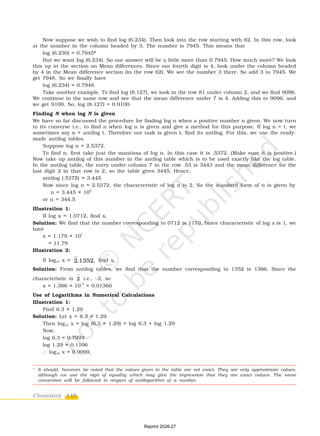
Now suppose wewish to find log (6.234). Then look into the row starting with 62. In this row, look
at the number in the column headed by 3. The number is 7945. This means that
log (6.230) = 0.7945*
But we want log (6.234). So our answer will be a little more than 0.7945. How much more? We look
this up in the section on Mean differences. Since our fourth digit is 4, look under the column headed
by 4 in the Mean difference section (in the row 62). We see the number 3 there. So add 3 to 7945. We
get 7948. So we finally have
log (6.234) = 0.7948.
Take another example. To find log (8.127), we look in the row 81 under column 2, and we find 9096.
We continue in the same row and see that the mean difference under 7 is 4. Adding this to 9096, and
we get 9100. So, log (8.127) = 0.9100.
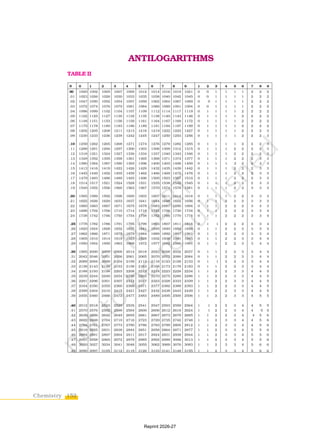
Finding N when log N is given
We have so far discussed the procedure for finding log n when a positive number n given. We now turn
to its converse i.e., to find n when log n is given and give a method for this purpose. If log n = t, we
sometimes say n = antilog t. Therefore our task is given t, find its antilog. For this, we use the ready-
made antilog tables.
Suppose log n = 2.5372.
To find n, first take just the mantissa of log n. In this case it is .5372. (Make sure it is positive.)
Now take up antilog of this number in the antilog table which is to be used exactly like the log table.
In the antilog table, the entry under column 7 in the row .53 is 3443 and the mean difference for the
last digit 2 in that row is 2, so the table gives 3445. Hence,
antilog (.5372) = 3.445
Now since log n = 2.5372, the characteristic of log n is 2. So the standard form of n is given by
n = 3.445 × 10
2
or n = 344.5
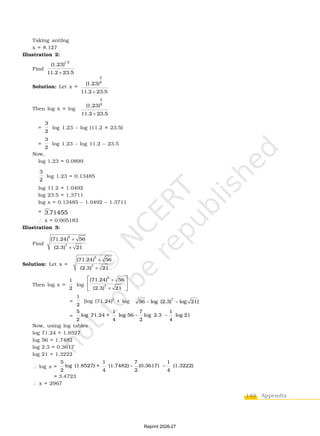
Illustration 1:
If log x = 1.0712, find x.
Solution: We find that the number corresponding to 0712 is 1179. Since characteristic of log x is 1, we
have
x = 1.179 × 101
= 11.79
Illustration 2:
If log10 x = 2.1352, find x.
Solution: From antilog tables, we find that the number corresponding to 1352 is 1366. Since the
characteristic is 2 i.e., –2, so
x = 1.366 × 10–2
= 0.01366
Use of Logarithms in Numerical Calculations
Illustration 1:
Find 6.3 × 1.29
Solution: Let x = 6.3 × 1.29
Then log10 x = log (6.3 × 1.29) = log 6.3 + log 1.29
Now,
log 6.3 = 0.7993
log 1.29 = 0.1106
log10 x = 0.9099,
* It should, however, be noted that the values given in the table are not exact. They are only approximate values,
although we use the sign of equality which may give the impression that they are exact values. The same
convention will be followed in respect of antilogarithm of a number.
Reprint 2026-27