Comprehensive Basics of Research Methodology for Pharmacy Students
An introductory presentation covering research types, processes, literature review, scientific databases, ethics, and tools essential for pharmacy research.
Comprehensive Basics of Research Methodology for Pharmacy Students
1.
SCHOOL OF PHARMACY
(Approvedby PCI, New Delhi)
SBV Chennai Campus
BASICS OF RESEARCH METHODOLOGY
Presented by
V. Dharshan,
Assistant Professor,
SBV Chennai Campus,
School of Pharmacy,
Shri Balaji Vidyapeeth.
2.
Session Outline
• Introductionto Research
• Why should study research methodology
• Types of Research
• Research Process
• Literature Review
• Source of Literature Review
• Scientific Database
• Research Ethics
• Summary
• Quiz
3.
What is Research?
•Research is a systematic, objective and scientific
investigation undertaken to discover new
knowledge, validate existing knowledge or solve
a specific problem.
• Key Characteristics:
✔ Systematic
✔ Logical
✔ Empirical
✔ Reproducible
✔ Ethical
4.
Why Study ResearchMethodology?
✅ Develop critical thinking
✅ Improve problem-solving skills
✅ Support evidence-based practice
✅ Enhance scientific writing
✅ Promote innovation and lifelong learning
5.
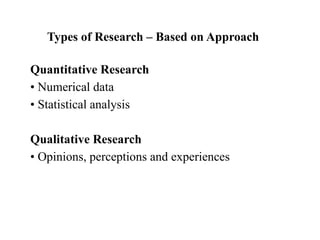
Types of Research– Based on Approach
Quantitative Research
• Numerical data
• Statistical analysis
Qualitative Research
• Opinions, perceptions and experiences
6.
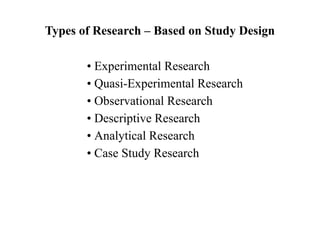
Types of Research– Based on Study Design
• Experimental Research
• Quasi-Experimental Research
• Observational Research
• Descriptive Research
• Analytical Research
• Case Study Research
7.
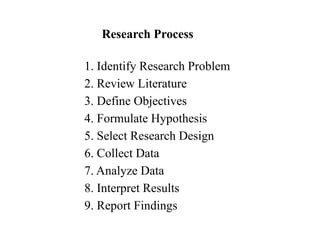
Research Process
1. IdentifyResearch Problem
2. Review Literature
3. Define Objectives
4. Formulate Hypothesis
5. Select Research Design
6. Collect Data
7. Analyze Data
8. Interpret Results
9. Report Findings
8.
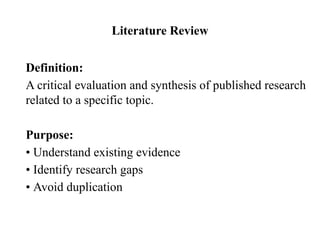
Literature Review
Definition:
A criticalevaluation and synthesis of published research
related to a specific topic.
Purpose:
• Understand existing evidence
• Identify research gaps
• Avoid duplication
9.
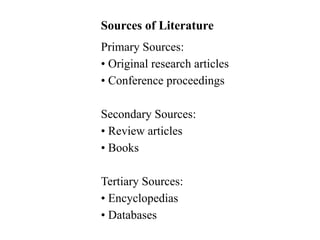
Sources of Literature
PrimarySources:
• Original research articles
• Conference proceedings
Secondary Sources:
• Review articles
• Books
Tertiary Sources:
• Encyclopedias
• Databases
10.
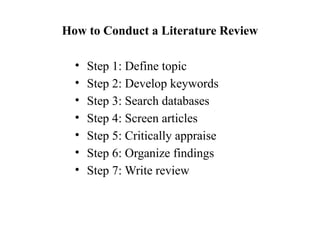
How to Conducta Literature Review
• Step 1: Define topic
• Step 2: Develop keywords
• Step 3: Search databases
• Step 4: Screen articles
• Step 5: Critically appraise
• Step 6: Organize findings
• Step 7: Write review
11.
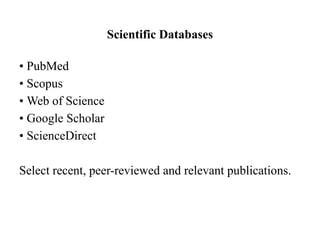
Scientific Databases
• PubMed
•Scopus
• Web of Science
• Google Scholar
• ScienceDirect
Select recent, peer-reviewed and relevant publications.
Research Ethics
Core Principles:
•Honesty
• Integrity
• Objectivity
• Confidentiality
• Respect for Participants
• Avoid plagiarism, fabrication and falsification.
14.
Summary
• Research isa systematic process.
• Different research types serve different purposes.
• Literature review is the foundation of research.
• Surveys are important data collection tools.
• Ethics ensure research quality and credibility.
15.
Quiz
1. What isresearch?
2. Name two types of research.
3. Why is literature review important?
4. Name any two scientific databases.
5. What is plagiarism?