Growth kinetics ofbatch culture
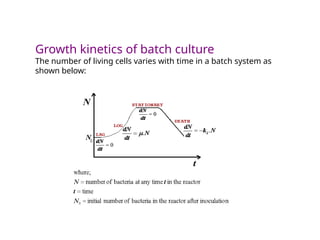
The number of living cells varies with time in a batch system as
shown below:
6.
where
;
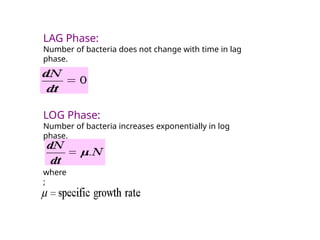
LAG Phase:
Number ofbacteria does not change with time in lag
phase.
LOG Phase:
Number of bacteria increases exponentially in log
phase.
7.
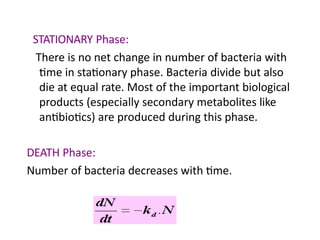
STATIONARY Phase:
There isno net change in number of bacteria with
time in stationary phase. Bacteria divide but also
die at equal rate. Most of the important biological
products (especially secondary metabolites like
antibiotics) are produced during this phase.
DEATH Phase:
Number of bacteria decreases with time.
8.
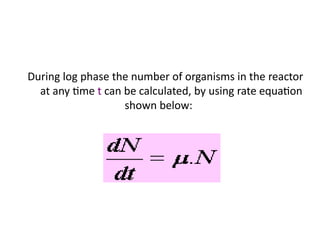
During log phasethe number of organisms in the reactor
at any time t can be calculated, by using rate equation
shown below:
9.
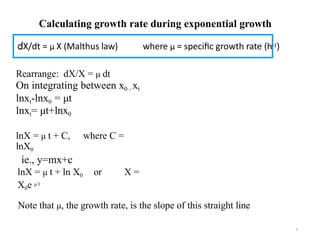
Note that μ,the growth rate, is the slope of this straight line
Calculating growth rate during exponential growth
9
dX/dt = μ X (Malthus law) where μ = specific growth rate (h-1)
Rearrange: dX/X = μ dt
On integrating between x0 - xt
lnxt-lnx0 = μt
lnxt= μt+lnx0
lnX = μ t + C, where C =
lnX0
ie., y=mx+c
lnX = μ t + ln X0 or X =
X0e μ t
10.
dX/dt = uXwhere u = specific
growth rate (h-1)
Rearrange: dX/X = udt
Integrate: lnX = ut + C, where C = lnX0
lnX = ut + ln X0 or X = X0eut
y = mx + b (equation for a straight line)
Note that u, the growth rate, is the slope of this
straight line
0 20 40 60
Time (Hours)
80 100
Viable
Count
(CFU/ml)
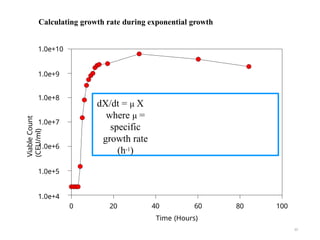
Calculating growth rate during exponential growth
10
1.0e+6
1.0e+5
1.0e+4
1.0e+7
1.0e+8
1.0e+10
1.0e+9
dX/dt = μ X
where μ =
specific
growth rate
(h-1)
11.
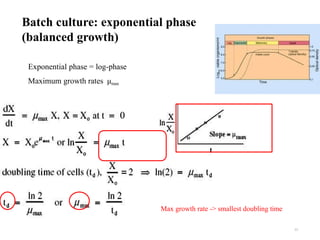
Batch culture: exponentialphase
(balanced growth)
11
Exponential phase = log-phase
Maximum growth rates μmax
Max growth rate -> smallest doubling time
12.
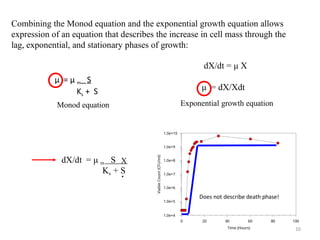
Combining the Monodequation and the exponential growth equation allows
expression of an equation that describes the increase in cell mass through the
lag, exponential, and stationary phases of growth:
dX/dt = μ X
μ = μ m S
Ks + S
Monod equation
μ = dX/Xdt
Exponential growth equation
dX/dt = μ m S X
.
Ks + S
Time (Hours)
0 20 40 60 80
Viable
Count
(CFU/ml)
1.0e+5
1.0e+4
1.0e+6
1.0e+7
1.0e+8
1.0e+9
1.0e+10
Does not describe death phase!
100
10
13.
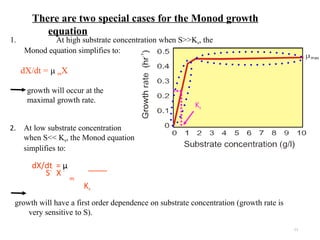
There are twospecial cases for the Monod growth
equation
13
1. At high substrate concentration when S>>Ks, the
Monod equation simplifies to:
dX/dt = μ mX
2. At low substrate concentration
when S<< Ks, the Monod equation
simplifies to:
dX/dt = μ
S.
X .
m
Ks
growth will have a first order dependence on substrate concentration (growth rate is
very sensitive to S).
growth will occur at the
maximal growth rate.
Ks
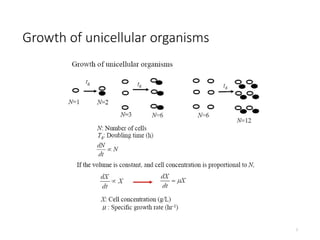
#1 Growth = Increase in the number of cells.
Kinetics = Study of the rate at which something happens.
So,
Growth kinetics is the study of how fast microorganisms grow under different conditions.
It helps us answer questions like:
How quickly do bacteria multiply?
When do they stop growing?
When do they start dying?
How can industries maximize bacterial growth to produce products like antibiotics or enzymes?
#2 This slide introduces the basic idea.
A unicellular organism is made of only one cell.
Examples:
Bacteria
Yeast
Some algae
How do they grow?
They do not become bigger and bigger.
Instead,
One bacterium divides into two.
Two divide into four.
Four divide into eight.
8 → 16 → 32 → 64
So growth means
Increase in cell number rather than cell size.
This is called binary fission.