Comparing Low-Latency Databases:
Aerospike and ScyllaDB
August 27, 2026 | 10am PT | 1pm ET | 6pm BST
The webinar will begin shortly…
Felipe Mendes, Technical Director at ScyllaDB
Guilherme Nogueira, Technical Director at ScyllaDB
Comparing Low-Latency Databases
Aerospike and ScyllaDB
Introductions
Felipe Mendes, Technical Director at ScyllaDB
+ Published Author on Linux and Databases
+ Helps teams solve their most challenging problems
+ Years of experience with Linux and distributed systems
Guilherme Nogueira, Technical Director at ScyllaDB
+ Previously Solutions Architect
+ Publishing
+ Streaming
+ Automotive
Agenda ScyllaDB and Aerospike Fundamentals
Supported Data Models & Querying Flexibility
Consistency & Durability Tradeoffs
Day 2 Operations
Storage Engine Internals
Takeaways
4
Beyond the Benchmark
5
A recent benchmark claimed Aerospike as the winner.
A 3rd party vendor ran the benchmark and reported the numbers.
But the workload primarily focused on the key-value access pattern Aerospike is optimized for.
In this webinar, we’ll:
● Compare the DBs beyond just performance numbers
● Why these databases fundamentally differ architecturally
● What performance tests don't show
● Costs of architectural flexibility (or the lack thereof)
The Controversy
6
Comparing ScyllaDB and
Aerospike
Fundamental differences between high performance databases
7
8
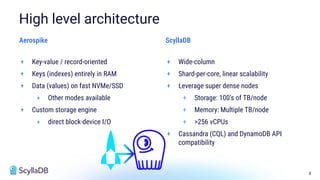
+ Key-value / record-oriented
+ Keys (indexes) entirely in RAM
+ Data (values) on fast NVMe/SSD
+ Other modes available
+ Custom storage engine
+ direct block-device I/O
High level architecture
+ Wide-column
+ Shard-per-core, linear scalability
+ Leverage super dense nodes
+ Storage: 100’s of TB/node
+ Memory: Multiple TB/node
+ >256 vCPUs
+ Cassandra (CQL) and DynamoDB API
compatibility
Aerospike ScyllaDB
9
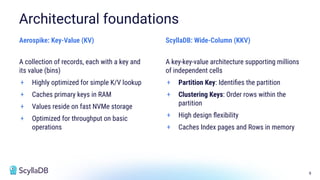
A collection of records, each with a key and
its value (bins)
+ Highly optimized for simple K/V lookup
+ Caches primary keys in RAM
+ Values reside on fast NVMe storage
+ Optimized for throughput on basic
operations
Architectural foundations
A key-key-value architecture supporting millions
of independent cells
+ Partition Key: Identifies the partition
+ Clustering Keys: Order rows within the
partition
+ High design flexibility
+ Caches Index pages and Rows in memory
Aerospike: Key-Value (KV) ScyllaDB: Wide-Column (KKV)
10
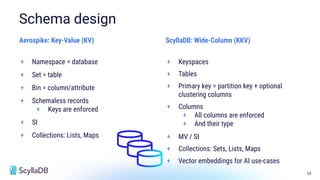
+ Namespace = database
+ Set = table
+ Bin = column/attribute
+ Schemaless records
+ Keys are enforced
+ SI
+ Collections: Lists, Maps
Schema design
+ Keyspaces
+ Tables
+ Primary key = partition key + optional
clustering columns
+ Columns
+ All columns are enforced
+ And their type
+ MV / SI
+ Collections: Sets, Lists, Maps
+ Vector embeddings for AI use-cases
Aerospike: Key-Value (KV) ScyllaDB: Wide-Column (KKV)
11
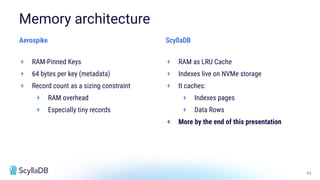
+ RAM-Pinned Keys
+ 64 bytes per key (metadata)
+ Record count as a sizing constraint
+ RAM overhead
+ Especially tiny records
Memory architecture
+ RAM as LRU Cache
+ Indexes live on NVMe storage
+ It caches:
+ Indexes pages
+ Data Rows
+ More by the end of this presentation
Aerospike ScyllaDB
12
https://developers.scylladb.com/stable/compare/aerospike.html
13
https://developers.scylladb.com/stable/compare/aerospike.html
14
https://developers.scylladb.com/stable/compare/aerospike.html
Data modeling flexibility
Same low-latency goal. Different data-modeling constraints.
15
16
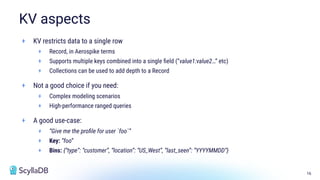
+ KV restricts data to a single row
+ Record, in Aerospike terms
+ Supports multiple keys combined into a single field (“value1:value2…” etc)
+ Collections can be used to add depth to a Record
+ Not a good choice if you need:
+ Complex modeling scenarios
+ High-performance ranged queries
+ A good use-case:
+ “Give me the profile for user `foo`”
+ Key: “foo”
+ Bins: {“type”: “customer”, “location”: “US_West”, “last_seen”: “YYYYMMDD”}
KV aspects
17
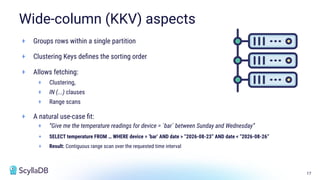
+ Groups rows within a single partition
+ Clustering Keys defines the sorting order
+ Allows fetching:
+ Clustering,
+ IN (...) clauses
+ Range scans
+ A natural use-case fit:
+ “Give me the temperature readings for device = `bar` between Sunday and Wednesday”
+ SELECT temperature FROM … WHERE device = ‘bar’ AND date > “2026-08-23” AND date < “2026-08-26”
+ Result: Contiguous range scan over the requested time interval
Wide-column (KKV) aspects
18
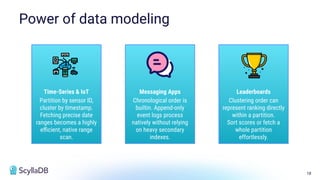
Power of data modeling
Time-Series & IoT
Partition by sensor ID,
cluster by timestamp.
Fetching precise date
ranges becomes a highly
efficient, native range
scan.
Messaging Apps
Chronological order is
builtin. Append-only
event logs process
natively without relying
on heavy secondary
indexes.
Leaderboards
Clustering order can
represent ranking directly
within a partition.
Sort scores or fetch a
whole partition
effortlessly.
19
Power of data modeling
Feature Stores
Partition by entity, cluster
by feature.
Allows fetching precise
feature values, or a whole
partition scan.
Ad bidding
Partition by targeting
attributes. Cluster by bid
value in descending
order. Precisely fetch a
page of the highest bids
on that category.
Real-time AI
Combine superfast
Vector Search
capabilities with
extended features
retrieval to power AI
pipelines.
TCO Efficiency
20
21
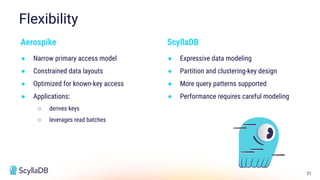
Aerospike
● Narrow primary access model
● Constrained data layouts
● Optimized for known-key access
● Applications:
○ derives keys
○ leverages read batches
Flexibility
ScyllaDB
● Expressive data modeling
● Partition and clustering-key design
● More query patterns supported
● Performance requires careful modeling
22
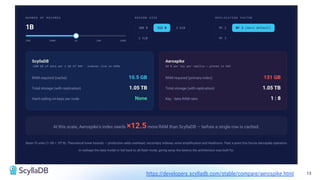
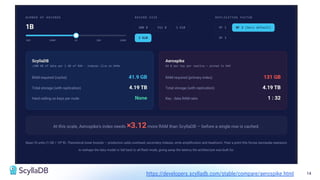
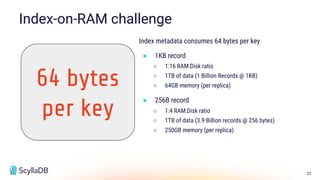
Index metadata consumes 64 bytes per key
● 1KB record
○ 1:16 RAM:Disk ratio
○ 1TB of data (1 Billion Records @ 1KB)
○ 64GB memory (per replica)
● 256B record
○ 1:4 RAM:Disk ratio
○ 1TB of data (3.9 Billion records @ 256 bytes)
○ 250GB memory (per replica)
Index-on-RAM challenge
64 bytes
per key
23
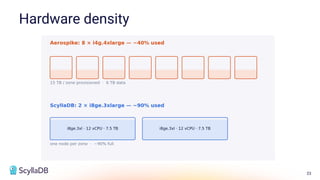
Hardware density
Storage Engine Internals
Balancing costs, performance and operations
24
25
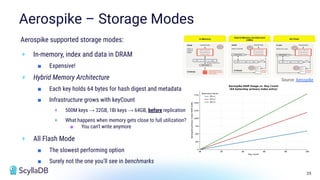
Aerospike supported storage modes:
+ In-memory, index and data in DRAM
■ Expensive!
+ Hybrid Memory Architecture
■ Each key holds 64 bytes for hash digest and metadata
■ Infrastructure grows with keyCount
+ 500M keys → 32GB, 1Bi keys → 64GB, before replication
+ What happens when memory gets close to full utilization?
■ You can't write anymore
+ All Flash Mode
■ The slowest performing option
■ Surely not the one you'll see in benchmarks
Aerospike – Storage Modes
Source: Aerospike
26
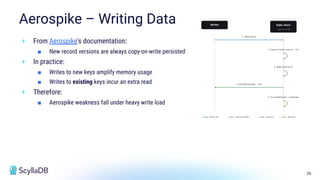
+ From Aerospike's documentation:
■ New record versions are always copy-on-write persisted
+ In practice:
■ Writes to new keys amplify memory usage
■ Writes to existing keys incur an extra read
+ Therefore:
■ Aerospike weakness fall under heavy write load
Aerospike – Writing Data
27
Aerospike – Replication topology
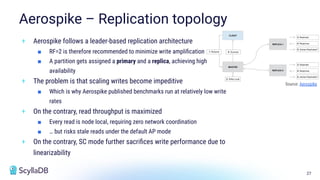
+ Aerospike follows a leader-based replication architecture
■ RF=2 is therefore recommended to minimize write amplification
■ A partition gets assigned a primary and a replica, achieving high
availability
+ The problem is that scaling writes become impeditive
■ Which is why Aerospike published benchmarks run at relatively low write
rates
+ On the contrary, read throughput is maximized
■ Every read is node local, requiring zero network coordination
■ … but risks stale reads under the default AP mode
+ On the contrary, SC mode further sacrifices write performance due to
linearizability
Source: Aerospike
28
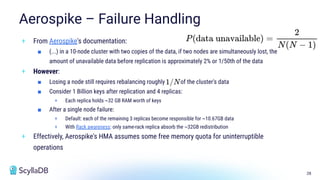
Aerospike – Failure Handling
+ From Aerospike's documentation:
■ (...) in a 10-node cluster with two copies of the data, if two nodes are simultaneously lost, the
amount of unavailable data before replication is approximately 2% or 1/50th of the data
+ However:
■ Losing a node still requires rebalancing roughly of the cluster's data
■ Consider 1 Billion keys after replication and 4 replicas:
+ Each replica holds ~32 GB RAM worth of keys
■ After a single node failure:
+ Default: each of the remaining 3 replicas become responsible for ~10.67GB data
+ With Rack awareness: only same-rack replica absorb the ~32GB redistribution
+ Effectively, Aerospike's HMA assumes some free memory quota for uninterruptible
operations
29
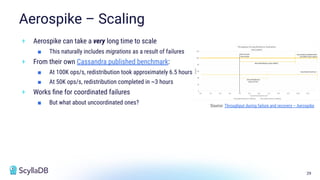
Aerospike – Scaling
+ Aerospike can take a very long time to scale
■ This naturally includes migrations as a result of failures
+ From their own Cassandra published benchmark:
■ At 100K ops/s, redistribution took approximately 6.5 hours
■ At 50K ops/s, redistribution completed in ~3 hours
+ Works fine for coordinated failures
■ But what about uncoordinated ones? Source: Throughput during failure and recovery – Aerospike
30
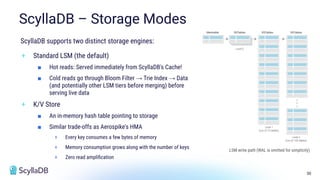
ScyllaDB supports two distinct storage engines:
+ Standard LSM (the default)
■ Hot reads: Served immediately from ScyllaDB's Cache!
■ Cold reads go through Bloom Filter → Trie Index → Data
(and potentially other LSM tiers before merging) before
serving live data
+ K/V Store
■ An in-memory hash table pointing to storage
■ Similar trade-offs as Aerospike's HMA
+ Every key consumes a few bytes of memory
+ Memory consumption grows along with the number of keys
+ Zero read amplification
ScyllaDB – Storage Modes
LSM write path (WAL is omitted for simplicity)
31
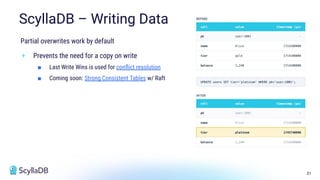
Partial overwrites work by default
+ Prevents the need for a copy on write
■ Last Write Wins is used for conflict resolution
■ Coming soon: Strong Consistent Tables w/ Raft
ScyllaDB – Writing Data
32
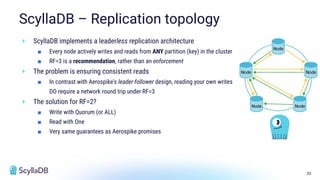
ScyllaDB – Replication topology
+ ScyllaDB implements a leaderless replication architecture
■ Every node actively writes and reads from ANY partition (key) in the cluster
■ RF=3 is a recommendation, rather than an enforcement
+ The problem is ensuring consistent reads
■ In contrast with Aerospike's leader-follower design, reading your own writes
DO require a network round trip under RF=3
+ The solution for RF=2?
■ Write with Quorum (or ALL)
■ Read with One
■ Very same guarantees as Aerospike promises
33
ScyllaDB – Failure Handling
+ With RF=3 and Quorum requests, the cluster remains available even under a whole AZ failure
■ Available means other AZs will observe higher traffic during since you'll be one AZ short in replicas
■ But other than that, no "rebalancing" will take place until the operator replaces the failed nodes
■ So long the cluster is correctly sized to tolerate a full AZ loss (+33% traffic), performance should go
unaffected
+ With RF=2 and Quorum Writes, the application must implement its own failover semantics:
■ Technically speaking, the loss of a single node is already an invitation for data loss
+ Hence why we recommend RF=3
■ Still, applications may dynamically downgrade their write consistency requirements via
DowngradingConsistencyRetryPolicy
■ Or stop accepting writes until the situation is corrected
+ Notice there is no "right" or "wrong" here. Unlike Aerospike, ScyllaDB will defers decision to YOU.
34
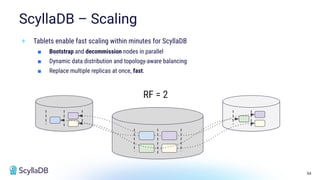
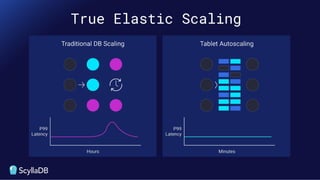
ScyllaDB – Scaling
+ Tablets enable fast scaling within minutes for ScyllaDB
■ Bootstrap and decommission nodes in parallel
■ Dynamic data distribution and topology-aware balancing
■ Replace multiple replicas at once, fast.
RF = 2
35
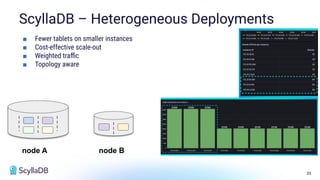
ScyllaDB – Heterogeneous Deployments
■ Fewer tablets on smaller instances
■ Cost-effective scale-out
■ Weighted traffic
■ Topology aware
node A node B
36
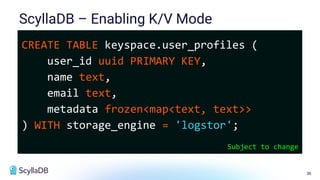
ScyllaDB – Enabling K/V Mode
CREATE TABLE keyspace.user_profiles (
user_id uuid PRIMARY KEY,
name text,
email text,
metadata frozen<map<text, text>>
) WITH storage_engine = 'logstor';
Subject to change
37
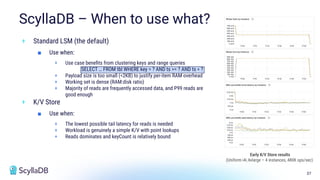
+ Standard LSM (the default)
■ Use when:
+ Use case benefits from clustering keys and range queries
○ SELECT … FROM tbl WHERE key = ? AND ts >= ? AND ts < ?
+ Payload size is too small (<2KB) to justify per-item RAM overhead
+ Working set is dense (RAM:disk ratio)
+ Majority of reads are frequently accessed data, and P99 reads are
good enough
+ K/V Store
■ Use when:
+ The lowest possible tail latency for reads is needed
+ Workload is genuinely a simple K/V with point lookups
+ Reads dominates and keyCount is relatively bound
ScyllaDB – When to use what?
Early K/V Store results
(Uniform i4i.4xlarge – 4 instances, 480K ops/sec)
True Elastic Scaling
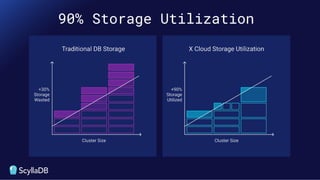
90% Storage Utilization
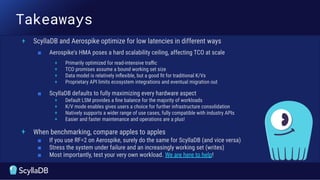
Takeaways
+ ScyllaDB and Aerospike optimize for low latencies in different ways
■ Aerospike's HMA poses a hard scalability ceiling, affecting TCO at scale
+ Primarily optimized for read-intensive traffic
+ TCO promises assume a bound working set size
+ Data model is relatively inflexible, but a good fit for traditional K/Vs
+ Proprietary API limits ecosystem integrations and eventual migration out
■ ScyllaDB defaults to fully maximizing every hardware aspect
+ Default LSM provides a fine balance for the majority of workloads
+ K/V mode enables gives users a choice for further infrastructure consolidation
+ Natively supports a wider range of use cases, fully compatible with industry APIs
+ Easier and faster maintenance and operations are a plus!
+ When benchmarking, compare apples to apples
■ If you use RF=2 on Aerospike, surely do the same for ScyllaDB (and vice versa)
■ Stress the system under failure and an increasingly working set (writes)
■ Most importantly, test your very own workload. We are here to help!
All Things Performance
A ScyllaDB Community
Virtual Event | OCTOBER 21 + 22, 2026
Register now at p99conf.io
Nowogrodzka 21
00-511 Warszawa, Poland
United States
1309 S Mary Ave Suite 219
Sunnyvale, CA 94087 USA
Israel
Maskit 4
Herzliya, Israel 4673304
www.scylladb.com
@scylladb
Poland
Thank You!