COMMUNITY-ENGAGED LEARNING
PRACTICE IN THE EUROPEAN CONTEXT
Conor Anderson (Campus Engage)
Dr Catherine O’Mahony and Dr Angela Veale (UCC)
and Dr Naomi Masheti (Cork Migrant Centre)
HORIZON EUROPE
ACTIVITY 1: PAIR-SHARE
1: In pairs, discuss the following:
“What does Community-engaged learning
mean in your context?”
2: List the top three words or phrases
that capture your discussion.
3: Report back to the full group your most
important word or phrase
*just one word or phrase.
**don’t repeat what other groups have said.
COMMUNITY-ENGAGED LEARNING
OVERVIEW
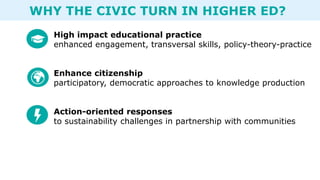
High impact educational practice
enhanced engagement, transversal skills, policy-theory-practice
Enhance citizenship
participatory, democratic approaches to knowledge production
Action-oriented responses
to sustainability challenges in partnership with communities
WHY THE CIVIC TURN IN HIGHER ED?
“ … universities are also
a part of our societies.
What’s the point unless
the accumulated
knowledge, insight and
vision are put at the
service of the
community?
With the privilege to
pursue knowledge comes
the civic responsibility to
engage and put that
knowledge to work in the
service of humanity.”
President M.D. Higgins
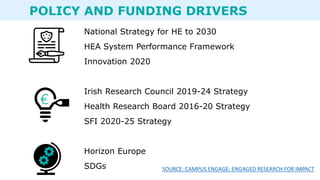
POLICY AND FUNDING DRIVERS
National Strategy for HE to 2030
HEA System Performance Framework
Innovation 2020
Irish Research Council 2019-24 Strategy
Health Research Board 2016-20 Strategy
SFI 2020-25 Strategy
Horizon Europe
SDGs SOURCE: CAMPUS ENGAGE: ENGAGED RESEARCH FOR IMPACT
HORIZON EUROPE
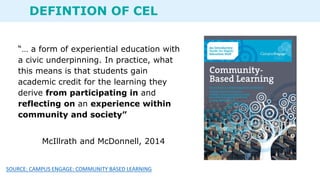
DEFINTION OF CEL
“… a form of experiential education with
a civic underpinning. In practice, what
this means is that students gain
academic credit for the learning they
derive from participating in and
reflecting on an experience within
community and society”
McIllrath and McDonnell, 2014
SOURCE: CAMPUS ENGAGE: COMMUNITY BASED LEARNING
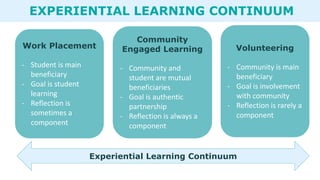
EXPERIENTIAL LEARNING CONTINUUM
Experiential Learning Continuum
Work Placement
- Student is main
beneficiary
- Goal is student
learning
- Reflection is
sometimes a
component
Community
Engaged Learning
- Community and
student are mutual
beneficiaries
- Goal is authentic
partnership
- Reflection is always a
component
Volunteering
- Community is main
beneficiary
- Goal is involvement
with community
- Reflection is rarely a
component
HORIZON EUROPE
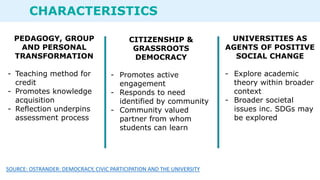
CHARACTERISTICS
PEDAGOGY, GROUP
AND PERSONAL
TRANSFORMATION
- Teaching method for
credit
- Promotes knowledge
acquisition
- Reflection underpins
assessment process
CITIZENSHIP &
GRASSROOTS
DEMOCRACY
- Promotes active
engagement
- Responds to need
identified by community
- Community valued
partner from whom
students can learn
UNIVERSITIES AS
AGENTS OF POSITIVE
SOCIAL CHANGE
- Explore academic
theory within broader
context
- Broader societal
issues inc. SDGs may
be explored
SOURCE: OSTRANDER: DEMOCRACY, CIVIC PARTICIPATION AND THE UNIVERSITY
COMMUNITY-ENGAGED LEARNING
WHO ARE OUR PARTNERS?
HORIZON EUROPE
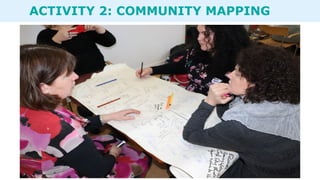
ACTIVITY 2: COMMUNITY MAPPING
COMMUNITY ENGAGED LEARNING
CASE STUDY
School of
Applied
Psychology,
UCC
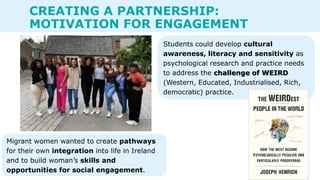
Students could develop cultural
awareness, literacy and sensitivity as
psychological research and practice needs
to address the challenge of WEIRD
(Western, Educated, Industrialised, Rich,
democratic) practice.
Migrant women wanted to create pathways
for their own integration into life in Ireland
and to build woman’s skills and
opportunities for social engagement.
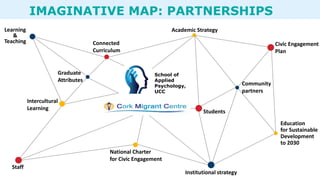
CREATING A PARTNERSHIP:
MOTIVATION FOR ENGAGEMENT
Academic Strategy
Intercultural
Learning
Institutional strategy
Civic Engagement
Plan
Education
for Sustainable
Development
to 2030
Connected
Curriculum
Staff
National Charter
for Civic Engagement
Learning
&
Teaching
Students
Graduate
Attributes
IMAGINATIVE MAP: PARTNERSHIPS
School of
Applied
Psychology,
UCC
Community
partners
PARTNERSHIP TIMELINE & EVOLUTION
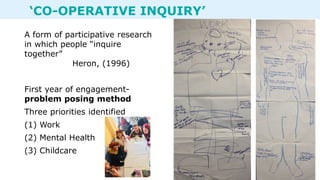
A form of participative research
in which people “inquire
together”
Heron, (1996)
First year of engagement-
problem posing method
Three priorities identified
(1) Work
(2) Mental Health
(3) Childcare
‘CO-OPERATIVE INQUIRY’
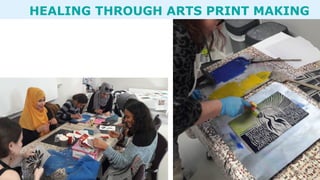
HEALING THROUGH ARTS PRINT MAKING
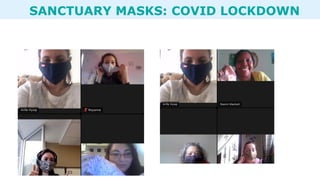
SANCTUARY MASKS: COVID LOCKDOWN
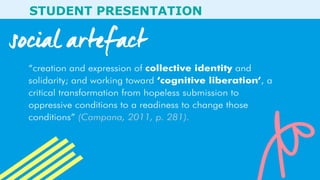
STUDENT PRESENTATION
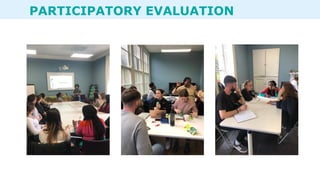
PARTICIPATORY EVALUATION
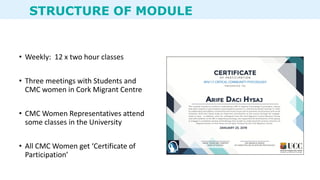
• Weekly: 12 x two hour classes
• Three meetings with Students and
CMC women in Cork Migrant Centre
• CMC Women Representatives attend
some classes in the University
• All CMC Women get ‘Certificate of
Participation’
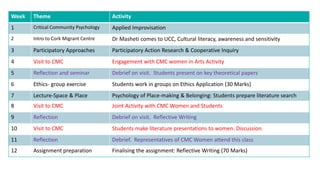
STRUCTURE OF MODULE
Week Theme Activity
1 Critical Community Psychology Applied Improvisation
2 Intro to Cork Migrant Centre Dr Masheti comes to UCC, Cultural literacy, awareness and sensitivity
3 Participatory Approaches Participatory Action Research & Cooperative Inquiry
4 Visit to CMC Engagement with CMC women in Arts Activity
5 Reflection and seminar Debrief on visit. Students present on key theoretical papers
6 Ethics- group exercise Students work in groups on Ethics Application (30 Marks)
7 Lecture-Space & Place Psychology of Place-making & Belonging: Students prepare literature search
8 Visit to CMC Joint Activity with CMC Women and Students
9 Reflection Debrief on visit. Reflective Writing
10 Visit to CMC Students make literature presentations to women. Discussion.
11 Reflection Debrief. Representatives of CMC Women attend this class
12 Assignment preparation Finalising the assignment: Reflective Writing (70 Marks)
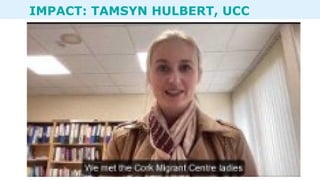
IMPACT: TAMSYN HULBERT, UCC
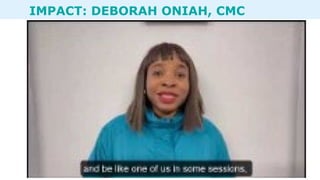
IMPACT: DEBORAH ONIAH, CMC
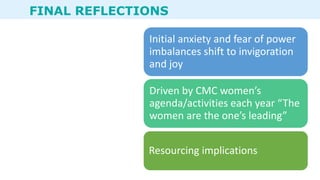
Initial anxiety and fear of power
imbalances shift to invigoration
and joy
Driven by CMC women’s
agenda/activities each year “The
women are the one’s leading”
Resourcing implications
FINAL REFLECTIONS
COMMUNITY-ENGAGED LEARNING
INTEGRATION INTO
THE CURRICULUM
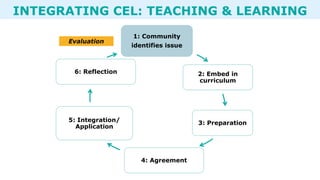
1: Community
identifies issue
2: Embed in
curriculum
3: Preparation
4: Agreement
5: Integration/
Application
6: Reflection
Evaluation
INTEGRATING CEL: TEACHING & LEARNING
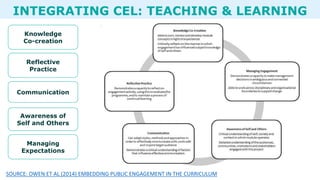
Knowledge
Co-creation
Reflective
Practice
Communication
Managing
Expectations
Awareness of
Self and Others
SOURCE: OWEN ET AL (2014) EMBEDDING PUBLIC ENGAGEMENT IN THE CURRICULUM
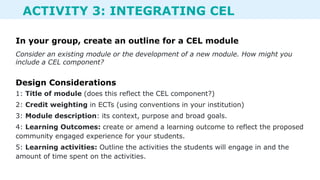
In your group, create an outline for a CEL module
Consider an existing module or the development of a new module. How might you
include a CEL component?
Design Considerations
1: Title of module (does this reflect the CEL component?)
2: Credit weighting in ECTs (using conventions in your institution)
3: Module description: its context, purpose and broad goals.
4: Learning Outcomes: create or amend a learning outcome to reflect the proposed
community engaged experience for your students.
5: Learning activities: Outline the activities the students will engage in and the
amount of time spent on the activities.
ACTIVITY 3: INTEGRATING CEL
Conor Anderson (Campus Engage) info@campusengage.ie; @campus_engage
Dr Catherine O’Mahony (UCC) catherine.omahony@ucc.ie; @cath_omahony
Dr Angela Veale (UCC) a.veale@ucc.ie;
Dr Naomi Masheti (Cork Migrant Centre) @corkmigrant
CONTACT DETAILS
RELATED READING
Veale, A., Robinson, S., Masheti, N. and Tint, B. (2020). Applied improvisation and visual
methodologies in priority identification with asylum seeker women in direct provision. In:
Jacqui O’Riordan and Mike Fitzgibbon (Eds), Direct Provision: Asylum, the Academy and
Activism, pp. 427-451.