Community-Led Affordable Housing in Montréal .pdf
This presentation examines community-led affordable housing in Montréal through the cases of Benny Farm and the Rosemont Housing Project. It explores the role of housing cooperatives, non-profit organizations, technical resource groups, public institutions, resident participation and integrated design processes in producing socially, environmentally and economically sustainable housing.
Community-Led Affordable Housing in Montréal .pdf
1.
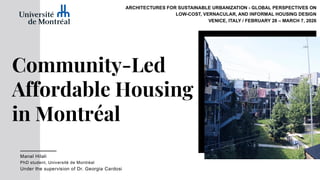
Community-Led
Affordable Housing
in Montréal
ManalHilali
PhD student, Université de Montréal
Under the supervision of Dr. Georgia Cardosi
ARCHITECTURES FOR SUSTAINABLE URBANIZATION - GLOBAL PERSPECTIVES ON
LOW-COST, VERNACULAR, AND INFORMAL HOUSING DESIGN
VENICE, ITALY / FEBRUARY 28 – MARCH 7, 2026
2.
Presentation
plan
1. Context: Affordablehousing and the housing continuum in
Canada and Montréal
2. Institutional and community actors involved in non-market
housing production
3. Case Study 1: Benny Farm, community-led sustainable
redevelopment
4. Case Study 2: Rosemont , cooperative housing and
integrated design process
5. Key lessons on governance, participation, and long-term
sustainability
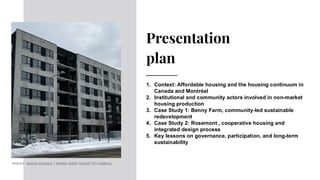
PHOTO : RADIO-CANADA / MARIE-JOSÉE PAQUETTE-COMEAU
3.
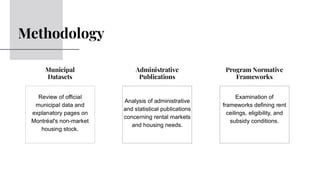
Analysis of administrative
andstatistical publications
concerning rental markets
and housing needs.
Examination of
frameworks defining rent
ceilings, eligibility, and
subsidy conditions.
Methodology
Review of official
municipal data and
explanatory pages on
Montréal's non-market
housing stock.
Municipal
Datasets
Administrative
Publications
Program Normative
Frameworks
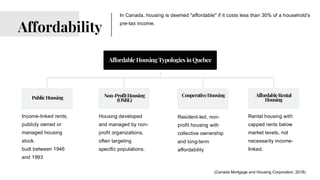
Affordability
In Canada, housingis deemed "affordable" if it costs less than 30% of a household’s
pre-tax income.
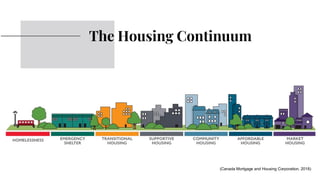
(Canada Mortgage and Housing Corporation, 2018)
AffordableHousingTypologies inQuebec
PublicHousing Non-ProfitHousing
(OSBL)
CooperativeHousing AffordableRental
Housing
Income-linked rents,
publicly owned or
managed housing
stock.
built between 1946
and 1993
Housing developed
and managed by non-
profit organizations,
often targeting
specific populations.
Resident-led, non-
profit housing with
collective ownership
and long-term
affordability
Rental housing with
capped rents below
market levels, not
necessarily income-
linked.
6.
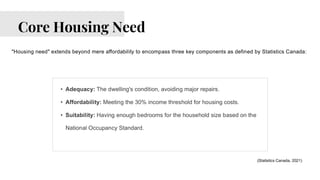
"Housing need" extendsbeyond mere affordability to encompass three key components as defined by Statistics Canada:
(Statistics Canada, 2021)
Core Housing Need
7.
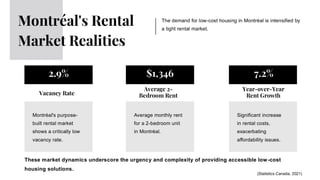
The demand forlow-cost housing in Montréal is intensified by
a tight rental market.
Montréal's Rental
Market Realities
Average 2-
Bedroom Rent
Year-over-Year
Rent Growth
These market dynamics underscore the urgency and complexity of providing accessible low-cost
housing solutions.
2.9%
Vacancy Rate
Montréal's purpose-
built rental market
shows a critically low
vacancy rate.
$1,346
Average monthly rent
for a 2-bedroom unit
in Montréal.
7.2%
Significant increase
in rental costs,
exacerbating
affordability issues.
(Statistics Canada, 2021)
8.
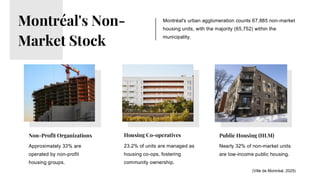
Montréal's urban agglomerationcounts 67,885 non-market
housing units, with the majority (65,752) within the
municipality.
Montréal's Non-
Market Stock
Approximately 33% are
operated by non-profit
housing groups.
23.2% of units are managed as
housing co-ops, fostering
community ownership.
Nearly 32% of non-market units
are low-income public housing.
Non-Profit Organizations Housing Co-operatives Public Housing (HLM)
(Ville de Montréal, 2025)
9.
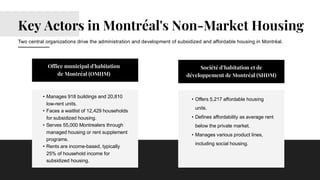
3
• Manages 918buildings and 20,810
low-rent units.
• Faces a waitlist of 12,429 households
for subsidized housing.
• Serves 55,000 Montrealers through
managed housing or rent supplement
programs.
• Rents are income-based, typically
25% of household income for
subsidized housing.
Key Actors in Montréal's Non-Market Housing
Two central organizations drive the administration and development of subsidized and affordable housing in Montréal.
• Offers 5,217 affordable housing
units.
• Defines affordability as average rent
below the private market.
• Manages various product lines,
including social housing.
Société d’habitation et de
développement de Montréal (SHDM)
Office municipal d'habitation
de Montréal (OMHM)
10.
3
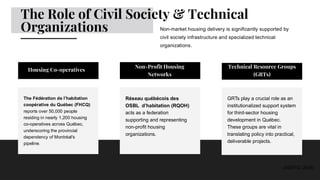
The Role ofCivil Society & Technical
Organizations
Housing Co-operatives
The Fédération de l’habitation
coopérative du Québec (FHCQ)
reports over 50,000 people
residing in nearly 1,200 housing
co-operatives across Québec,
underscoring the provincial
dependency of Montréal's
pipeline.
Non-Profit Housing
Networks
Réseau québécois des
OSBL d’habitation (RQOH)
acts as a federation
supporting and representing
non-profit housing
organizations.
Technical Resource Groups
(GRTs)
GRTs play a crucial role as an
institutionalized support system
for third-sector housing
development in Québec.
These groups are vital in
translating policy into practical,
deliverable projects.
(AGRTQ, 2026)
Non-market housing delivery is significantly supported by
civil society infrastructure and specialized technical
organizations.
11.
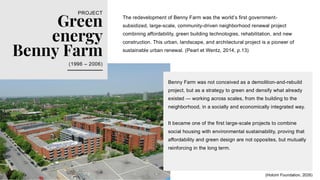
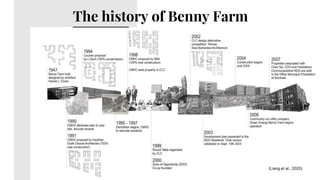
Benny Farm wasnot conceived as a demolition-and-rebuild
project, but as a strategy to green and densify what already
existed — working across scales, from the building to the
neighborhood, in a socially and economically integrated way.
It became one of the first large-scale projects to combine
social housing with environmental sustainability, proving that
affordability and green design are not opposites, but mutually
reinforcing in the long term.
The redevelopment of Benny Farm was the world’s first government-
subsidized, large-scale, community-driven neighborhood renewal project
combining affordability, green building technologies, rehabilitation, and new
construction. This urban, landscape, and architectural project is a pioneer of
sustainable urban renewal. (Pearl et Wentz, 2014, p.13)
Green
energy
Benny Farm
PROJECT
(1996 – 2006)
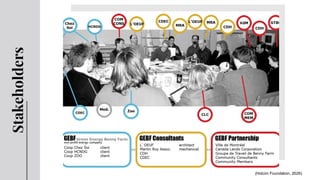
(Holcim Foundation, 2026)
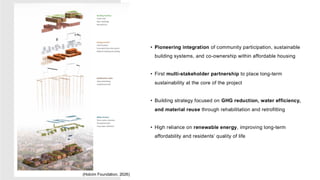
• Pioneering integrationof community participation, sustainable
building systems, and co-ownership within affordable housing
• First multi-stakeholder partnership to place long-term
sustainability at the core of the project
• Building strategy focused on GHG reduction, water efficiency,
and material reuse through rehabilitation and retrofitting
• High reliance on renewable energy, improving long-term
affordability and residents’ quality of life
(Holcim Foundation, 2026)
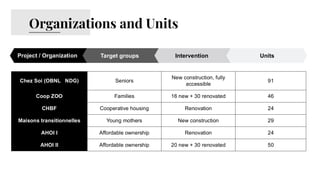
Target groups InterventionUnits
Project / Organization
Chez Soi (OBNL NDG) Seniors
New construction, fully
accessible
91
Coop ZOO Families 16 new + 30 renovated 46
CHBF Cooperative housing Renovation 24
Maisons transitionnelles Young mothers New construction 29
AHOI I Affordable ownership Renovation 24
AHOI II Affordable ownership 20 new + 30 renovated 50
Organizations and Units
16.
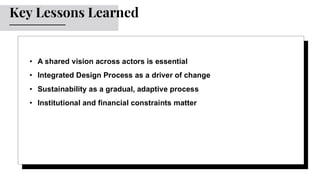
• A sharedvision across actors is essential
• Integrated Design Process as a driver of change
• Sustainability as a gradual, adaptive process
• Institutional and financial constraints matter
Key Lessons Learned
17.
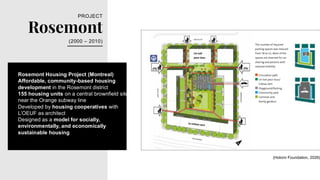
Rosemont
PROJECT
(2000 – 2010)
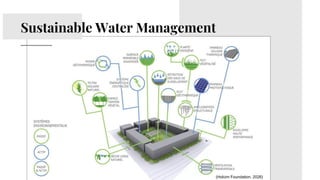
RosemontHousing Project (Montreal)
Affordable, community-based housing
development in the Rosemont district
155 housing units on a central brownfield site
near the Orange subway line
Developed by housing cooperatives with
L’OEUF as architect
Designed as a model for socially,
environmentally, and economically
sustainable housing
(Holcim Foundation, 2026)
18.
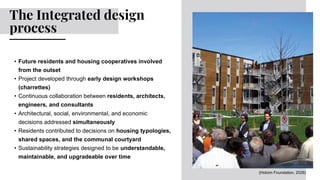
• Future residentsand housing cooperatives involved
from the outset
• Project developed through early design workshops
(charrettes)
• Continuous collaboration between residents, architects,
engineers, and consultants
• Architectural, social, environmental, and economic
decisions addressed simultaneously
• Residents contributed to decisions on housing typologies,
shared spaces, and the communal courtyard
• Sustainability strategies designed to be understandable,
maintainable, and upgradeable over time
The Integrated design
process
(Holcim Foundation, 2026)
19.
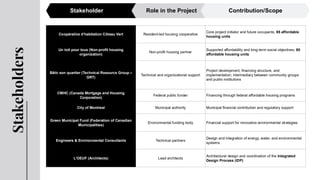
Coopérative d’habitation CôteauVert Resident-led housing cooperative
Core project initiator and future occupants; 95 affordable
housing units
Un toit pour tous (Non-profit housing
organization)
Non-profit housing partner
Supported affordability and long-term social objectives; 60
affordable housing units
Bâtir son quartier (Technical Resource Group –
GRT)
Technical and organizational support
Project development, financing structure, and
implementation; intermediary between community groups
and public institutions
CMHC (Canada Mortgage and Housing
Corporation)
Federal public funder Financing through federal affordable housing programs
City of Montreal Municipal authority Municipal financial contribution and regulatory support
Green Municipal Fund (Federation of Canadian
Municipalities)
Environmental funding body Financial support for innovative environmental strategies
Engineers & Environmental Consultants Technical partners
Design and integration of energy, water, and environmental
systems
L’OEUF (Architects) Lead architects
Architectural design and coordination of the Integrated
Design Process (IDP)
Stakeholders
Contribution/Scope
Stakeholder Role in the Project
• Early residentinvolvement as a foundation for the project
• Integrated design as a lever for sustainability
• Designing for evolution rather than completion
• Affordable housing as a multidimensional objective
Key Lessons Learned
22.
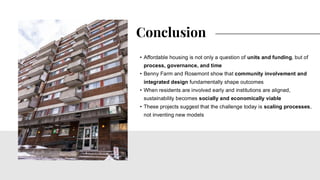
• Affordable housingis not only a question of units and funding, but of
process, governance, and time
• Benny Farm and Rosemont show that community involvement and
integrated design fundamentally shape outcomes
• When residents are involved early and institutions are aligned,
sustainability becomes socially and economically viable
• These projects suggest that the challenge today is scaling processes,
not inventing new models
Conclusion
 Most read
 Most read