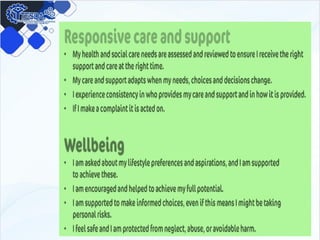
OBJECTIVES
❖To render properlythe standards of care to
every client.
❖To ensure best medical practices.
❖To monitor quality service from the
healthcare team.
❖To satisfy and accommodate clients needs
and complaints.
3.
Four (4) Elementsin Maintaining High
Standards of Client Services
1. Communicate appropriately with
patients/clients.
2. Establish and maintain good interpersonal
relationship with clients.
3. Act in respectful manner at all times.
4. Evaluate own work to maintain a high
standard of client services.
5.
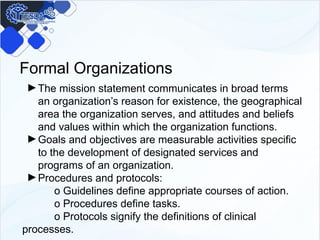
Formal Organizations
►The missionstatement communicates in broad terms
an organization’s reason for existence, the geographical
area the organization serves, and attitudes and beliefs
and values within which the organization functions.
►Goals and objectives are measurable activities specific
to the development of designated services and
programs of an organization.
►Procedures and protocols:
o Guidelines define appropriate courses of action.
o Procedures define tasks.
o Protocols signify the definitions of clinical
processes.
6.
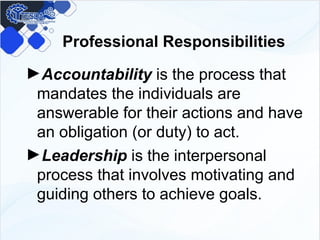
Professional Responsibilities
►Accountability isthe process that
mandates the individuals are
answerable for their actions and have
an obligation (or duty) to act.
►Leadership is the interpersonal
process that involves motivating and
guiding others to achieve goals.
7.
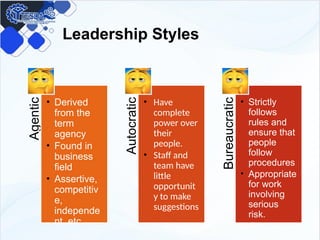
Leadership Styles
Agentic
• Derived
fromthe
term
agency
• Found in
business
field
• Assertive,
competitiv
e,
independe
nt, etc.
Autocratic
• Have
complete
power over
their
people.
• Staff and
team have
little
opportunit
y to make
suggestions
Bureaucratic
• Strictly
follows
rules and
ensure that
people
follow
procedures
• Appropriate
for work
involving
serious
risk.
8.
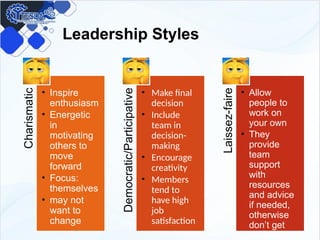
Leadership Styles
Charismatic
• Inspire
enthusiasm
•Energetic
in
motivating
others to
move
forward
• Focus:
themselves
• may not
want to
change
Democratic/Participative
• Make final
decision
• Include
team in
decision-
making
• Encourage
creativity
• Members
tend to
have high
job
satisfaction
Laissez-faire
• Allow
people to
work on
your own
• They
provide
team
support
with
resources
and advice
if needed,
otherwise
don’t get
involved.
9.
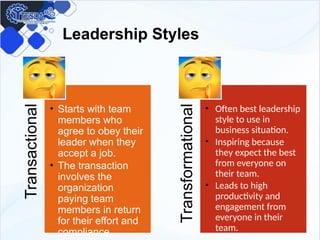
Leadership Styles
Transactional
• Startswith team
members who
agree to obey their
leader when they
accept a job.
• The transaction
involves the
organization
paying team
members in return
for their effort and
compliance.
Transformational
• Often best leadership
style to use in
business situation.
• Inspiring because
they expect the best
from everyone on
their team.
• Leads to high
productivity and
engagement from
everyone in their
team.
10.
Leadership Qualities
1) Communication– where leader listens actively to
others and communicates in an assertive manner and
speaks directly and honestly to others.
2) Credibility – it enhances accountability. Individuals
who perform well are those who can influence others.
3) Critical thinking – An individual with an open-
minded, questioning attitude is a critical thinker.
4) Initiation of action – leader initiates measures to
solve problems.
5) Risk taking – involves acting to solve problems and
are goal-directed.
11.
Power
It is theability to do or act and
results in the achievement of
desired results. Powerful persons
are able to modify behavior and
influence others to change, even
when others are resistant to
change.
12.
Types of Power
1)Reward: Ability to provide
incentives.
2) Coercive: Ability to punish.
3) Referent: Based on attraction.
4) Expert: Based on having an
expert knowledge base and skill
level.
13.
Types of Power
5)Legitimate: Based on a position
in society.
6) Personal: Derived from a high
degree of self-confidence.
7) Informational: When one person
provides explanations why another
should behave in a certain way.
14.
Empowerment
It is aninterpersonal process
of enabling others to do for
themselves.
It occurs when individuals are
better able to influence what
happens to them. This can
empower clients through advocacy.
15.
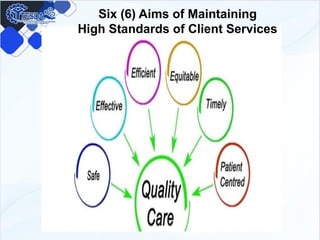
Six (6) Aimsof Maintaining
High Standards of Client Services
17.
Time management isa technique
designed to assist in completing
tasks within a definite time period.
Learning how, when and where to
use one’s time and establishing
personal goals and time frames is
part of time management.
18.
It requires anability to anticipate the
day’s activities, to combine activities
when possible, and to not be
interrupted by nonessential activities.
It also involves efficiency in
completing tasks as quickly as
possible and effectiveness in deciding
on the most important task to do and
doing it correctly.
19.
Principles and Guidelines
1)Identify tasks, obligations and
activities and write them down.
2) Organize the workday.
3) Prioritize client needs.
4) Anticipate the needs of the day.
5) Begin client rounds at the beginning
of the shifts.
6) Delegate tasks when appropriate.
20.
Principles and Guidelines
7)Keep daily hour-by-hour log.
8) Use hospital resources wisely.
9) Organize paperwork and
continuously document task
completion.
10) At the end of the day, evaluate the
effectiveness of time management.
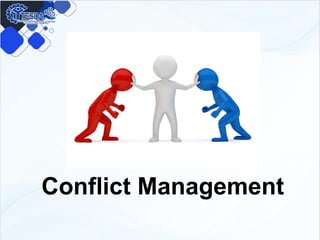
Conflict
A conflict arisesfrom a
perception of incompatibility or
differences in beliefs, attitudes,
values, goals, priorities and
decisions.
23.
Types of Conflict
1)Intrapersonal – occurs within a person.
2) Interpersonal – occurs between and
among clients, nurses, and other staff
members.
3) Organizational – occurs when an
employee confronts policies and
procedures of the organization.
24.
Modes of Conflict
Resolution
1)Avoidance – person is unassertive and
uncooperative.
2) Accommodation – the individual neglects own
needs, goals, or concerns (unassertive) while trying to
satisfy those for others.
3) Competition – pursues on needs and goals at the
expense of others.
4) Compromise – person is assertive and cooperative.
Quality Management –
DynamicState
What is considered quality
can and often does change as
time passes and circumstances
are altered.
27.
Quality Management –Products,
Services, People, Processes, and
Environments
It makes the point that quality
applies not just to the products and
services provided, but also to the
people and processes that provide
them and the environments in which
they are provided.
28.
Quality Management –Superior
Value
Quality is a key element in
providing superior value (i.e., superior
quality, cost, and service).
International Organization for
Standardization(ISO)
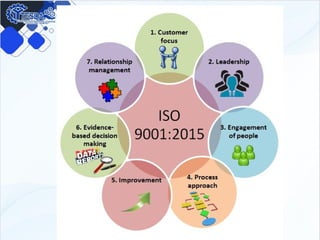
The adoption of a quality
management system is a strategic
decision for an organization that can
help to improve its overall
performance and provide a sound
basis for sustainable development
initiatives.
31.
International Organization for
Standardization(ISO) - Benefits
a) The ability to consistently provide products and
services that meet customer and applicable
statutory and regulatory requirements;
b) facilitating opportunities to enhance customer
satisfaction;
c) addressing risks and opportunities associated
with its context and objectives;
d) the ability to demonstrate conformity to
specified quality management system
requirements.
PDCA Process
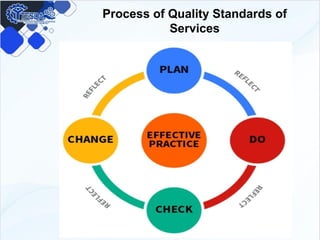
PLAN –set the objectives to deliver results
identify and understand the problem
ascertain the problem’s root cause
collect relevant data
decide what measurement to use to gauge
effectiveness
DO – implement and control what was planned
CHECK – monitor and measure results against
criteria
ACT – take action to improve performance of
processes


 Most read
 Most read